
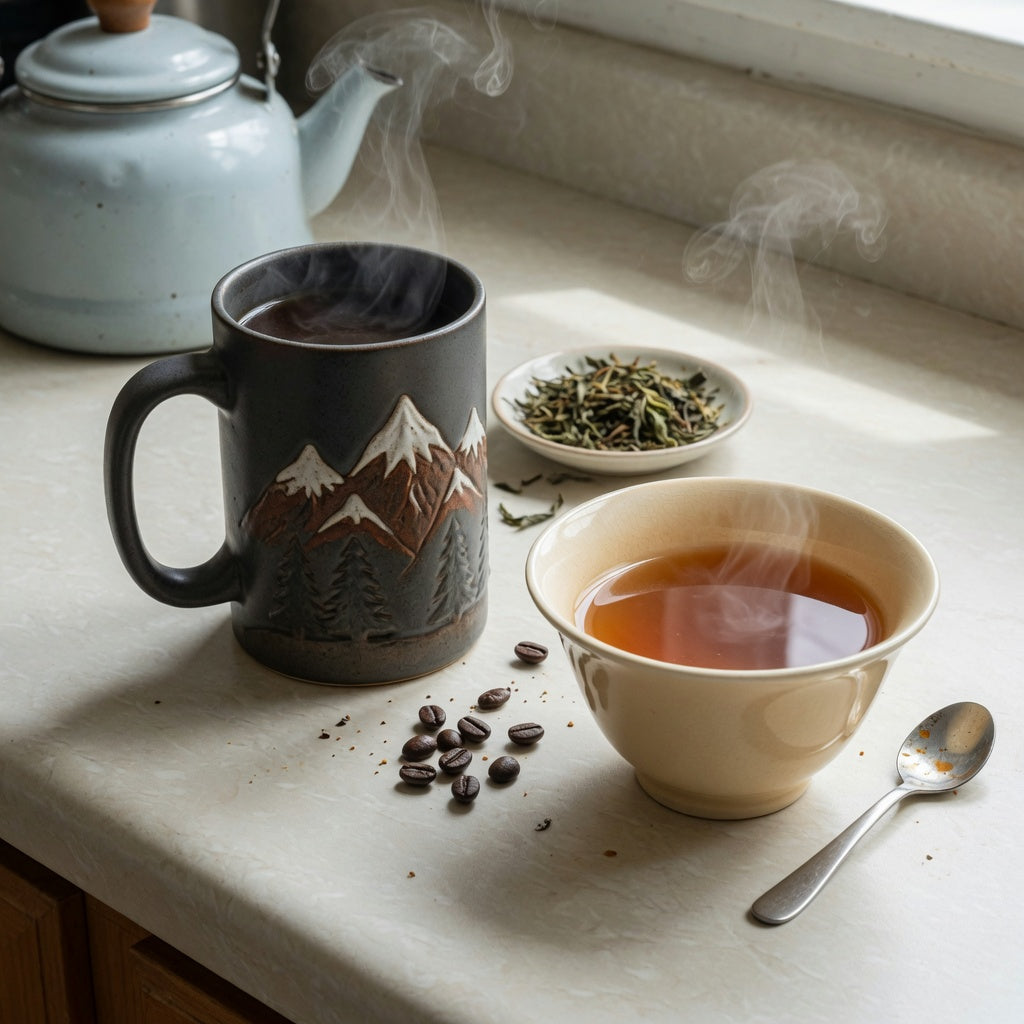
Great Mountain Coffee Mug vs Tea Mug: Which Fits Your Routine?
Reading time: about 9 minutes
A mug can look right in a product photo and still be wrong by the third sip. At an office desk, a deep vessel may keep coffee hot through a meeting yet leave green tea hotter than a slow sipper wants. At home, a gift-worthy design can become sink clutter if its care instructions do not match a dishwasher-only kitchen. That is the practical issue behind the great mountain coffee mug vs tea mug decision.
We sell and handle decorative drinkware, and the details that matter after unboxing are concrete: opening width, comfortable fill level, lip thickness, handle clearance, glaze condition, and appliance-safe care. Retail labels are loose, too. A product called a tea mug may share the same shape as a coffee mug, so compare the vessel rather than relying on the name.
Great mountain coffee mug vs tea mug: which suits your routine?
Short answer: a mug-leaning design usually suits a larger coffee, black tea with milk, or a drink kept beside a keyboard. A wider, lighter tea cup is often better for smaller servings, faster cooling, and teas whose aroma you want close to your nose.
| Buyer variable | Mug-leaning design | Tea-cup-leaning design | What changes in use |
|---|---|---|---|
| Opening profile | Relatively narrow and straight-sided | Wider or gently flared | Cooling rate and perceived aroma |
| Serving pattern | One larger desk pour | Smaller, quicker serving | Heat duration and refill frequency |
| Body and lip | Often heavier with a thicker lip | Often lighter with a thinner lip | Wrist load and sip feel |
| Handle | Roomier loop is common | Compact fingertip handle is common | Grip security and knuckle clearance |
If one vessel needs to cover coffee and tea, and the mountain design is part of the appeal, start with the current Great Mountain Coffee Tea Mug listing. We do not borrow specifications from similarly named mugs. Check whether the live page states the material, capacity, dimensions, handle construction, included pieces, and care instructions you need. If a different shape may work better, compare the options in our unique coffee mugs collection.
How do opening width and fill level change cooling?
Research on vessel geometry and cooling supports what shoppers notice at the table: surface-area-to-volume ratio and wall shape affect heat loss. A wider opening generally exposes more liquid to the surrounding air and cools faster. A taller, relatively narrow vessel can slow that process, all else being equal.
All else is rarely equal. Fill volume, wall material, wall mass, preheating, room temperature, and airflow also matter. A commonly cited coffee-brewing reference point is about 205°F. Tea guidance varies by type: black tea is commonly prepared around 205–212°F, while green tea is often closer to 175–180°F. Brewing temperature and comfortable sipping temperature are separate issues; a cup cannot correct water that was too hot for the leaves.
Product photos cannot show a cooling curve. For a simple home comparison:
- Use the same measured volume in both vessels—200 ml if both can hold it comfortably.
- Start with water at the same temperature, and either preheat both vessels or neither.
- Use plain water so steeping does not affect the result.
- Check the temperature at five-minute intervals for 15 minutes, then repeat at your normal fill level.
This test reveals more than general labels such as coffee mug or tea cup because it reflects your room, serving volume, and sipping pace.
Will a larger mug make tea bitter?
The vessel does not create bitterness by itself. Tea becomes bitter or drying when extraction runs too far for that leaf, water temperature, and steeping time. A cup that cools slowly can extend extraction if the tea bag, leaves, or infuser remains in the water. Bitterness and astringency are also different: bitterness is a taste, while astringency is the dry, puckering sensation some shoppers describe as rough tea.
- Follow the tea maker's temperature and steeping guidance rather than defaulting to boiling water.
- Start a timer as soon as the leaves meet the water, then remove them fully at the stated time.
- If you move from a 200 ml serving to a 400 ml serving, do not automatically steep twice as long. Adjust the amount of tea according to its instructions instead.
- Judge cooling only after the leaves are removed; otherwise, vessel shape and ongoing extraction are being tested at the same time.
Coffee works differently once brewing is complete. If coffee was extracted before it entered the mug, the serving vessel changes cooling, aroma, and sip feel—not the extraction that already happened.
Capacity, milk room, and handle clearance at a desk
Listed capacity does not always tell you the comfortable working fill. Ask whether a measurement represents liquid at the brim or leaves practical headroom. A mug filled to its maximum may be awkward to carry from the kitchen to a desk, especially after adding milk or foam.
- Measure your normal pour: use a kitchen measuring cup once instead of guessing from your current mug.
- Include additions: count milk, foam, lemon, or an infuser in the space calculation.
- Leave carrying room: roughly 1–2 cm of headroom can reduce sloshing during a walk to the couch or office.
- Assess filled weight: 400 ml of liquid adds roughly 400 g before the vessel's own weight is included.
- Check the handle: decide how many fingers you want inside the loop and whether your knuckles clear the hot body.
- Check storage: compare the base and height with your coaster, cabinet shelf, and drying rack.
Before ordering the Great Mountain mug, look for these measurements on the current page rather than estimating them from photography. In our experience, an empty mug can feel balanced while a full one exposes a tight handle or uncomfortable wrist angle. Gift buyers should apply the same test to the recipient's hand size and cleaning habits. If the fit is uncertain, the broader mug collection gives you other shapes to compare.
Can one vessel switch between coffee and tea without flavor carryover?
For a vessel approved for hot beverages with a smooth, intact glazed interior, switching between coffee and tea is mainly a cleaning and preference decision. Porcelain is itself a type of ceramic, so the broad material label does not predict performance on its own. Wall thickness, glaze coverage, shape, and care matter more than the word ceramic by itself.
Coffee oils can remain around the lip or interior if a mug receives only a quick rinse. Strong tea may leave visible staining. Sensitive tea drinkers sometimes prefer a dedicated cup even after thorough cleaning, while most everyday drinkers are comfortable using one well-washed vessel for both.
- Inspect the rim for chips that could create a sharp drinking edge.
- Look for fine crazing lines in the interior glaze, especially if they begin to darken.
- Check both handle joints for hairline cracks before carrying a full hot drink.
- Investigate any persistent odor or residue rather than covering it with a stronger beverage.
A decorative surface variation is not automatically a structural defect. If you cannot tell whether a line is part of the finish or a crack, follow the seller's or manufacturer's guidance before continued use.
What must you verify before a dishwasher cycle or microwave reheat?
Mountain artwork, material appearance, and a familiar product name are not proof of appliance compatibility. We do not transfer dishwasher, microwave, temperature-limit, or hand-wash claims from similar mugs to the linked Great Mountain product. Those instructions need to appear on its current listing or packaging.
- Look for explicit dishwasher-safe or hand-wash-only wording.
- Check for a direct microwave-safe statement rather than treating silence as approval.
- Review any maximum-temperature or thermal-shock warning.
- If metallic decoration, wooden parts, lids, or other removable components are present, check their instructions separately.
- Confirm what is included; do not assume a lid, spoon, filter, or infuser comes with a mug unless the listing says so.
A product without confirmed dishwasher compatibility is a poor match for a household that will not hand-wash. Likewise, do not choose a mug for routine microwave reheating unless that use is expressly supported. Open the live product page before checkout because care requirements can outweigh the visual design after the first week.
Which buyer should choose a dual-use mountain mug?
| Your routine | Better direction | Why and next step |
|---|---|---|
| Coffee and robust black tea, with one long desk serving | Mug-leaning dual-use vessel | Prioritize usable capacity, stable grip, and slower cooling. Review the Great Mountain option and verify its current specifications. |
| Green, white, or delicate oolong tea sipped slowly | Wider or smaller tea-leaning vessel | Faster cooling may suit the drink better. Compare rim profiles in the mug collection, but do not force a large mug to fit a small-pour ritual. |
| Dishwasher-only household | Listing with explicit dishwasher approval | Care compatibility matters more than the motif. Skip any option whose instructions are unclear. |
| Small kitchen with room for one everyday cup | Versatile mug with confirmed dimensions | Measure your regular coffee and tea pours, then select enough headroom without buying unnecessary volume. |
| Gift recipient with unknown preferences | Easy-care, moderate-size option | Confirm handle clearance, filled weight, care, and return terms before buying for the artwork alone. |
A dual-use mountain mug is not automatically the best tool for every drink. A dedicated tea cup is the stronger choice for precise small servings and rapid cooling. A purpose-built travel vessel or infuser mug is also smarter if spill resistance or built-in steeping is non-negotiable; never assume the linked product includes those features without listing confirmation.
Frequently asked questions
What should I check in a great mountain coffee mug vs tea mug comparison?
Compare opening width, usable capacity, lip thickness, filled weight, handle clearance, and care instructions. Then match those details to your usual drink: long coffee, black tea with milk, or a smaller serving of delicate tea.
Can I use a coffee mug for green tea?
Yes, if the vessel is approved for hot drinks and you control the brew rather than relying on the cup to fix it. Use temperature guidance appropriate to the tea, remove the leaves on time, and consider a wider vessel if your tea stays uncomfortably hot during slow sipping.
Does a 400 ml mug make tea more bitter?
Not because of capacity alone. Bitterness is more closely tied to water temperature, leaf quantity, and contact time, although a vessel that cools slowly can prolong extraction if the leaves remain inside.
Should I warm the mug before making coffee or tea?
Preheating is optional, but it reduces the initial temperature drop when the drink enters a cool vessel. Rinse with hot water, empty it, and then brew; for a fair comparison between two cups, preheat both or neither.
What is the safest next step before ordering the Great Mountain mug?
Open the current Great Mountain Coffee Tea Mug listing and write down five items: stated material, capacity and dimensions, handle details, included pieces, and care or appliance instructions. Compare those points with the drink and cleaning routine you actually use; if one is unclear or mismatched, browse the unique coffee mugs collection rather than guessing.
More from our blog
Read more

Ceramic Coffee Mug With Handle: Compare 3 Current Options
Compare three current CoffeifyMug options without guessing from styled photos. Learn how to verify listed ceramic material, handle form, capacity, vessel shape, care language, and food-contact clai...
Read more
Gift Ball Handled Coffee Tea Mug: Compare Grip, Care, and Fit
A ball handle can make a mug memorable, but it also changes grip, storage, cleaning, and transport. Our practical comparison helps gift buyers verify the current listing and decide when a loop hand...
Read more
Leave a comment
This site is protected by hCaptcha and the hCaptcha Privacy Policy and Terms of Service apply.