

Breakfast Cup vs Coffee Mug Size Difference: Oz & ML Chart
Reading time: about 9 minutes
The question lands in our inbox nearly every week, worded the same way: "My coffee maker says it brews 12 cups — why does it barely fill my two mugs?" A few days later comes the gift buyer, puzzled that the vintage breakfast cup they ordered looks like a small bowl beside a modern mug. Both puzzles come from the same tangle, and it explains the breakfast cup vs coffee mug size difference better than any chart can: the vessels themselves have fixed, measurable capacities, but the word "cup" changes meaning three times over, depending on whether a recipe writer, a coffee-machine manual, or a mug brand is doing the talking. Here is how we untangle it at the counter.
Breakfast cup vs coffee mug size difference: the numbers in oz and ml
The short answer first. A breakfast cup is a formal piece of teaware that grew out of the Victorian half-pint household measure, so surviving pieces commonly hold roughly 8 to 10 fluid ounces (240–300 ml), with imperial-era examples clustering near the 10 oz half pint. A coffee mug is the casual daily vessel; retailers typically list standard sizes between 8 and 12 oz (240–355 ml), with oversized models running 15 to 20 oz (440–590 ml). Notice the overlap — the numbers alone don't separate these vessels. Shape, saucer, heritage, and what you drink from each do the real separating.
| Vessel | Typical capacity (fl oz) | Milliliters | What it's for |
|---|---|---|---|
| Coffee-maker "cup" | ~6 oz | ~180 ml | Machine markings and brew ratios |
| Recipe / nutrition-label "cup" | 8 oz | 240 ml | Cooking measures and food labels |
| Teacup | ~6–8 oz | ~180–240 ml | Tea, small espresso drinks |
| Breakfast cup | ~8–10 oz | ~240–300 ml | Tea with milk, a full morning pour |
| Standard coffee mug | 8–12 oz | 240–355 ml | Daily drip, office refills |
| Oversized mug | 15–20 oz | 440–590 ml | Long desk sessions, big lattes |
Two details trip shoppers up here. First, a US fluid ounce (about 29.6 ml) and an imperial fluid ounce (about 28.4 ml) are not identical, so a UK or EU listing that states only "10 oz" can describe a slightly different volume than an American buyer expects — milliliter figures settle the argument. Second, most brands measure capacity to the brim. Your practical fill sits closer to a full ounce below that figure once you account for carrying hot coffee from counter to couch without scalding your wrist.
We stock both dominant mug shapes for exactly this decision. Readers who want a wide, palm-wrapping daily mug usually pick our round coffee-tea mug; readers packing a crowded desk tend toward our landscape tall coffee-tea mug. Confirm capacity, material, and dimensions on each listing before ordering — capacities vary enough between makers that guessing is how returns happen.
Why a "cup" isn't a mug: three measurements share one word
This is where the 12-cup coffee maker confusion is born. Three definitions of "cup" collide in one kitchen:
- The nutrition-label cup: 240 ml (about 8 oz), the standard printed on food packaging and the one a recipe means.
- The coffee-maker cup: roughly 6 oz — a convention tied to the "golden ratio" of about one to two tablespoons of ground coffee per 6 ounces of water, the brew math the National Coffee Association describes.
- Physical mug capacity: whatever the vessel in your hand actually holds, usually 8 to 12 oz for a standard mug.
Run the arithmetic on a 12-cup machine and the fog clears: 12 × 6 oz is about 72 fluid ounces, which fills roughly five or six 12-ounce mugs — not twelve of anything you would drink from, and slightly less once the grounds absorb their share of the water. We keep a 6-oz measuring cup on the store counter for this exact conversation, because one pour into a 12-oz mug ends the debate faster than any explanation. The convention matters when you brew by hand, too: a 12-ounce mug wants double the grounds of a 6-ounce serving, not the same scoop stretched further.
Is a vintage breakfast cup just an oversized mug?
No — and that mismatch costs vintage shoppers real money. A breakfast cup and saucer is a distinct piece of bone-china teaware, descended from the Victorian half-pint household measure and set at the morning table with its own noticeably wider saucer. It isn't a scaled-up teacup, and it isn't a mug in the modern retail sense, which is why listings that omit dimensions produce so many disappointed unboxings.
When a seller lists no measurements, ask for these before buying:
- Capacity in milliliters — the half-pint heritage puts genuine breakfast cups near 280–300 ml on imperial-era pieces.
- Saucer diameter, which should read clearly larger than a teacup saucer's.
- Bowl shape — straighter and deeper than a teacup's shallow curve.
- Handle form, sized for a fuller grip than a delicate teacup handle.
Be honest about the trade-offs, too. Vintage bone china is fragile, decorative rims and gilding often rule out the microwave, and hand washing is the safe default. A breakfast cup is the wrong tool for the garage fridge, the camping box, or any kitchen with a lidless dishwasher. Measured side by side, the breakfast cup vs coffee mug size difference here is less about raw ounces and more about form, fragility, and ritual — if durability runs your mornings, choose a purpose-made mug; if the ritual matters more, the vintage piece earns its shelf space.
Espresso to drip: which size fits which drink?
Capacity only means something relative to the drink in it. Our working mapping, drawn from what actually gets ordered and used:
- Espresso: a demitasse at 2–3 oz. Anything bigger lets the crema fade before you finish.
- Cappuccino: 5–6 oz — enough room for foam without turning the drink into warm milk.
- Flat white or small latte: 8–10 oz.
- Full latte: 10–12 oz or more, since steamed milk dominates the volume.
- Drip or batch brew: an 8–12 oz mug. Specialty coffee's own benchmark points the same way — the SCA's cupping vessel standard sits at 7–9 oz, close to a generous standard mug.
- Tea with milk: classic breakfast-cup territory at 8–10 oz, where the wider mouth brings the drink to a sippable temperature sooner.
Scale the brew to the vessel, not the other way around. The 6-ounce convention is a starting point; double it for a 12-ounce pour and adjust from taste, remembering that the same dose in more water also brews a lighter cup.
Does a bigger mug change how much caffeine you drink?
It can, and few buying guides mention it. The FDA's published figure for brewed coffee runs about 80–100 mg of caffeine per 8-ounce cup, so a same-strength 16-ounce fill puts roughly double that in one sitting. That isn't a flaw — it's a trade-off worth planning for. A 20-ounce mug suits someone who sips through a long morning; a standard mug plus a refill delivers the same total with a built-in decision point between pours. If you're pacing caffeine through an afternoon, the smaller vessel is the honest choice.
Tall or wide: which shape fits your brewer, cabinet, and cup holder?
Shape decides where a mug can live more than capacity does. Tall, narrower mugs expose less surface at the top, so coffee generally holds its heat a little longer, and they claim a slim footprint on a packed desk — the reason our landscape tall coffee-tea mug gets bought for office desks. The catches: measure the clearance under a single-serve brewer's spout before committing, and check whether the base tapers, because many straight-sided tall mugs won't sit in a car cup holder.
Wide, round mugs give you a full palm wrap, a stable base, and easy spoon access for stirring in sugar or cream — the profile that makes our round coffee-tea mug the one our own team keeps by the kettle. The trade-offs mirror it: a wider cabinet footprint per mug and faster cooling across the exposed surface. We can't measure your shelf from here, so take thirty seconds with a tape measure before you order. Note the weight as well: a 16-ounce fill is roughly a pound of liquid before you add the vessel, which matters for arthritic hands and one-handed microwave trips.
Six checks before you order any cup or mug
- Capacity in both units. Look for fl oz and ml on the listing, and note whether the figure is measured to the brim or to a fill line.
- Shape versus your space. Compare listed height and diameter against your shelf clearance, brewer spout, and cup holder.
- Handle clearance. Larger hands need knuckle room; check the handle opening in photos or listed dimensions.
- Saucer pairing for vintage pieces. A breakfast cup without its matching breakfast saucer loses both function and value.
- Care instructions. Dishwasher and microwave statements belong on the listing — if they're absent, ask the seller before you assume.
- Weight when full. Multiply capacity by roughly one ounce of liquid weight per fluid ounce, then add the vessel itself.
If you'd rather browse than measure, start in our unique coffee mugs collection, shortlist by the capacity each listing states, and run the six checks against your top two. Ten minutes of comparing specs beats a return label every time.
Frequently asked questions
What is the breakfast cup vs coffee mug size difference in ounces?
Genuine breakfast cups carry the half-pint heritage, so vintage pieces commonly hold around 8–10 oz (240–300 ml). Modern retail mugs typically list 8–12 oz, with oversized models at 15–20 oz. The ranges overlap more than shoppers expect — shape and saucer, not just ounces, separate the two — so confirm the figure on the specific listing, since makers vary.
How many ounces is a "cup" on a 12-cup coffee maker?
Coffee-maker cups follow the 6-ounce convention, not the 8-ounce recipe cup. Twelve machine cups is about 72 fluid ounces — closer to six 12-ounce mugs, and slightly less once the grounds absorb water. Your two 16-ounce mugs hold 32 oz between them, so the machine's number was never measured in mug units.
What size mug is best for drip coffee versus a latte?
Drip coffee suits an 8–12 oz mug, which lines up with the 7–9 oz vessel specialty coffee uses for cupping. Lattes need 10–12 oz or more because steamed milk makes up most of the volume, while cappuccinos stay small at 5–6 oz and espresso at 2–3 oz.
How do I tell a vintage breakfast cup from a teacup when the listing shows no measurements?
Ask the seller for capacity in milliliters (genuine pieces cluster near 280–300 ml), the saucer diameter (clearly wider than a teacup saucer's), and the bowl shape (deeper and straighter than a teacup's shallow curve). A seller who can't supply dimensions for a piece priced as a breakfast cup is giving you a reason to walk away.
More from our blog
Read more
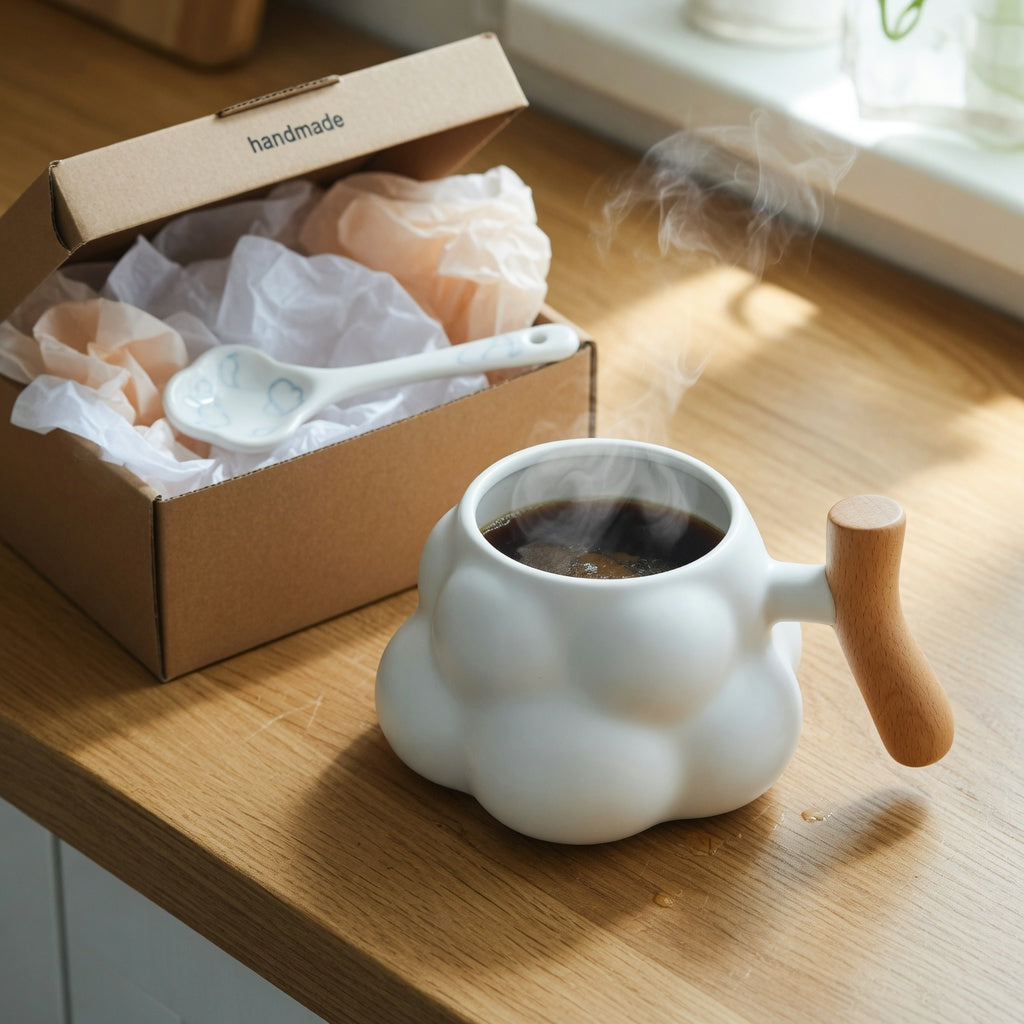
Cloud Mug With Handle Gift: What to Compare Before Ordering
Listings hide three different mugs behind one cloud name. Sort sculpted 3D mugs from cloud-lid spoon sets and printed designs, then run our capacity, handle-fit, glaze-safety, and packaging checks ...
Read more
Tall Ceramic Tea Mug With Desk Shelf: 7 Checks Before You Buy
A tall ceramic tea mug with desk shelf fit in mind is really two purchases: the mug and the clearance under your shelf. Our team's seven pre-order checks cover fit, stability, capacity, lids, glaze...
Read more
Leave a comment
This site is protected by hCaptcha and the hCaptcha Privacy Policy and Terms of Service apply.