
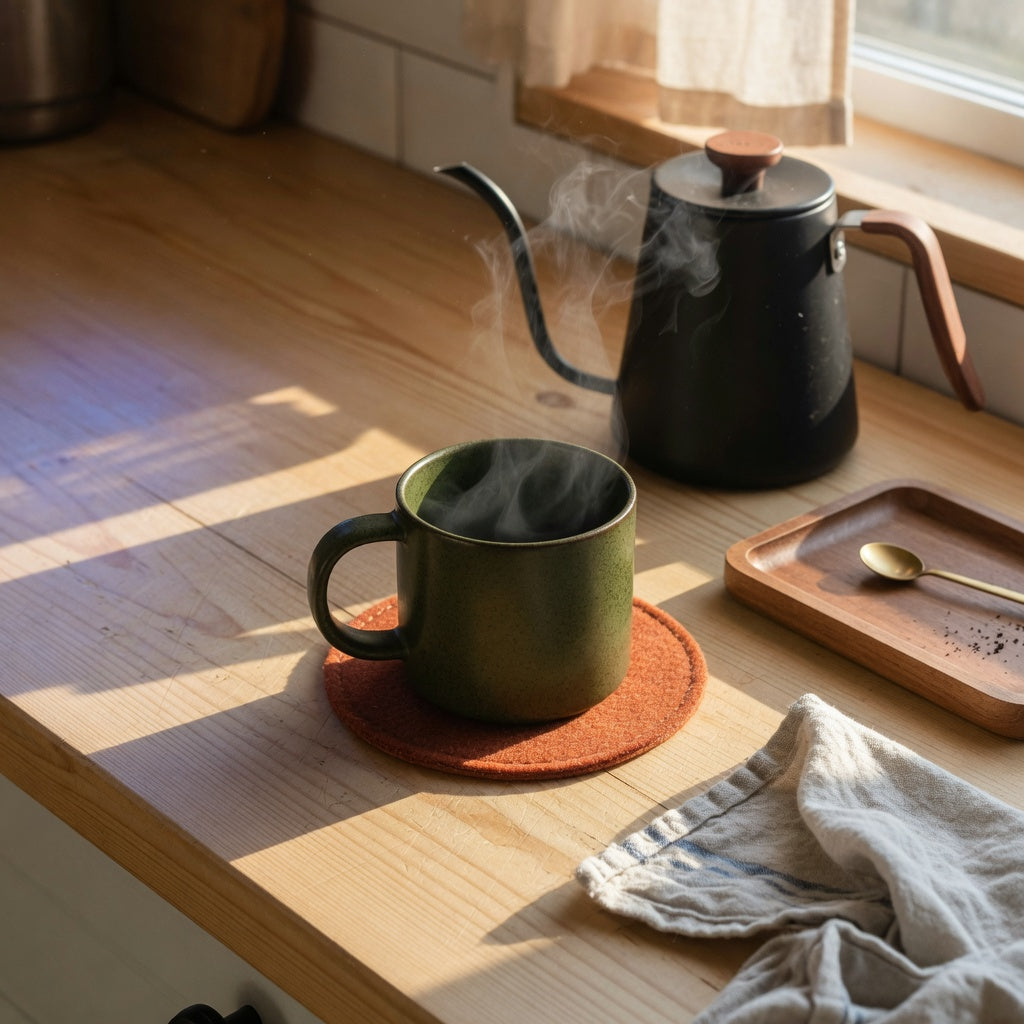
Quiet Coffee Routine Ceramic Mug: What Buyers Should Compare
Reading time: about 9 minutes
The loudest thing in most kitchens at 6 a.m. is not the kettle — it is the mug. A thin diner-style cup rings when it meets a stone counter, clinks at every stir, and announces breakfast to the whole apartment. A dense, well-fired ceramic mug lands with a dull thud and lets the rest of the house stay asleep. At CoffeifyMug we watch this test happen on our own counter almost daily: a customer picks up two near-identical cups, taps one down lightly, and quietly returns the one that rings. That small acoustic moment is what a quiet coffee routine ceramic mug is really about, and it is why this purchase deserves more scrutiny than a product photo can give you. Here is the full comparison we walk shoppers through.
What does “quiet” actually mean in a mug?
Most listings treat “quiet” as decor styling: beige glaze, soft light, a linen napkin. Styling matters, but the word has a literal meaning too, and it is the more useful one when two mugs sit side by side on a shelf.
- Set-down sound. Thick, dense walls absorb vibration, so the mug lands soft instead of ringing. It is the single biggest difference buyers notice on a hard counter.
- Stir sound. A teaspoon against thick ceramic stays muted; against thin glass it carries down the hallway. Early risers in shared homes notice this within a week.
- No moving parts. No lid snapping on, no sliding collar, no gasket trapping yesterday’s coffee. A quiet routine mug is one piece of fired clay.
- Pace. Heft slows you down. A mug you can empty in three swallows defeats the purpose of a slow hour; a little weight invites smaller sips.
“I want the kitchen to still feel asleep while I drink my coffee.” A line we hear almost weekly from shoppers in small apartments and shared flats.
That is the profile we look for across our unique coffee mugs: heavier bases, full handles, and rims finished for sipping rather than chugging.
Weight, walls, and rim: how a quiet coffee routine ceramic mug should feel
Every new mug that arrives at our store goes through the same short series of checks before it earns shelf space, and you can copy the whole sequence in two minutes — on a shop shelf or from a product listing:
- The pick-up test. The mug should sit stable in one hand, base flat, no tippiness when empty. Wobble now means tap-tap-tap later.
- Handle fit. Two fingers minimum, three for most adults. A cramped handle is the most common return reason we record, and it never shows in photos.
- Rim check. Run a finger around the lip. A smooth, rounded edge sips comfortably; a thin, sharp lip feels harsh and chips sooner.
- Foot ring. Flip it over. An unglazed ring on the bottom is normal for stoneware, but a rough or gritty foot can scratch wooden tables — one more reason a coaster earns its place.
- Glaze finish. Matte hides small scratches but shows coffee-oil film sooner; glossy wipes clean in seconds and shows chips more honestly. Neither finish is wrong. They just ask for different habits.
One detail most guides skip: thick walls slow temperature change in both directions. A cold, thick mug steals heat from your first pour, so give it a few seconds of warm tap water first. Preheated, those same thick walls hold coffee at drinking temperature noticeably longer — which is exactly what an unrushed cup needs.
How big should the mug be? Match capacity to the drink, not the number
Capacity charts treat every drinker the same. A quiet routine is more personal than that. These rough bands hold up across most of what we sell:
| Capacity | Ritual it suits | Worth knowing |
|---|---|---|
| 6–8 oz | Espresso, cortado, small tea pour | A true slow-sipper; the refill becomes part of the ritual |
| 10–12 oz | Pour-over, drip, standard tea | The workhorse band for most morning routines |
| 14–16 oz | Lattes and large refills | Taller shapes leave room for milk and foam |
If your quiet hour is a milk-heavy drink, a tall silhouette is the classic choice, and our Landscape tall coffee and tea mug follows that shape — check the current listing for its exact capacity and care guidance before you order. If you drink with the mug cradled in both hands, a rounder bowl suits that posture better; the Round coffee and tea mug is the one we hand to customers who describe that exact morning. We compare the round form in more depth in our guide to the best round ceramic mug for coffee and tea.
Ceramic, glass, metal, or travel mug: which keeps a morning quietest?
| Material | Sound | Feel and heat | Honest trade-off |
|---|---|---|---|
| Ceramic | Soft thud, muted stir | Warm to hold; temperature moves slowly through the walls | Heavy, and the rim is the first thing to chip if knocked |
| Glass | Clinks and rings | Shows the drink nicely; thin walls cool faster | The loudest option on a hard counter |
| Metal | Rings — the loudest | Conducts heat to the lip quickly on hot drinks | Usually lidded; built for movement, not stillness |
| Travel mug | Lid clicks, sloshing | Insulated for commutes | Wrong tool for a kitchen-table ritual, right tool for a train |
Here is the part that is not convenient for us to say: if your coffee happens behind a steering wheel or on a station platform, buy the travel mug instead. A quiet ceramic mug earns its keep on a counter, a desk, or a windowsill — places where nothing needs a lid and the point is to stay put. It is also the wrong pick if you need something nearly unbreakable for a camper, a workshop bench, or a household of toddlers; in those cases a lighter, inexpensive everyday cup is the smarter call, and we would rather tell you now than have you chip a rim by spring.
Glaze safety: what should you verify before checkout?
Safety questions arrive in our inbox more than any other topic, and they deserve better answers than a shrug. Three things are worth confirming on any listing:
- Food-contact glaze. Reputable makers state their glazes are formulated for food contact. Health regulators, including the FDA, have warned for decades about lead in some ceramic tableware — the concern concentrates in older pieces, souvenirs, and brightly decorated imports with unverified glazes, especially where decoration touches interior surfaces.
- Prop 65 wording. Listings that ship to California sometimes carry a Proposition 65 notice about lead or cadmium. Treat it as information rather than an automatic disqualification, and ask the seller what specifically it refers to.
- Crazing on used or handmade pieces. Fine crack lines can develop in glaze with age. Light crazing is usually cosmetic; heavy crazing inside the cup holds stains and coffee oils. With handmade pottery, it is fair to ask the maker whether the glaze was tested for food use.
We put the full sequence in order in our 10-check buying checklist for ceramic mugs — glaze, weight, capacity, care — so nothing gets skipped at checkout.
Which care habits keep a ceramic mug quiet for years?
- Mind thermal shock. Sudden temperature swings stress glaze. Skip the boiling-water pour into a mug fresh from a cold car, and never rinse a hot mug under a cold tap. Warm tap water first, then heat.
- Watch the rim. In our experience, nearly every retired ceramic mug fails at the lip first. Run a finger around the rim now and then; a chipped edge is sharp and only gets worse.
- Dishwasher, with expectations. Most modern glazes survive the machine, but harsh cycles dull finishes over the years. Hand washing is how you keep a matte glaze matte.
- Stains happen. Coffee and tea oils build a film, faster on matte finishes. A paste of baking soda and water, left on for a few minutes, lifts most of it without scrubbing the glaze raw.
- Metallic luster decor. If a glaze carries metallic luster decoration, keep the mug out of the microwave and confirm the microwave guidance stated on the listing.
What belongs next to a quiet mug on the counter?
The mug anchors the routine; the surroundings decide how quiet it stays. Four additions that earn their space:
- Felt or cork coaster. It absorbs the set-down sound a hard saucer would double.
- Wooden or fabric tray. Carries kettle-side drips and keeps the whole setup movable without clinks — a real advantage in small apartments.
- A mug cozy. Fabric softens contact noise and stretches the drinking window on long mornings; our ceramic mug cozy buying guide covers fit and fabric choices.
- Grind the night before. The loudest part of home coffee is the grinder. Grinding the evening before is how the quiet morning actually gets won.
That list is also the honest outline of a good gift: one substantial mug, a coaster, a cozy, wrapped as a slow morning rather than as “a cup.” Small-batch and handmade pieces carry some unit-to-unit variation in glaze and size — part of the charm, but worth remembering if the gift needs to match a set already at home.
The 60-second checklist we run before recommending any mug
- Weight and stability pass the pick-up test, and the handle fits your actual fingers.
- The rim feels smooth, with no rough foot ring that will scratch your table.
- Capacity matches your drink — small sips, pour-over, or a latte-height pour — and the listing states care and microwave guidance clearly.
- The glaze description answers the food-contact question, with any Prop 65 note explained rather than buried.
- You own the setting: coaster, tray, and a preheat habit.
When a mug passes all five, it stops being tableware and starts setting the tone of the day. Browse the unique coffee mugs collection and pick the silhouette that matches the morning you are trying to keep.
Frequently asked questions
What makes a quiet coffee routine ceramic mug different from a regular mug?
Three things: denser, thicker walls that absorb set-down and stir sounds; a single-piece design with no lid or gasket to click and rattle; and a rim shaped for slow sipping. A thin diner cup does the same job, but it rings on hard counters and cools faster over a long, unhurried cup.
Can ceramic mugs go in the microwave and dishwasher?
Plain ceramic without metallic decoration is generally microwave-friendly, and most modern glazes handle dishwashers — but guidance varies by glaze and construction, so confirm both on the specific product listing before you assume. When in doubt, hand wash; it also preserves matte finishes longest.
Is it okay to pour boiling water straight into a ceramic mug?
For a room-temperature mug, usually yes. The risk is thermal shock: a mug that is very cold — from a car, a garage, or a winter windowsill — can craze or crack under sudden heat. Give it a moment under warm tap water first, and never chase a hot mug with a cold rinse.
Do ceramic glazes contain lead?
Glazes from reputable modern makers are formulated for food contact and are not the concern; the risk sits with vintage pieces, souvenirs, and unverified decorative imports, particularly where decoration touches interior surfaces. Check the listing’s materials description, ask the seller directly, and read any Prop 65 notice for what it actually covers.
What size ceramic mug is best for a slow pour-over morning?
A 10–12 oz mug fits a standard pour-over with breathing room, which is why it is our default recommendation for quiet morning rituals. Drop to 6–8 oz if your ritual is espresso-style with deliberate refills, or go 14–16 oz for latte-height pours. Start by matching the mug to the drink you actually make — that decision narrows the shelf faster than any other.
Read more

Golden Waves Coffee Mug vs Tea Mug Difference: What to Check First
The golden waves coffee mug vs tea mug difference, broken down by capacity, rim shape, wall thickness, and gold-finish care — plus the exact listing checks to run before you order a crossover mug f...
Read more
Mountain Tea Cup vs Coffee Mug Size: Oz, ML & Fit Compared
Teacups and mugs are sized differently for practical reasons — heat, strength, and refills. We compare typical capacities in oz and ml, show what sculpted mountain mugs actually hold, and finish wi...
Read more
Leave a comment
This site is protected by hCaptcha and the hCaptcha Privacy Policy and Terms of Service apply.