
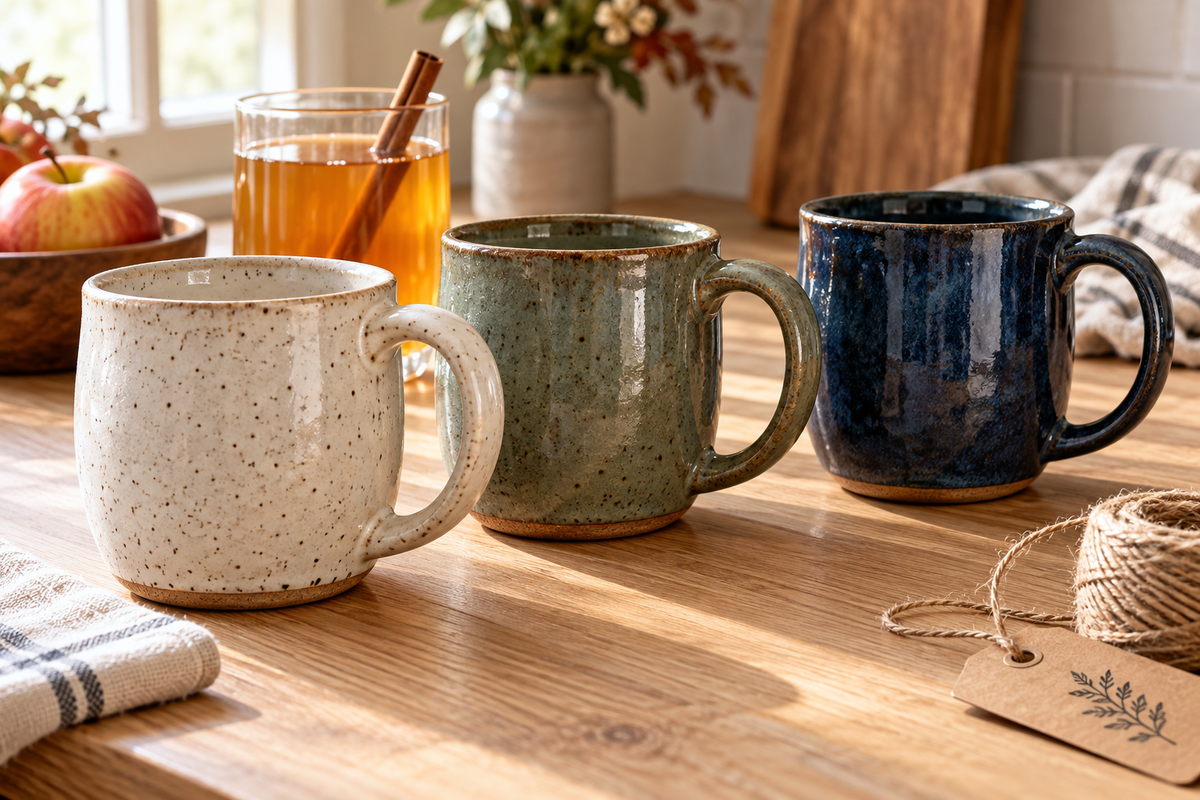
Apple Cider Mug Gift: Compare Capacity, Handle Shape, and Ceramic Fit
Reading time: about 7 minutes
Every October, the same message lands in our support inbox: “I want to give an apple cider mug gift, but I don’t know how to pick one.” We sell coffee and tea mugs year-round, so we hear exactly where shoppers stall — capacity, handle shape, and whether the mug will suit the way someone actually drinks. Those three variables decide whether a mug becomes a daily habit or cabinet filler. Here is how we walk buyers through the comparison.
How much capacity does an apple cider mug gift really need?
Capacity is the one spec that changes the experience outright, so start there. In our catalog, The Gradient Coffee Tea Mug and The Flow Coffee Tea Mug both hold 400 ml — about 13.5 ounces, a standard mug pour. The Rock Coffee Tea Mug holds 480 ml, roughly 16 ounces. That gap sounds small until you picture the person: 480 ml means fewer refills for a constant topper, while 400 ml suits the drinker who pours one serving and is done.
We watch the split play out every season. A customer shopping for an office gift exchange picked the Flow because her coworker’s desk had room for exactly one standard mug and nothing wider. Another chose the Rock for her father, who tops up his drink two or three times an evening — the larger capacity cut his trips back to the stove.
- 400 ml (Gradient and Flow): a standard 13.5 oz pour, lighter when full, easier for smaller hands and crowded desks
- 480 ml (Rock): fewer refills, extra headroom over ice, and roughly a pound of liquid when full before you even count the mug itself
- Hot versus iced servings: hot mulled cider is poured below the rim, but ice cubes eat into working volume — heavy ice users get more usable space from 480 ml
One honest trade-off: a big-pour drinker will find 400 ml undersized no matter how it looks, and a 480 ml mug takes up more room in the sink, the drying rack, and the cabinet. Match the number to the person, not to the packaging.
Which handle shape fits the recipient’s hands and habits?
The handle is the part of a mug someone touches every single time, and it is the detail gift buyers skip most often. We handle every model before it reaches our catalog, but grip comfort is personal — the loop width and finger clearance visible in the listing photos will tell you more than any adjective we could write. Zoom in on the handle from the side and picture the recipient’s hand around it. Larger hands, and anyone with reduced grip strength, need clear space between the loop and the mug body.
Habits matter just as much. If the mug will travel between the kitchen and a home-office desk all day, a secure one-handed grip should outrank a sculptural silhouette. If it lives on one counter beside the kettle, styling can lead instead. We put one whole handle family under the microscope in our ball handled mug gift guide if that comparison is your sticking point.
What does “everyday ceramic fit” mean on a real countertop?
“Everyday ceramic fit” is the phrase our catalog uses for how a mug behaves outside of a photo shoot: does it sit level, feel proportionate next to a kettle or a monitor stand, and settle onto a surface without drama? The test most buyers forget is the base. A mug that rocks on a flat counter is the most common complaint we hear about mugs people bought elsewhere, so when any gift arrives, set it on the flattest surface in the kitchen and press the rim gently. It should sit silent and still.
Fit also means proportion. Measure the shelf, desk, or dish rack where the mug will actually live before you order — a mug squeezed between a French press and a spice jar stops feeling like a gift and starts feeling like clutter. For a wider view of matching material and size to a specific drinker, our ceramic mug gift comparison splits tea and coffee recipients into separate checklists.
Gradient, Flow, or Rock: which recipient is each mug for?
Once you have settled on an apple cider mug gift, the remaining question is which model. This is the mapping we give customers at checkout:
- The one-good-mug recipient: someone who owns decent mugs but nothing they reach for first. The Gradient at 400 ml covers a standard pour with a clean everyday profile.
- The torn-between-two shopper: if the 400 ml size is right but you want a second option, the Flow holds the same volume — open both listings side by side and let the handle and silhouette break the tie.
- The refiller or the host: the Rock at 480 ml suits people who top up constantly, pour for guests, or load iced cider with enough ice to shrink the working volume.
| Buyer variable | Gradient | Flow | Rock |
|---|---|---|---|
| Capacity | 400 ml (≈13.5 oz) | 400 ml (≈13.5 oz) | 480 ml (≈16 oz) |
| Handle shape | Confirm on the listing | Confirm on the listing | Confirm on the listing |
| Our read on fit | Standard pour, everyday use | Same size, second style to compare | Refills, guests, iced pours |
The question that matters is not “is this a nice mug?” It is “does this mug match how the recipient actually pours?”
What will this apple cider mug gift not do?
We would rather lose a sale than set up the wrong expectation, so here is the honest list. These are open-rim mugs, not travel tumblers — no lid means they are the wrong pick for commutes, stroller pushes, or a keyboard-adjacent desk, where a lidded tumbler serves better. We do not market them as insulated or as heat-retention performers, so if the goal is cider that stays hot through a movie, a thermal vessel is the better tool. Each listing is for the mug alone, too: no cider mix, spices, or basket extras are included. That is disappointing if you wanted a ready-made set and a genuine advantage if you would rather build the bundle around the recipient’s taste. Finally, read the care instructions on the specific product page before checkout — they can differ between models, and they are the only source worth trusting on cleanup.
A five-minute checklist before you order
- Match capacity to the recipient’s usual pour: 400 ml for a standard serving, 480 ml for refillers and ice-heavy iced cider.
- Open the listing photos and zoom in on the handle — check loop clearance against the recipient’s hand size.
- Measure the shelf, desk, or dish rack where the mug will actually live.
- Read the care instructions on the product page before gifting someone who refuses to hand-wash anything.
- Choosing between two styles at the same capacity? Capacity is a tie — let handle and silhouette decide.
Still undecided? Browse our full unique coffee mugs collection and compare shapes side by side — the right gift is the one that matches a routine, not the one that photographs best.
Frequently asked questions
Do the Gradient, Flow, and Rock mugs include apple cider mix or gift extras?
No. Each listing is for the mug itself, so any cider spices, mix, or basket add-ons are yours to choose. That keeps the gift flexible — you can build a small cider kit around the mug instead of accepting a fixed set.
What size works best for an apple cider mug gift?
For most recipients, 400 ml (about 13.5 ounces) covers a standard serving, which is what the Gradient and Flow hold. The Rock’s 480 ml (about 16 ounces) suits refillers, hosts, and iced-cider drinkers who fill the mug with ice. Capacity is the spec most worth getting right, so confirm the exact figure on each product page before ordering.
Are these mugs dishwasher safe?
We do not make a blanket claim across the range. Care instructions are listed on each product page and can differ between models, so confirm them for the specific mug before you buy. When in doubt, hand washing with mild soap is the cautious default.
Is an apple cider mug gift useful outside of fall?
Yes. Every mug in this guide is a coffee and tea mug first — the cider angle is about the gifting moment, not a seasonal limit. The recipient can run hot cider through autumn and switch to coffee, tea, or cocoa the rest of the year with the same mug.
How do I choose between two mugs with the same capacity?
When capacity is equal, the decision moves to handle shape and overall look, both visible in the listing photos. Zoom in on the handle, picture the recipient’s hand around it, and compare the silhouettes side by side. If you still cannot separate them, our team is happy to help through the store’s contact options.
More from our blog
Read more

Unique Shaped Ceramic Coffee Mugs: 7 Checks Before You Order
Shaped mugs often pour less than they look. We compare usable capacity, glaze safety labels, handle fit, and care for unique shaped ceramic coffee mugs — then map the handbag, rhombus, and ball-han...
Read more
What Size Is a Piccolo Cup? ML, Oz and Cortado Sizes Compared
A piccolo cup typically holds 90–150 ml (3–5 oz), with the traditional café serve in a ~100 ml glass. We put piccolo, cortado, macchiato and espresso cup sizes side by side, weigh glass against cer...
Read more
Leave a comment
This site is protected by hCaptcha and the hCaptcha Privacy Policy and Terms of Service apply.