

Macchiato Cup First Time Buyer Practical Purchase Checklist
Reading time: about 10 minutes
A short espresso marked with a small amount of milk can look stranded at the bottom of an everyday breakfast mug. The drink may be fine; the vessel is simply too large for the pour. This macchiato cup first time buyer practical purchase checklist starts with the three catalog facts we can verify: the Retro option is listed at 170 ml, the Pleated option at 200 ml, and the Ball Handle option at 250 ml. Those figures describe cup capacity, not a required recipe volume.
Macchiato proportions vary by cafe, espresso machine, and personal preference. Some versions are little more than espresso marked with foam, while home recipes may use more milk. In our store, we ask first-time buyers to compare their normal finished drink, the headroom they need, and the listing details that affect daily use. We do not treat a product photo as proof of exact dimensions, dishwasher use, microwave safety, heat retention, or long-term durability.
Macchiato cup first time buyer practical purchase checklist: which facts come first?
Start with the details that can make a cup unusable in your kitchen. Color and styling matter, but they cannot fix a cup that does not clear the espresso machine or suit your usual pour.
- Confirm the listed capacity. Check for 170 ml, 200 ml, or 250 ml, and do not assume the stated figure is a comfortable working fill. A listing may show total capacity without defining how close that measurement comes to the rim.
- Read the exact material wording. Do not infer material from the photograph. Even if a cup appears ceramic or glass-like, its appearance does not establish care instructions or temperature limits.
- Find the external dimensions. Overall height, widest diameter, base diameter, and handle opening can matter more than capacity when space is tight. Ask the store if those measurements are absent.
- Verify the piece count. A styled photograph may show a saucer, spoon, or second cup without proving that those items are included.
- Check care instructions separately. Look for explicit dishwasher and microwave guidance. Material alone is not enough to establish either one.
- Review the inspection and return terms. Know whether you should report shipping damage before washing or using the cup.
A useful checklist leaves unknowns visible. If handle clearance, material, care, or included pieces matter to you and the listing does not answer the question, pause and ask rather than filling the gap with an assumption.
170 ml, 200 ml, or 250 ml: which capacity fits your pour?
The best capacity is tied to the macchiato you actually make most mornings. Among these three options, 170 ml leaves the least unused volume, 200 ml is the middle choice, and 250 ml provides the most potential headroom. Capacity alone does not tell us the cup's height, footprint, wall thickness, or usable fill line.
| Option | Verified catalog fact | Reader situation | Details still to verify |
|---|---|---|---|
| 170 ml Retro coffee tea cup | 170 ml capacity and visible Retro form | You usually make a short espresso-led drink and want the least spare capacity among these three choices. | Material, dimensions, working fill, care instructions, and included pieces |
| 200 ml Pleated coffee tea cup | 200 ml capacity and visible pleated form | You want more room than the 170 ml option for foam or a modestly longer home recipe while keeping the cup compact. | Material, exterior measurements, care around the pleated surface, and piece count |
| 250 ml Ball Handle coffee tea mug | 250 ml capacity and visible ball-style handle | You make a larger home interpretation or prefer more buffer between the finished drink and the rim. | Handle opening, side clearance, machine clearance, material, care, and included pieces |
If none of those situations matches your routine, compare the broader unique coffee mugs collection using the same checks. A different vessel is a better purchase than forcing a compact macchiato cup to handle large lattes, iced drinks, and every other beverage in the kitchen.
How much headroom will your usual macchiato need?
Headroom is the unused space between the finished foam and the rim. It gives you room to spoon on foam, lift the cup from the drip tray, and carry it across the kitchen without the first movement causing a spill. There is no honest universal headroom number because espresso output, milk volume, foam density, and cup geometry all vary.
Use a simple pre-purchase test:
- Measure the liquid used in the macchiato you normally make. Cool water can stand in for espresso and milk during this check.
- Add extra allowance for your usual foam rather than treating liquid volume as the finished drink volume.
- Choose a listed capacity above that total, with enough visible margin for the way you carry the cup.
- Remember that listed capacity may describe a near-rim fill unless the page states otherwise.
Choose for the drink you make most often, not the oversized drink you might make once a month.
The 170 ml Retro provides the smallest capacity of this group, so a very short pour will occupy more of the vessel. The 250 ml Ball Handle provides the largest buffer, but a minimal espresso-and-foam serving may look small inside it. The 200 ml Pleated option sits between those two decisions. None is universally correct.
Retro, Pleated, or Ball Handle: what changes in daily use?
Visible form can guide a style decision, but it should not be stretched into unsupported performance claims. A pleated surface does not automatically prove a nonslip grip, and a ball-style handle does not guarantee that every hand will find it comfortable.
- Retro form: Choose it if you prefer the simplest visible profile and the smallest listed capacity. Do not assume it stacks or fits beneath a low group head until dimensions confirm that.
- Pleated form: Choose it if the textured exterior suits your kitchen or gift recipient and the middle capacity matches the pour. Consider whether you are comfortable cleaning around exterior contours.
- Ball Handle form: Choose it if the handle is central to the look you want and 250 ml suits your recipe. Check the handle opening for finger room and allow side clearance in the cupboard and beside the espresso machine.
For a low-clearance machine, measure from the drip tray surface to the group head with the normal tray insert in place. For an office desk, check the base and foot before setting the cup on wood, and use a coaster if the foot feels rough. For a gift, verify material, piece count, care, and packaging instead of relying on a styled photograph.
Which material and care details must the listing state?
The verified comparison supplied for these three products establishes capacity and visible form, but it does not give us a basis to state one shared material or care method. The current wording on each product page should control your decision. If the listing names a material but says nothing about dishwasher or microwave use, those care points remain unknown.
- Look for the exact material and finish description, not just a color name.
- Check for an explicit dishwasher-safe statement before planning repeated dishwasher cycles.
- Check microwave guidance independently; a cup that looks ceramic is not automatically confirmed microwave-safe.
- Look for warnings about abrupt temperature changes, abrasive cleaners, or soaking.
- Ask whether decorative finishes require different care from the main cup body.
If the listing is silent and you decide to proceed after contacting the store, a conservative first clean uses lukewarm water, mild dish soap, and a soft sponge. That is not a substitute for product-specific instructions. Avoid abrasive pads, sudden hot-to-cold temperature changes, and automatic wash cycles until the correct care method is established.
On a finished or glazed cup, watch for new fine lines, flaking, or discoloration after cleaning. Inspect any handle-to-body joins for visible changes. These are general drinkware inspection points, not claims that the three products have those defects.
What should you inspect at the first unboxing?
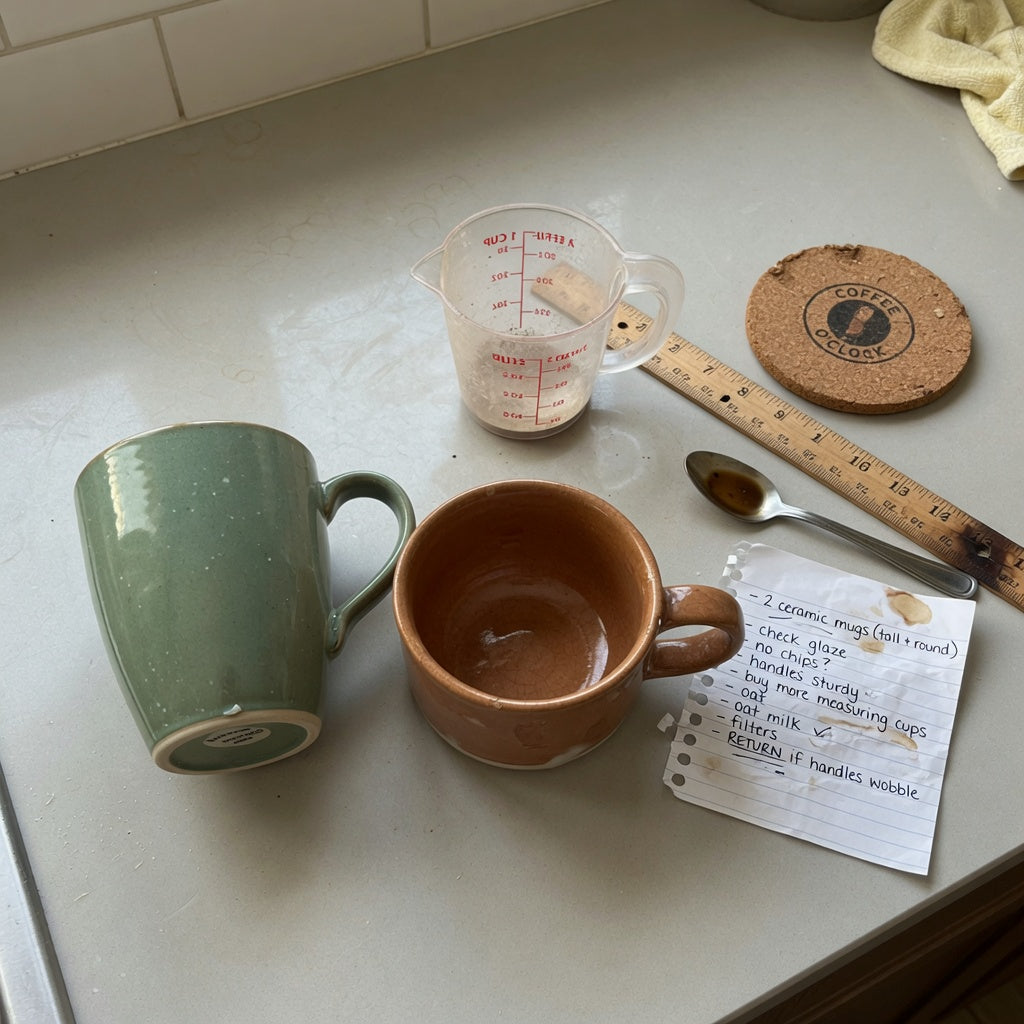
When our team handles a newly unpacked cup, we use a bright counter and a known-flat surface. This takes a minute and catches visible shipping or finish issues before coffee, milk, or a dishwasher cycle complicates the condition of the item.
- Inspect the rim, interior, exterior, and base under side lighting for chips, hairline cracks, or sharp areas.
- Set the cup on a flat, dry counter and check whether the foot sits evenly rather than rocking.
- For the Ball Handle form, look closely at both handle attachment points without twisting or stress-testing them.
- Check the underside for a rough foot that could mark a kitchen counter or office desk.
- Match the received form, capacity label, color, and quantity to the order.
- Photograph any concern and contact the store before washing or using the cup.
For a gift unboxing, inspect the shipping carton and product while preserving the presentation packaging. Also confirm whether a saucer or accessory is included; visible props in product photography should never be treated as proof of the package contents.
Who will outgrow a compact macchiato cup?
A 170 ml to 250 ml cup is not the practical choice for every coffee routine. Large lattes, long Americanos, drinks loaded with ice, and beverages intended for a travel lid generally need a different vessel. Ice consumes capacity quickly, and no lid compatibility should be assumed unless a listing states it.
The 170 ml option can feel crowded if your home macchiato regularly includes generous milk and foam. The 250 ml option can leave substantial visual space around a very short espresso-led serving. The pleated exterior may not suit someone who wants the simplest possible surface to wipe, while the ball-style handle requires side clearance that a tight shelf may not provide.
If one cup must handle tea, large milk drinks, iced coffee, and commuting, choose a larger mug or purpose-built glass instead. A dedicated compact cup makes more sense for shoppers who repeatedly prepare short hot drinks and are comfortable keeping another vessel for larger servings.
The five-minute decision before checkout
- Write down your normal liquid volume and allow visible space for foam.
- Select 170 ml, 200 ml, or 250 ml based on that routine, not on the largest possible serving.
- Verify material, dimensions, handle opening, piece count, and care on the current listing.
- Eliminate any option with an unanswered detail that affects machine fit, washing, storage, or gifting.
- Choose the visible form only after the practical checks pass.
Use the macchiato cup first time buyer practical purchase checklist in that order. It keeps a missing care instruction or machine measurement from being hidden by an appealing product photo.
Frequently asked questions
What should a macchiato cup first time buyer practical purchase checklist include?
Include listed capacity, actual external dimensions, material, care instructions, handle opening, piece count, and espresso-machine clearance. Also compare your normal drink volume with the cup capacity so there is practical space above the foam. Treat any missing non-negotiable detail as an open question for the store.
What size macchiato cup should a first-time buyer choose?
Choose according to your normal finished drink rather than a universal recipe. The 170 ml Retro is the smallest listed option, the 200 ml Pleated cup provides a middle capacity, and the 250 ml Ball Handle offers the most potential headroom. Cafe and home macchiato proportions vary, so measure your own routine.
Is the 250 ml Ball Handle cup too large for a macchiato?
Not automatically. It may suit a larger home recipe or someone who wants more space below the rim, but a very short espresso-and-foam serving will occupy less of the cup. Check the handle opening and overall dimensions as well as capacity.
Can these macchiato cups go in a dishwasher or microwave?
Only follow dishwasher or microwave use if the current product listing explicitly confirms it. Capacity and visible form do not establish care safety. Contact the store if the page does not provide a clear instruction.
Will a 170 ml cup fit under my espresso machine?
Capacity cannot answer that question because a 170 ml cup may be short and wide or relatively tall and narrow. Measure from the drip tray to the group head, then compare that clearance with the cup's stated height. Check the base diameter against the usable tray area too.
Open the three product pages side by side and record capacity, material, dimensions, care, and included pieces. Remove any option with an unresolved detail that matters to your routine, then compare the remaining choices in the unique coffee mugs collection. The right next step is the cup whose verified facts fit your actual pour, machine, storage, and cleaning habits.
More from our blog
Read more
12 oz ceramic coffee mugs first time buyer practical purchase checklist
A first-order checklist for checking 12 oz capacity, ceramic finish, handle clearance, dimensions, care directions, and damage risks. It also shows how to compare CoffeifyMug's tall and round listi...
Read more
Green Tea Mug Shared Household Product Shortlist Guide: 3 Sizes
Compare the Retro 170 ml, Pleated 200 ml, and Emerald 270 ml by refill habit and visible shape. This practical shortlist explains who each size suits, when to skip it, and which unverified details ...
Read more
Leave a comment
This site is protected by hCaptcha and the hCaptcha Privacy Policy and Terms of Service apply.