
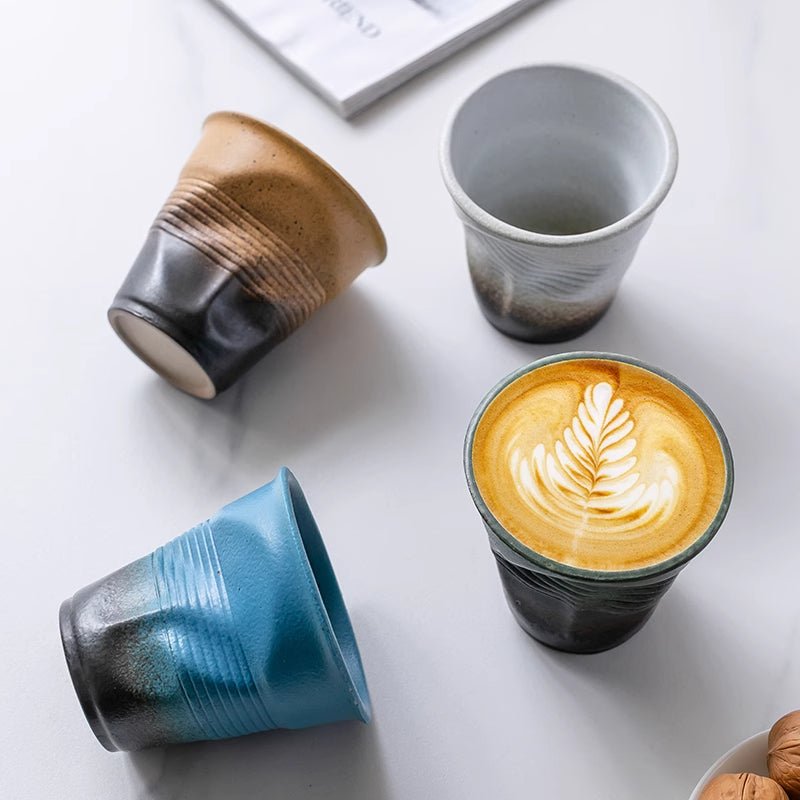
Your macchiato cup morning routine practical purchase checklist
Reading time: about 9 minutes
At 7:15 a.m., a compact cup can feel exactly right for a short espresso marked with a little milk. Ten minutes later, while packing a bag and answering a message, the same cup can feel restrictive if you usually add more milk or carry it to another room. In our experience selling compact coffee cups, wrong-size purchases often start with choosing for the drink name instead of measuring the drink and observing the routine. That is why our macchiato cup morning routine practical purchase checklist begins with timing, finished volume, and refill tolerance.
A macchiato is generally understood as an espresso marked with a modest amount of milk or foam, but recipes are not universal. Coffee shops, home machines, pod systems, and personal preferences can produce very different serving volumes. Treat the name as useful context, not as proof that one capacity will fit every morning.
170, 200, or 250 ml: which capacity leaves useful headroom?
The listed capacity is the first comparison point, but it is not automatically a comfortable carry level. A cup filled close to its maximum leaves little room for foam, an unsteady walk to the desk, or a hurried pour. We recommend measuring your finished drink and choosing enough space above it for the way you actually move through the morning.
| Morning situation | Listed capacity | Why it may fit | Main trade-off |
|---|---|---|---|
| You make one consistently short drink and finish it near the machine or breakfast table. | 170 ml | The Retro Coffee Tea Cup keeps the choice at the compact end and presents a visible retro form. | There is less flexibility for extra milk, foam, or a recipe that changes from day to day. |
| Your usual pour needs a little more working room, but you still want a small ceramic cup. | 200 ml | The Pleated Coffee Tea Cup adds 30 ml over the 170 ml option and has a visibly pleated form. | It may still feel tight for a milk-forward drink or ingredients added without measuring. |
| Your recipe varies, you dislike refilling, or you carry one drink to an office desk. | 250 ml | The Ball Handled Coffee Tea Mug provides the most listed capacity of these three and a distinctive visible ball handle. | A short espresso may look small inside it, and the handle form may not suit every grip or storage setup. |
Capacity does not establish exterior height, base diameter, machine clearance, or finger room. Check the current listing for those details or ask our store before ordering if your espresso machine tray, shelf, or hand fit imposes a hard limit. You can also compare the visible shapes across our unique coffee mugs collection.
How many minutes does your morning coffee actually get?
Timing changes which inconvenience matters most. A person who drinks beside the machine can tolerate a precise fill and an occasional top-up. Someone moving between a kitchen counter, bathroom, and home-office desk usually benefits from more carrying headroom. The cup does not create extra time, but the right capacity can remove an avoidable second pour.
- Five-minute routine: Measure the drink carefully. A 170 ml cup can make sense if the finished beverage reliably leaves carrying room.
- Breakfast-table routine: A 200 ml cup gives more flexibility for a small milk adjustment without immediately moving into a standard larger mug.
- Desk-bound routine: Consider 250 ml if one fill matters more than preserving the visual proportions of a very short serving.
Also account for the wait built into your process. If you steam milk, add sweetener, or rinse the pitcher before sitting down, your actual routine is more than the espresso extraction time. Watch one normal morning instead of designing around an idealized version of it.
The macchiato cup morning routine practical purchase checklist: six decisions
- Measure the finished drink. Make your normal recipe in your current cup, note the fill line, and measure the equivalent amount of water in a graduated jug. Do this on an ordinary weekday, not on the day you deliberately make a smaller test drink.
- Protect usable headroom. Do not choose a capacity equal to your measured drink volume. Foam, a slightly longer shot, and movement from counter to desk all use the space above the liquid.
- Count tolerated refills. Decide whether a second pour is acceptable. If the answer is no, the 250 ml option deserves consideration even if the finished drink is usually smaller.
- Check machine and shelf constraints. Listed milliliters cannot tell you whether a cup clears a low group head or fits a crowded open shelf. Confirm dimensions on the live page when supplied, or contact us with the clearance you need.
- Choose the visible form deliberately. Retro styling, pleated sides, and a ball handle create different storage and handling considerations. A distinctive handle may appeal visually while taking more lateral room than a conventional profile.
- Verify care before checkout. Ceramic material alone does not prove that every finish is microwave or dishwasher compatible. Follow the current product-page or packaging instructions for the exact cup.
How much refill tolerance do you have before 9 a.m.?
The spread between these options is meaningful: the 250 ml cup has 80 ml more listed capacity than the 170 ml cup and 50 ml more than the 200 ml cup. That extra room is useful only if your drink or routine needs it. Buying the largest option automatically can leave a small macchiato looking lost, while buying the smallest can turn every generous milk pour into a cleanup risk.
If you already know that capacity is your main decision, our macchiato cup daily use guide for 170 ml to 250 ml examines the broader everyday trade-offs. For this morning decision, give priority to the smallest cup that fits your measured drink, practical headroom, and acceptable refill count.
Ceramic care on rushed counters, office desks, and gift days
Ceramic works well for many at-home coffee routines, but it remains a breakable material. A compact cup can still chip if its rim strikes a tap, another cup, or a dishwasher rack. A visible handle also creates a contact point that deserves space in a crowded sink or cupboard.
- At unboxing: Inspect the rim, foot, and handle-to-body junction under clear side light. Look for chips, hairline cracks, or an uneven base before using or wrapping the cup as a gift.
- On a flat counter: Set the empty cup down and press lightly near opposite sides of the rim. Persistent rocking after removing packaging or debris is worth reporting before use.
- Before a dishwasher cycle: Confirm that the exact product is listed as dishwasher safe. If it is, position it so the rim and handle cannot knock against another item during the cycle.
- Before microwave use: Check the current care guidance rather than assuming all ceramic cups behave alike. If microwave suitability is not stated, ask first.
- During temperature changes: Avoid abrupt movement from a very cold environment to very hot liquid unless the product guidance expressly supports it. Sudden temperature differences can stress ceramic.
We cannot judge hand fit, cupboard clearance, or care compatibility from capacity alone. Those unknowns matter in a rushed kitchen. Our small ceramic coffee cup daily use guide covers more of the practical handling trade-offs that apply beyond macchiatos.
Which cup fits your actual morning pattern?
A short, repeatable drink at the kitchen counter
If your recipe is consistent, your measured volume leaves room, and you rarely walk far with the cup, the 170 ml Retro option is the direct fit. Its compact listed capacity supports a short-serving routine without pretending to be a large breakfast mug. It is not the forgiving choice for frequent milk adjustments.
A compact drink with an inconsistent milk pour
If the espresso stays consistent but the milk or foam changes, the 200 ml Pleated option provides a practical middle step. The additional 30 ml over the Retro cup can serve as headroom rather than an instruction to make a larger drink. Choose it because that margin solves a real pouring issue, not only because the pleated form catches your eye.
One trip from the kitchen to an office desk
If you want the most capacity among these three and have little patience for a refill, the 250 ml Ball Handled option is the relevant next step. Its ball handle is a visible design feature, but grip comfort is personal, so study the product images and confirm dimensions if finger clearance matters.
A large iced coffee or long Americano
These compact capacities are not the strongest choice if ice displacement, a long espresso dilution, or a generous milk serving pushes your drink toward a full-size mug. Start with a larger category instead. Our Americano coffee cup guide for 200, 270, and 350 ml offers a more relevant comparison for longer drinks.
What are compact ceramic macchiato cups not good for?
A compact ceramic cup is not a sealed commuter vessel, an impact-resistant option for a drop-prone shared kitchen, or an efficient choice for a large iced drink. It may also frustrate someone who routinely returns for multiple tea top-ups. For those situations, a lidded travel cup, a more durable material, or a larger mug is the better category even if the compact cup looks appealing on the shelf.
Frequently asked questions
What size cup is best for a morning macchiato?
Start with your measured finished volume rather than a universal recipe. A 170 ml cup suits a consistently short drink, 200 ml adds moderate working room, and 250 ml offers the most flexibility among the options compared here. Leave enough headroom for foam and carrying.
Is a 170 ml cup too small if I add milk?
Not necessarily. It depends on the combined espresso and milk volume, plus the space you need above the drink. If your usual pour approaches the cup's listed capacity, move to 200 ml rather than relying on a brim-level fill.
Are these ceramic cups dishwasher and microwave safe?
Do not treat ceramic material as automatic confirmation. Check the current product page or packaging for the exact cup and finish, because care requirements can vary. If the guidance is absent, hand wash and confirm microwave suitability with our store before heating.
How do I use the macchiato cup morning routine practical purchase checklist if my recipe changes?
Measure both your smallest normal drink and your largest normal drink. Choose for the larger version if you will not tolerate spills or refills, or choose the smaller cup if compact presentation matters and you are willing to adjust the occasional pour. The 200 ml option is the middle capacity, while 250 ml provides the widest margin of these three.
Your 60-second checkout test
- Write down your largest usual finished drink volume.
- Decide how much carrying headroom and how many refills you will accept.
- Confirm machine clearance, handle fit, storage space, and current care instructions.
Then compare the Retro 170 ml, Pleated 200 ml, and Ball Handled 250 ml forms in our unique coffee mugs collection, and open the matching product page to verify the remaining details before checkout.
Read more
Loose leaf tea mug home office practical purchase checklist: 3 sizes
Compare three current drinkware options by listed capacity, the Ball Handle mug's 11.2 cm diameter, visible opening, desk routine, and specifications to verify before buying.
Read more
Mocha Mug Home Office Practical Purchase Checklist
Compare The Flow 400 ml, Morning and Night 440 ml, and The Rock 480 ml against desk space, meeting rhythm, care details, and unboxing checks. This checklist separates verified capacity facts from d...
Read more
Leave a comment
This site is protected by hCaptcha and the hCaptcha Privacy Policy and Terms of Service apply.