



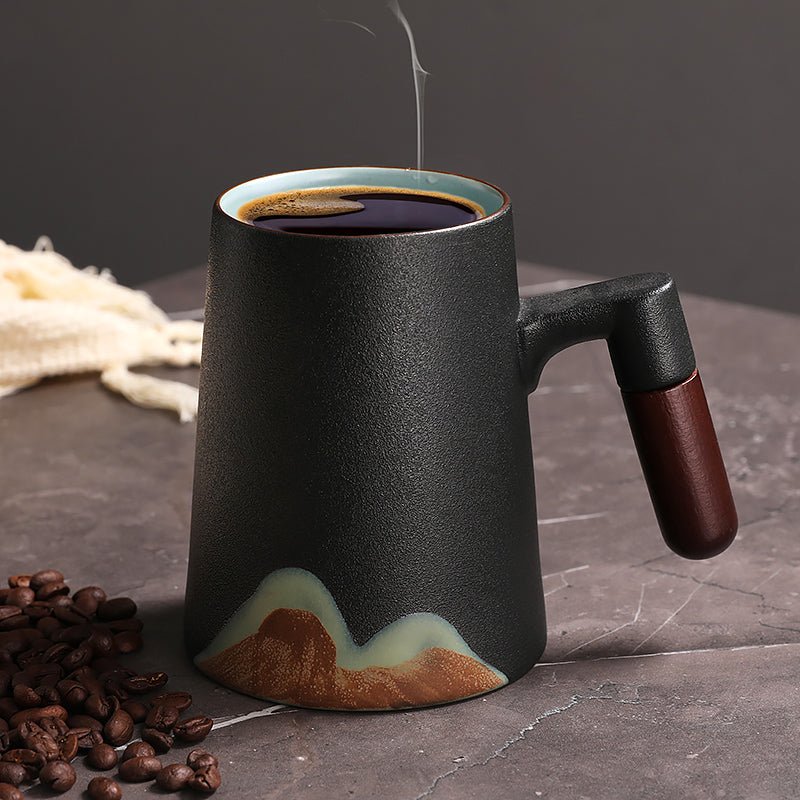
Latte Mugs Tall Replacement Purchase Practical Purchase Checklist
Reading time: about 10 minutes
Start with the mug that failed, not the one you are buying
Something pushed you into the market. A hairline crack spreading down from the rim. A handle that let go mid-pour and left a brown arc across the floor. Or a latte that goes cold before the foam settles because the vessel is too wide, too shallow, and too thin-walled to hold heat. Whatever it was, that failure is the most useful specification you own — and it is where every latte mugs tall replacement purchase practical purchase checklist should begin.
Before you open a single product listing, put the retired mug on the counter and measure it. Height. Outside rim diameter. Base diameter. The usable opening inside the handle. Write the numbers down, then compare every candidate against them. We keep a small steel ruler and a soft tape at our packing bench for exactly this reason: a shopper who knows the old mug's rim diameter can spot a bad replacement in seconds, while a shopper working from ounces alone usually cannot.
Capacity tells you how much liquid a vessel holds at the brim. It tells you nothing about whether the mug clears your group head, whether the handle fits three fingers, or whether the shape lets you pour at all. So the first line of the checklist is a tape measure, not a checkout button. Keep our unique coffee mugs collection open in a second tab while you measure, so you can compare profiles instead of scrolling blindly.
What does 'tall' actually mean on the listings you are comparing?
Three genuinely different products get sold under the same phrase, and confusing them is the most common pre-purchase mistake we see.
- A tall everyday coffee mug. Cylindrical sides and a full handle, built for volume. FDA's ceramic guidance describes a mug as small hollowware with cylindrical sides and a handle, normally holding about 240 mL (8 fl oz). That is a regulatory description of the category, not a rule that a latte must be eight ounces.
- A wide cafe latte cup. Shorter and broader, with a small handle or none. Built for milk texture and latte art, not for carrying across a parking lot.
- The conical gift or photo mug. Straight tapered walls and a print wrap, sold for the design as much as the drink inside it. These often look 'tall' in a product photo without matching the proportions of a cafe cup.
None of these is wrong. They answer different questions. Convert before you compare, using the standard factor of 29.57 mL per U.S. fluid ounce: 8 fl oz is roughly 237 mL, 12 fl oz about 355 mL, and 16 fl oz about 473 mL. A metric listing and an imperial listing can look wildly different and describe nearly the same vessel. If you are replacing a mug you loved, match the old profile first and the ounce number second.
Does the advertised capacity match the pour you actually drink?
Rarely, and this is where most tall mug disappointments begin. Advertised capacity is usually a brim-full measurement. A latte needs headroom: steamed milk expands, foam sits on top, and a mug filled to the lip is a mug you cannot carry without regret.
The working rule we use is to subtract 15 to 20 percent from the advertised number to estimate a comfortable pour. A 400 mL mug is realistically a 320 to 340 mL drink. If your current latte fills a 12 fl oz mug to a comfortable line, a 400 mL vessel gives you a small amount of extra room, while a 480 mL vessel gives you noticeably more.
Check your milk pitcher too. If the pitcher is far larger than the mug, a controlled pour gets harder, and the foam tends to arrive in one heavy blob rather than a steady stream. When you replace the mug but keep the pitcher, the mug should be the thing that moves. This is also why a listed capacity that looks generous on paper can feel tight in the hand once the foam settles.
Will the height clear your machine, your shelf, and your cup holder?
Ounce charts cannot answer this, and the answer is model-specific. Measure the gap between the drip tray and the group head or automatic spout — with the tray in the position you actually use. Then measure your cabinet gap. A mug that fits the machine but not the shelf ends up living on the counter permanently.
- Height: machine clearance and cabinet clearance. Measure both, not one.
- Rim diameter: sipping comfort, usable latte art surface, and whether it fits your favorite saucer.
- Base diameter: stability on a saucer, and whether it drops into a car cup holder or a desk riser.
- Handle opening: whether two or three fingers fit comfortably while the mug is full.
- Loaded weight: a large ceramic mug full of latte is genuinely heavy one-handed. If you carry coffee up stairs or across an office, price that in.
This is a place where our customer messages split cleanly. Desk drinkers care about base diameter and a handle that clears a keyboard tray. Home espresso users care about spout height and whether the mug fits under the portafilter without tilting. Gift buyers care about how the silhouette reads in a photo. None of those buyers is served by an ounce chart alone.
Tall and narrow, or wide and shallow — which shape earns counter space?
Shape changes the drinking experience more than capacity does. A wide rim gives you a surface to work with and lets you bring the pitcher spout close to the liquid, which is the mechanical part of pouring latte art. A taller, narrower vessel stacks the layers visibly — you see the milk band and the crema line — but the pitcher sits farther from the surface, and the pour is less forgiving.
Our honest position: if latte art is the goal, a wide cafe-style cup beats a tall mug almost every time. If the goal is a large, hot, easy-to-carry coffee that shows its layers, the tall mug wins. Plenty of shoppers want the second thing and buy the first by mistake. A tall mug is not a failure because it makes latte art harder; it is simply doing a different job.
Which of our three vessels fits the mug you are replacing?
We keep three sizes in the lineup. The differences are small on paper and meaningful in the hand, so here they are stated plainly, converted at 29.57 mL per fluid ounce:
| Model | Listed capacity | Approx. fl oz | Closest replacement situation |
|---|---|---|---|
| The Flow | 400 mL | ~13.5 | Replacing a 12 oz mug and wanting a modest step up |
| Morning and Night | 440 mL | ~14.9 | Replacing a 14 oz mug, or one that always ran short |
| The Rock | 480 mL | ~16.2 | Replacing a 16 oz mug; large lattes and long desk sessions |
Use the silhouette, not just the number. Compare the product-page profile against your retired mug before committing, and confirm height, rim diameter, and base diameter on the listing itself. If any of those three numbers is missing, ask before ordering. We will not guess on a product page's behalf, and neither should you.
Two trade-offs worth naming. The Rock is the one that can feel unwieldy when full — if you mostly drink an 8 oz flat white, it is more mug than you need. The Flow is the opposite risk: comfortable and quick to drain, but if your current habit is a full 16 oz latte, you will notice the smaller fill line. For grip-specific geometry, our notes on ceramic coffee mugs with large handles go deeper on handle openings and knuckle clearance.
If shape is still the sticking point, read our checklist on ceramic latte cups for replacement purchases before you choose between a wide cup and a taller mug. And if you are undecided on body type, our comparison of ceramic vs porcelain coffee mugs covers how each handles chips and heat.
Care, glaze, and food contact: what the replacement has to survive
This is where marketing language outruns evidence. Treat microwave, dishwasher, and lead-free claims as product-specific until the maker states them for that exact piece. A care line on one mug does not transfer to a similar-looking one in the same collection.
On microwaving, USDA guidance is narrow: only cookware manufactured for microwave use should go in, glass and ceramic vessels safe for the microwave are usually labeled for microwave oven use, and china with metallic paint or trim is not safe. If an unlabeled piece warms up quickly when heated beside a cup of water for one minute, USDA treats that as a sign it is not microwave safe. That is a useful test for an inherited mug from a cabinet, but it is not a substitute for a manufacturer's statement on a new purchase.
On glaze, FDA sets an action level of 0.5 micrograms per milliliter for leachable lead from cups and mugs, and it advises extra caution with handmade or crude pottery, antiques, damaged or worn pieces, flea market finds, and brightly colored orange, red, or yellow decoration. Washing or boiling does not remove lead from pottery, and some traditional pieces labeled 'lead free' have still shown extractable lead at or above the action level. Ordinary commercial factory pottery is described by FDA as much less likely to have a problem. A piece marked decorative or not for food use stays decor.
For a replacement purchase, read the listing's care section like a contract. If it says microwave safe, does it say which model or glaze? If it says dishwasher safe, is that a recommendation or a guarantee? If it says nothing, assume nothing. That is not a reason to avoid the mug, but it is a reason to ask before you make it your daily driver.
The latte mugs tall replacement purchase practical purchase checklist we run in our store
- Measure the retired mug: height, rim diameter, base diameter, handle opening.
- Convert your usual pour into milliliters, then add 15 to 20 percent headroom.
- Measure machine clearance with the drip tray in its real position, plus cabinet clearance.
- Check the base diameter against your saucer and your car cup holder.
- Decide shape first: wide rim for latte art, taller profile for volume and visible layers.
- Confirm the listing states height, rim, and base, not just capacity.
- Read the care line for microwave and dishwasher statements, and avoid metallic trim if you microwave.
- Buy one piece and live with it for a week before replacing a set.
When you are ready to compare profiles side by side rather than one listing at a time, return to the unique coffee mugs collection and keep the measurements from step one in front of you. The right replacement is usually the one that matches the mug you already trusted, not the one with the largest number in the title.
Frequently asked questions
What should I check first on a latte mugs tall replacement purchase practical purchase checklist?
The retired mug, not the new one. Height, rim diameter, base diameter, and the handle opening tell you what actually failed and what the replacement has to clear. Capacity is the last thing to compare, not the first.
How many ounces should a tall latte mug hold so a 12 oz latte does not overflow?
If your finished drink measures about 355 mL, look for a listed capacity near 400 to 440 mL so the foam has somewhere to sit. Advertised numbers are usually brim-full, so plan on losing roughly 15 to 20 percent to headroom.
Will a tall mug fit under my espresso machine or automatic spout?
Measure the gap between the drip tray and the group head or spout with the tray in the position you use, then compare that to the mug's listed height. Machine clearance is model-specific, so no ounce chart can answer it for you.
Are printed or photo tall latte mugs microwave and dishwasher safe?
Only if the maker says so for that specific piece. USDA lists china with metallic paint or trim as not microwave safe, and decoration durability varies by print method. Check the listing's care line and test an unlabeled piece with the one-minute water method before trusting it.
What is the one next step after I finish measuring?
Compare your old mug's numbers against The Flow, Morning and Night, and The Rock, then open the collection only after you know your height and rim limits. If a listing omits height, rim, or base, ask the seller before you order.
Ready to pick your mug? Two ways to save on today's order:
Ordering 1–3 mugs? Get an extra 10% off your 1st order with code 10_OFF Apply 10% Off & Shop Wooden-Handle Mugs →
Gifting 4+ mugs? Buy 3, Get the 4th Free applies automatically at checkout (no code needed; offers do not stack) · Free standard shipping (Nov pre-Christmas delivery: 15–20 calendar days US) · Free replacement if chipped in transit.
Popular mug buying guides: Ceramic Tea Cups & Infuser Mugs · Ceramic Mugs with Lids Compared · Wooden-Handle Tea Infuser Mugs Compared · Christmas & Secret Santa Mugs 2026 · Espresso & Cortado Cups Guide · Cup & Saucer Gift Sets · All 25 Mugs Spec Table · Mug Size Guide · Shipping & Promo FAQ
FIRST ORDER 10% OFF (CODE: 10_OFF) · OR BUY 3, GET THE 4TH FREE


Read more

Pottery Tea Cups Replacement Purchase: Practical Checklist
A replacement cup is a repair job, not a fresh start. This checklist walks you from the exact failure on the old cup to glaze condition, listed capacity in millilitres, handle fit, and the care que...
Read more
Wide Based Coffee Mugs Replacement Purchase Practical Purchase Checklist
Replacing a mug starts with why the old one failed: a rocking foot, a cramped handle, a refill too soon. This checklist covers base stability, five measurements, the listed 250 ml, 400 ml, and 480 ...
Read more
Leave a comment
This site is protected by hCaptcha and the hCaptcha Privacy Policy and Terms of Service apply.