



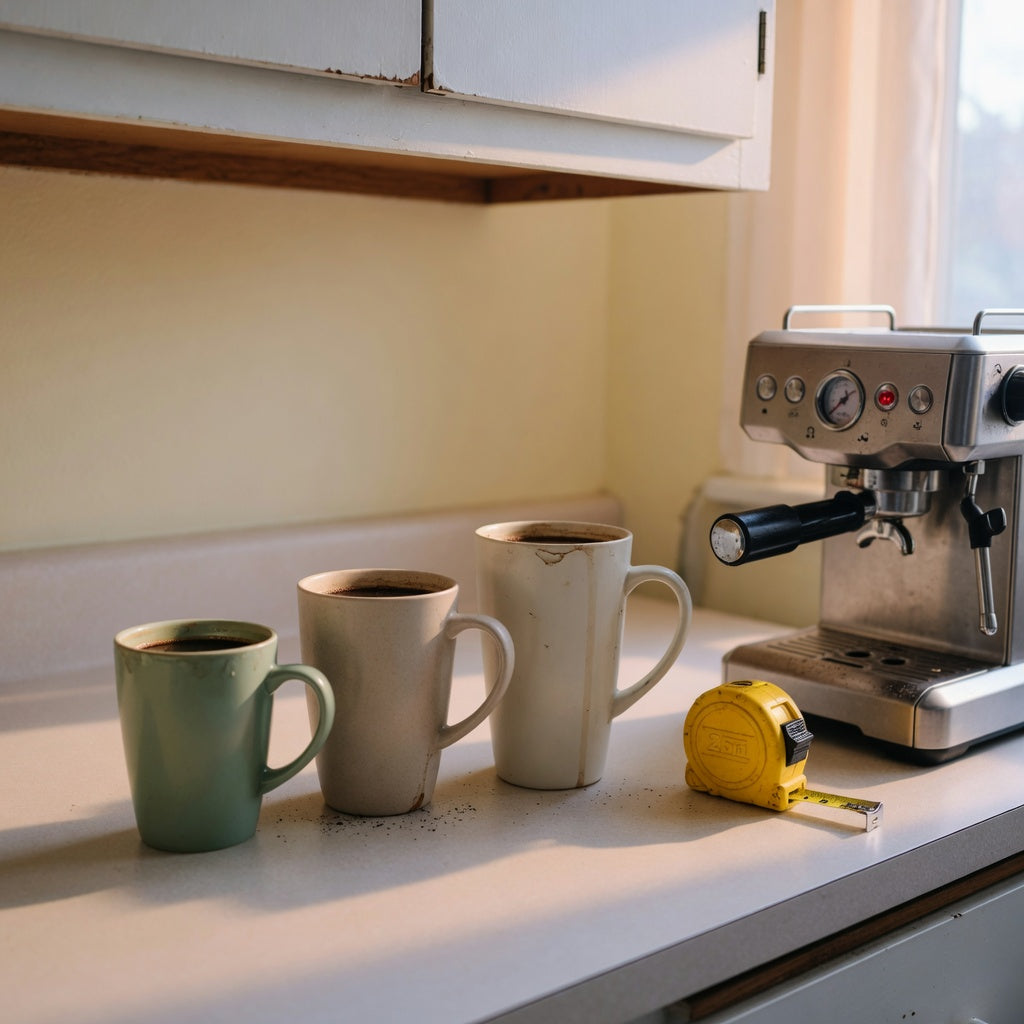
Latte Mugs Tall: Compact Kitchen Practical Purchase Checklist
Reading time: about 9 minutes
Pull a mug off a crowded shelf and the handle catches the shelf above it. Or the mug clears the cabinet but not the espresso machine, and it quietly becomes a tea mug for the rest of its life. We sell these mugs and we handle the exchanges, and the pattern holds: most small-kitchen disappointment is a measurement mismatch, not a quality problem. That is why this latte mugs tall compact kitchen practical purchase checklist begins with the gap above the handle, not with the capacity printed on the box.
You can see the silhouettes side by side in our unique coffee mugs collection before reading further. What follows is the order we would measure in a real kitchen, with a tape measure in one hand and a phone in the other.
Start with the gap above the handle, not the height on the spec sheet
Height gets all the attention. Handle protrusion causes most of the snagging.
- Shelf-to-shelf distance at the back of the cabinet. Cabinets taper, and the rear corner is usually tighter than the front edge where you measured.
- Handle depth. Body height plus the handle's outward reach is the number that has to clear the shelf above.
- Base diameter against shelf depth. If you stack two mugs or slide them into a drawer, the footprint decides whether that works.
Two mugs with identical capacity can have very different footprints. A 480 mL body that barely fits is worse in daily use than a 400 mL you can grab one-handed while the kettle boils. We have watched shoppers trade down a size for exactly this reason and end up happier with the mug they actually reach for.
Which of the three "tall latte mug" shapes are you picturing?
The phrase covers three different objects, and shoppers mix them up constantly:
- A tall everyday mug. High sides, moderate rim, built to hold volume at a desk or on a sofa arm.
- A cafe-style latte cup. Shorter and wider — the shape that lets a pitcher tip close to the surface for latte art.
- A conical gift or photo mug. Often listed around 17 fl oz, shaped to show a printed wrap rather than to pour from.
Decide which of the three you want before comparing any numbers. If latte art is the goal, rim width matters more than height. If the goal is a 12 oz latte at a desk with no spills, stability and handle comfort win. A listing that quotes only ounces is telling you very little about either.
How much of the listed capacity survives the foam?
Most capacity figures are measured to the rim, and the rim is not where the coffee stops. Steamed milk expands, so cold milk filled to the brim will overflow once the foam settles. In our store we plan for the finished drink to sit roughly 15–25 mm below the rim, and that is the headroom figure we quote when a customer asks which size to take.
Convert before you compare, using NIST's approximate factor of 29.57 mL per US fluid ounce:
| Fluid ounces | Milliliters | What it usually means in a home kitchen |
|---|---|---|
| 8 fl oz | ≈237 mL | A small cafe cup; a modest flat white |
| 10 fl oz | ≈296 mL | A modest mug for a single-shot latte |
| 12 fl oz | ≈355 mL | A common everyday mug and a typical two-shot latte |
| 16 fl oz | ≈473 mL | A large mug, a travel-cup volume, or an iced drink |
The FDA's ceramic guidance describes a cup or mug as a piece normally holding about 240 mL (8 fl oz), with a mug having cylindrical sides and a cup a base with curved sides. That is a regulatory description of a category, not a rule for how big a latte should be — retail mugs run well past it. Chain-menu names like Short, Tall, Grande and Venti are familiar reference points too, but they describe one company's cup lineup, not a build standard you have to follow.
So do the subtraction: brim capacity minus headroom equals usable fill. A mug that reads 480 mL to the rim does not pour 480 mL of latte without a spill down the side.
400 mL, 440 mL, or 480 mL — matching our three bodies to a real morning
We list three capacities plainly, and here is how they line up against everyday pours:
| Mug | Listed capacity | Approx. fluid ounces | Best-suited pour |
|---|---|---|---|
| The Flow | 400 mL | ≈13.5 fl oz | A two-shot hot latte with room for foam; tea for one |
| Morning and Night | 440 mL | ≈14.9 fl oz | A larger milk drink, extra foam, or a generous tea serving |
| The Rock | 480 mL | ≈16.2 fl oz | Big morning pours, iced drinks, anyone used to a 16 oz cup |
Silhouette matters as much as the number. The three bodies do not read alike on a shelf, and the taller the body, the more the shelf gap and the machine spout start deciding the purchase for you. We state capacities here because those are verified; height, rim diameter and base diameter should be read off the current product page, since those numbers decide fit and they do not carry over from one capacity to another.
One honest limitation: none of these replaces a short, wide cafe cup if latte art is your priority. A taller body makes it harder to bring the pitcher close to the surface, and a narrower rim gives less canvas for a pattern. Buy one of ours for the drink you actually make daily; buy a wide cup if the pour is the hobby.
Will it clear the group head, the bean-to-cup spout, and the car cup holder?
Measure the gap between the drip tray and the group head with the basket locked in, then measure again with your scale sitting on the tray. A scale can eat 15–20 mm of clearance without warning, and that is the difference between a mug that slides under and one that does not. On bean-to-cup machines, measure to the lowest spout position, not the retracted one.
This is where capacity-first buying fails. A 480 mL mug that will not sit under the spout becomes a tea mug, while the 400 mL that slides in cleanly gets used every single morning. For a car cup holder, base diameter is the deciding number — check it against the holder's inner width, especially if you are considering The Rock 480 mL, where a larger body usually means a larger footprint.
What has to be in writing before the first dishwasher cycle?
Both "microwave safe" and "dishwasher safe" are product-specific claims, not properties of ceramic in general. The USDA says only cookware manufactured for microwave use should go in, notes that microwave-safe glass and ceramic are usually labeled as such, and lists china with metallic paint or trim as unsafe. For an unlabeled piece, the USDA test is one minute beside a cup of water — if the vessel itself gets hot, it is not microwave safe.
Dishwashing works the same way: the claim has to come from the maker. Repeated high-heat cycles plus detergent are exactly where printed decoration and glazes show wear first, which is why we send shoppers to the care lines on the listing rather than to the product photo. If the listing is silent on both, ask before the first wash rather than after.
Is "lead free" the whole food-contact answer?
No. The FDA sets an action level of 0.5 micrograms per milliliter of leaching solution for cups and mugs, tested across six units. A lead-containing glaze that is fired properly binds the lead into the glaze; under-fired, it may not. Washing or boiling does not remove lead from pottery, and the FDA notes that some traditional pottery labeled "lead free" has still shown extractable lead at or above action levels.
The FDA advises extra caution with handmade or crude pottery, antiques, damaged or worn pieces, flea-market finds of unknown origin, and brightly colored orange, red or yellow decoration. Everyday commercial factory pottery is described as much less likely to be a problem. Practical version: buy from a seller who will state food-contact status in writing, and keep anything marked decorative-only off the breakfast table.
Latte mugs tall compact kitchen practical purchase checklist: six numbers to note before ordering
This is the sequence we would hand a friend standing in a small kitchen, phone in hand:
- Shelf-to-shelf gap, measured at the back of the cabinet. Low clearance is the first thing that disqualifies a mug.
- Body height plus handle reach. The combined figure has to clear the shelf above, not just the body alone.
- Usable fill, not brim capacity. Subtract your headroom for foam before comparing milliliters or ounces.
- Rim diameter. Wide for pouring and sipping comfort; narrower if the mug has to fit a tight shelf.
- Base diameter. It decides shelf footprint, stability, and whether the mug sits in a cup holder.
- Machine and spout clearance with the scale in place, plus care and food-contact claims in writing.
If two mugs tie on all six, take the smaller base — it will fit more places over the years. If your shelf is shallow rather than low, a wider, lower body often wins, and the full range of unique coffee mugs is the place to compare shapes rather than guess from a photo. For most one-latte-a-day households, The Flow 400 mL is the safe call; step up to Morning and Night 440 mL if you like a wetter, milkier drink and have the cabinet room for it.
Frequently asked questions
Will a 480 mL tall latte mug fit under a compact espresso machine?
Measure the drip tray to group head gap with the basket locked in and your scale on the tray, then compare that to the mug's height on the product page. Machine clearance is model-specific, so we cannot promise a fit for your setup. If the gap is tight, the 400 mL body is the more realistic choice.
Is 400 mL enough for a latte with steamed milk and foam?
For most two-shot hot lattes, yes. At 400 mL you are at roughly 13.5 fl oz, and leaving headroom for foam still leaves a full drink. If you routinely add extra milk, drink iced lattes, or are used to a 16 oz cup, the 440 mL or 480 mL body is the better match.
How do I check whether a tall latte mug is microwave safe?
Look for the maker's microwave-safe labeling, and skip anything with metallic paint or trim — the USDA lists that as unsafe. If a piece is unlabeled, heat it for one minute beside a cup of water; a vessel that turns hot while the water warms is not microwave safe.
Does the size in ounces tell me if it fits a car cup holder?
No. Base diameter decides that, not capacity. Check the base measurement against the holder's inner width, especially on the larger body, where the footprint tends to grow along with the volume.
What should I ask a seller if the listing only shows capacity?
Ask for height, rim diameter, base diameter, and the food-contact and care status in writing. That short reply covers most of this latte mugs tall compact kitchen practical purchase checklist, and a seller who will not answer is telling you something useful too.
More from our blog
Ready to pick your mug? Two ways to save on today's order:
Ordering 1–3 mugs? Get an extra 10% off your 1st order with code 10_OFF Apply 10% Off & Shop Wooden-Handle Mugs →
Gifting 4+ mugs? Buy 3, Get the 4th Free applies automatically at checkout (no code needed; offers do not stack) · Free standard shipping (Nov pre-Christmas delivery: 15–20 calendar days US) · Free replacement if chipped in transit.
Popular mug buying guides: Ceramic Tea Cups & Infuser Mugs · Ceramic Mugs with Lids Compared · Wooden-Handle Tea Infuser Mugs Compared · Christmas & Secret Santa Mugs 2026 · Espresso & Cortado Cups Guide · Cup & Saucer Gift Sets · All 25 Mugs Spec Table · Mug Size Guide · Shipping & Promo FAQ
FIRST ORDER 10% OFF (CODE: 10_OFF) · OR BUY 3, GET THE 4TH FREE


Read more
Large Round Coffee Mugs: Compact Kitchen Practical Purchase Checklist
A measurement-first buying checklist for wide, rounded mugs in small kitchens: belly width versus shelf depth, real fill lines in millilitres and ounces, brewer clearance, filled weight, and the gl...
Read more
Ceramic Mug Pair for Home Coffee Station: What Buyers Compare
Two mugs have to survive a shared counter, a spout clearance measurement, and a few hundred dishwasher cycles. Here is how we would compare capacity, glaze claims, body material, and wear before ad...
Read more
Leave a comment
This site is protected by hCaptcha and the hCaptcha Privacy Policy and Terms of Service apply.