
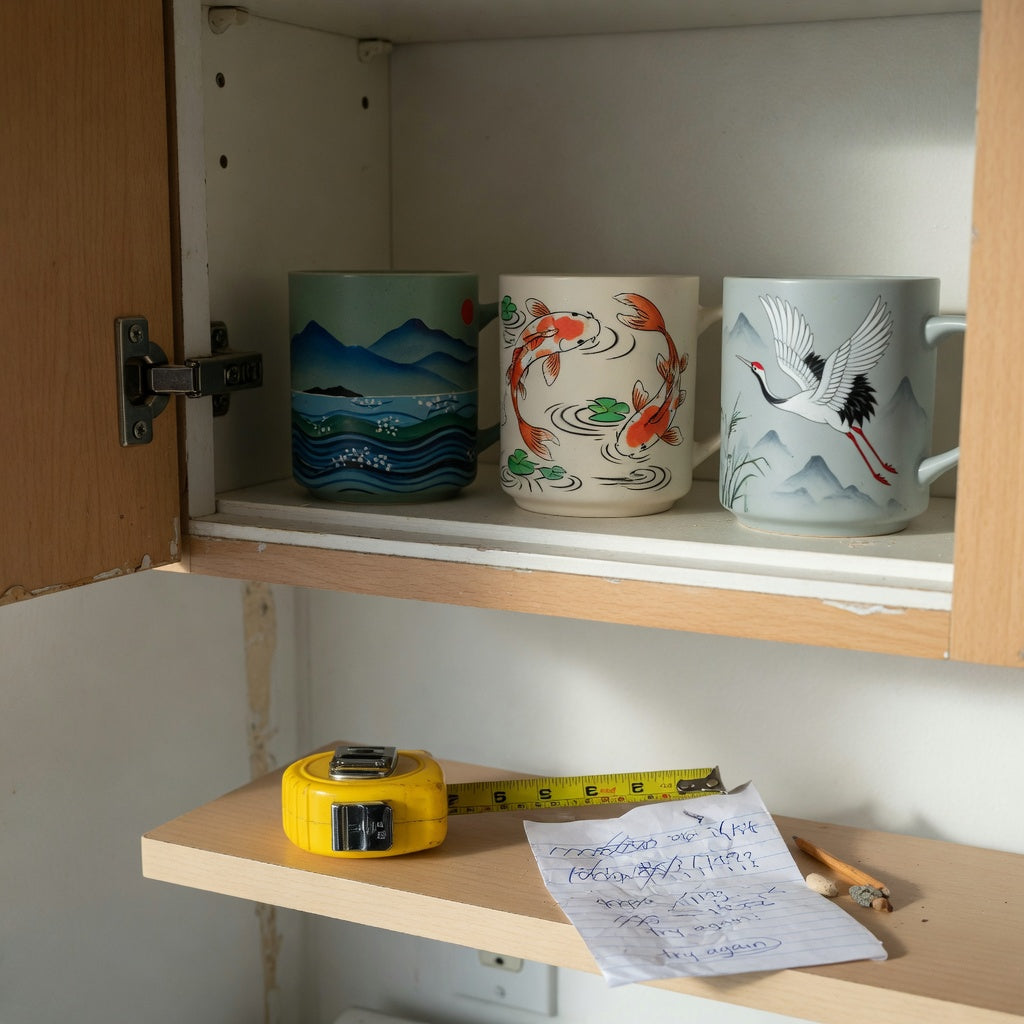
Art Coffee Mugs Compact Kitchen Practical Purchase Checklist: 7 Checks
Reading time: about 9 minutes
A mug can clear the space between two shelves and still fail in a compact kitchen. The handle may hit a cabinet hinge, the rim may catch the shelf above as you lift it, or the cupboard door may refuse to close once the mug is turned sideways. That is the reason for our art coffee mugs compact kitchen practical purchase checklist: it starts with the physical space, then compares the visible mountain-sea, koi fish, and crane motifs.
Our team handles mugs during product checks and packing, where the rim, handle attachment, body profile, and foot are easier to assess than they are in a styled photograph. We use the same rule when helping shoppers compare options: rely on the stated material, listed capacity, supplied measurements, visible shape, and product imagery. If a listing does not confirm a detail, treat it as unknown rather than filling the gap with an assumption.
Which cupboard measurements decide whether a mug fits?
Start inside the cabinet, not at the front edge of the shelf. Hinges, shelf lips, door rails, and sloped cabinet backs can reduce the usable space. If the mug will live beneath an upper cabinet, also measure around the coffee maker or kettle with lids and moving parts fully open.
| Kitchen constraint | Measure at home | Compare with the listing |
|---|---|---|
| Shelf opening | From the shelf surface to the lowest lip, hinge, or shelf above | Overall mug height, if supplied |
| Closed-cabinet depth | From the back wall to the inside of the closed door | Body depth and handle orientation shown in the images |
| Side-to-side space | The clear width between neighboring mugs or cabinet hardware | Maximum width, including the handle, if listed |
| Base contact area | The usable flat shelf or counter area | Base or foot dimensions, if supplied |
| Removal path | The space needed to tilt and lift the mug out | Rim width, handle projection, and body profile visible in side views |
Listing photographs are useful for shape and motif placement, but they are not scale drawings. A stated capacity also does not prove that a mug will fit: two mugs can hold the same amount while using very different heights, body widths, and handle shapes. If an essential dimension is absent, ask before ordering or choose an option with enough information to verify the fit.
Art coffee mugs compact kitchen practical purchase checklist: seven checks
Write down these seven points before opening product tabs. This prevents the artwork from becoming the only deciding factor.
- Clear shelf height: Measure to the lowest obstruction, not just the shelf above.
- Usable cabinet depth: Check the space with the door completely closed.
- Maximum mug width: Include the handle rather than measuring only the body.
- Base and widest body point: A narrow foot does not mean the upper body is equally narrow.
- Listed capacity: Match it to the amount you normally pour, including milk, tea infusers, or ice.
- Exact material description: Use the wording on the current product page without assuming a more specific ceramic type.
- Care and storage instructions: Verify dishwasher, microwave, and stacking guidance separately.
Repeat the fit check at the place where you will use the mug. A cup that stores neatly can still crowd a narrow preparation area, bump a kettle, or leave too little room beside a sink or office keyboard.
How do listed capacity and body shape affect a small counter?
Capacity tells you how much a mug is intended to hold, not how efficiently it uses cabinet space. A tall, narrow body may conserve shelf width but create a height problem. A lower, broader body may clear the shelf above while taking more room beside other cups. Neither form is automatically better.
Use your current mug as a reference. Fill it to your normal coffee or tea level, then note whether you actually need more volume. Iced coffee needs room for ice as well as liquid, while a tea infuser may need enough opening and headspace to remove it without dripping. If you routinely underfill a large mug, a smaller listed capacity may be the more practical compact-kitchen choice. If you make large iced drinks, a dedicated taller vessel may suit you better even if it cannot share the same cabinet slot.
What does the stated material mean for care and durability?
Ceramic is a broad category label. It does not by itself establish that a mug is porcelain or stoneware, and it does not automatically confirm dishwasher use, microwave use, thermal-shock resistance, or the process used to apply the artwork. A glossy photograph also cannot prove whether a motif is printed, painted, placed beneath a glaze, or applied by another method. In our store, we keep those claims limited to the wording provided on the product page.
These are the practical handling checks we use for ceramic drinkware and recommend for gift unboxings:
- Inspect the rim and interior under direct light for chips or hairline cracks before first use.
- Check both handle attachment points; a crack at either joint deserves attention before the mug is filled.
- Set the empty mug on a dry, flat counter to check for significant rocking or an unusually rough foot.
- Use a dishwasher or microwave only when the product instructions expressly support it.
- Do not force mugs to nest. A tapered profile does not guarantee that a design is intended for stacking.
If dishwasher use is confirmed, leave enough rack space to prevent the rim and handle from striking neighboring pieces during the cycle. For ceramic drinkware, it is also sensible to avoid abrupt changes from very cold storage to intense heat unless the product instructions specifically allow that routine.
Mountain-sea, koi, or crane: which motif fits the setting?
Here, art is a style preference grounded in the imagery visible on each listing. We do not assign an artist, art movement, provenance, edition status, or production method that the product page does not state.
For a landscape-focused open shelf
If the mug will stay visible on an open shelf and you prefer scenery as the main subject, start with the Mountain-Sea Coffee Tea Mug. The named mountain-and-sea motif directly matches that preference. Use the product images to check where the primary scene sits relative to the handle, then compare the current material, capacity, shape, and any listed measurements with your cabinet notes.
For a fish motif or an aquatic-themed gift
If the shopper or gift recipient specifically likes koi imagery, the Koi Fish Coffee Tea Mug is the relevant next comparison. Review every available angle rather than relying on the first image; this shows how much of the motif remains visible when the mug is held, placed beside another mug, or turned inside a cabinet.
For a bird-led desk or tea-corner design
If a crane motif is the deciding visual preference, compare The Crane Coffee Tea Mug. It fits the shopper looking for that specific bird subject, but the artwork should not override an unresolved capacity, handle, or storage question. Confirm the listing-backed specifications against the way the mug will be used.
If you are undecided on the subject matter, compare the unique coffee mugs collection with your measurement sheet beside you. Eliminate shapes that cannot be verified first, then choose among the remaining motifs. That order is especially useful in a shallow cabinet where only one handle orientation works.
Can you lift, grip, and store the mug without collisions?
A static fit is only half the test. In a crowded cupboard, a mug often has to move forward and tilt before it clears the shelf above. A handle that fits beside a neighboring cup may still catch that cup during removal. At an office desk, the same projection can interfere with a keyboard, notebook, or charging cable.
- Use your current mug to trace the route from the intended shelf position to the counter.
- Check whether you can grip and lift it with the cabinet door fully open and adjacent mugs in place.
- Review the product images for handle size, attachment position, and artwork orientation, but do not estimate exact dimensions from the image alone.
If a comfortable handle opening is essential, look for a listed measurement or ask our store before buying. This matters for anyone who uses a full-hand grip, has limited hand mobility, or regularly carries the mug between a kitchen and desk.
Who should choose a different drinkware style?
An art coffee mug is not the best tool for every routine. Choose a sealed travel mug if the drink must go into a bag or car. Choose an insulated vessel if hours of heat retention matter more than visible artwork. If tight nesting is mandatory, select a mug explicitly described or shown as stackable rather than assuming a curved body will nest safely.
A different style may also be better if you need a large iced drink, require confirmed dishwasher and microwave compatibility, or expect frequent drops in a busy shared space. For a gift recipient with unknown cabinet dimensions, matching the approximate size and form of a mug they already use is safer than choosing by motif alone. The mountain-sea, koi, or crane imagery should be the final preference check, not a substitute for functional information.
Run this shelf test before checkout
- Photograph the intended shelf with the cabinet door open.
- Record clear height, closed-door depth, available width, and any hinge obstruction.
- Measure a mug that already fits and note its overall height, widest point, handle projection, and base.
- Write down your normal drink volume instead of choosing the largest listed capacity by default.
- Open the relevant product pages side by side and record only stated specifications.
- Mark missing dimensions or care guidance as unknown and resolve any deal-breaking gap.
- Choose the visible motif only after the mug passes the storage, grip, capacity, and care checks.
Use this art coffee mugs compact kitchen practical purchase checklist as an elimination tool. A mug that fails one essential physical constraint should leave the shortlist, even if its artwork is your first choice.
Frequently asked questions
What should I measure before buying an art coffee mug for a small cabinet?
An art coffee mugs compact kitchen practical purchase checklist should record clear shelf height, usable depth with the door closed, side-to-side space, and the position of hinges or shelf lips. Compare those numbers with the mug's overall height, maximum width including the handle, and base or body footprint when the listing supplies them. Capacity alone cannot confirm fit.
Can I use listed capacity to predict the outside size of a mug?
No. Mugs with a similar capacity can have different body heights, widths, rim shapes, and handle projections. Use capacity to match your drink routine, then verify exterior dimensions and visible shape separately.
Which CoffeifyMug design should I choose for a compact kitchen?
Choose the Mountain-Sea mug for a landscape preference, the Koi Fish mug for fish imagery, or The Crane mug for a bird motif, provided the listing-backed specifications fit your space. If several pass the physical checks, compare artwork placement relative to the handle and how the mug will face on your shelf or desk.
How do I verify dishwasher or microwave use if a listing is unclear?
Do not assume compatibility from the word ceramic or from a glossy finish. Record the missing care detail and contact our store, or choose a product page that states the required use clearly. Then reopen the unique coffee mugs collection with your cabinet measurements beside you and remove any option whose essential fit or care information remains unresolved.
More from our blog
Read more
Ceramic Tea Mug Compact Kitchen Practical Purchase Checklist: Fit First
Measure the shelf opening, total width with handle, counter footprint, and your normal pour before choosing. This checklist compares CoffeifyMug ceramic listings without guessing at unlisted dimens...
Read more
Emerald Green Coffee Mug Compact Kitchen Product Shortlist Guide
Compare two mug forms against your actual cabinet, shelf, and counter limits. This scenario-based shortlist explains which option to choose, which to skip, and which product detail must be confirme...
Read more
Leave a comment
This site is protected by hCaptcha and the hCaptcha Privacy Policy and Terms of Service apply.