



Large Round Coffee Mugs: Compact Kitchen Practical Purchase Checklist
Reading time: about 11 minutes
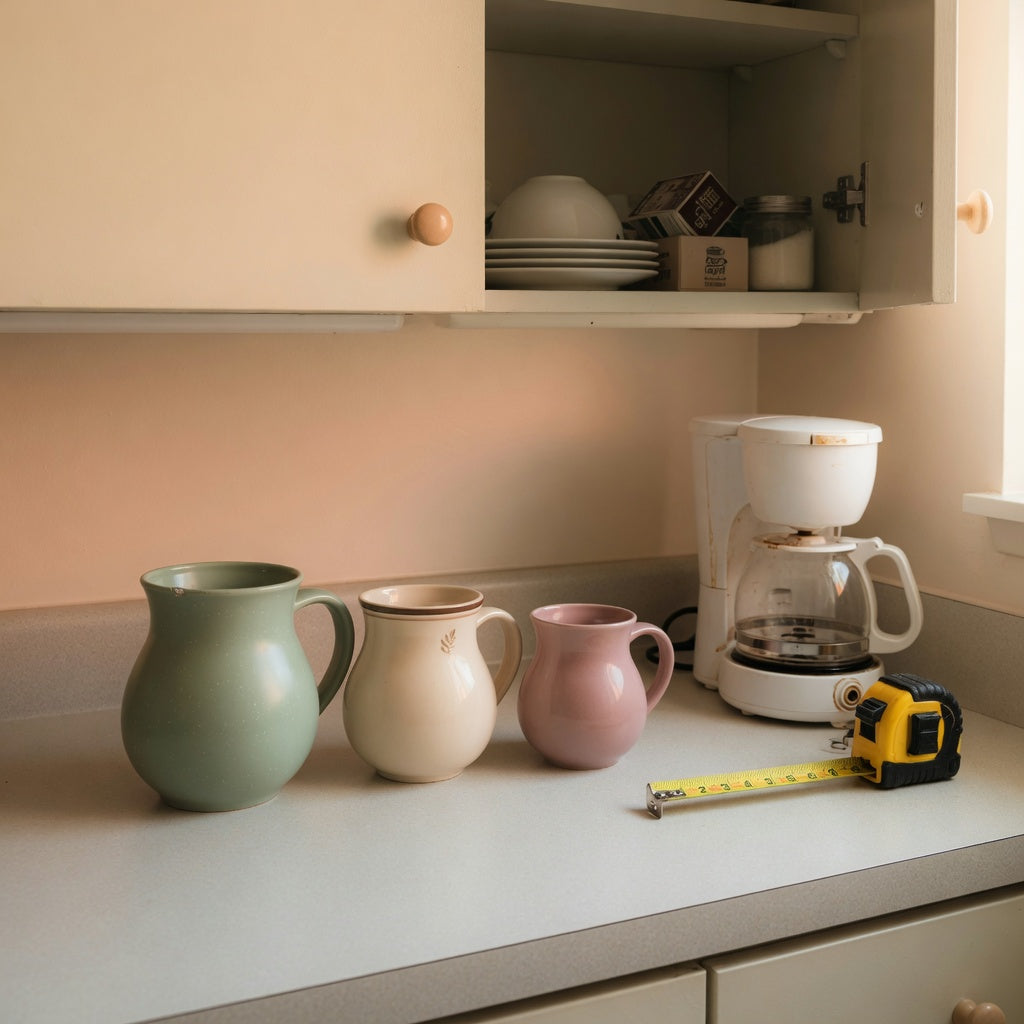
Picture the moment a new mug meets a small kitchen: the cabinet above the sink is shallow, the counter already holds a kettle and a cutting board, and the brewer sits under an upper cabinet with barely an inch of headroom. That is where a wide, rounded cup either earns its place or becomes shelf clutter. This large round coffee mugs compact kitchen practical purchase checklist is the version we walk shoppers through when they ask which of our mugs will actually fit — measured, a little skeptical, and honest about the cases where a tall straight-sided mug is the smarter buy.
Round body versus tall body: same ounces, completely different fit
Two mugs can both be called large and behave nothing alike. A tall diner-style cylinder earns its volume vertically, so it needs cabinet height and brewer clearance but very little shelf real estate. A rounded, belly-shaped body earns its volume horizontally, which flips the trade-off: it usually slides under a spout or a low shelf, but it eats more depth and width per mug.
In practice, that means a round mug is often the better choice for three specific situations, and the worse choice for one:
- Better under a brewer. Short, wide mugs clear spouts and drip trays that tall mugs force you to work around.
- Better on a low shelf. If your upper cabinet has a tight gap between shelves, a short round body fits where a tall cylinder will not.
- Better for spoon work. A wide mouth takes a spoon, a whisk, or a latte-art pour without scraping.
- Worse in a shallow cabinet. Width is the cost. A bellied body plus a handle can occupy noticeably more shelf depth than a cylinder of the same capacity, and it will not stack.
If stacking is how you survive a small kitchen, be realistic: round mugs are usually a one-row-per-shelf commitment.
Three measurements to take before you spend anything
Product photos flatter curvature. A tape measure does not. Before you compare any large round coffee mug, take these three numbers, in this order:
- Widest point of the body, not the rim. Run the tape across the belly at its fattest line. Rim diameter tells you almost nothing about whether the mug clears a shelf lip or a neighbouring glass.
- Handle projection. Measure from the far edge of the handle to the opposite wall of the body. This total is the horizontal footprint that has to fit inside your cabinet, and it is the number that most often kills a purchase.
- Shelf depth and clear height. Measure front to back on the shelf, then from the shelf surface to whatever is above it. Leave yourself a margin — a mug that touches on both sides is a mug you will stop using.
The quickest calibration trick: pull out the mug you already own that fits comfortably, measure it the same way, and treat those numbers as your ceiling. We cannot publish one footprint figure that works in every kitchen, because cabinet depths and handle shapes vary so much — but your existing favourite mug is a reliable local standard.
What 400, 440 and 480 ml actually pours once you leave headspace
Listed capacity is a brim-full figure. It is the volume the vessel holds at the very edge, and nobody carries a mug across a kitchen at that level. The U.S. standard conversion is 1 fluid ounce to 29.57353 millilitres, with 1 measuring cup defined as exactly 8 fluid ounces — so the maths is straightforward, and so is the correction you need to apply.
Our rule of thumb when advising shoppers: plan on roughly 2 to 3 fluid ounces of headspace for any mug you carry rather than drink in place. Here is how our three rounded mugs land:
| Mug | Listed capacity | Brim-full in fluid ounces | Realistic pour | Where it earns its space |
|---|---|---|---|---|
| The Flow coffee tea mug | 400 ml | About 13.5 fl oz | Around 10 to 11 fl oz | An 8 oz brew with a generous pour of milk, or a full cup of tea |
| Morning and Night coffee tea mug | 440 ml | About 14.9 fl oz | Around 12 fl oz | A larger drip coffee, a latte, or a long steeped tea |
| The Rock coffee tea mug | 480 ml | About 16.2 fl oz | Around 13 to 14 fl oz | Americanos, big flat whites, broth, or an afternoon bowl of oatmeal |
All three have the visibly rounded silhouette that puts them in this category, and each lists its capacity plainly on the product page. What the listings will not do is decide your fill line for you — that depends on how much milk you add and how far you carry the cup. If you routinely drink a 14 oz mug of coffee, the 400 ml model will feel small once you account for headspace.
Handle room and filled weight: the one-handed carry test
A wide body and a small handle is the most common mismatch we see in this category. The mug looks generous, then you pick it up full and the handle takes two fingers instead of three or four, so the weight hangs off your fingertips instead of your palm. Before ordering, look closely at the handle opening in the gallery photos and compare it to the mugs you already carry without thinking.
Weight is the other half of that test, and the liquid does most of the work. A 480 ml mug holds roughly 480 grams of coffee before you add the vessel itself — a bit over a pound of liquid alone. That is fine on a desk or a kitchen counter and tiring on a long walk from a break room.
Two places to think about that are easy to forget:
- Car cup holders. Rounded bodies with wide bellies and thick handles are often too broad for a standard console holder. A round mug is a desk mug, not a commute mug.
- Balance when full. A domed or bellied body can feel top-heavy if the base is narrow relative to the belly. Check the product photos for how flat and how wide the base reads.
Wide mouths, pour-over drippers and brewer clearance
This is where rounded mugs split the room. A wide opening catches twin espresso spouts neatly and gives you room for a spoon or a milk swirl. It also creates two problems worth checking before you buy:
- Dripper stability. A cone or flat-bed dripper needs a rim it can actually sit on. Measure the outside diameter of your dripper's base ring, then compare it to the mug's opening — if the base ring is wider than the mouth, the dripper will perch rather than sit, and a nudge sends hot coffee sideways.
- Tilt and spill. A bellied body moves liquid toward the rim faster as you tip it, especially when the mug is nearly full. Drinkers who like to sip while walking tend to prefer a straighter wall.
For brewer clearance, measure from the drip tray to the spout with the tray in place rather than removed. A short round mug often means you keep the tray where it belongs, which is one of the quiet advantages of this shape in a small kitchen.
Heat behaviour: thick walls help, a wide open mouth does not
Rounded mugs get a reputation for keeping coffee warm, and it is half true. A thick wall holds thermal mass, so the first pour loses less heat to the vessel. But heat also leaves through the exposed surface, and a wide circular mouth is a large open surface. The result is a mug that starts hot and cools in the middle — usually pleasant for black coffee you intend to drink within the hour, less so if you nurse a cup across a whole morning.
If you use a mug warmer, look at the base. A recessed foot ring that keeps the centre of the base a millimetre or two above the plate reduces contact and slows heating. A flat, unpainted base transfers heat far more predictably.
Glaze, lead and the appliance question we will not guess at
Bright, heavily decorated glazes deserve a specific question rather than a vibe check. Under FDA Compliance Policy Guide 545.450, the action level for lead in ceramic cups and mugs is 0.5 µg/mL of leaching solution, and the agency describes cups and mugs as small hollowware — normally, though not exclusively, around 240 mL with a handle — where the guideline is applied to any one of six units tested. Cadmium is covered separately under CPG 545.400, at 0.5 µg/mL for small hollowware and 0.25 µg/mL for large hollowware, again judged on any one of six units.
Two details matter for shoppers. The FDA has reported imported pottery labelled "Lead Free" that nonetheless contained extractable lead, in some cases above those action levels — a label is not a test result. And decorative ceramicware that could plausibly be mistaken for drinkware must, under 21 CFR 109.16, carry a conspicuous "not for food use" warning about lead or a hole through the food-contact surface. A published pilot study in Food Safety and Risk also found that lead from ceramic mugs can leach into coffee and tea, with results varying by individual cup.
Because of that, we do not announce microwave or dishwasher suitability for a mug unless the current product listing states it. Check the listing for the mug you are considering and read the care section before the first wash. As a general rule that travels well across this category: skip the microwave for any mug with a metallic rim, gold luster or painted trim, and avoid plunging a hot mug into cold water, which is a classic way to crack glazed ware.
Large Round Coffee Mugs Compact Kitchen Practical Purchase Checklist
Run these seven checks in order. Any single failure is a reason to pick a different shape or size, not a reason to hope it works out.
- Belly width plus handle projection. Confirm the full horizontal footprint fits your shelf with room to spare, and that the cabinet door still closes.
- Shelf clear height. Short round bodies win here, but measure the gap rather than assuming.
- Brewer clearance with the drip tray in place. Measure tray to spout, then subtract for the mug's height.
- Dripper and press compatibility. Compare your dripper's base ring to the mug's opening before you commit.
- Converted capacity minus headspace. Use 1 fl oz = 29.57353 ml, then subtract 2 to 3 fl oz for a mug you carry. 400 ml gives about 13.5 fl oz brim-full; 440 ml about 14.9; 480 ml about 16.2.
- Handle opening and filled weight. Three to four fingers of clearance, and remember the liquid alone can weigh over a pound.
- Care and glaze verification. Read the current listing for microwave and dishwasher statements, and ask the maker what leach testing backs any food-safety claim.
If you are still weighing shapes, our unique coffee mugs collection lets you compare silhouettes side by side, and the guide to comparing large unique mugs for gifts covers how these pieces read in person. For handle sizing specifically, our notes on large-handled ceramic mugs in compact kitchens go deeper on grip and knuckle clearance.
Frequently asked questions
Do large round coffee mugs take up more cabinet space than tall mugs of the same capacity?
Usually yes on shelf depth and width, and less on height. A rounded body spreads the same volume sideways, so measure the widest point of the belly plus the handle rather than the rim. Tall cylinders use less shelf footprint but need vertical clearance a round mug does not.
How do I use this large round coffee mugs compact kitchen practical purchase checklist if I only have one shallow shelf?
Prioritise the footprint test over everything else: belly width plus handle projection, then shelf depth. If the numbers are tight, choose the smaller listed capacity and keep two mugs rather than forcing one oversized mug into a space where it will rub against the cabinet door every time you open it.
Will a wide round mug cool my coffee faster than a narrow one?
In most cases, yes. Thick walls add thermal mass, so the first pour loses less heat to the vessel, but a wide open mouth exposes more liquid surface and heat escapes there. Expect a good drinking temperature sooner and a shorter total window before the coffee goes tepid.
Can I brew straight into a wide-mouth round mug with a pour-over dripper?
Only if the dripper's base ring is wider than the mug's opening so it sits on the rim rather than sinking into it. Measure both before you try it with hot water — a perched dripper is a spill waiting to happen, and a wide bellied body tilts liquid toward the rim quickly.
Is a "lead-free" label enough on a large decorated mug?
Not on its own. The FDA action level for lead in cups and mugs is 0.5 µg/mL of leaching solution, and the agency has reported imported pottery labelled "Lead Free" that still contained extractable lead above those levels. Ask the maker what testing backs the claim, and treat heavily decorated yellow, orange and red glazes as worth a specific cadmium question too.
Ready to pick your mug? Two ways to save on today's order:
Ordering 1–3 mugs? Get an extra 10% off your 1st order with code 10_OFF Apply 10% Off & Shop Wooden-Handle Mugs →
Gifting 4+ mugs? Buy 3, Get the 4th Free applies automatically at checkout (no code needed; offers do not stack) · Free standard shipping (Nov pre-Christmas delivery: 15–20 calendar days US) · Free replacement if chipped in transit.
Popular mug buying guides: Ceramic Tea Cups & Infuser Mugs · Ceramic Mugs with Lids Compared · Wooden-Handle Tea Infuser Mugs Compared · Christmas & Secret Santa Mugs 2026 · Espresso & Cortado Cups Guide · Cup & Saucer Gift Sets · All 25 Mugs Spec Table · Mug Size Guide · Shipping & Promo FAQ
FIRST ORDER 10% OFF (CODE: 10_OFF) · OR BUY 3, GET THE 4TH FREE


Read more
Wide Based Coffee Mugs Home Office Product Shortlist Guide
A broad foot prevents spills only if it fits your actual desk setup. We evaluate our three catalog mugs by listed capacity, desk landing zone, and workday routines so you can shortlist the right mu...
Read more
Latte Mugs Tall: Compact Kitchen Practical Purchase Checklist
A tall latte mug only earns counter space when the shelf gap, the group head, and the usable fill line agree. Here is the measurement sequence we walk shoppers through, plus how our 400 mL, 440 mL,...
Read more
Leave a comment
This site is protected by hCaptcha and the hCaptcha Privacy Policy and Terms of Service apply.