



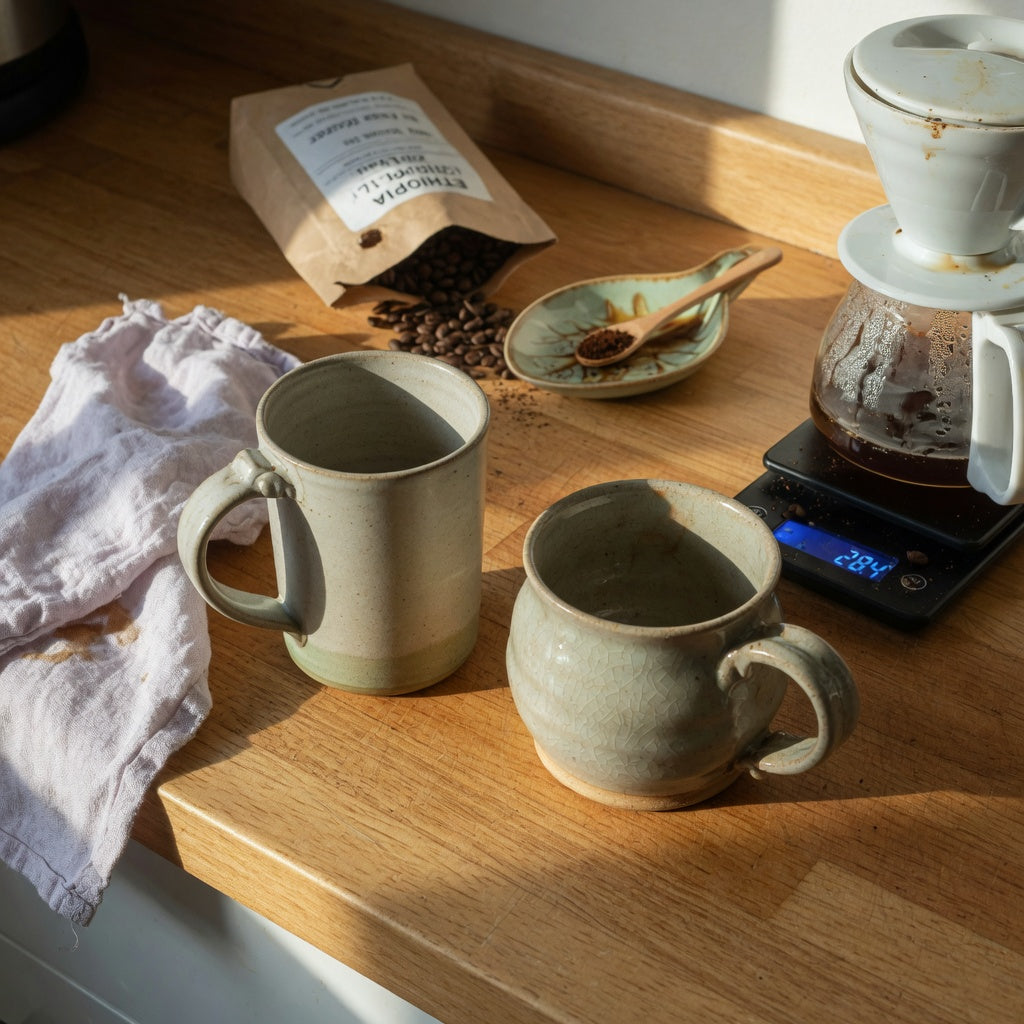
Ceramic Mug Pair for Home Coffee Station: What Buyers Compare
Reading time: about 11 minutes
Two mugs sit beside the brewer. One gets picked up every morning without a second thought. The other arrived in the same box, looked right in the product photo, and has been parked behind the grinder since spring. That gap, between a pair that photographs well and a pair that survives a shared counter, is the only comparison worth making.
We sell ceramic mugs, and the questions we field about a ceramic mug pair for home coffee station duty almost never start with color. They start with capacity, handle width, glaze safety, whether the cup clears the spout, and what the rim looks like after a few hundred dishwasher cycles. Here is how our team works through it, including the cases where we tell a shopper that a matching ceramic pair is the wrong purchase for their counter.
Two drinkers, one counter: what the pair has to survive
A coffee station is not a dinnerware set. It is roughly two feet of counter that also holds a brewer, a grinder, a scale, and a spoon rest. Before comparing glazes, write down the four jobs the pair actually has to do:
- Two drinkers, two rhythms. One person pulls a double shot and adds milk. The other pours ten ounces of drip and walks away. One capacity frequently fits one of them badly.
- Clearance under the machine. Rim diameter and height decide fit. Width on the shelf matters less than you think when a portafilter has to swing.
- Idle footprint. Two mugs plus a grinder on a narrow counter is already crowded. Stackability is a feature, not a bullet point.
- A care cycle you will actually run. A mug that cannot go in the dishwasher lives in the sink, and a mug in the sink is not on the station.
The honest trade-off: a matched pair stacks neatly and reads as intentional on an open shelf, but it locks both people into one capacity and one handle size. If your household splits between espresso and filter coffee, two complementary shapes usually beat two identical cups, provided the glaze ties them together so the counter still looks deliberate.
Which ceramic mug pair for home coffee station size fits your actual pour?
Listings quote capacity. Almost none of them explain headroom, and headroom is where spills come from. The FDA's compliance guidance describes cups and mugs as small ceramic hollowware holding about 240 mL (8 fl oz) and often made with a handle. That is the reference point the category is built around, not the size of your pour.
Practical translation from what we see in customer questions:
- A mug listed at 12 oz is comfortable at roughly 9 to 10 oz if you want to carry it across a room without watching the rim.
- A listed 8 oz cup is a tea cup or a milk-drink cup, not a drip coffee cup, unless you enjoy refilling.
- Latte and cappuccino drinkers usually need a wider mouth as much as more volume, because foam takes vertical space and needs surface area to pour into.
- If you brew on a scale, weigh your normal pour once in grams. Buy to that number plus about two ounces of headroom, not to the number on the box.
Our ceramic versus porcelain capacity guide walks through how wall thickness changes usable volume at the same listed ounce figure.
Porcelain, stoneware, or double-wall: how each feels when it is full
These three bodies behave differently in the hand at 6:40 a.m., and that difference is the whole purchase decision.
| Body | In the hand | Best fit | Watch for |
|---|---|---|---|
| Porcelain | Dense, can be thrown thin, lighter for its size | Daily drip, tea, anyone who dislikes a heavy cup | Thin rims chip visibly; check rim thickness, not just the photo |
| Stoneware | Heavier, thicker walls, holds warmth in the mass of the clay | Lattes, Americanos, two-handed cradlers | Weight when full; takes more cabinet space per mug |
| Double-wall ceramic | An air gap between walls keeps the exterior cooler than a single wall at the same fill | Desks and laptops, anyone who skips a coaster | Confirm microwave guidance on that specific listing; construction varies and no consumer standard promises a keep-warm time |
One number worth knowing before you trust any heat-retention claim: a 2019 Journal of Food Science review cites Specialty Coffee Association and National Coffee Association recommendations to brew at 195–205 °F, while the authors conclude a sensible serving range is 130–160 °F. Preferred drinking temperature sits well below brew temperature, so judge a mug on how the outside feels in your palm and how the rim meets your lip, not on an unverifiable hours-long claim.
Is microwave safe the same claim as lead-free glaze?
No, and this is the most blurred distinction in the category. They answer two different questions.
Leaching. FDA compliance guidance treats lead above 0.5 micrograms per milliliter of leaching solution in any one of six units as a level that can support enforcement for cups and mugs, and sets the same 0.5 µg/mL threshold for extractable cadmium in small hollowware under 1.1 liters. The FDA also notes lead in a properly fired glaze is essentially bound, while lead that is not properly fired may contaminate food, and that washing or boiling does not remove lead from pottery. Ware marked not for food use should never hold a drink, no matter how good it looks on a shelf.
Microwave labeling. USDA FSIS advises using only cookware made for microwave use, notes that microwave-safe glass, ceramic, and plastic is usually labeled as such, and lists china with metallic paint or trim as not safe. Their water test is the practical check at home: a utensil that gets hot in a cup of water in the microwave has metal in the body or glaze and is not microwave safe.
Two more points we raise with customers. The California Department of Public Health notes that coffee and tea are acidic and can leach lead faster than non-acidic drinks, that heating or microwaving accelerates leaching from a dish containing lead, and that dishwashing can damage the glaze of such a dish and make later leaching more likely. Separately, the FDA flags higher-concern ceramicware as handmade pieces with a crude or irregular look, antiques, damaged or worn pieces, items from uncertain sellers, and ware brightly decorated in orange, red, or yellow, because lead has historically been used to intensify those pigments. A vivid coral mug of unknown origin is a display piece, not a daily drinker.
Will the mug clear the spout and the shelf above it?
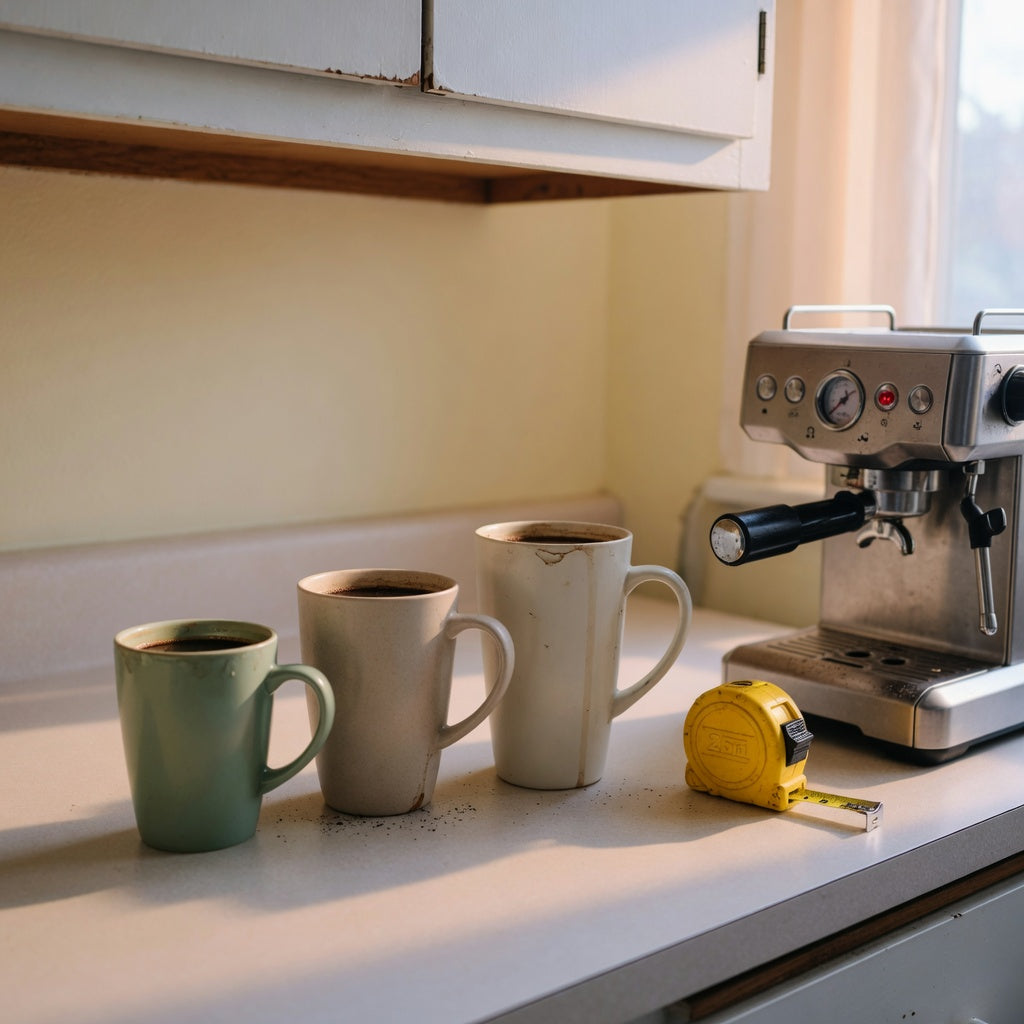
Espresso clearance is the complaint we hear most, and there is no standard for it. Cup height, rim diameter, and spout clearance are decided by the machine and the mug independently. Measure before you commit:
- Height from the drip tray to the lowest point of the spout or portafilter, machine cold.
- Rim diameter including the handle's outward reach; a wide handle can hit the machine body before the rim reaches the spout.
- Whether the mug has to sit on a scale, which adds roughly half an inch.
- Idle footprint: side-by-side width on the counter, or stack height if you nest them.
A small tray earns its place on a tight counter because it defines a boundary, so two mugs stop migrating toward the grinder, and it catches drips that would otherwise sit under the machine. If your counter is genuinely narrow, stackability beats a tray. If you have twelve usable inches, a tray looks better and keeps rings off the wood.
Tall silhouette or round silhouette, and who each one suits
Our lineup comes down to two shapes, and the split follows how you drink rather than how you decorate.
The Landscape Tall Coffee & Tea Mug is the taller of the two profiles. A taller, narrower cup generally sits further back from the machine and nests more easily in a shallow cabinet, which helps when counter depth is the constraint. Before ordering, confirm the exact height, stated capacity, and the microwave and dishwasher statements on the current listing, then hold those numbers against the clearance you measured. Those figures belong on the product page, and they are the ones that decide fit.
The Round Coffee & Tea Mug is the wider, rounder shape. That geometry is the friendlier one for milk drinks, for anyone pouring latte art, and for drinkers who wrap both hands around the body. It also takes more shelf width per mug. Check the listed rim diameter and capacity, and confirm whether the handle opening suits a full four-finger grip if you have larger hands.
One of each is a legitimate pairing for a two-person station, and both silhouettes live in our collection of unique coffee mugs if you want to compare glazes side by side. What we would not do is buy two wide round mugs for a household where one person drinks eight ounces of filter coffee, or two tall narrow cups for the person making flat whites every morning.
Chips, crazing, and coffee rings: what daily wear looks like
Ceramic does not fail dramatically. It fails at the rim first, then in the glaze.
- Rim chips come from stacking without a buffer and from knocking the mug against the drip tray. A chipped rim stops being a dependable food-contact surface, and the FDA lists damaged or worn ceramicware among higher-concern items, so retire it.
- Crazing is the fine web of cracks within the glaze, distinct from a crack through the body. It is common on older pieces and worth watching; once the glaze is compromised, the piece is no longer reliable for hot drinks.
- Staining shows fastest on matte and reactive glazes and in the ring just below the rim where coffee oils collect. A rinse right after use does more than any specialty cleaner.
- Fading is a dishwasher issue. High-temperature cycles and strong detergents attack decoration harder than they attack the clay body.
Handle attachment is the quiet failure point we check first whenever a pair comes back to us. A handle pinched thin where it meets the body feels fine empty and flexes when full. If you have ever held a mug that seemed to be deciding something, that was the joint talking. For a narrower look at glaze and clay choices on a shared desk, our notes on daily fit and capacity pick up where this leaves off.
The seven-line listing check before you add to cart
- Capacity in ounces or milliliters, and whether that figure is brim-full or working capacity.
- Height and rim diameter, held against the clearance you measured.
- An explicit microwave statement in the maker's own words, plus whether any metallic trim or bottom decal is present.
- An explicit dishwasher statement, written separately from the microwave claim.
- Any lead or cadmium test claim, and whether it names a standard rather than the adjective non-toxic.
- Empty weight per mug. Our rule of thumb: past about a pound, a full 12 oz pour starts to feel like a workout.
- Whether the pair ships as two identical mugs or one of each shape.
If a listing skips one of these lines, ask before you buy. A seller who handles the product answers in a sentence. One who cannot is telling you something too.
Frequently asked questions
Does a ceramic mug pair for home coffee station duty need to be both microwave and dishwasher safe?
Only if that specific listing says so, and treat the two claims as separate. USDA FSIS notes that microwave-safe ceramic is usually labeled for microwave use and that metallic paint or trim is not safe. Dishwasher durability is a separate statement about glaze and decoration, so read both lines rather than assuming one implies the other.
Does a lead-free label mean the mug is safe for hot coffee?
Not on its own. FDA guidance sets a lead leach limit above 0.5 micrograms per milliliter for cups and mugs, and notes that some traditional pottery labeled lead-free has been found at or above action levels. Look for a stated test rather than an adjective, and never use a piece marked not for food use.
What size should each mug in a two-person pair be?
Start from your real pour. Measure your usual cup once, add about two ounces of headroom, and buy to that number. Drip drinkers often land near a listed 12 oz; latte drinkers usually want more volume and a wider mouth; tea drinkers are often content at 8 to 10 oz.
Should both mugs in the pair match exactly?
Only if both people drink the same way. Identical mugs stack better and look calmer on an open shelf. If one person pulls espresso and the other pours filter coffee, a tall mug plus a round mug is the more practical buy, as long as the glaze keeps them reading as a set.
Can I keep using a mug after the rim chips or the glaze crazes?
We would not. The FDA lists damaged or worn ceramicware among higher-concern items, and a compromised glaze stops being a dependable barrier between your drink and the clay body. Move chipped and crazed mugs to plant pots or pen cups and replace them.
Start with the tape measure, not the photo. Note your spout clearance, your normal pour, and whether the machine sits on a scale. Then compare the tall profile and the round profile against those three numbers, and browse the full unique coffee mugs collection if you want the pair to match the rest of the counter.
More from our blog
Ready to pick your mug? Two ways to save on today's order:
Ordering 1–3 mugs? Get an extra 10% off your 1st order with code 10_OFF Apply 10% Off & Shop Wooden-Handle Mugs →
Gifting 4+ mugs? Buy 3, Get the 4th Free applies automatically at checkout (no code needed; offers do not stack) · Free standard shipping (Nov pre-Christmas delivery: 15–20 calendar days US) · Free replacement if chipped in transit.
Popular mug buying guides: Ceramic Tea Cups & Infuser Mugs · Ceramic Mugs with Lids Compared · Wooden-Handle Tea Infuser Mugs Compared · Christmas & Secret Santa Mugs 2026 · Espresso & Cortado Cups Guide · Cup & Saucer Gift Sets · All 25 Mugs Spec Table · Mug Size Guide · Shipping & Promo FAQ
FIRST ORDER 10% OFF (CODE: 10_OFF) · OR BUY 3, GET THE 4TH FREE


Read more
Latte Mugs Tall: Compact Kitchen Practical Purchase Checklist
A tall latte mug only earns counter space when the shelf gap, the group head, and the usable fill line agree. Here is the measurement sequence we walk shoppers through, plus how our 400 mL, 440 mL,...
Read more
Coffee Mug vs Tea Mug Size Checklist: 7 Checks Before You Buy
Two mugs stamped 12 oz can pour completely different drinks. This coffee mug vs tea mug size checklist separates labeling cups, brewer cups, and printed capacity so you can match a mug to your drin...
Read more
Leave a comment
This site is protected by hCaptcha and the hCaptcha Privacy Policy and Terms of Service apply.