
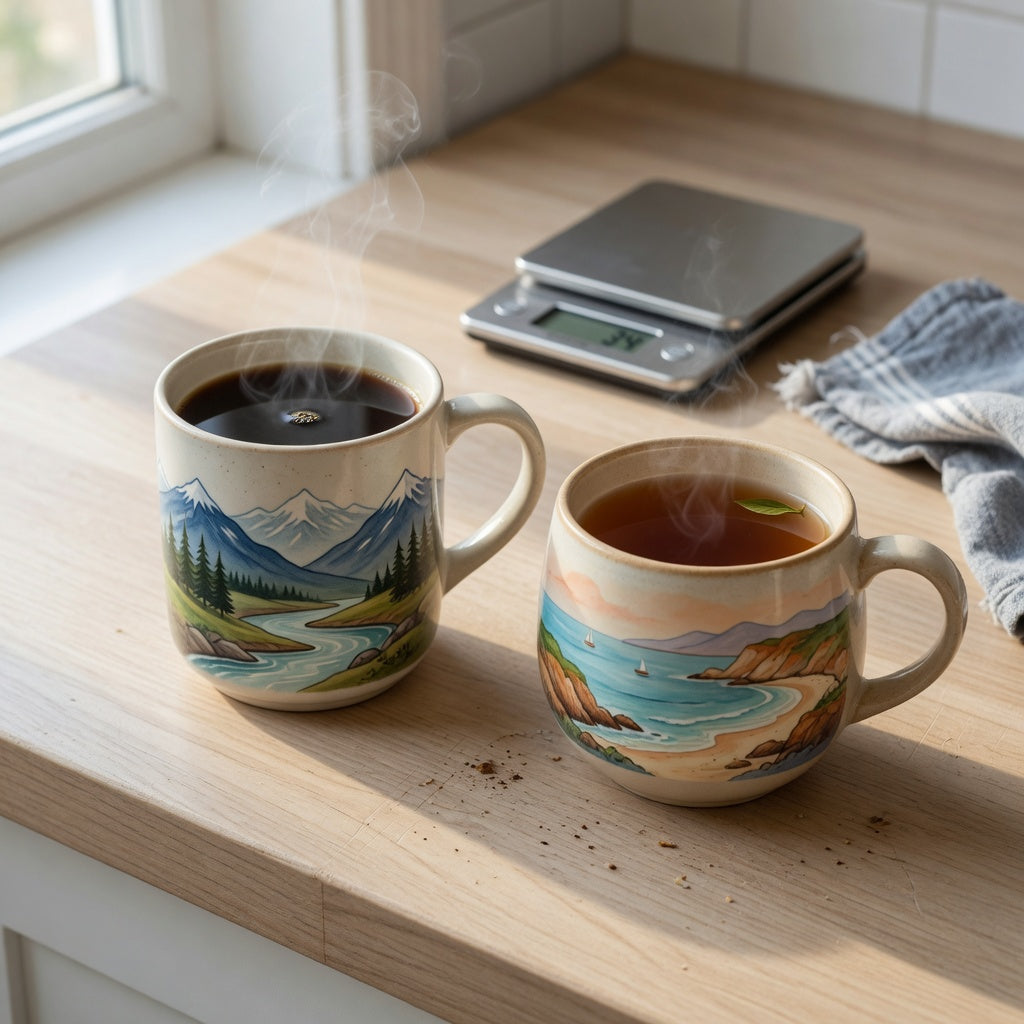
Landscape Ceramic Coffee Mug Comparison: 6 Specs Buyers Should Check
Reading time: about 11 minutes
A mountain-scene mug can look sharp on a shop shelf and washed-out by March. We see that gap in our store every time a buyer compares a hand-finished scenic piece with a printed souvenir mug and asks why one costs more. A useful landscape ceramic coffee mug comparison starts with the same six checks we run before we recommend a mug for daily coffee, tea, or gifting: decoration method, true capacity, empty weight, handle clearance, appliance claims, and food-contact evidence.
Two mugs can carry the same ridge line and behave nothing alike in a kitchen. One fades after a few hot cycles. Another is heavy, hand-glazed, and still looks right two years later but holds barely enough coffee for a small cup once you add cream. Both were sold as landscape mugs. The difference is in the details most listings leave out.
What should a landscape ceramic coffee mug comparison measure first?
Start with the six checks below. Get these right and the rest is taste.
- Decoration method. Is the scene underglaze, a kiln-fired decal, carved into the clay, or a print sitting on the glazed surface? This decides whether the artwork lasts two years or two months.
- Stated capacity in ounces or millilitres. Not the size of the mug in the photo. The usable volume below the rim.
- Empty weight. The spec buyers most often wish they had checked, and the one least often published.
- Handle clearance. How many fingers actually fit, and whether the handle is pulled by hand or moulded.
- Microwave and dishwasher status. Read the care line, not the title. They disagree more often than you would expect.
- Food-contact evidence. Whether the maker can point to lead and cadmium leach testing, or only uses the words lead free.
If a listing answers four of six, it is worth considering. If it answers two, you are buying a photograph.
It helps to read a real page while you work through this. Open our Landscape Coffee & Tea Mug listing next to the unique coffee mug collection and apply the six checks to each piece. Where a detail is missing, ask before you order rather than after.
Which landscape mug type are you actually buying?
Almost every scenic mug on the market falls into one of four buckets. Knowing which bucket you are in tells you what to expect from the finish.
| Type | How the scene is made | Where it wins | Where it disappoints |
|---|---|---|---|
| Hand-glazed studio stoneware | Scene painted, poured, or carved by hand, then kiln fired | Depth of glaze, one-of-a-kind piece, tactile surface | Size and weight vary between pieces; often hand wash only |
| Carved or slip-textured stoneware | Ridges and relief pressed into the clay body | Hides fine scratches; feels substantial in the hand | Texture catches coffee oils and needs a soft brush |
| Kiln-fired decal under glaze | Printed scene fired into the glaze layer | Repeatable across a set, durable print | Colours read flatter than hand painting |
| Surface print on ceramic | Image applied over the glaze, often as a fused film | Sharp detail, low cost, matching sets | This is the layer that fades, clouds, or peels |
The type is not a quality ranking. A well-made printed mug is honest about what it is. Problems start when a surface print is marketed with the care language of a kiln-fired piece.
Will the scene survive the dishwasher, or is it a hand-wash mug?
This is the number one return question in our experience, and it is almost always a decoration question rather than a ceramic question.
Ask the seller one direct question: is the landscape underglaze, a fired decal, or a surface print? Very few listings volunteer it. Then read the care copy end to end. If the product title says dishwasher safe and the description says hand wash to protect the artwork, treat the stricter instruction as the real one. Repeated hot cycles plus detergent are hard on any applied image, and once a print clouds there is no fix.
- Underglaze and fired decals: usually the most tolerant of washing, because the image sits beneath the glaze.
- Surface prints: the ones to hand wash, regardless of the badge on the page.
- Metallic accents, gold rims, lustre: hand wash, and keep them out of the microwave entirely.
- Carved texture: dishwasher safe or not, a soft brush once a week keeps coffee oils out of the grooves.
Does the stated capacity hold a real cup once you add cream?
Capacity is where scenic mugs most often oversell themselves. Photos shot at a low angle make a 12 oz mug look like a 16 oz one, and buyers consistently say the mug arrived smaller than expected.
For context, FDA food-contact guidance defines cups and mugs as small ceramic hollowware for hot drinks that normally, though not exclusively, hold about 240 mL (8 fl oz) and have a handle. In other words, mug is a regulatory category, not a size promise. A landscape mug could be 8 oz or 18 oz and still be a mug.
Three practical notes:
- Leave roughly half an inch of headspace, or the first sip goes on your shirt.
- Count the cream. Two ounces of milk in a 12 oz mug leaves you with 10 oz of coffee, which is a small cup.
- Ask for filled weight, not just capacity. A mug that weighs a lot empty and holds little is a display piece pretending to be a daily driver.
If you drink one slow 8 to 10 oz coffee, an 11 oz mug is right. If you make a 16 oz pour-over or drink tea by the pint, size up. Our landscape coffee and tea mug page is the place to confirm the stated capacity and filled weight for the exact piece you are considering.
When does stoneware weight help, and when does it tire your wrist?
Weight is a feature until it is not. Thick stoneware holds heat longer and sits still on the counter while you stir. It also tires a wrist during a long morning and feels clumsy if you drink standing at a kitchen island.
Before ordering, weigh a mug you already like on a kitchen scale and compare it to the number in the listing, if there is one. That single measurement predicts satisfaction better than any photo. Then check handle clearance: a two-finger handle is fine for espresso, annoying for a full 16 oz cup. Look closely at the handle join in the product images. A thick, blended join at the top and bottom resists the hairline cracks that appear when a mug is carried full and hot every day.
If you have wrist pain or you drink several cups in a row, a lighter porcelain or thin-walled ceramic body may suit you better than heavy stoneware. If you mainly want a mug that stays warm on a desk, the extra mass can be worth it.
Can you microwave a scenic mug with metallic trim or an unknown print?
USDA food safety guidance is blunt on this: only use cookware manufactured for microwave use, microwave-safe glass and ceramic are usually labelled as such, and china with metallic paint or trim is not safe in a microwave.
So the checklist item is simple. If the scene includes gold, silver, or lustre accents, do not microwave it. If the mug is unlabelled and you are unsure, USDA describes a check for unlabelled utensils: microwave the piece for one minute beside, but not touching, one cup of water. If the mug feels warm or hot afterwards, it is not microwave safe because there is metal in the material or glaze. Treat that as a one-time test on an older piece, not a routine.
A warm mug after the water test is your answer. Metal in the glaze, metal in the body, out of the microwave.
What does lead free prove on a landscape ceramic mug?
Less than buyers assume. FDA guidance sets the extractable-lead guideline for ceramic cups and mugs at 0.5 micrograms per millilitre of leaching solution in any one of six units, tested with methods that include ASTM C738. There is a matching cadmium guideline of 0.5 micrograms per millilitre for small hollowware, which covers ceramic articles deeper than 25 mm with a capacity under 1.1 litre.
FDA has also reported traditional pottery labelled lead free that still released extractable lead at levels comparable to lead-glazed pottery, sometimes above action levels. And no amount of washing, boiling, or home treatment removes lead from a badly made piece.
Where does that leave a shopper?
- Commercial factory pottery made for everyday use is described by FDA as much less likely to have lead problems than handmade, crude, or irregular ware.
- Extra caution is advised with antique or damaged pieces, flea-market finds from unknown makers, and ware brightly decorated in orange, red, or yellow.
- Ornamental ceramicware that looks food-safe is treated as food-use unless it is made unsuitable or permanently labelled with a Not for Food Use warning.
Ask any seller for leach-test information tied to the specific piece. A maker who can point to a method is more useful than one who repeats a slogan.
Where do landscape mugs fail first: rim, foot ring, or handle join?
In our experience these are the three wear points, in order of frequency.
- The rim. Chips come from stacking, not from drinking. If you stack mugs, put a cloth or a coaster between them, or store them handle-out in a single row.
- The foot ring. Unglazed feet grind against shelves and each other, dulling the base and scuffing counters. Felt pads solve it for a few cents.
- The handle join. Thermal shock is the quiet killer. Pouring boiling liquid into a cold stoneware mug stresses the seam where handle meets body. Warm the mug with tap water first on a cold morning.
Crazing, the fine web of cracks in a glaze, is mostly cosmetic on a well-fired piece, but it can trap residue. If a glaze crazes heavily and the surface feels rough, retire it from daily hot drinks.
Which landscape mug fits your morning: desk sipper, cafe pour, gift, or cabin set?
Match the piece to the drinker rather than to the prettiest photo.
- Slow single coffee, black, at a desk: 8 to 11 oz, moderate weight, textured glaze that feels good to hold. Prioritise handle comfort over volume. Start with our Landscape Coffee & Tea Mug and verify the care line before you commit.
- Cafe-style 14 to 16 oz with milk: a wider body and a four-finger handle. Confirm filled weight before buying; big plus heavy is a lot to lift.
- Gift or shelf display: hand-painted or one-of-a-kind pieces shine here, and a decorative warning label is not a dealbreaker if the mug is meant to be looked at. If the recipient will actually drink from it, check food-contact guidance first.
- Cabin, coastal, or travel souvenir: a matching set or a repeatable print beats a single handmade piece, especially if several people will use them. Browse the unique coffee mugs collection to compare mountain, forest, and coastal scenes side by side.
Our Landscape Coffee & Tea Mug is not the right choice if you need a matched set for a rental cabin, or if the current care line calls for hand washing and you will only run mugs through a dishwasher. In those cases, choose a repeatable printed set or a different piece. The listing is where to confirm material, capacity, weight, and care for the exact mug we are shipping.
Frequently asked questions
What is the most overlooked spec in a landscape ceramic coffee mug comparison?
Empty weight. Buyers check capacity and colour, then discover the mug is too heavy to lift comfortably when full. Weigh a mug you already like and compare that number to the listing before you buy.
Is a handmade landscape ceramic coffee mug more durable than a printed one?
They fail differently. Handmade stoneware usually has a thicker body that resists chipping, but the piece may be hand wash only and vary slightly from the photo. A printed mug is more consistent and often cheaper, yet the print layer is what wears out. Judge the body and the decoration separately.
Is 11 oz enough for coffee with cream?
It is enough for a small cup, not a large one. Two ounces of cream in an 11 oz mug leaves roughly 9 oz of coffee, and headspace takes a little more. If you drink a 16 oz brew, look for a 14 to 16 oz mug and check the filled weight.
How can I tell if a scenic mug is microwave safe?
Use the maker label first. USDA advises using only ceramic manufactured for microwave use and keeping anything with metallic paint or trim out entirely. If the mug is unlabelled, USDA describes microwaving it for one minute beside a cup of water: if the mug gets warm, it contains metal and is not microwave safe.
Does lead free mean the mug has been tested?
Not necessarily. FDA has found traditional pottery labelled lead free that still released extractable lead. Ask for leach-test information tied to the specific piece, and be extra careful with antique, damaged, or unknown-maker ware and with bright orange, red, or yellow decoration.
Next step: open the mug you are considering and run the six checks in order, starting with decoration method and empty weight. Those two answers eliminate most bad purchases before they reach your kitchen. If you want to compare scenic styles first, start with our landscape and nature mug collection and shortlist two pieces before you check the specs.
More from our blog
Read more
Big Latte Mug Size Decision Guide: 400, 440 or 480 ml?
400, 440 and 480 ml look nearly identical on a spec sheet and completely different on a counter. We compare our three current sizes by handle room, filled weight and desk footprint, and say plainly...
Read more
Cozy Coffee Corner Mugs: Capacity, Handle Fit, and Glaze Care
Cozy coffee corner mugs are slow-sip, stay-home cups, so usable capacity, handle opening, rim finish, and glaze care matter more than the photo. Here is how we compare them in our store, plus what ...
Read more
Leave a comment
This site is protected by hCaptcha and the hCaptcha Privacy Policy and Terms of Service apply.