
Big Latte Mug Size Decision Guide: 400, 440 or 480 ml?
Reading time: about 11 minutes
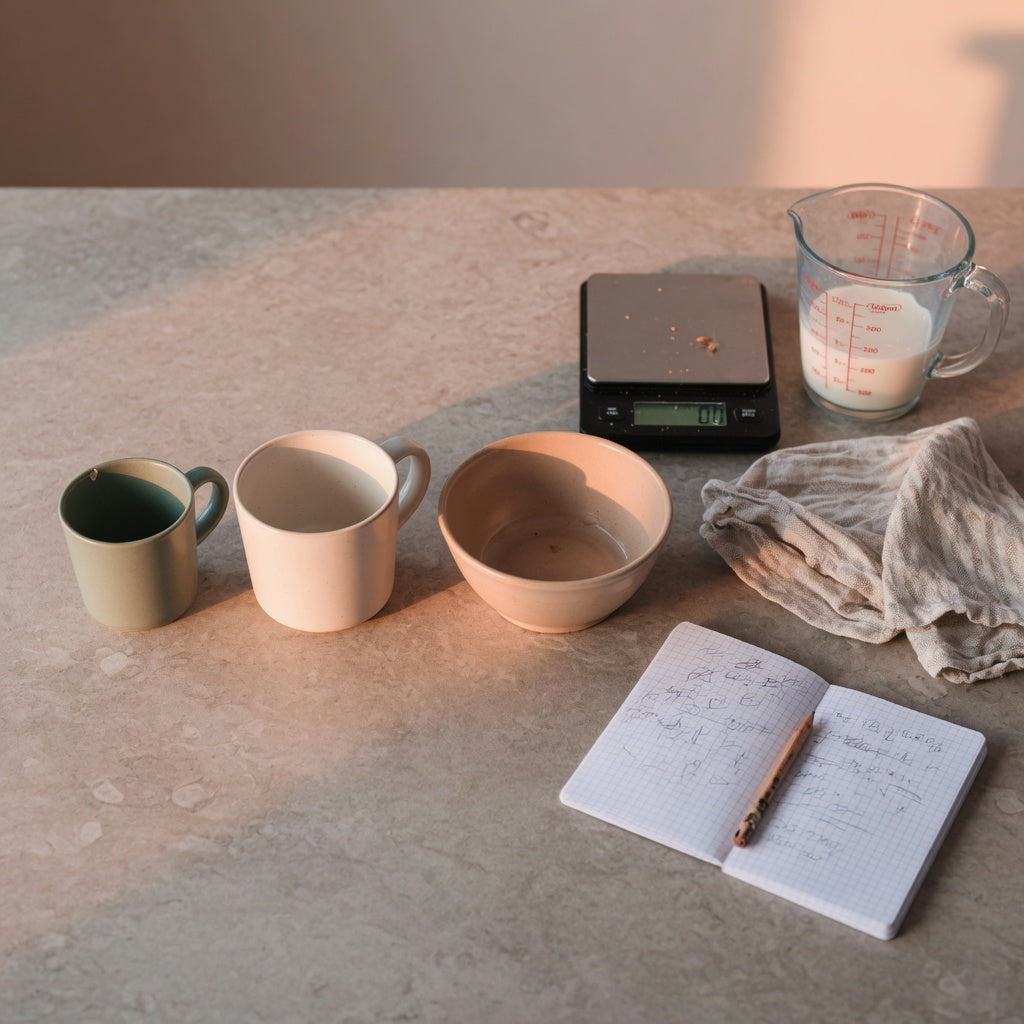
Set a 400 ml mug and a 480 ml mug side by side on the same counter and ask someone which holds more. In our experience most people point at the wrong one. The gap is 80 ml, under three fluid ounces, a single short pour of milk, and it disappears behind differences in base width, wall thickness and handle size. That mismatch between the number you can compare online and the object you actually use every morning is the whole problem with buying a big latte mug. This big latte mug size decision guide works through our three current capacities, 400 ml, 440 ml and 480 ml, and shows which one we would hand to which kind of drinker.
We sell all three, and we hear the same questions once the box is open. Almost nobody writes in about millilitres. They ask whether the handle takes a hand with a ring on it, whether the mug clears the shelf they had in mind, and whether a full one is comfortable to carry from the kitchen to the sofa. So capacity opens the conversation here. Fit checks close it.
Why the phrase big latte mug covers two different vessels
Specialty café latte cups are commonly listed by makers somewhere around 300 to 355 ml. That range is built for a double shot plus steamed milk and a thin foam cap, drunk fairly quickly while it is still hot.
Search to buy a big latte mug for home and you land on something noticeably larger, usually 400 ml and up. Both products carry the same name. Neither is wrong.
There is no single legal capacity for a latte mug. The FDA compliance guidance for ceramic hollowware describes cups and mugs as small hollowware commonly used for hot beverages, normally about 240 ml (8 fl oz) and made with a handle, and it sets small hollowware as anything under 1.1 litres. That is a testing definition used for lead-leaching assessment, not a rule about what a latte should be served in. Every size on this page sits comfortably inside the small-hollowware band.
Practically, a bigger mug is not a more authentic latte mug. It is a bigger mug, and you are choosing how much milk to steam and how much weight to hold one-handed.
What 400, 440 and 480 ml pour out to in ounces
The conversion is fixed. NIST lists one US fluid ounce as 29.57353 ml, and its packaging conversion uses 29.5735. Applied to the capacities we list:
| Mug | Listed capacity | Approximate US fluid ounces | What the gap means in practice |
|---|---|---|---|
| The Flow | 400 ml | about 13.5 fl oz | Smallest of the three, least liquid to carry |
| Morning and Night | 440 ml | about 14.9 fl oz | Roughly 1.4 fl oz more than The Flow |
| The Rock | 480 ml | about 16.2 fl oz | Roughly 2.7 fl oz more than The Flow, just past the 16 fl oz mark |
Two details in that table matter more than the rest.
First, The Rock at 480 ml lands around 16.2 fl oz, while 16 oz converts to 473.176 ml under the NIST Handbook 130 packaging figures. Shoppers searching for a big latte mug 16 oz and shoppers looking at a 480 ml listing think they want the same thing. They nearly do, but not exactly. If you are replacing a mug you already own, write its capacity down in millilitres before you shop and compare like with like.
Second, the full spread from 400 to 480 ml is 80 ml. That is a short pour of milk, not a different drink. Expecting a dramatic jump between the smallest and largest option here will leave you disappointed.
There is also a limitation almost nobody prints, ours included: few listings say whether the capacity is measured to the brim or to a comfortable fill. Assume brim, then subtract room for foam, a spoon, or milk you pour after the espresso. If a specific fill line matters to you, ask before ordering. It is a fair question and far cheaper than a return. All three sizes sit together in our unique coffee mugs collection if you want to compare silhouettes rather than numbers.
When the smaller current option is the smarter buy
The Flow at 400 ml is the smallest of our three current sizes, and it is the one we point desk workers toward. A smaller vessel leaves more room for the things that genuinely live beside a keyboard, and there is simply less liquid to shift when you reach for a notebook. If you have ever clipped a mug while lunging for a mouse, this is the size that lowers the odds.
Weight is the other half of it. A 400 ml drink weighs roughly 400 grams before you add the mug itself, so the mug's own heft matters proportionally more here than it does at 480 ml. Put your current mug on a kitchen scale, fill it, weigh it again, and you will know within a few grams what you are asking your wrist to do every morning.
Where 400 ml stops being the right answer: iced drinks, because ice occupies volume the listed capacity does not account for; soup or a full breakfast serving; and any habit where a 16 oz café drink is the baseline you are trying to reproduce at home.
What the extra 40 ml in the 440 ml mug actually changes
Morning and Night at 440 ml sits 40 ml above The Flow, about 1.4 fl oz. Most people cannot taste that difference. They can feel it in how the mug sits in the hand, because the volume has to go somewhere — wider base, taller body, or both.
In our experience the 400 versus 440 decision almost never turns on volume. It turns on which handle suits your grip and which silhouette suits your shelf. If you are stuck between those two, choose on handle comfort and where the mug will live. Do not agonise over the 40 ml, and do not pay extra for it if the handle is the thing you actually care about.
Where 440 ml is a poor fit: if you want one mug that handles both coffee and soup, or if you pour iced drinks regularly, the extra 40 ml over The Flow solves neither problem. You are paying for a middle ground, and middle grounds are only worth it when the shape is the reason.
When 480 ml is the honest answer, and when it is a mistake
The Rock at 480 ml is the size for iced lattes, cold brew over ice, and long drinks you nurse for an hour. It also doubles as a soup mug, which is a real reason people buy it and one we would rather say out loud than pretend does not happen.
Two trade-offs we will not hide. A 480 ml drink weighs roughly 480 to 500 grams before the mug is added, so one-handed carry gets noticeably harder than at 400 ml — not impossible, just a different grip. And a large mug claims more shelf height and counter depth, which makes it the size most likely to fail a cabinet or car cup holder measurement you never took.
We do not publish heat-retention figures for any of our mugs, so treat any assumption that a bigger mug stays hot longer as something to test in your own kitchen rather than a spec. A large mug filled only halfway is a different drinking experience from a full smaller one, with more exposed surface and more air above the liquid. Readers ask about it constantly. It is worth testing, not assuming.
The big latte mug size decision guide we give at the counter
- One hot latte at a desk with limited room: The Flow at 400 ml. Least liquid to carry and the smallest footprint of the three.
- You want a little more milk without jumping into oversized territory: Morning and Night at 440 ml, chosen on handle and silhouette rather than the 40 ml.
- Iced lattes, cold brew, or a mug that also does soup: The Rock at 480 ml, accepting the extra filled weight and counter space.
- A gift where you do not know their kitchen: a middle size is safer than the largest, because shelf height and cup holder diameter are the two things you cannot guess about someone else's home.
- Your latte is genuinely more milk than espresso: the 400 to 480 ml band is the right zone, and you should pick inside it on shape rather than chasing the biggest number.
If your baseline drink is a cappuccino rather than a latte, none of these three is the natural match — our cappuccino mug size decision guide covers the 170 to 270 ml range where a cappuccino actually belongs. Shopping in ounces instead? Our ceramic coffee mug with handle size decision guide runs the same method through 12, 14 and 15 oz.
Handle room, filled weight, and the three measurements that outrank capacity
Shoppers searching for a tall latte mug with large handle are usually trying to solve a problem they have already had once. These are the checks we suggest running before you commit, in order of how often they cause a return:
- Espresso machine clearance. Measure from the drip tray up to the group head with your scale already sitting on the tray. The scale eats height, and that is the measurement people forget.
- Shelf and cabinet height. Measure the shelf, not the mug. A 480 ml mug that fits your hand may not fit the shelf you planned to store it on, and mugs stored on their sides are mugs that chip.
- Car cup holder diameter. A wide base will not drop into a narrow holder, and no amount of careful pouring fixes that.
- Handle opening. Check that the opening clears your fingers with a ring on. Handle openings are rarely listed, so ask if yours is close.
- Filled weight. Weigh a mug you already own, fill it, weigh again. That number tells you more about daily comfort than any capacity printed on a box.
None of those five is a specification we publish per mug, which is exactly why we would rather you measure your own space than trust a photo. A render makes every mug look like it fits.
Dishwasher, microwave and lead-free labels on a large mug
FDA guidance notes that some ceramic foodware can leach lead from food-contact surfaces, and that continued food use can cause the effects of chronic lead poisoning. For ceramic cups and mugs, the FDA lead action level is 0.5 micrograms per millilitre of leaching solution, applied to any one of six units tested.
Read that carefully. Lead-free on a listing is a marketing statement. The measurable standard is a leach test against a specific threshold on specific units. If food-contact safety is genuinely your deciding factor, ask what a claim is based on rather than accepting the phrase at face value — from us or from anyone else.
On dishwasher and microwave labels, treat them as claims about the piece surviving the cycle, not promises about how the mug behaves. A microwave-safe mug still gets hot in the microwave, handle included. Check the current product listing for the care statement on any mug you are considering, and two habits that extend the life of any glazed mug:
- Avoid thermal shock. Do not move a mug straight from a cold fridge or freezer into a microwave or a hot dishwasher cycle.
- Hand wash anything with a metallic or decal finish, even when the listing says dishwasher safe. Decorative surfaces dull first, and dulling is not covered by a care label.
Frequently asked questions
How many ounces is a 480 ml mug?
480 ml converts to about 16.2 US fluid ounces using the NIST factor of 29.57353 ml per fluid ounce. That is why a mug listed as 16 oz (473.176 ml) and one listed at 480 ml are close but not identical, even though shoppers treat them as interchangeable.
If I only buy one big latte mug, which of the three sizes should it be?
The short version of this big latte mug size decision guide: 440 ml is the safest single choice if you drink hot lattes and do not know your shelf measurements, while 480 ml is the better single choice if iced drinks or soup are regular. Buy 400 ml only when desk space or carrying weight is the real constraint.
Will a 480 ml mug fit under my espresso machine?
That depends on your machine, not the mug. Measure from the drip tray to the group head with your scale in place, then compare against the mug height on the product page. If the numbers are close, pull the shot into a smaller cup and transfer rather than buying on hope.
Is a 480 ml mug too big for a hot latte?
Not too big, just different. It holds roughly 80 ml more than the 400 ml option, so a full mug means a larger, milkier drink. Filled halfway, you get more exposed surface and more air above the liquid than a full smaller mug. Buy it for iced drinks, long coffees or soup rather than for a standard hot latte.
Are these mugs dishwasher and microwave safe?
Check the current product listing for the care statement rather than relying on a general claim, because we do not want you assuming. Whatever the label says, avoid moving a mug from cold storage straight into heat, and hand wash anything with a metallic or decal finish.
Before you decide, do three things: measure the shelf the mug will live on, measure the clearance under your machine if you have one, and weigh a mug you already own while it is full. Those three numbers will settle 400 versus 440 versus 480 faster than any chart. When you are ready, the current mug lineup lists every capacity we stock in one place, so you can compare shapes side by side instead of guessing from a single hero photo.
More from our blog
Read more
Unique Espresso Cups Current Product Facts: 170, 200 & 250 ml
The unique espresso cups current product facts we can actually confirm — 170 ml, 200 ml and 250 ml ceramic bodies — sorted by which drink each one really holds, plus the specs the listings leave bl...
Read more
Landscape Ceramic Coffee Mug Comparison: 6 Specs Buyers Should Check
A store-level landscape ceramic coffee mug comparison: decoration method, true capacity, empty weight, microwave safety, lead limits, and the wear points that decide whether a scenic mug survives d...
Read more
Leave a comment
This site is protected by hCaptcha and the hCaptcha Privacy Policy and Terms of Service apply.