
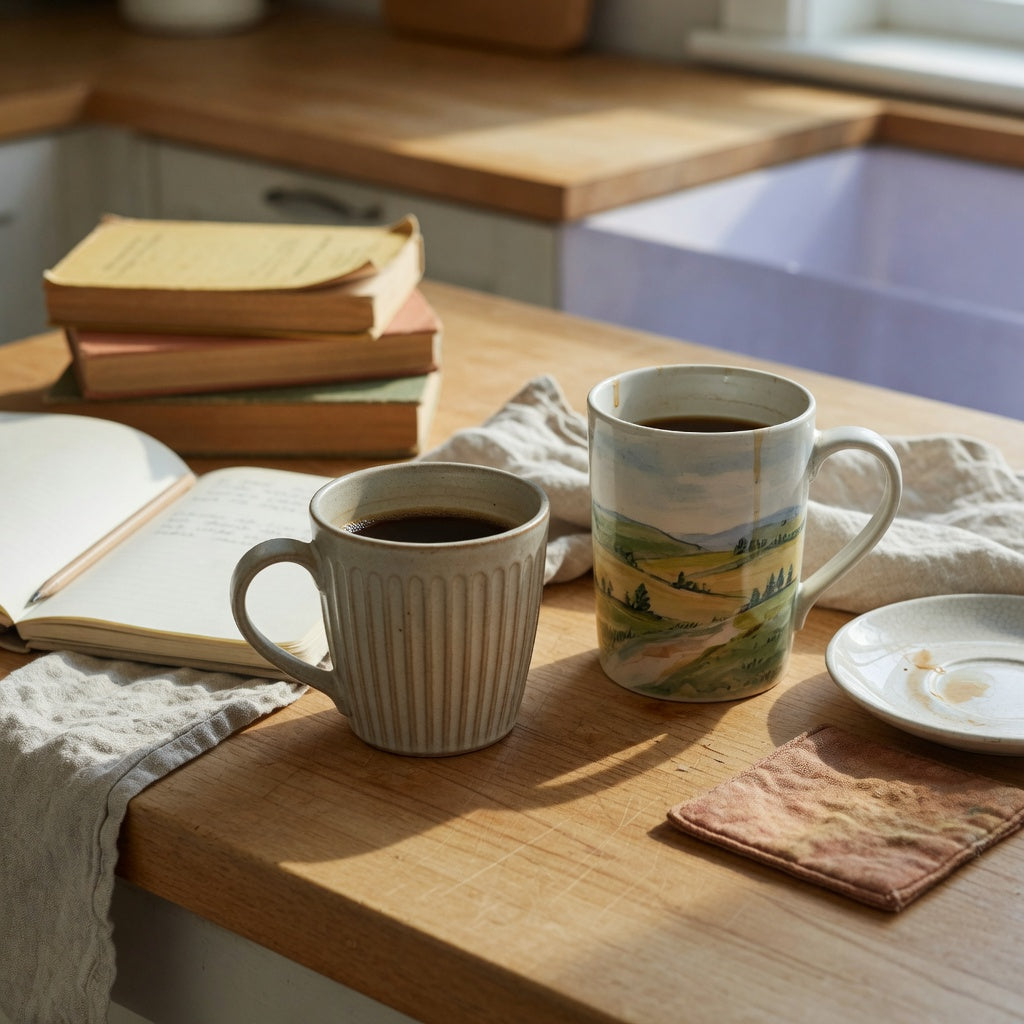
Cozy Coffee Corner Mugs: Capacity, Handle Fit, and Glaze Care
Reading time: about 10 minutes
Cozy coffee corner mugs are the ones that stay home — the cup you set beside a book, wrap both hands around, and refill before the last inch goes cold. But the mug that looks best on the shelf is rarely the one you reach for on a Tuesday morning. In our store, we see the same pattern in returns and repeat orders: people fall for a glaze, then live with a handle.
That is why we compare cozy coffee corner mugs by the details you notice after the first week: usable capacity, handle opening, rim finish, shelf footprint, and what the glaze can safely handle. A handmade or imported piece adds one more question — food-contact safety — that most roundups skip.
Here is the checklist we walk customers through when they are choosing a cup for a reading nook, a farmhouse kitchen shelf, or a gift box.
Which cozy coffee corner mugs earn a permanent spot in a reading nook?
A cozy coffee corner mug is a stay-home mug. It is not built for a cup holder, a backpack, or a four-hour commute. It is the cup you set on a saucer next to a book, cup with both hands, and refill before the last inch goes cold.
That one distinction filters out most bad purchases:
- Shape over sealing. Wide, short, or gently flared vessels that invite a two-hand grip. No lid, no gasket, no spout.
- Hand feel over spec sheets. Weight matters once the mug is full, not when it is empty on a shelf.
- Decor that survives daily use. Speckled, neutral, rustic, or illustrated glazes that still look good after repeated washes.
- Gift readiness. Sets and saucers matter if the mug is leaving your kitchen as a present.
If you need a drink to stay hot through a long meeting or a school run, a ceramic corner mug is the wrong tool. Choose an insulated tumbler and keep the ceramic for slow mornings. That trade-off is worth saying plainly: ceramic looks better on a shelf, but it loses heat faster than a sealed, double-wall cup.
Capacity: why cozy coffee corner mugs with thick walls pour smaller than the label
Listed capacity and usable capacity are not the same number. Thick stoneware walls, a heavy foot, and a wide flared rim all eat interior volume. A mug that measures big on the outside can leave you with less coffee than you expect.
Two questions worth asking before you buy:
- Is the listed capacity a brim-full volume or a comfortable working fill? Many listings never say.
- How thick are the walls? Chunky pottery looks generous and pours smaller.
For reference, a standard drip coffee is usually somewhere in the range of a small cup, while a latte or a mug of tea with milk pushes you toward the larger end. If you drink two cups in a sitting, buy accordingly rather than refilling twice.
When a customer wants a cup rather than a tall mug, we point them to the pleated coffee and tea cup — then ask them to check the current listing for the stated capacity and whether it is measured to the brim or to a working fill. We do not assume the photo tells the whole story.
Across the unique coffee mugs collection, capacity varies more than the product photos suggest, so read the numbers rather than trusting the visual scale.
Handle opening, rim finish, and full-mug weight: the first-week test
Most mugs that get quietly retired were not returned for their design. They were returned, or shoved to the back of the cabinet, because of three physical details.
- Handle opening. Can you slide two fingers through comfortably, or four? A pinch grip is fine on a small espresso cup and miserable on a full 14 oz mug.
- Rim. A thin, cleanly finished rim tends to release liquid neatly; a thick rolled rim feels softer on the lip but can pool and dribble if the curve is off. This is a try-it detail, not a spec you can read.
- Weight when full. Add the drink to the empty weight in your head. A heavy mug plus a full pour is a two-hand lift for a lot of people, which is fine in a reading chair and annoying at a desk.
Our rule of thumb: if you cannot comfortably hold the handle with three fingers while the mug is full, it is a display piece, not a daily driver. That sounds strict until you have carried a full mug across a kitchen with one hand.
Stoneware, porcelain, or glass in a small corner
Material changes how a mug feels far more than how long it stays warm. We do not claim one material always holds heat longer, because wall thickness, preheating, and room temperature matter just as much.
- Stoneware. Denser and heavier, with the chunky hand feel most cozy setups are after. Speckled and reactive glazes hide wear well.
- Porcelain. Thinner walls and lighter in the hand. More refined, but edges chip more easily if it lives near a sink or a stack.
- Glass. Shows the drink, which is lovely for tea. Heat transfers to your fingers faster than with thick ceramic.
If you want a genuinely warmer sip, preheat the mug with hot tap water for about thirty seconds and tip it out before you pour. That habit does more for a small cup than swapping materials. Our team also tells customers to compare the empty weight in one hand before they fall for a glaze, because a heavy mug gets old by the second refill.
Tall mugs, shallow shelves, and the footprint problem
Tall mugs photograph beautifully and cause the most shelf problems. Before buying a tall profile, measure the gap between your shelf and the shelf above it — then subtract room to lift the mug out without knocking it into the upper board.
The landscape tall coffee and tea mug is the style people ask about for narrow, upright corners. We tell them to verify the listed height and capacity on the current listing, then hold a tape measure against their shelf before ordering.
Short and wide shapes are the opposite trade-off. They are more stable, easier to cup with both hands, and less likely to tip. They also take up more floor or shelf footprint and often hold less than a tall mug of similar height. If your shelf is shallow, a short wide mug can overhang; if your corner is narrow, a tall mug may not clear the shelf above.
Microwave, dishwasher, and metallic trim: what the label must say
Two care claims decide whether a mug survives year one: whether it is microwave safe and whether it is dishwasher safe. Check the listing for that exact mug rather than assuming, because finishes differ within the same shape family.
Watch for these cases:
- Gold, luster, or metallic trim. These finishes commonly rule out microwave use and can dull in a hot dishwasher cycle. Confirm on the label before you heat.
- Surface prints and transfers. Print-on-demand and illustrated mugs vary widely in dishwasher durability. A hand wash keeps artwork crisper longer.
- Crazing. That fine web of lines in the glaze is a warning sign, not a texture. If liquid seeps or beads from the handle after microwaving, stop drinking from it.
- Chips on the contact rim. Retire the mug. A chipped rim is a hygiene problem and a cut waiting to happen.
Hot dishwasher cycles and strong detergents are hard on glazes in general. For a favorite corner mug, hand washing is the cheapest way to extend its life.
Glaze safety for handmade and vintage mugs: what the FDA and CDPH say
This is the part most cozy mug roundups skip, and it matters for handmade, vintage, and brightly glazed pieces.
The FDA sets an action level of 0.5 micrograms per milliliter for lead leaching from ceramic cups and mugs under its compliance guide for pottery. The same agency has found traditional pottery labeled lead free that still released extractable lead at or above that level, and it notes that washing, boiling, and other home treatments do not remove lead from pottery.
The FDA advises extra caution with handmade pottery that looks crude or irregular, antique or badly worn pieces, items from flea markets or unknown makers, and ware brightly decorated in orange, red, or yellow. Anything marked Not for Food Use — May Poison Food should not hold drinks at all.
California's Department of Public Health adds a detail specific to this category: coffee and tea are acidic, so they leach lead from lead-bearing dishes faster than non-acidic drinks, and heat or microwaving speeds that up. It also warns that a dishwasher can damage a leaded glaze, making later leaching more likely, and can contaminate other dishes in the same load.
What to do in practice:
- For handmade or imported pottery, ask the maker directly about the food-contact glaze and whether the piece has been tested.
- Skip unknown glazes for daily coffee and tea, the two most aggressive drinks you could put in them.
- Retire any piece with a worn, chalky, or cracking glaze instead of trying to clean it back to health.
None of this is a reason to avoid ceramic mugs. It is a reason to buy from sellers who can tell you what is on the surface you drink from.
How do you style a coffee corner without buying nine mugs?
Once the practical checks are done, the decorating part is easy. A corner reads as intentional when it has fewer, more deliberate pieces.
- Pick a two-mug set rather than six singles. One for coffee, one for tea, both in a glaze that matches your counter.
- Choose one accent. Speckled neutral with one illustrated or bookish mug is calmer than four competing patterns.
- Add a saucer or coaster to protect wood and to give the cup a defined landing spot.
- Keep the footprint honest. If the shelf is shallow, short wide mugs will overhang. Measure before styling.
If you want to compare glazes before you commit, start with the unique coffee mugs collection and shortlist two shapes rather than nine.
Frequently asked questions
Are cozy coffee corner mugs usually too small for a daily coffee?
Not always, but the label can mislead. A short, thick-walled mug often pours less than its exterior size suggests, so check the stated capacity and whether it is measured to the brim or to a working fill. If you drink large lattes or a full mug of tea with milk, look at the taller options in our unique coffee mugs collection before settling on a small shape.
Can I put a handmade ceramic mug in the microwave?
Only if the maker or the listing says it is microwave safe. Handmade glazes and finishes vary, and metallic or luster details are a common reason a mug cannot be microwaved. If liquid beads or seeps from the handle after heating, stop using it for drinks.
Will a cozy ceramic mug keep coffee hot longer than a travel mug?
No. Ceramic loses heat faster than a sealed, insulated tumbler. Thick walls feel warm in your hands and slow the drop slightly, but preheating the mug with hot water does more than anything else. Use ceramic for slow mornings at home, not for a commute.
How do I know if a thrifted or vintage mug is safe to drink from?
Treat unknown-origin and antique pottery as suspect, especially pieces that are badly worn or brightly decorated in orange, red, or yellow. Home washing or boiling will not remove lead from a glaze that contains it. If a lead swab shows leaching, do not use it for drinks.
Where should I start if I only want one mug?
Measure your shelf clearance and your usual pour first, then pick the shape that fits both. Start with the pleated coffee and tea cup if you want the cup silhouette, or the landscape tall coffee and tea mug if your corner is narrow and upright. Confirm capacity, microwave, and dishwasher details on the listing you choose, and you will skip the shelf of regret.
More from our blog
Read more
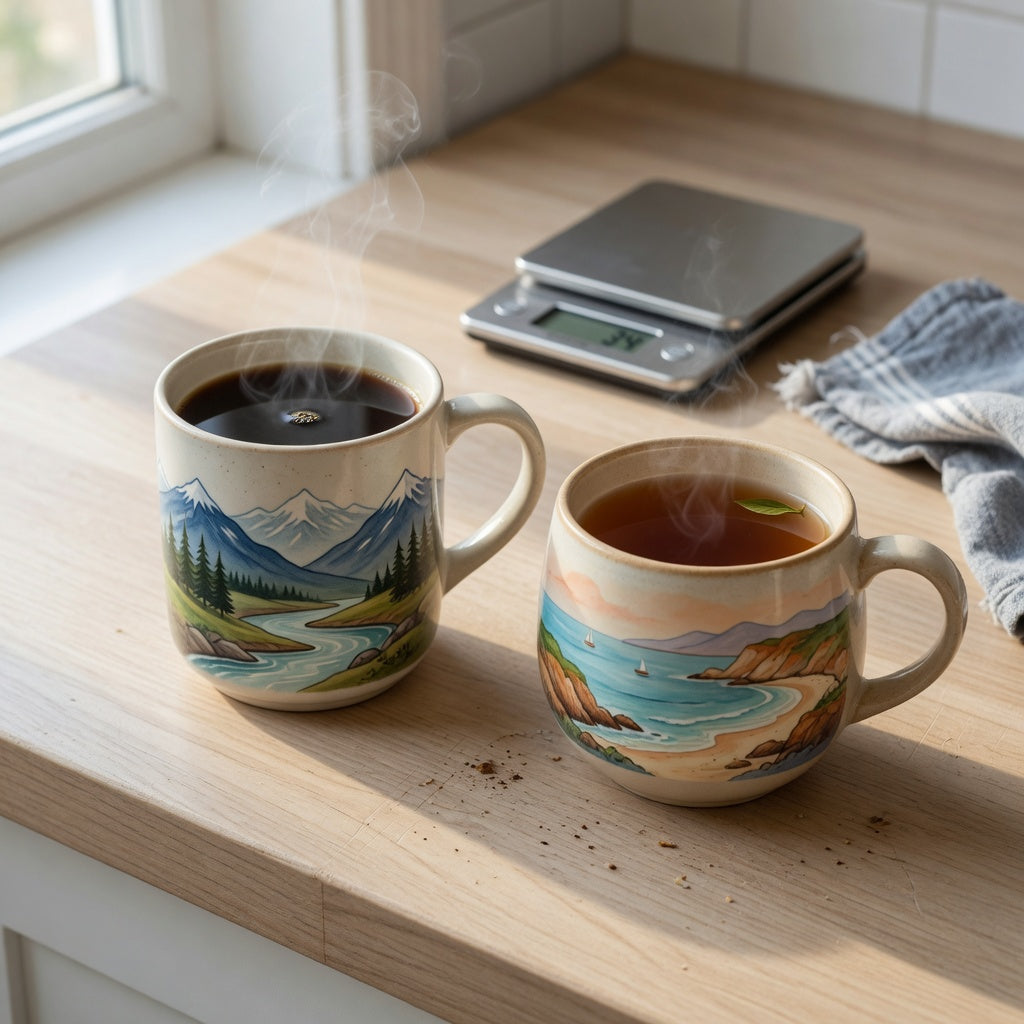
Landscape Ceramic Coffee Mug Comparison: 6 Specs Buyers Should Check
A store-level landscape ceramic coffee mug comparison: decoration method, true capacity, empty weight, microwave safety, lead limits, and the wear points that decide whether a scenic mug survives d...
Read more
Best Tall Mugs for Home Office Desk Shelf Coffee: Compare First
A tall mug only earns its shelf space if it clears the gap, stays stable next to a keyboard, and still pours a useful cup after headspace. Here are the measurements, materials, and care trade-offs ...
Read more
Leave a comment
This site is protected by hCaptcha and the hCaptcha Privacy Policy and Terms of Service apply.