
Hot Toddy Mug First Time Buyer Product Shortlist Guide: 3 Picks
Reading time: about 8 minutes
A mug can look convincing on a product page and feel wrong as soon as you fill it. The drink may sit closer to the rim than expected, a knuckle may press against the cup, or the full mug may be more than you want to lift repeatedly from an office desk. Our hot toddy mug first time buyer product shortlist guide starts with those ordinary moments. In our store, we narrow a first purchase using three details we can actually verify: listed capacity, visible handle shape, and current care information for everyday ceramic drinkware. We also leave missing specifications marked as unknown instead of filling the gaps with assumptions.
The hot toddy mug first time buyer product shortlist guide: 400 ml or 480 ml?
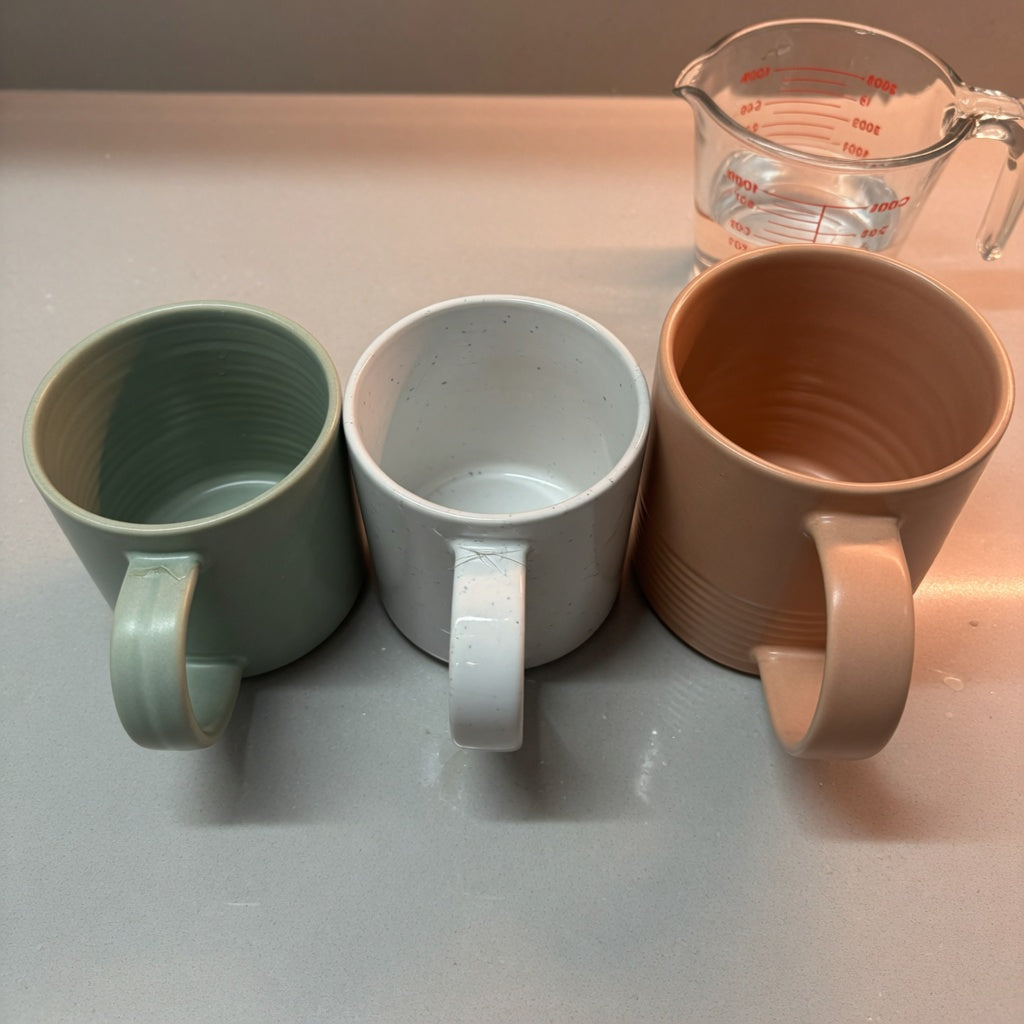
The verified capacity choices are straightforward. The Gradient holds 400 ml, The Flow holds 400 ml, and The Rock holds 480 ml. That gives The Rock 80 ml more listed capacity than either 400 ml option. It does not automatically tell us the mug's exterior height, base diameter, empty weight, or comfortable fill level, so capacity should answer only one question: how much room do you need for your usual finished drink?
Measure that drink before comparing designs. Pour the amount you normally prepare into a measuring jug, then account for the headroom you prefer for carrying and stirring. A listed capacity can describe the mug's upper limit rather than the level you would comfortably carry across a kitchen.
- Start with 400 ml if your measured pour leaves enough room below that figure and you prefer a more moderate amount of liquid to lift.
- Move to 480 ml if your usual pour crowds a 400 ml vessel or you want an additional 80 ml of nominal capacity.
- Pause the purchase if cabinet clearance or appliance fit is critical. Milliliters do not reveal exterior dimensions.
Do not size up merely because 480 ml sounds more generous. A larger pour adds liquid weight, while unused capacity can leave you with a mug that feels larger than the job requires.
What should the handle photo prove before you buy?
Handle comfort is personal, but the product photographs should still give you useful evidence. We check how the handle relates to the mug body rather than judging it as a decorative detail. This matters at a kitchen counter, and it becomes more noticeable during a long desk session when the mug is picked up and set down repeatedly.
- Look at the inner handle opening and estimate whether it suits your usual one-, two-, or three-finger grip.
- Check the gap between the handle and mug body. Limited clearance can place a knuckle against warm ceramic.
- Inspect the upper and lower attachment points. They affect where your fingers naturally settle, even when two handles have similar openings.
- Find a side view if available. A front-facing photograph alone can distort the apparent depth and clearance.
Exact handle-clearance measurements are not part of the verified catalog facts supplied for these three mugs. That means a photograph remains an impression, not a measurement. Between The Gradient and The Flow, capacity is tied at 400 ml, so the current handle images and visual design are the practical tiebreakers unless their listings provide another confirmed specification. If neither profile suits your grip, compare additional shapes in our unique coffee mugs collection rather than forcing a choice between two similar capacities.
Which three mugs make the shortest useful shortlist?
This comparison keeps the decision tied to known capacities and observable listing details. Each option has a reason to choose it and a clear reason to leave it out.
| Option | Listed capacity | Best starting scenario | Reason to skip |
|---|---|---|---|
| The Gradient | 400 ml | Your measured pour fits 400 ml and its current handle photos suit your grip | You need more capacity or exact handle measurements |
| The Flow | 400 ml | You want 400 ml and prefer its visible handle and overall design | You expect a capacity increase over The Gradient |
| The Rock | 480 ml | Your usual pour needs more room or you want fewer top-ups | You prefer a smaller liquid load or need confirmed exterior dimensions |
Your measured pour fits 400 ml: The Gradient
Choose The Gradient 400 ml coffee and tea mug when your normal drink leaves adequate headroom and the handle shown on the current product page looks compatible with your grip. It is a practical first option for a kitchen-counter or sofa routine where extra capacity is not solving a real problem. Skip it if 400 ml already feels restrictive or if the photographs do not give you enough confidence about finger clearance.
You want another 400 ml design: The Flow
Choose The Flow 400 ml coffee and tea mug when the capacity is already settled and its current visual profile is the one you would rather use at home or at a desk. The Flow is not a size upgrade from The Gradient; both are listed at 400 ml. Skip it if your shortlist exists because you need more volume, or if its handle shape remains unclear in the available images.
An extra 80 ml matters: The Rock
Choose The Rock 480 ml coffee and tea mug when a measured pour shows that 400 ml would leave too little headroom. Its reason for making the shortlist is capacity: 480 ml gives you 80 ml more than the other two options. Skip it if you deliberately want less liquid weight in hand, need a compact mug, or require exterior dimensions that the listing does not confirm.
Which ceramic listing gaps should remain marked as unknown?
The word ceramic does not, by itself, confirm dishwasher suitability, microwave suitability, wall thickness, empty weight, exterior dimensions, or heat-retention performance. Check the current product page for care instructions before ordering. We do not claim that these mugs include drink ingredients, provide specialized temperature control, or have undergone professional performance testing.
Care details matter because an everyday mug moves through sinks, cabinets, dishwashers, and gift boxes. If a listing does not explicitly permit dishwasher or microwave use, do not infer that permission from the material alone. Hand washing is the conservative approach until the correct care guidance is confirmed, and abrupt hot-to-cold temperature changes are best avoided with ordinary ceramic drinkware.
During an unboxing, we inspect three vulnerable areas before first use:
- The rim, where a small chip can be easy to miss under packaging.
- Both handle attachment points, where a hairline crack deserves close attention.
- The base on a flat counter, where unexpected rocking may indicate an uneven contact surface.
Do this inspection before discarding gift packaging. A mug with a cracked handle or damaged drinking rim should not be put into regular use.
Who should skip these everyday ceramic mugs?
These options are intended to be considered as everyday ceramic drinkware. They are not the right shortlist for every routine.
- Skip all three if you need a locking lid, bag-ready travel design, or confirmed vehicle cup-holder fit.
- Choose a different category if verified insulation or a specific heat-retention time is central to the purchase.
- Look for a smaller cup if your measured serving is well below 400 ml and you dislike unused space.
- Wait for exact measurements if cabinet height, base diameter, empty weight, or handle clearance determines accessibility or fit.
A travel tumbler, insulated vessel, or smaller ceramic cup may suit those situations better. A hot toddy label should not outweigh the practical requirements of the person using the mug.
What should you verify in the final five minutes?
Use this short check before moving a mug from shortlist to cart:
- Measure your usual finished pour and include the headroom you want for stirring and carrying.
- Choose between the verified 400 ml and 480 ml capacities.
- Study a side view of the handle and check likely finger and knuckle clearance.
- Confirm current ceramic care instructions instead of assuming dishwasher or microwave suitability.
- Rule out any need for a lid, insulation claim, exact exterior dimensions, or specialized grip.
If one answer is missing and it affects daily use, keep it marked as unknown. That is a valid reason to delay or skip a purchase.
Frequently asked questions
What does a hot toddy mug first time buyer product shortlist guide need to verify?
It should verify listed capacity, the handle shape visible in current product photographs, and the care information stated on the listing. It should also identify missing details, such as exact dimensions or handle clearance, instead of presenting estimates as product facts.
Should I choose a 400 ml or 480 ml hot toddy mug?
Measure the finished amount you normally pour and leave room for stirring and carrying. The Gradient and The Flow are both listed at 400 ml, while The Rock is listed at 480 ml. Choose the extra 80 ml only if it answers a real capacity need.
Which 400 ml mug is better, The Gradient or The Flow?
Neither has a verified capacity advantage because both hold 400 ml. Compare their current handle photographs and visual designs, then choose the one that better matches your grip and kitchen or desk setting. If the handle information is insufficient, do not guess.
Can I assume these ceramic mugs are dishwasher-safe?
No. Ceramic identifies the material category, not the approved care method for every finish or product. Read the current care note on the relevant product page and treat dishwasher suitability as unknown if it is not explicitly stated.
Does The Rock keep a drink hot longer because it holds 480 ml?
Capacity does not establish heat-retention performance. The Rock belongs on this shortlist because it holds 480 ml, not because of an insulation claim. Choose a product with documented thermal specifications if temperature retention is your main requirement.
Start with the mug whose listed capacity matches your measured pour, then inspect its handle photos and care details one last time. If none of the three clears that check, return to the broader ceramic mug collection and apply the same capacity, handle, and care filter to the next option.
More from our blog
Read more

Green Tea Mug Weekend Coffee Practical Purchase Checklist: 3 Sizes
A slower Saturday makes capacity and silhouette more noticeable. This green tea mug weekend coffee practical purchase checklist compares CoffeifyMug's listed 170 ml, 200 ml, and 270 ml options, the...
Read more
Cafe Au Lait Mug Weekend Coffee Practical Purchase Checklist
Compare The Flow, Morning and Night, and The Rock using their verified 400, 440, and 480 ml capacities. This checklist covers pour size, handle comfort, table fit, care questions, and the trade-off...
Read more
Leave a comment
This site is protected by hCaptcha and the hCaptcha Privacy Policy and Terms of Service apply.