
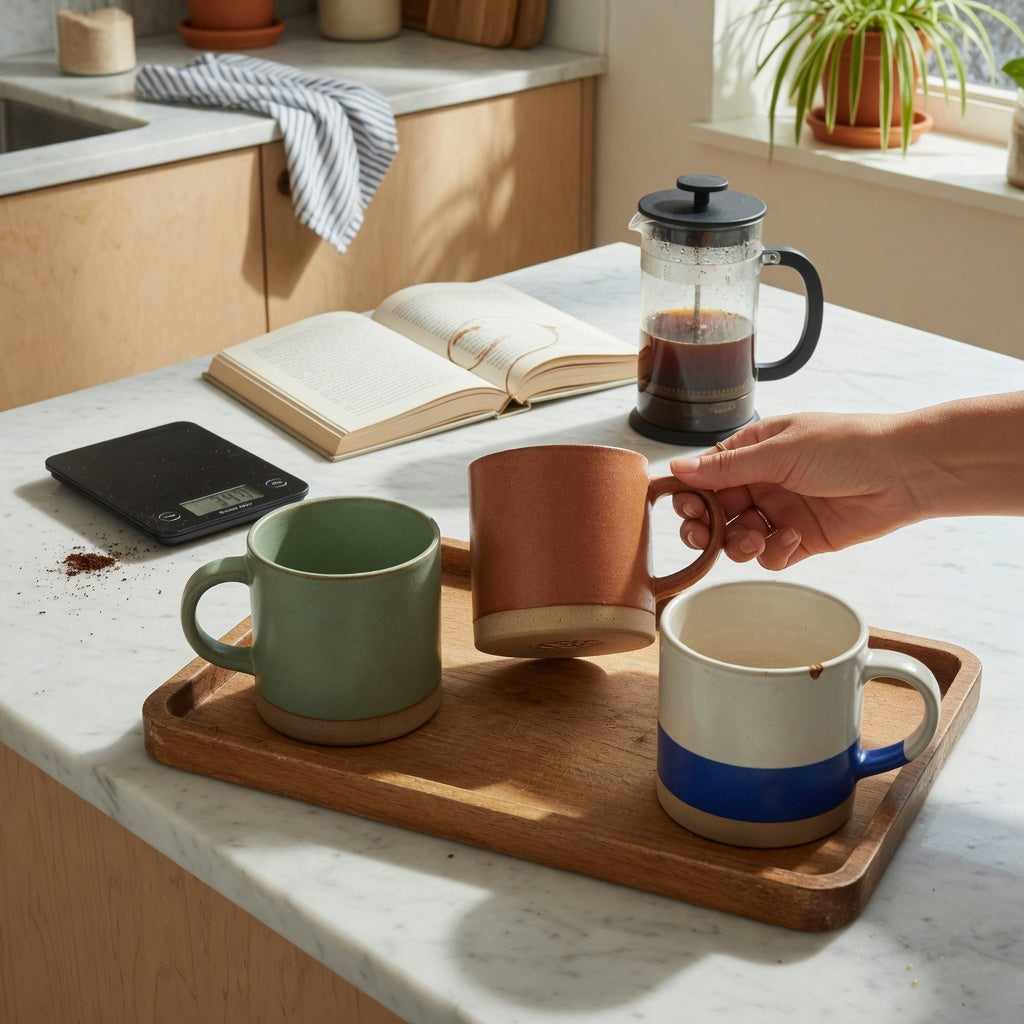
Heavy Ceramic Coffee Mugs Weekend Coffee Practical Purchase Checklist
Reading time: about 9 minutes
The second Saturday pour often leaves the kitchen: it lands on a low side table, moves to a home-office desk, or follows you to a porch chair. Our heavy ceramic coffee mugs weekend coffee practical purchase checklist is built for that slower route, where the mug stays in your hand longer and may be lifted one-handed from a less-than-perfect surface.
In our store, we handle and pack ceramic mugs often enough to see where buying decisions go wrong. Shoppers focus on the word heavy, then overlook filled weight, handle leverage, cabinet clearance, or a rough foot ring. A substantial mug can feel satisfying, but the heaviest option is not automatically the best weekend mug, and weight alone does not support a heat-retention claim.
Why does a slow Saturday change the weight test?
A quick weekday cup may travel only from the coffee maker to the kitchen counter. Weekend coffee tends to involve longer holds, refills, books, breakfast plates, and moves between rooms. The useful question is not simply how heavy the empty mug feels. It is how well you can control the mug after adding your normal serving.
Think through the complete route. A mug that works on a flat kitchen island may be awkward on a narrow end table. A large handle may clear your fingers comfortably but collide with other dishes in the dishwasher. A wide body may feel settled in the hand yet take up more cabinet space than expected. Those are practical trade-offs, not signs that one design is universally better.
Heavy ceramic coffee mugs weekend coffee practical purchase checklist: seven checks
Use these checks to compare mugs online, then repeat the handling tests after delivery and before regular use.
- Test filled weight, not empty weight. Add your usual amount of coffee and hold the mug for 60 seconds using your normal grip. A kitchen scale can record the total filled weight when you are comparing mugs at home.
- Check handle clearance. Note how many fingers fit without rubbing your knuckles against the mug body. Also check where your thumb rests; a large opening can still feel poorly controlled if the handle sits too far from the body.
- Notice wrist leverage. Lift the filled mug by its handle and keep your wrist neutral. If the body pulls sharply away from your hand, the weight distribution may become tiring during a long reading or conversation session.
- Inspect the base and foot ring. Set the mug on a flat, dry counter and press lightly around the rim. Rocking, an uneven contact point, or a rough unglazed foot deserves attention, especially on wood desks and polished side tables.
- Examine the rim, glaze, and handle joins. Run a clean fingertip around the drinking edge. A chip, sharp glaze spot, or unexpected hairline crack near a handle join is a reason to stop using the mug and contact the seller.
- Separate brim capacity from usable capacity. Your practical fill line needs headspace for milk, foam, stirring, and walking. Measure your normal serving rather than choosing solely by the largest capacity number shown.
- Measure storage and confirm care. Check mug height, widest body diameter, handle projection, shelf clearance, and dishwasher-rack space. Treat microwave and dishwasher compatibility as unknown unless the current product page states it.
Online photographs can show proportion and design, but they cannot prove exact weight, balance, surface smoothness, or care compatibility. If a relevant specification is not listed, mark it as unknown and ask our team before ordering rather than filling the gap with an assumption.
How should you compare The Rock, Spittoon, and The Flow?
The linked product pages provide three named design starting points. We use them for scenario-based shortlisting, not as permission to invent a performance ranking. Current page details should decide material, dimensions, capacity, and care questions.
| Weekend situation | Why this is a useful starting point | Product or collection next step |
|---|---|---|
| Solo reading corner where you want the mug to look visually substantial beside a book or coffee pot | Start with The Rock if its current product images match the solid, object-like direction you prefer. The name alone does not establish weight or stability. | Open The Rock Coffee Tea Mug and check every listed specification against the seven-point checklist. |
| Weekend brunch where an unconventional mug shape can become part of the table setting | The Spittoon design concept gives you a distinct visual comparison. Pay particular attention to its widest point, handle clearance, and required space between place settings. | Review the current photos and details for the Spittoon Coffee Tea Mug before measuring your shelf and table space. |
| Breakfast nook or home-office desk where you prefer a more fluid-looking design direction | If The Flow photographs match that preference, compare its grip area and footprint with the surfaces you actually use. Do not infer exact balance from appearance. | Use The Flow Coffee Tea Mug page to verify the currently stated product facts. |
| Gift shopping or comparing for someone whose handle and style preferences are uncertain | A broader shape comparison is more useful than forcing a decision among three names. Look for a design that suits the recipient's grip, storage, and serving routine. | Browse our unique coffee mugs collection, then shortlist only the options that pass the same checklist. |
We are not stating that The Rock is heavier, the Spittoon is more stable, or The Flow is easier to hold unless those points are explicitly supported by current product information. Product names and styling can guide your first click. They should not replace specifications or a real handling test.
What should you verify about ceramic, dimensions, and care?
Ceramic is a broad category term. A thick-looking wall in a photograph does not identify the precise ceramic body, finished weight, chip resistance, or care method. Use the exact material wording shown on the product page, and do not silently convert ceramic into stoneware, porcelain, or another specific body type.
- Record four dimensions. Overall height, widest body diameter, base diameter, and handle projection affect shelf fit, coaster fit, dishwasher placement, and how closely several mugs can sit together.
- Check contact surfaces. The foot ring should sit evenly on a level counter. A rough exposed section may call for a coaster on wood, stone, or a finished office desk.
- Look for common damage points. Inspect the rim, the inner and outer handle joins, and the base for chips or hairline cracks. Glaze variation may be intentional, so compare it with product photography or ask us when a mark is unclear.
- Follow stated care instructions. Do not assume microwave or dishwasher suitability. During permitted dishwasher cycles, leave enough space to keep heavy rims and handles from knocking against neighboring pieces, and use a nonabrasive sponge for hand washing.
At gift unboxings, we suggest leaving the packaging nearby until the recipient has completed three quick checks: place the mug on a level counter, inspect the drinking rim and handle joins under good light, and test the normal filled weight over a kitchen counter. That catches practical fit problems before the mug disappears into a crowded cupboard.
Abrupt temperature changes can also stress ceramic, so follow the individual care directions and avoid moving a very cold mug directly into an extreme hot-water situation unless the product instructions support it. None of these checks should be treated as evidence that a heavier mug keeps coffee hot for a particular length of time.
Who is better served by a lighter or lidded mug?
Heavy ceramic is not a universal upgrade. The extra mass that feels grounded to one shopper can be inconvenient or uncomfortable to another.
- Limited grip strength or wrist discomfort: Choose a lighter mug that remains comfortable after adding the beverage. Handle size cannot cancel excessive filled weight.
- Frequent stairs, commuting, or outdoor walking: A lighter lidded vessel usually provides better carrying control and spill protection than an open ceramic mug.
- Tight cabinets or compact dishwasher racks: Broad bodies and projecting handles can reduce usable space. A narrower, stackable style may be the more practical purchase.
- Young children or edge-prone tables: Breakable ceramic is a poor match for surfaces where mugs are regularly bumped or pulled down.
- Buyers building a large matching set: Total shelf weight and storage footprint matter. Measure the full space rather than testing the fit of a single mug.
Heavy ceramic also makes little sense if your main goal is a leak-resistant travel cup. A weekend mug can move from kitchen to sofa or porch, but it is not a substitute for a purpose-built lidded tumbler during a commute.
Frequently asked questions
What belongs on a heavy ceramic coffee mugs weekend coffee practical purchase checklist?
Compare total filled weight, handle clearance, wrist leverage, base contact, rim condition, usable capacity, storage dimensions, and stated care instructions. Test the mug along your actual kitchen-to-chair route rather than judging it only while empty. Treat every unlisted product detail as unknown.
Does a heavier ceramic mug keep weekend coffee hot longer?
Weight alone does not guarantee a specific heat-retention result. Beverage volume, mug geometry, room conditions, preheating, and the presence of a lid can all affect temperature changes. We do not use heaviness by itself to make a heat-retention claim.
How can I judge mug weight when an online listing does not give it?
Do not estimate an exact weight from photographs or the product name. Use listed dimensions to judge likely scale, then ask our store for clarification if weight is a deciding factor. After delivery, test the mug with your normal pour rather than relying on the empty feel.
Are heavy ceramic mugs suitable for people with wrist or grip pain?
They may not be. The total of the mug and beverage can increase strain even when the handle is roomy. A lighter mug is the better option when a 60-second filled hold causes discomfort or makes the wrist tilt.
Which CoffeifyMug mug should I compare first for a weekend setup?
Start with The Rock for a visually substantial design direction, the Spittoon for an unconventional brunch-table concept, or The Flow if its current images suit a more fluid-looking setup. These are aesthetic starting points, not claims about weight or performance. Use the collection when the recipient or room style is still undecided.
Your next step is to open the CoffeifyMug unique coffee mug collection, shortlist two or three shapes, and record three details from your own kitchen: usual pour, available shelf height, and comfortable filled weight. Buy after the current product page answers the material and care questions, and ask us about anything left unstated.
More from our blog
Read more

Oversized Ceramic Coffee Mugs: Weekend Coffee Purchase Checklist
Use actual pour volume, handle clearance, base footprint, cabinet space, and care labels to judge a weekend mug. We also map three CoffeifyMug product pages to distinct style priorities without gue...
Read more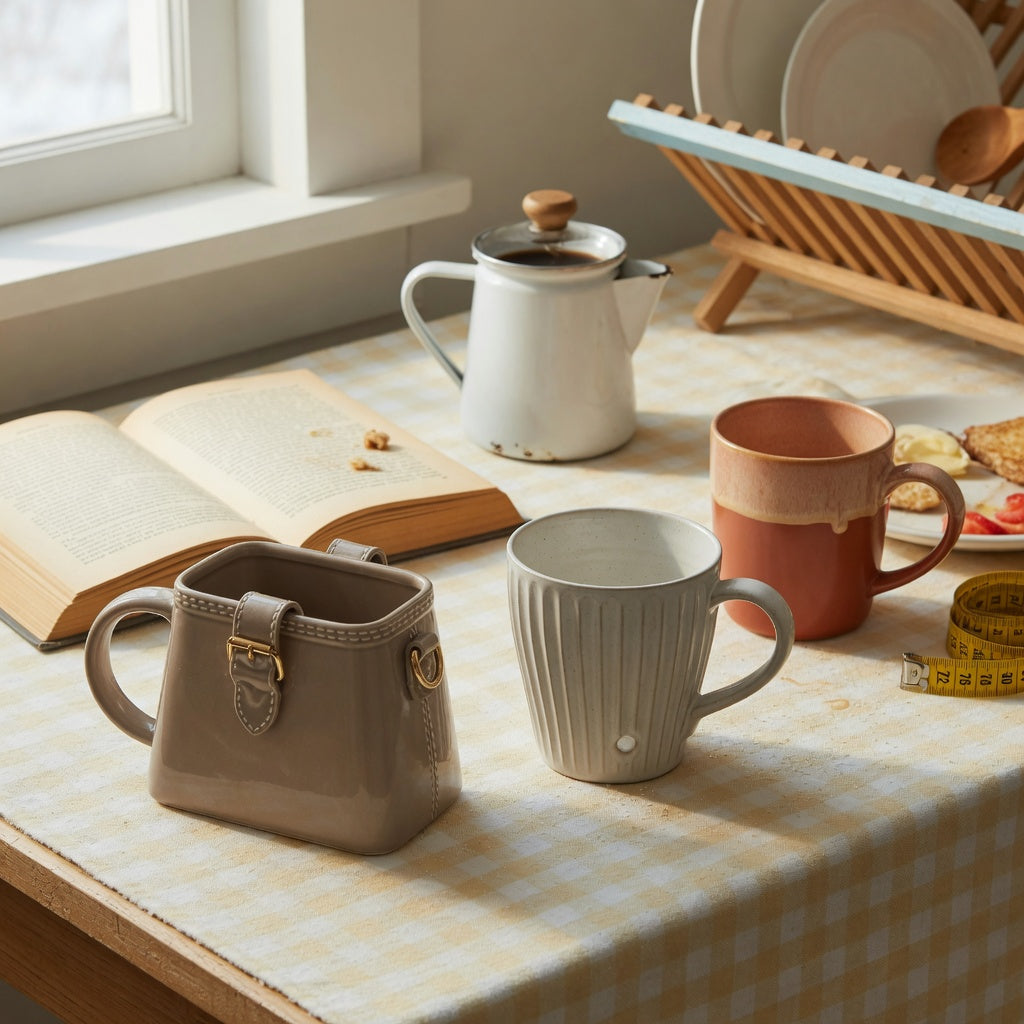
Buy cute ceramic coffee mugs weekend coffee practical purchase checklist
A practical weekend checklist from CoffeifyMug for comparing ceramic mug shape, grip, storage, cleaning, and gifting fit. See how the Handbag, Pleated, and Gradient Coffee Tea Mugs suit different s...
Read more
Leave a comment
This site is protected by hCaptcha and the hCaptcha Privacy Policy and Terms of Service apply.