
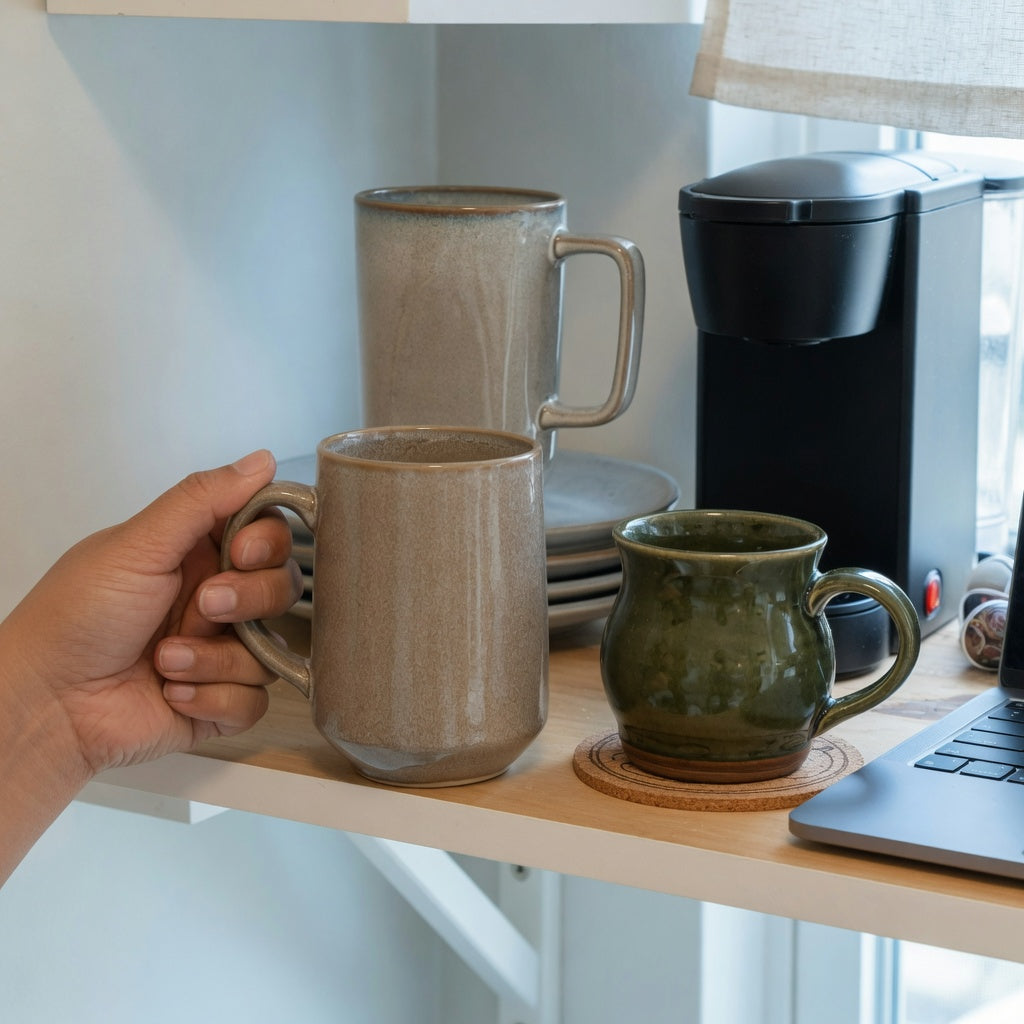
Heavy Ceramic Coffee Mugs: Everyday Mug Rotation Purchase Checklist
Reading time: about 10 minutes
At 8:10 a.m., a daily mug has to come off a crowded shelf, fit under the brewer, sit beside a keyboard, and return to a drying rack. A mug can look right in a product photo and still fail one of those ordinary jobs. In our store, we call the filter we use before recommending a shape the heavy ceramic coffee mugs everyday mug rotation practical purchase checklist.
We handle and compare mugs with repeat use in mind: loaded grip, rim feel, base footprint, cabinet clearance, and the care information a shopper can actually verify. Heft alone does not prove capacity, heat retention, stability, or resistance to chips. Those depend on other design and material details, so the general buying checks below are kept separate from claims about specific CoffeifyMug products.
How many mugs does your wash cycle actually require?
An everyday rotation should match your washing rhythm, not an arbitrary set size. Start with the number of drinks you normally prepare and how often clean mugs return to the shelf. This matters more than buying several matching pieces simply because they are sold or displayed together.
- Count daily pours: Include coffee, tea, and iced coffee separately if you prefer a clean mug for each drink.
- Count days between washes: Include dishwasher timing and the days when you do not want to hand-wash a mug.
- Add a practical buffer: Allow for a guest, a mug left at the office, or a delayed dishwasher cycle.
- Check available shelf positions: A rotation is too large if mugs have to be wedged together or moved every time you reach for one.
For example, two drinks per day and a dishwasher run every other evening create four clean-use slots if you do not reuse or hand-wash between drinks. A spare may be useful, but that does not mean five identical heavy mugs will fit your cabinet. A smaller mixed rotation can be easier to store and more useful.
Can your hand repeat the mug's loaded weight?
An empty mug test misses the most important part: the drink. Capacity and mug mass combine every time you lift from desk to mouth. A reassuring empty weight can become tiring once the mug holds your normal pour, especially during long tea sessions or repeated office refills.
- Weigh your current favorite mug empty on a kitchen scale.
- Fill it to the level you normally use, then weigh it again.
- Carry it from the brewer to your usual chair or desk and take several normal lifts.
- Use that loaded weight as your comparison point. If a candidate product page does not list mug weight or capacity, treat the result as unknown rather than guessing.
Handle geometry changes the experience too. Check the opening's inside height and width, how many fingers you naturally use, whether your knuckles touch the ceramic body, and where your thumb rests. A large handle can improve clearance but also increase the mug's total cabinet width. A thick rim may feel substantial, while a thinner drinking edge may suit someone who takes small, frequent sips. Neither is universally better.
Does heavy ceramic identify material, capacity, or heat performance?
No. Ceramic is an umbrella category that can include earthenware, stoneware, and porcelain. Weight, color, or glaze appearance does not confirm the exact clay body. Use the material wording on the current product page, and do not assign a more specific ceramic type if it is not listed.
Capacity is also separate from weight. A thick-walled mug can feel heavy while holding a modest amount, and a larger mug may carry most of its loaded weight in the drink itself. Compare the listed fluid capacity with the amount you actually pour. You can find your normal serving by filling your current mug to its usual line and transferring the liquid to a marked measuring jug.
Do not use weight as a shortcut for heat retention or tip resistance. Wall thickness, surface opening, starting temperature, room conditions, base contact area, and overall geometry can all affect those results. Heavy ceramic can feel planted, but a narrow base or top-heavy shape still deserves careful placement beside a keyboard.
Will it clear your cabinet, brewer, dishwasher, and desk?
Measure the full route a mug follows, not just the shelf where it ends up. We see storage fit become the deciding issue in compact kitchens, shared offices, and gift purchases for people whose cabinet dimensions are unknown.
- Cabinet: Measure usable shelf height, depth, and width. Leave enough vertical room to lift the mug over the shelf lip, and include the handle in the total width.
- Brewer: Measure from the drip tray to the coffee outlet in the machine configuration you normally use. A mug that fits the cabinet can still be too tall for the brewer.
- Dishwasher: First confirm that the specific mug is approved for dishwasher use. Then check rack-tine spacing, spray-arm clearance, and whether the rim or handle would strike nearby dishes.
- Desk: Mark the listed maximum width and depth with painter's tape beside your keyboard. This exposes conflicts with a mouse, notebook, monitor stand, or charging cable before the mug arrives.
For a gift, a single statement mug is often easier to place than a full matching set. The unboxing may be more dramatic with an unusual silhouette, but the recipient still needs a shelf position, a comfortable grip, and care instructions that fit their routine.
Which CoffeifyMug route fits your rotation?
The recommendations below map shopping situations to the product pages where you can inspect the current photos, description, and listed specifications. We are not assigning an exact capacity, weight, ceramic subtype, dimension, or care rating unless the current page states it.
| Your situation | Why this route fits | Relevant next step |
|---|---|---|
| You want a visually substantial mug for a fixed kitchen counter or office station. | A bold profile can anchor a mixed rotation, while a fixed station reduces the need to carry a heavy mug over long distances. | Inspect The Rock Coffee Tea Mug, then confirm its current measurements, capacity, and care information against your checklist. |
| Your rotation already contains angular shapes and you want a softer visual contrast. | A flowing silhouette can add variety without forcing you to buy a matching set. | Compare the photographed profile and listed details for The Flow Coffee Tea Mug. |
| You want an unconventional mug for a gift or display-forward rotation. | A distinctive shape makes sense when visual variety matters, provided the recipient has the shelf room and grip comfort it requires. | Review the Spittoon Coffee Tea Mug and verify every practical requirement before choosing it on appearance alone. |
| You need to compare several profiles before committing. | Side-by-side browsing helps you screen for shape and handle preferences before opening individual pages for current specifications. | Start with our unique coffee mugs collection, then eliminate any option with an unanswered must-have. |
Heavy ceramic coffee mugs everyday mug rotation practical purchase checklist
Run this heavy ceramic coffee mugs everyday mug rotation practical purchase checklist from top to bottom before adding a mug to your active shelf. It turns personal habits and product-page facts into a decision without filling unknowns with assumptions.
- Name the primary station. Decide whether the mug will live at a kitchen table, office desk, reading chair, or another stable surface.
- Record your normal pour. Measure the coffee or tea volume you actually serve rather than choosing the largest listed capacity.
- Establish a comfortable loaded weight. Weigh and carry your current mug when full so you have a real comparison.
- Define the grip. Note finger count, knuckle clearance, thumb position, and whether you switch hands during use.
- Check the drinking edge. Decide whether you prefer a substantial rim or a finer lip, and inspect product photos for the available view.
- Map the footprint. Compare maximum width, depth, and height with the cabinet, brewer, drying rack, dishwasher, and desk.
- Verify product facts. Look for listed material, capacity, dimensions, weight, and care instructions. Treat missing information as unknown.
- Plan the wash rotation. Match the number of mugs to daily pours, washing frequency, and actual shelf positions.
- Check the use limits. Decide whether the mug will be carried in a bag, used outdoors, or placed on soft furniture. Those scenarios may call for another material or a lid.
- Choose style last. Once several options clear the practical checks, use shape, glaze, and visual character as the tie-breakers.
If dishwasher use, microwave reheating, or an exact shelf dimension is essential and the product page does not answer it, contact our store before checkout. An unanswered must-have is a reason to pause, not a reason to assume.
Which care and unboxing checks catch problems early?
Care instructions are product-specific. A ceramic mug should not be called dishwasher-safe or microwave-safe solely because it is ceramic, particularly if it has decoration or accents that require special handling. Follow the current product page and any instructions included with the mug.
During gift or personal unboxing, examine the mug under clear light before washing it. Run a fingertip carefully around the rim, look at both handle attachment points, inspect the body for a line that continues through the ceramic, and place the mug on a flat counter to check for unexpected rocking. Fine lines in a glaze may be part of the intended finish or may need review, so compare them with the product images and contact the store if you are uncertain.
- If dishwasher use is approved, load the mug so its rim and handle cannot knock against other items during the cycle.
- Avoid abrupt temperature changes, such as moving a very hot mug directly into cold water.
- Check for trapped water around the base or foot before stacking the mug in a closed cabinet.
- Do not keep using a mug with a new rim chip, loose handle, or crack through the body while you wait to assess it.
These are general ceramic handling practices, not a durability promise for any linked product. Heft should never be treated as evidence that a mug cannot chip or break.
Who should choose a lighter or lidded vessel?
Heavy ceramic is best considered for stable indoor stations. It is a poor match for a backpack commute, a crowded sofa arm, repeated outdoor transport, or a user who experiences grip or wrist fatigue. A lighter cup or locking travel tumbler is usually easier to manage in those situations.
For iced coffee at a fixed desk, ceramic may still work if the listed capacity and footprint fit your pour. For a drink that must move through a commute without spilling, a lidded insulated vessel serves a different job more directly. Shoppers with very shallow shelves or narrow dishwasher racks may also get more daily use from a slimmer mug.
Frequently asked questions
How do I use the heavy ceramic coffee mugs everyday mug rotation practical purchase checklist?
Start with your normal pour, loaded comfort, hand position, storage measurements, and washing frequency. Compare those requirements with facts explicitly listed on each product page. If a must-have specification or care instruction is missing, ask before purchasing rather than estimating it from photos.
Are The Rock, The Flow, and Spittoon the same size and weight?
Do not assume that they are. Product names and collection placement do not establish identical dimensions, capacity, or weight. Review the current page for each mug and compare only the specifications that are actually provided.
Can a heavy ceramic mug go in the dishwasher or microwave?
Not automatically. Dishwasher and microwave suitability can depend on the clay body, glaze, decoration, and construction. Use the care statement on the specific mug page or contact our store when that information is not shown.
Does a heavier mug keep coffee hot longer?
Weight alone is not enough to make that claim. Wall thickness, opening size, starting temperature, room conditions, and the presence of a lid can influence how quickly a drink cools. Treat any product-specific heat claim as unverified unless the page provides supporting information.
How many heavy ceramic mugs belong in an everyday rotation?
Base the number on daily drinks, days between washes, and available shelf positions. Add a buffer only if you regularly host a guest or leave a mug in another room or office. A smaller rotation that fits cleanly is more practical than a larger set that must be wedged into storage.
Put your measurements beside the current product pages, remove any option with an unanswered essential requirement, and compare the remaining shapes in CoffeifyMug's current mug collection. The best next purchase is the mug that clears your grip, shelf, care routine, and normal pour before appearance decides the tie.
More from our blog
Read more
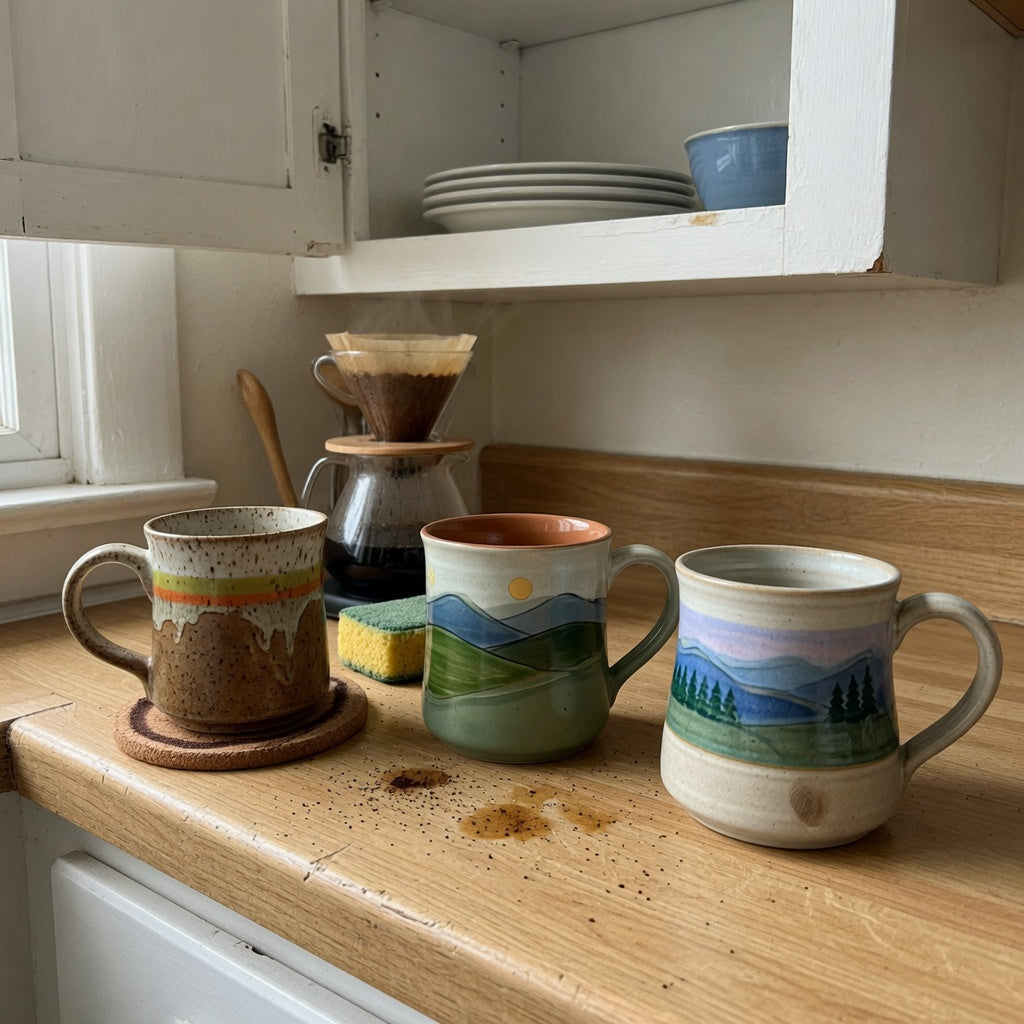
Vintage Pottery Coffee Mugs: Practical Everyday Mug Rotation Checklist
Build an everyday mug rotation around verified product details, cabinet and brewer clearance, usable capacity, grip, and care. This checklist also identifies unknowns and situations where a travel ...
Read more
White Pottery Coffee Mugs Everyday Mug Rotation: Purchase Checklist
Build a rotation around washing frequency, cabinet measurements, drink size, and published care instructions. This checklist maps three CoffeifyMug designs to specific daily-use gaps without assumi...
Read more
Leave a comment
This site is protected by hCaptcha and the hCaptcha Privacy Policy and Terms of Service apply.