
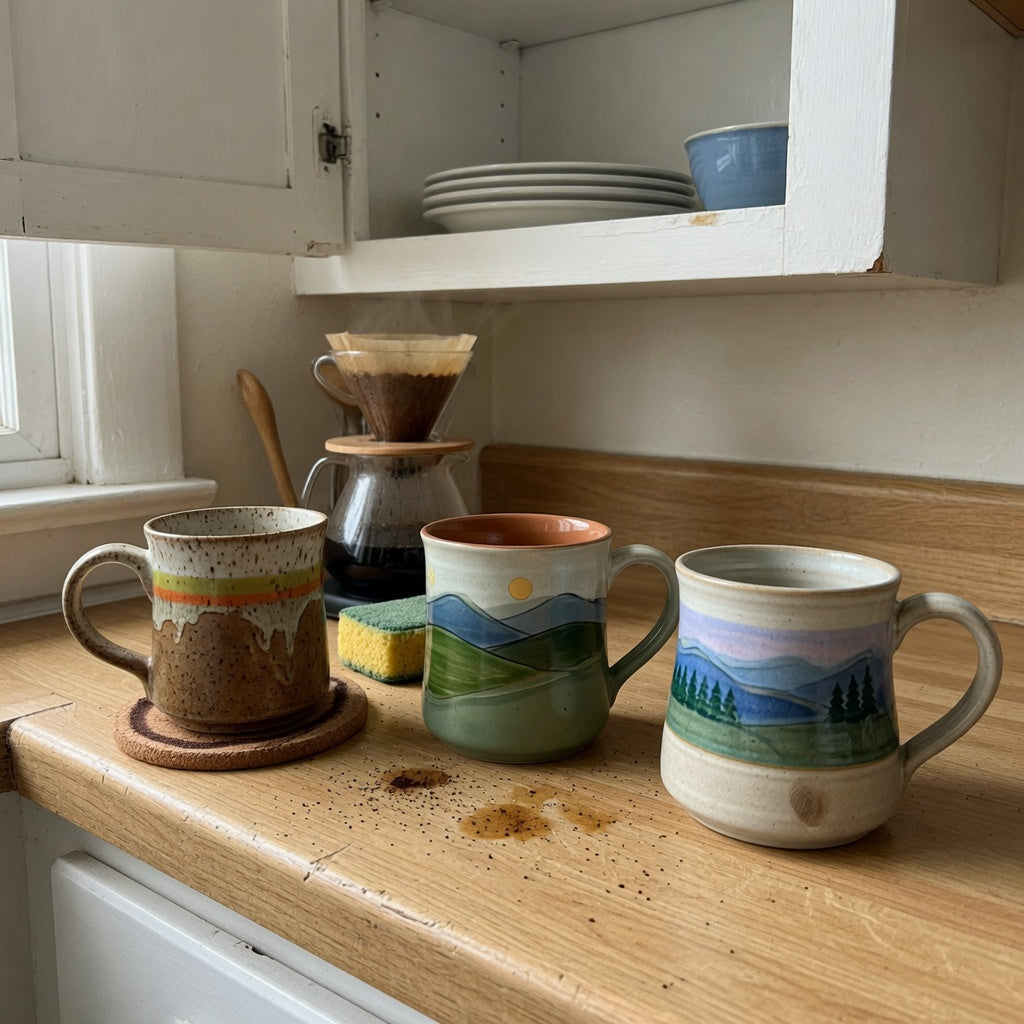
Vintage Pottery Coffee Mugs: Practical Everyday Mug Rotation Checklist
Reading time: about 10 minutes
The mug nearest the cabinet door gets the first coffee of the day. The attractive cup behind it may not move for weeks because its handle catches the shelf, it does not fit under the brewer, or nobody wants to hand-wash it. Our vintage pottery coffee mugs everyday mug rotation practical purchase checklist starts with that familiar pattern: a daily mug has to work in your space and routine, not just look good in a product photo.
In our store, we separate product-page facts from checks that must happen in your kitchen or office. A page can show the product name, design, photos, and any stated material, capacity, dimensions, or care instructions. Your cabinet clearance, preferred pour, grip, desk setup, and washing habits are personal. If a specification is not stated on the linked page, we treat it as unknown rather than guessing from appearance. We also do not assume that a vintage-style mug is an authenticated antique unless age or provenance is explicitly documented.
How much space does one mug need in your cabinet, brewer, and desk setup?
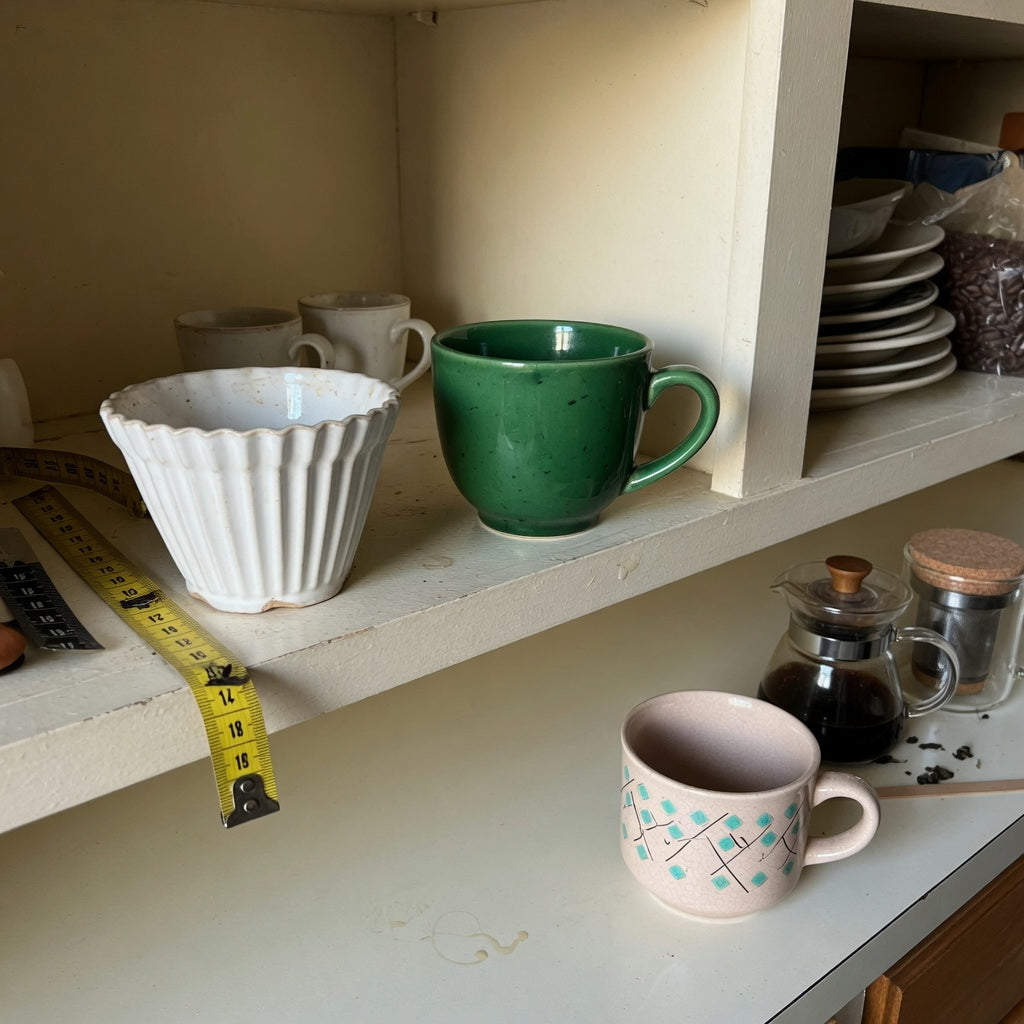
Use the mug you reach for most often as a measuring template. Its dimensions reveal more about your daily fit than an average cabinet measurement would. Record the following before opening several product tabs:
- Shelf opening height: Measure the clear vertical opening, including any shelf lip that can catch a rim.
- Total depth and width: Include the handle projection. A body-only diameter does not tell you how much cabinet space the whole mug occupies.
- Brewer clearance: Measure from the drip tray to the spout and check how far the mug must slide under the machine.
- Base footprint: Compare the base with your coaster, desk tray, or other regular resting surface.
If retro styling is the reason you are shopping, start with the Retro Coffee Tea Cup. The product name establishes the retro direction, but it does not by itself confirm cabinet fit, material, capacity, or care. Check the details visible on the page against your measurements. Shoppers who are still deciding between profiles and visual themes can compare the broader unique coffee mug collection without assuming that similarly styled pieces share the same specifications.
Open shelving keeps more designs visible, but it also exposes mugs to dust and adds visual clutter. Closed cabinets look calmer, yet deep shelves can hide less-used pieces. The better storage choice is the one that lets you lift each mug without striking its rim or handle against a neighbor.
Does the listed capacity match your real coffee, tea, or iced drink?
A capacity figure is useful only when it is stated and compared with the drink you actually make. A brim-full measurement is not the same as a comfortable carrying level. We recommend measuring your usual pour in your current favorite mug, including the headroom you leave below the rim.
- Hot coffee or tea: Measure the liquid at your normal fill line, not at the rim.
- Iced coffee: Put your usual amount of ice in first, then measure the liquid needed to finish the drink.
- Milk, foam, or an infuser: Include the space those additions occupy instead of counting only the base coffee or tea.
A kitchen scale makes this test straightforward: the weight of water in grams gives a close estimate of volume in milliliters. That specific number is more useful than calling your usual mug small or large.
If you want a scenic design, compare the Mountain Sea Coffee Tea Mug with the Great Mountain Coffee Tea Mug. Their names point to different landscape themes, but similar naming does not prove that their capacities, materials, dimensions, or care requirements match. Read each page separately and mark any missing specification as an open question.
Will the handle, rim, and weight work at 7 a.m. and on an office desk?
Product photos can show handle position and overall form, but they cannot fully reproduce grip or balance. Before first use, inspect a delivered mug under the applicable return conditions. After deciding to keep it, perform a short water test:
- Check the rim for chips, the handle attachments for hairline cracks, and the foot ring for rough spots or visible wobble.
- Grip the handle the way you normally do. Confirm that your preferred one-finger, two-finger, or three-finger hold has enough knuckle clearance.
- Fill the mug to your normal level with water and carry it from the sink to the table or office desk.
- Set it on your usual coaster and place it beneath your brewer to confirm the measurements in real use.
Fine lines limited to the glazed surface are commonly described as crazing. Crazing may be part of a deliberate finish or an unintended glaze condition, so compare what you see with the product description and photos instead of diagnosing it from one line. A crack through the body or handle joint is a different issue; do not test a questionable structural line with a hot drink.
Handle and weight choices involve real trade-offs. A visually distinctive handle may be less comfortable for a quick desk refill. A wide base can feel stable but consume more shelf space. A substantial mug may suit seated use while feeling inconvenient if you carry coffee between rooms throughout the morning.
What do the material and care fields tell you about daily use?
Material terms should be read precisely. Ceramic is an umbrella category that includes earthenware, stoneware, and porcelain, while glazed describes a surface treatment rather than the clay body itself. Pottery and vintage may also describe the product category or visual style. Do not convert those words into a more specific material, manufacturing method, or product age unless the page states it.
For a high-frequency rotation, care instructions can matter more than color. If every mug in your home enters a nightly dishwasher cycle, a page that does not state dishwasher compatibility leaves a meaningful unknown. The same rule applies to microwave use. Appearance alone cannot confirm either feature.
- Follow the care directions stated on the individual product page.
- Use a nonabrasive sponge unless the instructions permit another cleaning method.
- Dry the mug fully, paying attention to any unglazed foot ring that can retain surface moisture.
- Avoid abrupt hot-to-cold temperature changes unless the manufacturer specifically permits them.
These are general care precautions, not promises about the linked products. If dishwasher or microwave use is essential and the page does not answer the question, ask before buying or choose a mug whose care requirements are explicitly stated.
Retro, Mountain Sea, or Great Mountain: which page fits your shortlist?
Our product-selection logic begins with the shopper's situation, then sends that shopper to the most relevant page for verification. A visual match earns a place on the shortlist; the listed specifications decide whether it stays there.
| Reader situation | Why the page is relevant | Decision step |
|---|---|---|
| You want a retro visual direction for coffee or tea. | The retro cup product page is the closest named match. | Verify material, capacity, full dimensions, and care information shown on the page. |
| You prefer a design combining mountain and sea references. | The Mountain Sea option directly matches that named theme. | Compare its photos and stated details with your shelf, brewer, and pour measurements. |
| You want a mountain-led design rather than a broader coastal theme. | The Great Mountain design is the relevant product page. | Check it independently rather than assuming it shares specifications with another scenic mug. |
| You have not settled on a motif or profile. | The unique mug collection gives you a wider visual comparison. | Shortlist by design, then reject any option that does not meet your practical requirements. |
Gift shoppers should apply the recipient's routine, not their own. Someone who uses only a dishwasher, drinks under a low brewer spout, or works at a crowded desk has different constraints. Check the product on arrival before wrapping it, and keep any stated care information available for the gift unboxing.
Which mugs earn a place in a seven-day rotation?
Before adding another mug, watch the ones you already own for seven days. This gives you direct evidence about frequency of use without relying on a prescribed set size.
- Record which mug you choose for each coffee or tea and why you chose it.
- Measure the most-used mug's normal fill level, full width with handle, height, and base diameter.
- Write down why other mugs stayed unused, such as awkward grip, difficult care, poor brewer fit, or hidden storage.
- Use those findings to evaluate one new mug before buying several pieces with the same unknowns.
Vintage-style pottery mugs are not automatically the right choice for sealed commuting, car cup holders, backpack travel, or an authenticated antique collection. If you require a leak-resistant lid, a verified cup-holder diameter, low carrying weight, or documented provenance, another product category is a better fit. A scenic or retro mug can still be an excellent desk, kitchen, or gift choice, but only after its stated details match that setting.
How should you use the vintage pottery coffee mugs everyday mug rotation practical purchase checklist?
Keep this list beside the product pages and treat every item as confirmed, incompatible, or unknown. An unknown is not an automatic failure, but it should not be silently converted into a favorable assumption.
- Write down your usual drink, additions, and comfortable fill level.
- Measure your current daily mug and the storage, brewer, coaster, and desk spaces it uses.
- Record only the material, capacity, dimensions, and care facts stated on each product page.
- Flag missing specifications that affect a must-have use, especially dishwasher, microwave, or brewer compatibility.
- Use product photos to assess handle form, rim shape, base profile, and visual scale without treating photos as measurements.
- Match the design to a real situation: retro styling, mountain and sea imagery, a mountain-led motif, or a broader unique-mug comparison.
- Inspect the rim, handle joints, glaze, and foot ring before first use, following the applicable return conditions.
- After choosing to keep the mug, test it with water and track whether it earns repeated use during the next seven days.
This is the stop rule we use in our store: if a critical field is unknown and your routine depends on it, pause the purchase until it is clarified. The complete vintage pottery coffee mugs everyday mug rotation practical purchase checklist should narrow the shortlist, not provide excuses to overlook a poor fit.
Frequently asked questions
What comes first in the vintage pottery coffee mugs everyday mug rotation practical purchase checklist?
Start with your own measurements: cabinet opening, total shelf depth, brewer clearance, coaster size, and normal fill level. Then compare those numbers with facts explicitly stated on the product page. If a required dimension is missing, keep it marked as unknown until it is confirmed.
Are vintage pottery coffee mugs automatically dishwasher and microwave safe?
No. Vintage describes a style or appearance unless the page says more, and pottery does not establish a universal care method. Treat dishwasher and microwave compatibility as confirmed only when the individual product information states it.
How can I estimate usable mug capacity before buying online?
Measure the normal pour in your current favorite mug, leaving the same headroom you use while carrying it. Water weighed in grams gives a close milliliter estimate. Compare that result with any listed capacity, remembering that ice, milk, foam, or an infuser also needs room.
Which CoffeifyMug page should I open first for a retro or landscape mug?
Open the Retro Coffee Tea Cup page for retro styling, or compare the Mountain Sea mug with the Great Mountain mug for landscape themes. If none is an obvious visual match, place them beside the full unique coffee mugs collection. Reject any finalist whose material, capacity, dimensions, or care remains incompatible with your daily routine.
More from our blog
Read more
Small Ceramic Coffee Cup: Everyday Mug Rotation Buying Checklist
Compare pour size, cabinet clearance, handle footprint, care instructions, and breakability before adding a small ceramic cup to your daily rotation.
Read more
Heavy Ceramic Coffee Mugs: Everyday Mug Rotation Purchase Checklist
Use our practical checklist to compare loaded weight, handle clearance, pour size, storage fit, care instructions, and three CoffeifyMug shopping routes.
Read more
Leave a comment
This site is protected by hCaptcha and the hCaptcha Privacy Policy and Terms of Service apply.