



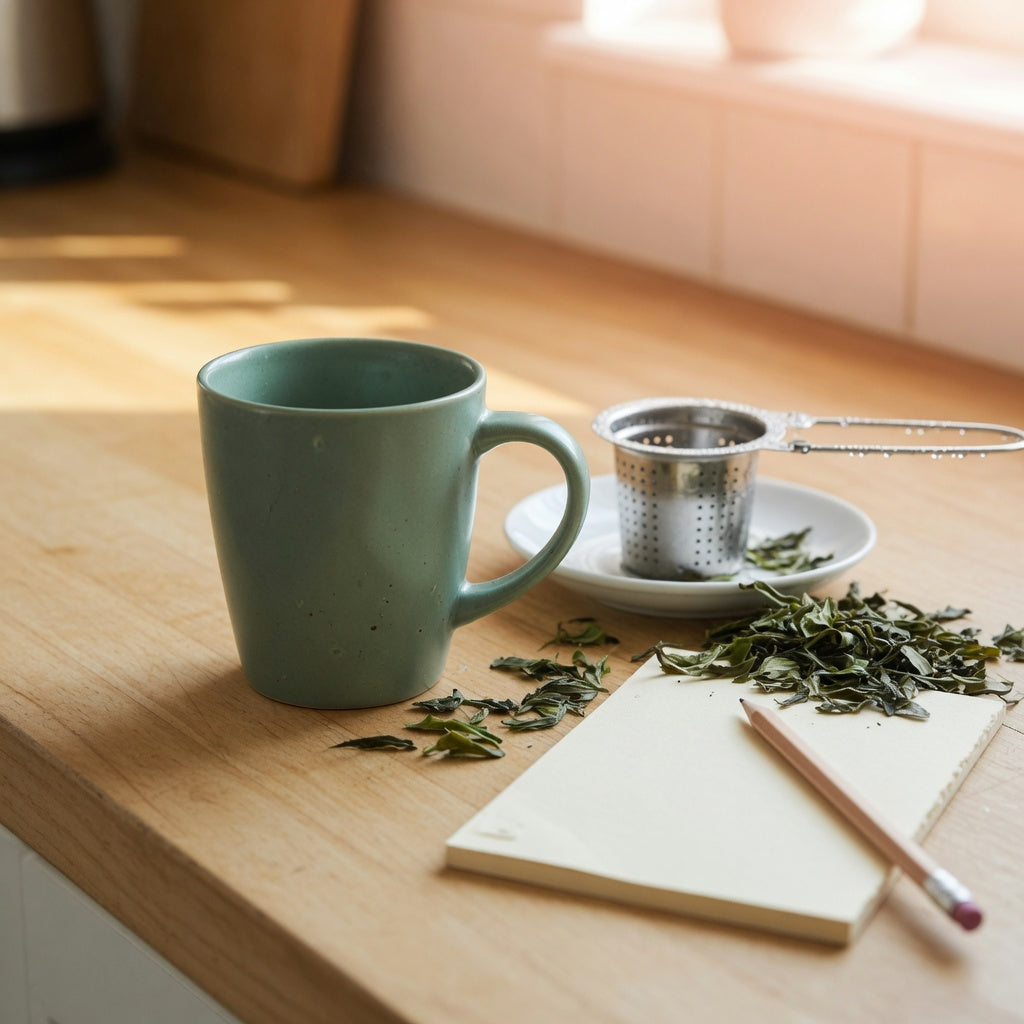
Green ceramic coffee mug for tea checklist: what to compare
Reading time: about 13 minutes
Last week a regular customer set two green mugs on our packing counter and asked which one could take loose-leaf tea without a metallic rim going into the office microwave. Both looked finished. One lip carried a thin gold line you only catch in daylight. We did not pick a winner from the shade. The green ceramic coffee mug for tea checklist we use on that counter is the same short list we want you to run before checkout: stated capacity, whether a basket can sit level, what the inside glaze is, and what the listing actually says about heat and the dishwasher.
If you are shortlisting our Green Waves Large Ceramic Coffee Mug, read the live page against that list. The catalog title includes the word large. That word is not an ounce measurement, and it does not say whether a lid or infuser ships in the box.
What belongs on a green ceramic coffee mug for tea checklist?
Shoppers often fold five different questions into one: is it a good mug? Capacity, infuser fit, heavy-metal documentation, microwave labeling, and glaze wear do not travel together. A handsome exterior can pass one check and fail the others.
Before checkout, we want a clear answer, or a deliberate not-needed, on each line:
- Serving size. Stated capacity versus the amount of tea you actually drink. There is no universal best ounce count.
- Rim, depth, and wall. Opening width and interior depth if you drop in a basket. Wall thickness is rarely printed, so do not invent a heat-retention claim from a photo.
- Handle gap. Enough room for your fingers without knuckles pressed against a hot wall. Confirm the grip material too, ceramic or otherwise.
- What is in the box. Lid, infuser, both, or neither, and whether a separate basket will sit level and clear the handle.
- Food-contact surface. A fully glazed interior. Exterior color is not the surface your tea sits on.
- Lead and cadmium. Any leach documentation the maker provides. A green glaze name is not that documentation.
- Microwave mark. A microwave-safe label, plus a hard look for metal, luster, or a non-ceramic handle.
- Dishwasher and wear. The care line, then chips, crazing, and how the glaze takes a tea stain.
If two of those lines are blank on the product page, leave them blank. Lifestyle photos crop out rims, and stylists borrow baskets that never ship.
Does the capacity match a short steep or a full loose-leaf pour?
FDA guidance describes cups and mugs as small ceramic hollowware commonly used for coffee or tea served above room temperature. They normally, but not exclusively, hold about 8 fluid ounces (240 mL) and are made with a handle. Tea drinkers ignore that normal constantly. Some want a smaller cup so a short steep stays hot and does not sit and stew. Others want room for leaves to open and for a second pour from the same leaves.
Match the mug to the drink already on your counter:
- A short green-tea steep. A modest fill is easier to finish while it still tastes fresh. A very large mug pushes you toward a weak, oversized cup or a long sit that flattens delicate leaves. In our store, the dull-green-tea complaints usually come from a small steep poured into a mug built for a long session.
- Loose leaf in the mug. You need water volume plus space for wet leaves. A basket that only wets the bottom layer brews thin tea.
- A covered steep. The lid should close without sitting in the liquid. Headspace matters more than a tall product photo.
- Matcha. Whisking wants a wider opening. A narrow rim fights the whisk and splashes the desk. If that is the daily drink, a different silhouette may beat a classic mug.
We do not treat one capacity as the right tea mug. The right one is the serving you already make. Read whatever ounce or milliliter figure is printed on the Green Waves page, then compare it with the line on your kettle or the cup you finish most mornings. If the shape is wrong for how you brew, look through our unique coffee mugs for a wider rim or a different handle instead of forcing this listing.
An open ceramic mug is also a poor commute cup. It belongs on a kitchen counter or an office desk, not in a bag.
Will a basket sit level, and is the infuser even included?
This is the check most green-mug pages skip. A photo can show a basket and a lid that never appear in the included line. Confirm three things in writing: whether a lid ships, whether an infuser ships, and whether you are expected to supply your own.
If you add a basket yourself, the rim has to support it. The basket should sit level, not rock toward the handle, and the perforated cup should hang deep enough that expanding leaves stay under the water instead of brewing in a dry pile near the top. Finer mesh suits smaller leaves. A coarse basket lets dust into the cup. When a lid is included, it should double as a drip rest so you are not parking a hot basket on a wood table.
Listings rarely print rim diameter or interior depth. If those numbers are missing, do not scale them off the photo. Measure a mug you already like, or ask before you order a basket sold as fitting most mugs. Most is not this mug.
Treat any infuser, lid, or filter for Green Waves as unconfirmed until the current product page says it is in the box. Buying the mug as an infuser set when the page is silent is how people end up with a handsome green cup and no way to steep the leaves they already own.
Does green glaze prove the mug is lead- or cadmium-free?
No. Color is a style choice. Leachable metal is a manufacturing and firing question. Official cautions about bright decoration name orange, red, and yellow more often than green. That does not make a green interior automatically clean. A speckled second glaze inside the cup can be a different formula from the green you see on the outside.
For cups and mugs, FDA compliance policy treats leachable lead above 0.5 micrograms per milliliter of leaching solution, in any one of six units, as a level for regulatory action. Testing referenced in that guide includes ASTM C738. Cadmium is a separate limit: 0.5 micrograms per milliliter for small hollowware under 1.1 liters, and 0.25 micrograms per milliliter for large hollowware, again in any one of six units. The cadmium guide states that acid foods can pull extractable cadmium from ceramic ware and that continued food use could cause chronic cadmium poisoning.
Boundaries we keep when someone asks whether the green one is food safe:
- Everyday commercial factory pottery is described as much less likely to present a lead problem than crude handmade pieces, antiques, damaged or heavily worn ware, flea-market finds, or pieces from unknown makers.
- A lead-free sticker is not a test report. Some traditional pottery carrying that phrase still showed extractable lead, in some cases above action levels. Ware that fails the agency method should not carry that wording, and the phrase may be treated as false or misleading.
- Washing, boiling, or soaking does not pull lead out of a glaze and make the mug safe later.
- A home lead-test swab that indicates leachable lead is a reason not to cook, serve, or store drinks in that piece. A clear swab is not the same thing as an acid-leach result on six units. Do not treat the two checks as interchangeable.
- Decorative ware may carry a permanent warning that it is not for food use and may poison food. That piece stays on the shelf, however good the green looks.
WHO materials list ceramic glazes among lead uses and state there is no known safe blood lead concentration. CDC guidance says lead can move from older dishware into food or drinks, advises against vintage ware for food service unless you know it does not contain lead, and states that no safe blood lead level has been identified for children. A CDC field report tied elevated blood lead in a New York City family to traditional glazed ceramic ware used for cooking, storing meals, and making coffee. Levels declined after that ware left the food and drink rotation.
None of that is a reason to panic over every commercial mug on a retail shelf. It is a reason to skip unlabeled vintage green ware and to ask what a modern maker can show for the food-contact glaze. On our pages, the word ceramic describes the body. It is not a certificate. If a listing says food safe or lead free without naming a leach method, or without saying the interior glaze was part of that check, read it as a claim to verify, not as a lab result. That rule applies to Green Waves the same way it applies to any other green mug in the catalog.
Can you microwave it if the rim has metal or the handle is not ceramic?
Microwave safety is a labeling question and a metal question. Glaze color does not settle it. University of Illinois Extension advises heating food only in microwave-safe containers and checking for the microwave-safe symbol when you are unsure. We use that same bar at the packing table.
A gold, platinum, or luster line at the lip is a reason to leave the mug out of the microwave unless that exact listing clearly says otherwise. Metal trim can arc. Even a plain-rim mug can leave the body, and sometimes the handle, uncomfortably hot after a long reheat. A microwave-safe mark does not mean the handle stays cool.
Wood is a different limit. A wooden handle is generally a hand-wash detail, and it does not belong in a microwave or a dishwasher just because the ceramic bowl might. Do not copy wood-handle care onto Green Waves unless the current listing actually shows a wood handle. If the grip material is not stated, treat it as unknown.
Silence on microwave use means the answer is not established. Silence is not a yes.
What do dishwasher cycles, crazing, and tea stains change?
Dishwasher-safe, stain resistance, and a crazed glaze are three outcomes that short care lines mash together. In our experience, a pale or glossy green can look even on day one and show a tea tide line after weeks of daily cups, especially with hard water and a strong detergent. We have watched one mug from a matched set pick up that brown line in the dishwasher while its hand-washed mates stayed even. Darker emerald and olive hide a tint better than mint or a thin celadon. The color shift is cosmetic until flavor changes or the surface roughens.
Crazing is a web of hairline cracks in the glaze. Tea can travel into those lines and show up as dark cracks on the rim or the outside. Once liquid is moving through the glaze, we take that mug out of the drinking rotation. Chips at the lip are the same stop. Damaged and excessively worn ceramic is already on the higher-concern list for lead exposure, which is another reason not to keep using a piece until it finally breaks.
Thermal shock is the quiet crack we hear about after cold mornings. A mug that sat on a winter sill, then took a full pour of boiling water, can fissure at the rim even when the glaze looked perfect an hour earlier. Let a chilled mug warm up. Do not hit cold ceramic with boiling water.
An unglazed foot ring is normal on a lot of pottery and can leave a damp ring on a wood desk. Green specks on that foot are often firing marks, not mold. The drinking surface is the part that must be glazed. Bare clay inside a cup is not a surface we would put tea in.
Sage, mint, or emerald: what actually matters in a gift box?
Shade is the last decision, and it is a real one. Sage and olive sit quietly on an office desk and hide tea tint. Mint and bright celadon photograph well and show every stain. Emerald reads as a gift. None of those names tells you the clay body, the firing, or the interior glaze.
A green ceramic mug is a practical gift for someone who already drinks tea at a kitchen counter or a desk and will read a one-line care note. It is a weak gift for a commuter who needs a sealed travel cup, for a matcha drinker who needs a wide bowl, or for anyone whose main request was an infuser and a lid when the listing does not include them. Put the limits in the card: microwave only if marked and free of metal, dishwasher only if the page says so, and retire it if the rim chips or the glaze crazes.
| Check on the listing | What you are confirming | If the page is vague |
|---|---|---|
| Capacity | Ounces or milliliters for your usual steep | Do not treat large as a size |
| Lid and infuser | Included, optional, or absent | Assume neither until stated |
| Rim and depth | Basket sits level and leaves stay wet | Do not scale it from a photo |
| Handle and wall | Finger gap, grip material, and that thickness is unstated | Do not guess heat retention |
| Interior glaze | Food-contact surface, not just exterior green | Ask; speckles may be a second glaze |
| Lead and cadmium | Any named leach check, not a color claim | Lead free alone is not a report |
| Microwave | Symbol or explicit wording, and no metal trim | Do not microwave it on a guess |
| Dishwasher and handle | Ceramic body versus wood or luster details | Hand wash until the page says otherwise |
| Condition | No chips, crazing, or bare clay inside | Skip damaged or vintage unknowns |
Frequently asked questions
What should a green ceramic coffee mug for tea checklist include before I buy?
Confirm stated capacity against your usual pour, whether a lid or infuser is actually included, and whether a basket will sit level and keep leaves submerged. Then separate the green glaze from food-contact safety: interior glaze, any lead or cadmium leach documentation, a microwave-safe mark with no metal trim, and a dishwasher line that matches the handle material. If the listing leaves a line blank, leave that feature off your reason for buying.
Is a green ceramic mug safe for tea just because the glaze looks solid?
A smooth, glossy interior is a sign the surface is finished, but the shade of green does not prove the glaze is free of leachable lead or cadmium. Cups and mugs are held to a lead action level of 0.5 micrograms per milliliter in any one of six units, and cadmium has its own hollowware limits. Look for maker documentation, and do not drink from vintage or damaged ware, or from anything marked not for food use.
Can I microwave a green ceramic tea mug with a gold or metallic rim?
Do not, unless that exact listing explicitly says the piece is microwave-safe despite the trim. Metal and luster at the lip are a heating risk, separate from whether the glaze is suitable for food contact. Even a marked ceramic mug can leave the body or handle very hot. If the page never mentions the microwave, treat microwave use as not established.
How do I tell whether a loose-leaf basket will fit?
You need the mug rim and interior depth, not a lifestyle photo. The basket should rest level without hitting the handle, and it should hang deep enough that expanding leaves stay in the water. Many pages omit rim diameter. If an infuser is not listed as included, do not assume one arrives in the carton.
Should I keep using a mug after tea bleeds into hairline cracks?
No. That pattern means liquid is moving through a crazed glaze, which also holds stain and old flavor. Chips at the rim are a reason to retire a mug from drinking as well. Washing will not undo crazing, just as washing will not remove lead from a glaze that should not be used for tea.
Open the Green Waves listing and tick the table against what is printed there today: capacity, included parts, care marks, and any glaze note. If this shape is close but the handle, rim, or size is wrong for your steep, start again in the unique coffee mugs collection and run the same checks before you order.
More from our blog
Ready to pick your mug? Two ways to save on today's order:
Ordering 1–3 mugs? Get an extra 10% off your 1st order with code 10_OFF Apply 10% Off & Shop Wooden-Handle Mugs →
Gifting 4+ mugs? Buy 3, Get the 4th Free applies automatically at checkout (no code needed; offers do not stack) · Free standard shipping (Nov pre-Christmas delivery: 15–20 calendar days US) · Free replacement if chipped in transit.
Popular mug buying guides: Ceramic Tea Cups & Infuser Mugs · Ceramic Mugs with Lids Compared · Wooden-Handle Tea Infuser Mugs Compared · Christmas & Secret Santa Mugs 2026 · Espresso & Cortado Cups Guide · Cup & Saucer Gift Sets · All 25 Mugs Spec Table · Mug Size Guide · Shipping & Promo FAQ
FIRST ORDER 10% OFF (CODE: 10_OFF) · OR BUY 3, GET THE 4TH FREE


Read more
Office Desk Landscape Coffee Mug: What Buyers Compare
A scenic mug only earns desk space if you can see the landscape from your chair and the cup will not tip into the keyboard. Compare print placement, the capacity printed on the listing, dishwasher ...
Read more
Ceramic Mug Pair for Home Office: What Buyers Should Compare
A working comparison of capacity, handle fit, lead and cadmium limits, microwave and dishwasher claims, and lid behavior for anyone buying two ceramic mugs for a home office desk.
Read more
Leave a comment
This site is protected by hCaptcha and the hCaptcha Privacy Policy and Terms of Service apply.