



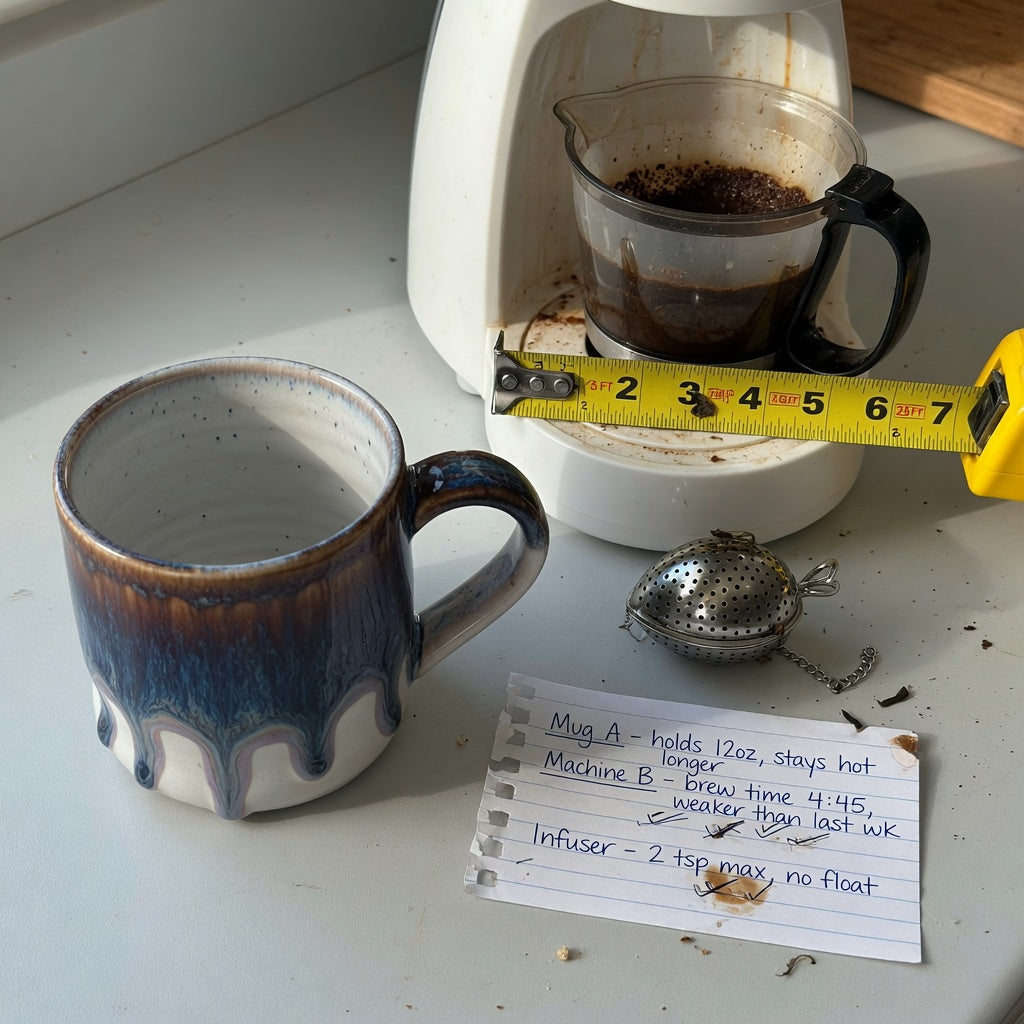
Flow Ceramic Coffee Tea Mug Buying Checklist: What to Compare
Reading time: about 16 minutes
A buyer emailed a close-up last month and asked whether the streaks were the safe part. They sat on the outside. The inside was a smoother glaze, and the page never said which surface was meant for coffee or tea. We see that split on the packing bench all the time, which is why the flow ceramic coffee tea mug buying checklist we walk through with customers starts at the drinking surface, not the glaze photo. People choose the exterior, then live with the rim, the handle, and whatever a week of coffee and tea does to the inside.
Use it when you want one ceramic mug for both drinks and the word flow is doing too much work. On the listings we compare, flow can mean glaze that moved in the kiln, a curved body or sweeping handle, or only a product-line name. None of those is a safety grade. The checklist will not turn a decorative piece into dinnerware, and it is not a lab report for the mug in your cart.
If you are comparing our own option, open The Flow coffee and tea mug in another tab and read the current page against the lines below. In our store the catalog title is The Flow Large Ceramic Coffee Mug. Treat the word large as a name until that page states ounces or milliliters, names the clay body, and gives separate microwave and dishwasher lines. A styled photo cannot fill those blanks. Neither can a similar mug from another maker.
Flow ceramic coffee tea mug buying checklist: judge the drinking surface first
Flow is not a clay body. Before we talk capacity with a customer, we ask which surface actually meets the drink. The interior and the inner lip touch every sip. An exterior flow glaze can look excellent and still be the wrong place to hunt for a food-contact claim.
- A flowing or reactive glaze moved in the firing and left streaks, pools, or a matte break over a glossier ground.
- A curved body or a sweeping handle can carry the word flow with no running glaze at all.
- A product-line name may describe neither the glaze nor the shape.
Color on the inside, decoration sitting on top of the glaze, and a bright band on the upper rim are separate questions from a fully fired, undecorated bowl. You cannot confirm lead by looking. Public health guidance treats bright orange, red, and yellow decoration, and color on the inside or upper rim, as reasons to slow down. They are not proof the piece is unsafe. A quiet color is not proof it is safe.
In our experience the risky photo is the one that crops off the rim. Ask for a clear shot of the inner lip if you cannot see a continuous interior glaze. Bare clay, pinholes, bubbles, or a crackle pattern on the drinking surface should be resolved before you order, not after the first pour.
Handmade, antique, flea-market, and unlabeled pieces call for more skepticism than ordinary factory ware. FDA describes properly made everyday pottery as much less likely to leach lead, and it tells buyers to be especially careful with crude or irregular handmade work, antiques, damaged or worn glaze, and pieces from an unknown maker. A kiln that previously fired leaded glaze can contaminate a later piece even when someone marks it lead free. A slogan copied onto a marketplace tile is not leach results for this mug.
Can you see lead or cadmium, or only a marketing line?
You cannot see either metal. Washing and boiling do not remove lead. Coffee and tea are acidic, and acidic drinks pull lead from a problem glaze much faster than water does. Heating food or drink in lead-bearing ware, including in the microwave, raises that chance again. The California Department of Public Health is plain about the limit of a visual check: testing is what tells you, not a glance at the color.
FDA's action level for lead leaching from cups and mugs is 0.5 micrograms per milliliter of leaching solution, on any one of six tested units. That bar is tighter than FDA's lead action level for flatware, 3.0 µg/mL as an average of six units, and tighter than the level for small hollowware that is not a cup or mug, 2.0 µg/mL. A plate standard is the wrong yardstick for a mug you use every morning.
FDA also states that no safe level of lead exposure has been identified. Infants, young children, and a developing fetus are the groups named for harm that may not look like an obvious illness, including learning disabilities, developmental delays, and lower IQ. Ware that leaches significant lead can contribute to chronic lead poisoning if you keep using it. We can help you read a listing. We cannot judge a swab result from a photo. If a test flags a piece, stop drinking from it.
Cadmium is the check most mug pages skip. FDA's action level for cadmium from ceramic small hollowware is 0.5 µg/mL on any one of six units. Acid foods can extract it, and continued use of ware with significant extractable cadmium is described as a path to chronic cadmium poisoning. A bright glaze is not a cadmium test. A dull glaze is not a free pass.
Read the usual claims against that gap:
- The phrase lead free on traditional pottery has, in FDA's reporting, appeared on pieces that still leached lead at or above action levels. Proper firing binds lead into a glaze. Improper firing does not. Residue in an old kiln can undo the label.
- A home lead swab is a screen, not a cadmium panel and not a six-unit lab test. If a swab shows leachable lead, FDA's advice is not to use that piece for cooking, serving, or storing food or drinks.
- Anything marked not for food use, including wording that it may poison food, stays decorative. Do not drink from it.
- Plain white factory dishes are described as rarely the lead problem. That still is not a personal lab report for one colored mug.
A published pilot study looked only at ceramic mugs already known to contain lead. In that set, measured lead ranged from 0.2 to 8.6 micrograms per liter in coffee and from under 0.2 to 1.6 micrograms per liter in tea. The cup mattered more than the drink or how long it sat. For one of five mugs, the estimated daily dose was above California's 0.5 microgram per day maximum allowable dose level then in use. That is not a verdict on every ceramic mug. It is a reason to care which cup you repeat, and a reason not to make an unlabeled bright antique your daily coffee mug.
On the current Flow listing, do not assume a food-contact test, a lead-free mark, or a cadmium statement unless those words are on the page. If they are absent, the honest status is unstated. Ceramic, by itself, is not a test result.
Why is dishwasher safe a different claim from microwave safe?
Shoppers mix these up every week in our inbox. Dishwasher safe is about detergent, water, and washer heat. Microwave safe is about how the body, the glaze, and any decoration behave in a microwave. A mug can be rated for one and not the other. Some makers rate neither.
USDA's microwave guidance is the rule we point to. Heat food and drinks only in containers made for that use. Glass and ceramic that are suitable are usually labeled for the microwave. China with metallic paint or trim is listed as not safe. Gold bands, metallic print, and a metal-looking handle belong in that group even when the rest of the mug is ordinary ceramic. Arcing is the spark that happens when microwaves meet gold paint or other metal. Leave it going and you can damage the mug and the oven.
That risk has shown up in a recall, not only in theory. In 2023 the CPSC described ceramic mugs mislabeled as microwave safe. A gold metallic handle and gold lettering could spark and posed a fire hazard. The firm had one report of a mug smoking while it was microwaved. If a page says microwave safe and the photos show metal decoration, treat that as a conflict. Keep the piece out of the microwave until the seller resolves it. We do not suggest trying a gold rim to see whether it sparks.
USDA also describes a one-minute water test for an unlabeled utensil. If that utensil becomes warm or hot, it is not microwave safe, because metal is in the material or the glaze, and the utensil or the oven bottom might crack. FDA says foods and drinks should be heated only in ceramic or other cookware that specifies it is microwave safe.
No microwave line means do not microwave it. Silence is not a quiet yes.
Dishwashers fail differently. Metallic luster, some decals, and softer or matte glazes can dull when they were meant to be washed by hand. A flowing exterior marked hand-wash only is a poor match for an office kitchen that runs every cup on a heavy cycle. If the Flow page is silent on either appliance, leave both unconfirmed. Do not copy a care line from another brand's flow cup.
How much will it hold, and will it clear the brewer?
Photos lie about volume. A wide low mug and a tall narrow one can look alike in a square crop and pour very differently. Ignore the lifestyle shot and find a stated capacity in ounces or milliliters. Then leave headroom. Filled to the lip, the mug will slosh between the counter and a laptop. On the mugs we handle at the bench, a usable pour sits about a finger-width below the rim.
Coffee and tea do not ask for the same working volume. A smaller steep can feel right in a modest cup. A full filter coffee needs more room once you stop filling to the brim. Retail pages rarely say whether their number is brim-full capacity or a practical fill. If only one figure is printed, you still need to leave space. Do not invent the missing number from the photo.
Machine fit is the measurement people skip until Monday morning. Compare three things with your own brewer:
- Height from base to rim against the clearance under the spout.
- Base width against the drip tray, so the mug sits flat instead of rocking on a grate.
- Handle swing, so the handle does not hit the housing when you slide the mug in.
If the current Flow listing does not print height or base size, do not guess from the scale of the photo. Measure the machine, then ask us or choose another shape. Our unique coffee mugs are the next stop when fit matters more than one glaze name. Read stated dimensions on each listing before you decide a curved handle will clear your machine.
A long meeting is a different job. Keep ceramic for the desk, where taste and a comfortable rim matter more than a multi-hour temperature. Single-wall ceramic will not hold heat like a vacuum steel bottle, and it is a poor car cup. If you need the drink hot two hours later, a bottle is the better tool.
What rim, lip, and handle reach your hand?
A strong exterior glaze still fails if the sip is annoying. The complaints we hear after the first week are specific: a drip down the outside onto a notebook, a lip that feels sharp, or a handle that digs in once the mug is full.
- A smooth, slightly rounded lip tends to empty cleanly. A flat thick rim with glaze piled on the front edge often trails a drip.
- Very thin rims feel precise and chip sooner when mugs are stacked or knocked in a sink.
- The inner edge should be even. A glaze run that breaks the circle at the lip is where drips start.
Handle comfort is a full-mug test, not an empty-hand test. Look for finger room, clearance between handle and wall for a larger hand, and attachment points that look substantial. A sweeping handle can look generous and still leave a narrow gap. If the listing never mentions clearance, judge the photos carefully or pick a simpler handle.
Weight belongs in the same pass. A heavy wall feels steady on a desk and tiring if you cradle it through a long call. A thinner wall is lighter and can feel more fragile in a crowded sink. Do not assign stoneware, porcelain, or earthenware from the word flow. The listing has to name the body. Earthenware that is not fully vitrified is the body we are most cautious about for daily hot drinks, because a porous wall is less forgiving of chips and of worn glaze. If the material line is missing on the Flow page, that is an open question, not a hidden upgrade.
Will coffee and tea stain the glaze, and does ceramic hold the heat?
Sheen changes cleaning more than the exterior pattern does. A smooth glossy interior releases coffee oils more easily than a matte, dry, or textured inside. Tea tannins still leave a brown line on pale glossy glaze. That film is usually a cleaning job, not a safety defect, unless the surface has gone chalky, pitted, or soft. For ordinary tannin stain we soak the mug and use a non-scratch pad on the glossy interior only. We do not scrub a soft matte exterior, especially a flowing glaze the maker said to wash by hand.
Keep the outside and the inside in separate columns. A reactive exterior can show fingerprints and still be fine if you never drink from it. If the flow glaze runs over the lip and into the bowl, judge that area as food-contact glaze, not as decoration.
Loose-leaf tea adds gear the coffee checklist often ignores. The rim has to support an infuser without tipping, and you need to know whether an infuser and a lid are actually in the box. Do not assume The Flow includes either. If the listing does not name them, it is a drinking mug, not a steeping set. Our notes on what coffee and tea drinkers should compare go further into shared daily use. If your morning pour is the main job, the morning coffee mug comparison is the closer read. One mug can do both only when capacity and care marks agree. Otherwise it is a compromise, and a dedicated tea piece may suit you better.
Heat is the expectation we reset most often. Ceramic is a good choice for flavor at the desk, and a microwave-safe mug can be reheated. It is not double-wall steel. Double-wall ceramic can feel steadier for a short sit than a thin single wall, and it still will not match a vacuum bottle. If the listing does not say double wall, assume single wall. Drink it while it is hot.
Gifting adds a blind spot. You cannot watch the recipient measure the brewer or test the handle. What we tell gift buyers is simple: clear care lines, no undisclosed metal trim, and a capacity you can explain in one sentence. A glaze that varies piece to piece can be a good surprise. An unlabeled antique with a gold rim is not.
What should you inspect the day the box arrives?
Check the mug before the first pour, on a counter with the light coming across the rim, not under a dim cabinet. This is the same pass we use when a customer sends a photo of a chip the top-down product shot hid.
- Chips, cracks, or a worn patch on the lip and inside the bowl.
- Crazing, a fine crackle network, pinholes, or bubbles in the food-contact glaze.
- A chalky or corroded feel after a gentle wash.
- Metal, gold, or a metallic print you did not see in the listing.
- Any not-for-food mark on the base.
Stop using it for drinks if you find those, if a lead swab reacts, or if the piece was sold as decorative. FDA names damaged and excessively worn ceramicware among the pieces that deserve extra caution, and the California Department of Public Health flags a corroded glaze or a chalky residue after washing. A crazed or chipped drinking surface on a new mug is also a quality problem worth a return, even before leach questions. A flowing exterior that simply does not match the photo is different. Reactive glazes move in the kiln, so streaks often differ from the hero image. That variation is not, by itself, a defect.
Use the table while the listing is open. Then work the short list under it. Keep this flow ceramic coffee tea mug buying checklist next to the page so a pretty exterior does not skip a line.
| Check | Where it should be stated | If it is missing |
|---|---|---|
| Drinking surface versus exterior flow | Interior and rim photos, plus food-use wording | Ask before you buy |
| Lead and cadmium | A claim tied to this product, not a copied slogan | Treat both as unstated |
| Microwave | Its own line, with no metal-trim conflict | Do not microwave it |
| Dishwasher | Its own line | Hand wash until you know |
| Capacity | Ounces or milliliters | Do not trust the photo |
| Brewer fit | Height and base, if you use a machine | Measure the machine or switch mugs |
| Infuser and lid | Box contents | Assume they are not included |
Order the decision this way:
- Confirm it is for drinks, and separate the interior from any exterior flow glaze.
- Read lead, cadmium, microwave, and dishwasher lines as four different facts.
- Reject undisclosed metal trim for microwave use.
- Match stated capacity to a real pour with headroom, then match height and base to the brewer.
- Check the lip for drip points and the handle for a full-hand grip.
- Decide whether you need an infuser. If the page does not include one, do not invent it.
- On arrival, stop for chips, crazing on the drinking surface, surprise metal, or a failed lead swab.
If those lines check out on the current page, put The Flow coffee and tea mug in the cart. If height, handle, or material is unstated and your brewer is fussy, compare shapes in the unique coffee mugs collection instead of guessing from one glaze photo. Ceramic still will not replace a travel bottle, and a mug with no infuser listed will not become a loose-leaf set because the glaze looks right.
Frequently asked questions
What should a flow ceramic coffee tea mug buying checklist include before I pay?
Separate the drinking surface from any exterior flow glaze, then confirm food-use wording, lead and cadmium claims, microwave safety, and dishwasher safety as different lines. After that, compare stated ounces or milliliters with headroom, brewer height and base, rim drip, handle clearance, and whether an infuser is actually included. If a line is missing on the current listing, treat it as unknown. The word large in a catalog title is not a measured pour.
How do I tell whether a ceramic mug is lead-free if the glaze looks bright?
You cannot tell by color. Bright interior or rim color, handmade or unknown origin, antiques, and worn glaze are reasons to be more careful, and plain white factory ware is less often the problem, but only a test settles it. A lead-free label on traditional pottery has still failed leach checks. If a home swab shows leachable lead, do not drink from that mug. Washing it will not remove lead.
Can a mug be dishwasher safe and still be unsafe in the microwave?
Yes. The two ratings measure different stresses. Metallic paint, gold lettering, and a gold handle can spark even when the mug survives a dishwasher, and mislabeled gold-decorated mugs have been recalled after one smoked in a microwave. No microwave wording means do not microwave it. No dishwasher wording means hand wash until the maker says otherwise.
Should I trust the product photo instead of the ounce or milliliter figure?
No. Cropped photos hide whether a mug is wide and low or tall and narrow, and they do not show headroom or brewer clearance. Use the stated capacity, leave room below the rim, and compare listed height and base with your machine. If the Flow page does not give those figures, ask or choose a listing that does.
What should I do if the glaze is chipped or crazed when the mug arrives?
Do not use it for coffee or tea. Chips, crazing, pinholes, and a chalky worn surface on the drinking surface are stop-use signs, especially on unlabeled or older pieces, because regulators flag damaged and excessively worn glaze for extra caution. Contact us about a return on a new piece. A flowing exterior that simply differs from the photo is normal kiln variation, not the same problem.
More from our blog
Ready to pick your mug? Two ways to save on today's order:
Ordering 1–3 mugs? Get an extra 10% off your 1st order with code 10_OFF Apply 10% Off & Shop Wooden-Handle Mugs →
Gifting 4+ mugs? Buy 3, Get the 4th Free applies automatically at checkout (no code needed; offers do not stack) · Free standard shipping (Nov pre-Christmas delivery: 15–20 calendar days US) · Free replacement if chipped in transit.
Popular mug buying guides: Ceramic Tea Cups & Infuser Mugs · Ceramic Mugs with Lids Compared · Wooden-Handle Tea Infuser Mugs Compared · Christmas & Secret Santa Mugs 2026 · Espresso & Cortado Cups Guide · Cup & Saucer Gift Sets · All 25 Mugs Spec Table · Mug Size Guide · Shipping & Promo FAQ
FIRST ORDER 10% OFF (CODE: 10_OFF) · OR BUY 3, GET THE 4TH FREE


Read more
Green Waves Coffee Tea Mug Gift: What to Compare First
Shoppers searching for a green waves coffee tea mug gift often mix coastal ceramics, lidded tea cups, and team merch. We compare material, capacity, appliance marks, food-contact wording, and boxin...
Read more
Tall Ceramic Coffee Mug for Office: What to Compare
Shoppers reach for a tall office mug to cut refills, then run into brewer clearance, a tippy base, and glaze questions. We separate height from capacity and list the facts to verify on the current ...
Read more
Leave a comment
This site is protected by hCaptcha and the hCaptcha Privacy Policy and Terms of Service apply.