
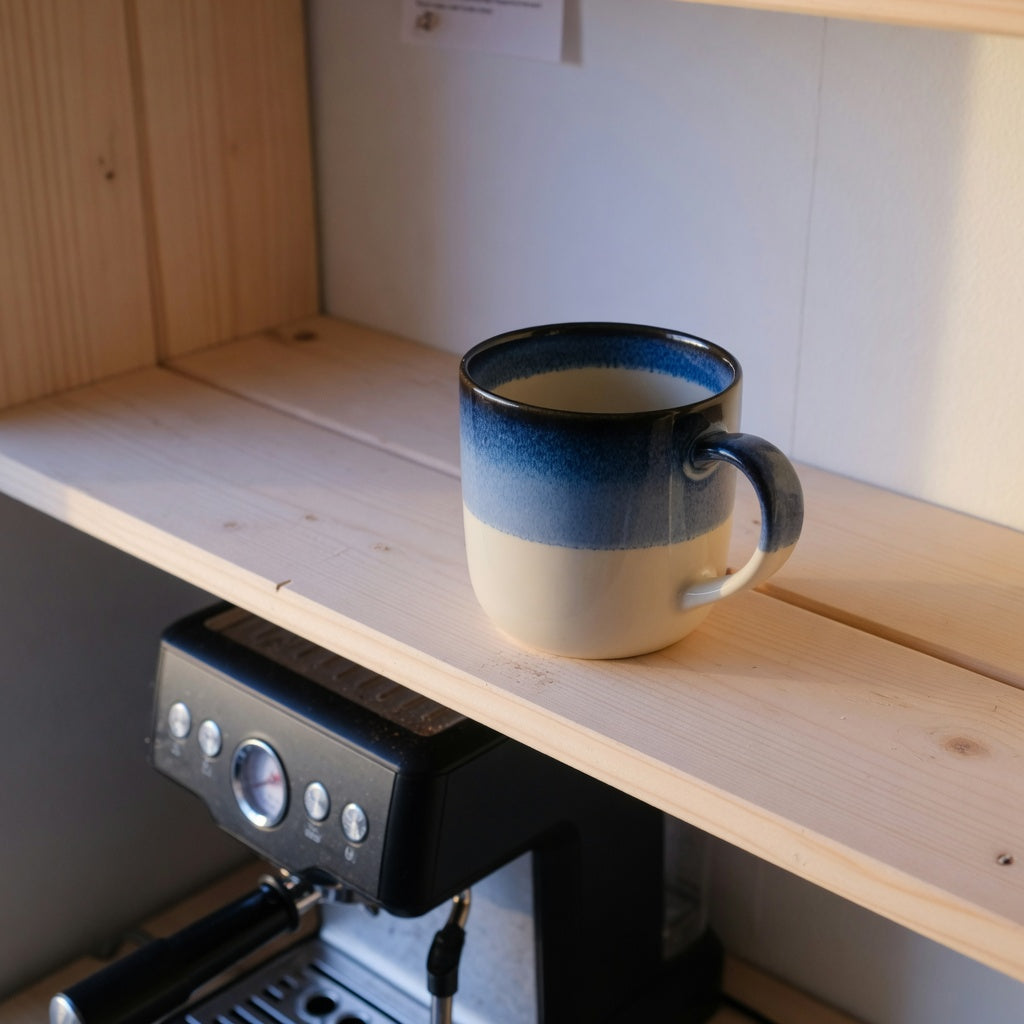
Gradient Coffee Tea Mug for Coffee Lovers Home Decor: Compare
Reading time: about 13 minutes
The mug that looks right on a walnut tray is often the one that comes back dull, peeling, or chipped after a month in a shared kitchen. We see that split at the counter all the time. A shopper wants a gradient coffee tea mug for coffee lovers home decor: a cup that can sit beside the kettle and still be the one they grab on a weekday. The photo sells the shelf. The care line decides the weekday.
Open the current page for the gradient coffee tea mug and read capacity, material, handle, and care there. Do not lift those details from a lookalike listing. If the fade does not match how this kitchen actually runs, compare shapes and finishes in our unique coffee mugs collection using the same checks.
Is a gradient coffee tea mug for coffee lovers home decor a daily cup or a shelf piece?
Open shelving changed the question we get. Between pours the cup is part of the room, so the color break, the rim, and the handle silhouette matter as much as the 7 a.m. sip. A gradient earns that shelf when the shift reads from across the counter, not only inside a cropped photo.
It is a poor fit when you need six matching cups, when leftovers always go back into the microwave, or when the house runs a heated dry cycle and nobody will hand-wash a special piece. It is also the wrong mug if the listing says decorative use only. That line means do not put coffee or tea in it.
In our store we sort these requests into three routines:
- Daily driver. One person, one favorite cup, a dishwasher most nights. The finish has to survive that, even if the shipped shade is a step off the photo.
- Coffee-bar piece that still gets used. It stays out for guests and slow mornings, and hand-washing is acceptable if the page asks for it.
- A gift that has to read in the box. The fade should say coffee person before anyone hunts for the ounce mark. The care rule has to go in the box too.
A fade that looks rich on a rail can still be the wrong daily cup. If the kitchen will not follow the care the finish needs, pick a different mug rather than hoping the gradient behaves.
Glaze, reactive ombre, or a print that can peel?
The color shift is not one material. Where the color sits is what decides whether it survives soap, heat, and a year of hands. Our team hears peel complaints far more often on surface prints than on a glaze that was fired into the clay.
| What the listing shows | Where the color sits | What shows up in real use |
|---|---|---|
| High-fired or kiln glaze gradient | Color melted into the glaze on the clay | Tougher daily option when the glaze is fully fused and the drinking surface is sound. Shade can still differ from piece to piece. |
| Reactive or handmade ombre | Glazes move in the kiln, so the fade is not a fixed graphic | The photo is a sample, not a twin of what ships. Strong on a shelf. A problem if two gifts must match. |
| Printed, decal, or wrap gradient | Ink or a transfer sits on the surface | The finish that peels, scratches, or dulls in the dishwasher. Hand-wash if the maker says so. |
| Metallic, luster, or mirror coating | A metal-look layer over ceramic | Keep it out of the microwave unless the page shows ordinary glaze, not a metal coat. Coatings can overheat or crack. |
Read any listing in this order. Is the gradient glazed or printed? Is the interior a plain food-contact surface, or does the decoration run inside the cup? Does the bottom or the page say dishwasher safe, hand wash, or nothing at all? Silence is not a yes.
A controlled solid is easier when you need a set that matches. A gradient is the better buy when one cup should carry the shelf. For four identical mugs at the table, leave the fade and look through calmer mugs in the collection instead.
Pour size, handle gap, and the space a mug takes on a rail
Ounce marks on gradient mugs are scattered. Pages shoppers ask us to compare are often marked around 10, 11, 12, or 14 ounces, and some tea cups near 350 milliliters. Those are comparison points, not a spec for every gradient mug, and not a figure for the cup on our page. Use the number on the live listing in front of you.
- Coffee at a desk. A smaller, lighter cup lifts more easily through a morning and crowds a laptop tray less. A wide bowl looks generous and cools faster.
- Tea with an infuser. You need space above the liquid and a mouth wide enough for the basket. A tight, tall cup fights that.
- Open shelf or mug rail. A thick foot and a long handle eat width. Two statement mugs can fill a rail that holds four plain diner cups.
- Interior color. A dark inside hides coffee stains and the drink level. A light inside shows the tea, and it shows crazing or wear sooner.
Handle comfort is the check photos hide. A wooden handle can look warm next to a cool glaze and feel kinder when the body is hot. It also changes care. Do not microwave wood unless that exact page says the assembled mug is microwave safe. Verify that sentence on the page you are buying. It is not a rule for every gradient mug, and it does not describe our mug unless the current listing says the handle is wood.
On a ceramic handle, check the gap. A narrow opening punishes larger knuckles. A wide, thin loop twists in a smaller hand. Weight shows up once the mug is both decor and a full pour. A heavy foot looks planted on a shelf and tires a smaller hand halfway down. Judge it full, not empty.
What dishwasher badges and microwave claims actually cover
Dishwasher safe and microwave safe are not the same test. A dishwasher means alkaline detergent, a long hot cycle, and spray. A microwave interacts with water in the ceramic and with any metal in the decoration. A mug can pass one and fail the other.
In our experience, printed gradients are the fade-and-peel complaints. A well-fired glaze more often dulls slowly, if it changes at all. The word ceramic does not guarantee either result. Match the care line to the kitchen you actually have. If nobody hand-washes, do not buy a hand-wash finish and hope.
Wooden handles are sold with conflicting instructions. Some pages put the whole mug in the dishwasher and the microwave. Others say keep the wood out of the microwave and wash it by hand so the grip does not swell, stain, or loosen at the joint. If your page is vague, hand-wash it and skip the microwave. Do not borrow a yes from another brand.
Metallic and luster finishes need a harder stop. U.S. product-safety officials have warned that a metallic coating on a ceramic mug can overheat or break if it is microwaved or filled with extremely hot liquid, which means burns and cuts are real risks. A recall announced on March 21, 2024 covered about 440,500 metallic-coated ceramic mugs in Starbucks-branded gift sets, after 12 overheating or breaking incidents and 10 injuries. A gold rim or a mirror fade on a gradient mug is not automatically that recalled item. It sits in the same hazard class until the maker shows ordinary glaze rather than a metal coating. We would not microwave a metallic gradient to find out.
Care we give customers when the fade is supposed to stay presentable:
- Wash a new mug before the first pour. Boiling will not pull lead out of a badly fired glaze, and it will not make a questionable surface safe.
- If the listing says hand-wash, use mild soap and a soft sponge. Dry the handle joint so water does not sit in wood or a metal fitting.
- Keep scrub pads off printed fades. They cut the ink first.
- Do not stack a decorated wall against a rough foot ring. That unglazed ring scuffs the gradient on the mug underneath.
- Retire a chipped rim, or crazing that has stained and gone soft. A damaged drinking surface is no longer the surface sold for daily coffee and tea.
Food-contact limits: lead, cadmium, and decorative-only marks
The brightest part of a gradient is often where the glaze is working hardest, which is where food contact matters. The U.S. Food and Drug Administration has said some ceramic foodware can leach lead from the surface that touches food, and that extractable lead can cause harm, including effects associated with chronic lead poisoning if that use continues. For cups and mugs, FDA's action level for lead leaching is 0.5 micrograms per milliliter of leaching solution, under Compliance Policy Guide 545.450.
Cadmium is the paired concern on some colored glazes. FDA's action level for cadmium leaching from ceramic small hollowware is 0.5 micrograms per milliliter under CPG 545.400. The agency has found extractable cadmium in ceramic ware and has said it could cause chronic cadmium poisoning with continued food use.
Boundaries we keep repeating, because badges blur them:
- Lead-free is not lead-safe, and neither phrase is a lab report. California's Department of Public Health describes lead-free tableware as ware with no lead, and lead-safe tableware as ware that may contain some lead if the amount that can enter food stays inside Proposition 65 standards. Tableware under those levels is treated as safe to use. Ware above them may be sold only with a written warning. FDA also regulates tableware that contains lead. A word in a product title is not the test.
- Washing does not fix a leaded glaze. If lead in the glaze was not fired properly, it may never lock into the ware. FDA has said no amount of washing, boiling, or other home process removes it.
- A decorative-only mark means do not drink from it. Language such as Not for Food Use, or a warning that the piece may poison food, exists so the mug is not used to cook, serve, or store drinks. Shelf display is a fair use. Breakfast is not.
- Some pieces deserve more caution. Be more careful with crude handmade ware, antiques, chipped or worn glaze, sellers who cannot name the maker, and bright orange, red, or yellow decoration. FDA notes that lead has often been used to intensify those pigments. Commercial factory pottery made for everyday use is described as much less likely to have lead problems. Less likely is not a certificate for the mug in the cart.
If the page does not say the mug is for food use, treat it as shelf decor until you have a clear answer.
On our listing, read the safety language on that page in full. This article cannot upgrade it. If the page does not say the mug is meant for food, ask before it becomes a morning cup. A beautiful gradient with no food-surface story is a display object.
Gift the fade, or pick a plainer daily mug?
A gradient gifts well when the person already has a daily cup and will like one more that looks intentional on a shelf. It gifts poorly when you do not know if they hate hand-washing, share an office microwave, or need four cups that match. The unboxing lasts a minute. The care rule lasts for years.
Before you wrap one, use the filter we use at the counter. Is the capacity visible on the listing? Will the handle fit their hand? Will their kitchen follow the care line? Put a note in the box if it is hand-wash only. A surprise that fails in the first week does not feel thoughtful.
Choose the gradient when:
- You want one visible cup, not a matched set for the table.
- The drinker keeps mugs on open storage and cares how the coffee bar looks.
- You have confirmed food-contact status and the appliance claims on the exact listing you are buying.
Choose a plainer, fully machine-safe mug that is easy to replace for a shared office kitchen, a household that runs everything through the dishwasher, or a recipient who wants four identical cups. A finish they cannot clean the way they live gets resented, then donated. The gradient is the wrong tool for that job.
If you still want this fade, treat a gradient coffee tea mug for coffee lovers home decor as a buy only after the listing answers capacity, care, and food use. The lifestyle crop is not that answer.
Frequently asked questions
Will a gradient coffee tea mug for coffee lovers home decor fade in the dishwasher?
It depends on whether the fade is fired glaze or surface print. Printed and decal gradients are the ones that peel or go dull under detergent and heat. A kiln glaze is generally tougher, but only when that specific mug is rated dishwasher safe. If the listing is silent, hand-wash it or choose another cup.
Can I microwave a gradient mug with a wooden handle?
Do not assume yes, and do not assume the mug has a wooden handle. Some pages allow the assembled mug in the microwave. Others say keep the wood out and wash the handle by hand so it does not swell or loosen. Follow the exact page. If handle material is never mentioned, leave the mug out of the microwave until you know.
Does a lead-free label mean the mug is safe for daily coffee?
No. Lead-free means the seller claims no lead is in the ware. Lead-safe can mean some lead is present while leaching stays under a stated limit. Those are different claims. FDA's action level for lead from cups and mugs is 0.5 micrograms per milliliter of leaching solution. A badge in the title is not a leach test, and a decorative-only warning means the mug should not hold drinks.
What size should I compare for coffee versus tea?
Shoppers line up cups around 10 to 12 ounces for a straight coffee pour, and something nearer 14 ounces when they want room for milk or a tea infuser. Those are comparison habits, not a promise about one product. Read the live listing, then picture that volume full. A larger gradient cup is heavier and takes more width on a shelf.
Will a handmade gradient match the product photo?
Reactive and handmade glazes move in the kiln, so the shade and the break in the fade can differ from the sample and from the next mug in the batch. That variation is part of the look unless the page promised a fixed print. If two cups must match, a factory-controlled color is more predictable. The trade-off is that a surface print can wear.
Five checks on the listing, not the photo
Run this on the product page before the mug goes in the cart:
- Confirm whether the color is glaze or print, and whether piece-to-piece variation is expected.
- Read the capacity, then decide if it fits black coffee, milky coffee, or tea with an infuser.
- Check handle material and the grip opening, especially if wood is part of the build.
- Separate the dishwasher claim from the microwave claim. Skip the microwave for metal, luster, or an unclear wooden handle.
- Confirm the mug is sold for food use, not decorative only. Do not treat a lead-free line as a lab report.
If those five match how you drink, open the gradient coffee tea mug listing and verify every detail there. If you want another silhouette, or a calmer finish for a weekday rotation, run the same care check across the other mugs we stock.
More from our blog
Read more

Gradient coffee mug for office desk: what to compare
A gradient coffee mug looks right in a photo, then fails on handle clearance, fill size, or a finish that cannot take the microwave. We compare the desk checks we use before that cup stays beside a...
Read more
Decorative Golden Waves Ceramic Coffee Mug: What to Compare
A decorative golden waves ceramic coffee mug may be printed wave art or real metallic gold, and those are different buys. Compare food-use marks, microwave and dishwasher labels, usable fill, and w...
Read more
Leave a comment
This site is protected by hCaptcha and the hCaptcha Privacy Policy and Terms of Service apply.