
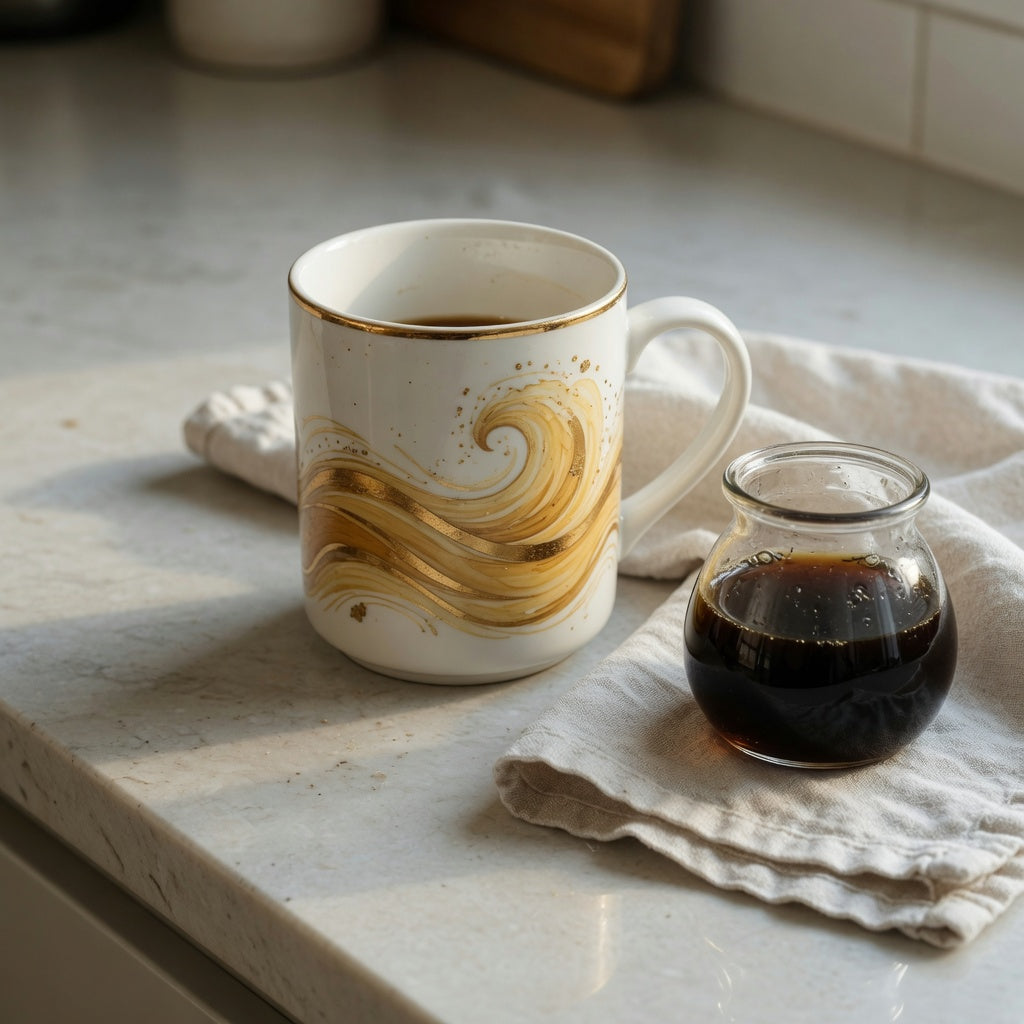
Decorative Golden Waves Ceramic Coffee Mug: What to Compare
Reading time: about 12 minutes
Two wave mugs can sit side by side on our packing bench and still be different products. One has a gold-colored print fired into the glaze. The other has a bright rim that catches the light like metal. Both get called a decorative golden waves ceramic coffee mug in search results. The roommate who reheats yesterday's coffee in the office microwave does not care which photo looked better. They care whether the base and the care line allow it.
That question reaches our store more often than questions about the shade of gold. Some pieces are glazed ceramic or porcelain with a printed wave in gold, or in blue and gold. Others carry real metal: a luster rim, gold leaf, a gold handle, or a coated band. Thumbnails make those groups look interchangeable. Care labels do not. If you are comparing our Golden Waves Kio coffee and tea mug, the live listing is the only place that can state material, capacity, and appliance wording. We will not assign those facts from a similar photo or from another wave cup. To judge handle shape against other cups we stock, start with the unique coffee mugs and run the same checks.
Is the gold a printed wave, a luster rim, or a coated handle?
Judge the decoration under ordinary kitchen light, not under a retouched photo. A printed, underglaze, or in-glaze wave sits in the ceramic surface. The color can look metallic without being a separate metal skin. Luster, leaf, and a coated handle have a different sheen. They often sit on top of the glaze, and they usually land where a lip or a finger rests.
Pages in this style family contradict one another. A printed wave may be sold as microwave and dishwasher safe. A gold-trim cup with a similar photo may say hand wash only and not microwave safe. Neither sentence transfers to a different brand, or to our listing, just because the motif matches. On the bench we treat the care line as part of the product, the same way we treat the handle.
- Where does the gold sit? Under the glaze, on the rim, across the handle, or as a broader coating. Location tells you what your mouth and your fingers actually touch.
- Is there a microwave symbol or a do-not-microwave line? Silence is not a yes. A claim on a different wave mug is not a yes either.
- Does the wash line protect the finish, or only the clay body? A body that survives the rack can still lose the gold that made you want the cup.
| What you see | What to verify on the listing | Why it changes the buy |
|---|---|---|
| Gold-colored wave print | Is the color in or under the glaze, and is there a microwave and dishwasher mark? | A print can be a daily cup only if the maker says the finished piece is. |
| Luster, leaf, or gold rim | Does the page require hand washing, and does it ban the microwave? | The metal finish is what dulls or misbehaves, not the clay body alone. |
| Gold handle or metallic coating | Any warning about microwaves or extremely hot liquid? | Heat can move into the handle or stress a coated wall. |
| Not-for-food-use base mark | Is there a permanent warning, or a hole through the well? | That cup stays off the coffee station. |
What should the base of a decorative golden waves ceramic coffee mug say about food use?
Turn the mug over before you commit to the pattern. Food-use status is a mark on the base and on any hangtag. It is not a feeling you get from a gold wave.
Under U.S. food rules, ceramic that looks suitable for food is treated as food-use ware unless it carries a required conspicuous warning and a permanent version of that warning on the base, or unless a hole is bored through the surface that would hold food. A piece marked not for food use, including the line Not for Food Use—May Poison Food, should not cook, serve, or store food or drinks. Washing and boiling do not pull lead out of a glaze or decoration that was never fired safely.
Lead has been used in some glazes and decorative decals. Used to prepare, serve, or hold food, that ware can leach lead into the drink. The FDA states there is no known safe level of lead exposure. High lead exposure in utero, in infancy, and in early childhood can cause neurological effects such as learning disabilities, behavior difficulties, and lowered IQ. In adults, chronic lead exposure is associated with kidney dysfunction, hypertension, and neurocognitive effects. For cups and mugs, the FDA action level for lead is 0.5 micrograms per milliliter of leaching solution.
Cadmium is the quieter question, and it still belongs in the comparison. FDA compliance guidance on pottery notes that some imported and domestic ceramic ware has carried significant extractable cadmium, that acid foods can pull it out, and that continued food use of such ware could cause chronic cadmium poisoning. For small hollowware — ceramic articles deeper than 25 millimeters with capacity under 1.1 liters — the guideline is 0.5 micrograms of cadmium per milliliter of leaching solution in any one of six units, using test methods that include ASTM C738.
Everyday commercial factory pottery is much less likely to be the problem than crude handmade ware, antiques, damaged pieces, uncertain sources, or bright orange, red, or yellow decoration. That is not a free pass for every gold accent. Gold on the lip is where your mouth meets the cup, so the question is not only the interior wall. If a listing never says the piece is for food, ask the seller. Do not pour coffee into a cup sold as ornament because the wave looks drinkable. We would rather lose a decorative sale than watch a shelf piece become a breakfast cup.
How much of the stated ounce size can you actually carry?
A capacity figure in ounces or milliliters is often a fill to the lip. Nobody carries a hot latte that way. Milk, foam, or a short walk from the kettle to a desk all need headspace. A brim-full mug spills on the first step. Tea drinkers who like the water high will use more of the stated size than someone leaving room for milk.
Compare the number in both ounces and milliliters so you are not mixing systems, then ask whether it is a lip-full measurement. On the Golden Waves Kio listing we will not assign a volume from the photo or from a similarly named cup. If the page does not state ounces, milliliters, or a fill note, size stays unverified. Do not borrow 11, 12, or 15 ounces from other wave mugs online. Those figures belong to other products.
Height changes the drink more than the ounce count suggests. The same stated volume in a taller, narrower cup sips differently and balances differently on a small handle. A wide, low cup sits steadier on a crowded desk and cools faster. Neither shape is a travel mug.
This style is a poor commute cup. A decorative open mug does not belong in a bag unless the listing you are reading actually includes a sealing lid. It is also the wrong tool if you need one vessel for noon soup and a short espresso. Match the volume to the drink you repeat. If the household rule is a shared dishwasher every night, a plain glaze without metallic trim will frustrate you less. That plainer cup may still be among the other cups we keep with the unique coffee mugs. The wave piece is the one you choose when the finish is worth the extra care.
Which layer fails first: luster, overglaze paint, or an in-glaze print?
Dishwasher safe, but please hand wash the gold, sounds like a contradiction. It is usually two sentences about two layers. The ceramic body may survive the rack. Metallic luster, overglaze paint, or a surface decal may not.
In our experience the failures are quiet. A rim clouds after a few cycles. A gold line thins where the lip meets the cup. A printed wave scuffs where a rack tine rubbed it. Abrasive sponges do the same job more slowly at the sink. If the gold is why you wanted the mug, wash it by hand with a soft cloth, keep bleach and scouring powder off the band, and do not leave it soaking with a metal spoon inside.
- Metallic luster or leaf. The shine is what dulls. The mug can come out whole and still look tired.
- Overglaze paint or a surface decal. Color sitting above the glaze can fade, peel, or chip at edges and high spots.
- In-glaze or underglaze print. Color fired into or under the glaze is the more wash-tolerant of the three, but only when the maker says the finished mug is dishwasher safe. The wave motif is not proof.
Heat shock is a different crack. Boiling water into a cold thin wall, or a hot cup set on a wet stone counter, is how hairlines start. That is the ceramic, not the gold. A chip on the drinking rim is a food-surface problem either way. Retire a mug when you can feel a crack or when the lip is chipped. A decorative golden waves ceramic coffee mug is the wrong pick for a whatever-survives-the-machine rule when the gold is the point.
When is a metallic coating a reason to skip the microwave?
Microwave safety is a label, not a guess from the word gold. USDA food-safety guidance says to use only cookware manufactured for microwave use, and that glass, ceramic, and plastic should be labeled for the microwave. Aluminum foil does not go in. We would not heat an unmarked mug, even if another wave design online claims it is fine.
Metal is a separate reason to stop. On March 21, 2024, the U.S. Consumer Product Safety Commission announced a recall of about 440,500 ceramic mugs with a metallic coating, sold in Starbucks-branded holiday gift sets in 11-ounce and 16-ounce sizes. Microwaved, or filled with extremely hot liquid, those mugs could overheat or break, posing burn and laceration hazards. The agency reported 12 incidents and 10 injuries, including burns, blisters, and one cut. That record is about those coated mugs. It is not a finding against every gold-wave design. It is why a metallic surface and a gold-colored print should not share one care assumption.
Read the Kio listing for a microwave mark or a clear do-not-microwave line. If the copy describes metal, luster, leaf, or a coating, and it never clears microwave use, do not test it with a cup of coffee. The documented problems with metallic-coated ceramic mugs are overheating and breaking, which can burn or cut. A mug that looks uncracked afterward is not cleared for the next drink. Take it out of food service and ask the seller if it was heated against the label.
Handle comfort belongs in the same minute. Some handles stay pleasant with a hot pour. Some transfer heat, especially on a thin wall or where a metallic coating is involved. At the sink, fill a new mug with hot tap water before you use a boiling kettle, and see whether you can hold it for a normal walk to the table. That test beats a studio photo of a floating handle.
Gifting works when the recipient wants a cup they will display and wash by hand. It is a weak gift for a kitchen where everything goes in the machine and the microwave. Do not assume a gift box, a sleeve, or a saucer unless the current listing includes them. Pass the care lines along with the mug, or the gold will be the first thing a helpful recipient ruins.
A counter check before this mug goes in the cart
Run the lines in order. Skip any line the product page already answers in plain language.
- Confirm a food-use mug, not ornamental ware with a not-for-food-use warning.
- Name the gold: print or in-glaze color, versus luster, leaf, rim band, gold handle, or coating.
- Find the microwave instruction. No label means do not microwave it.
- Find the wash instruction. Real metal or overglaze means hand washing if the finish matters to you.
- Read capacity in ounces and milliliters, and decide whether you can live below a brim fill.
- Check the handle against the hand that will hold a hot drink.
- See whether the wave is one face or a wrap. One-sided art disappears when the mug turns toward a guest.
- For a gift, confirm packaging on the listing, then pass along the same care lines.
If those answers match how you actually wash and heat drinks, open the current Golden Waves Kio listing and decide from the facts on that page, not from a similar photo. If you need a plainer glaze for nightly dishwashing, or a different handle for a smaller hand, stay with the unique coffee mugs for a kitchen that runs the dishwasher every night and pick the cup that fits the kitchen you have.
Frequently asked questions
Is a decorative golden waves ceramic coffee mug microwave safe?
Only if that exact mug is labeled for microwave use. Gold-colored print and real metallic gold are not the same decoration, and sellers in this style publish opposite care lines. USDA guidance is to microwave only containers labeled for that use. If the current listing is silent, or if it describes metal, luster, leaf, or a coating, do not microwave the mug to find out.
Will a dishwasher strip gold off even if the page says dishwasher safe?
It can dull metallic luster, gold leaf, or overglaze color while the ceramic body stays intact. That is why some pages say dishwasher safe and still recommend hand washing to protect the gold. If the finish matters, use a soft cloth and skip scouring pads on the rim.
How do I tell a food-use coffee mug from a decorative-only cup?
Look for a permanent not-for-food-use warning on the base, and any hangtag that says the piece is not for food or may poison food. Ware that looks like a normal drinking cup is treated as food-use unless it carries that kind of warning or has a hole through the food-contact surface. Do not serve coffee in a cup marked ornamental. Washing it first does not remove lead.
What capacity is practical once I leave room under the rim?
Use the ounce or milliliter figure on the current listing, then leave headspace for milk, foam, or carrying. A brim measurement overstates what you can walk with. If the page does not state a volume, treat size as unknown instead of estimating from the photograph.
I microwaved a gold-leaf mug and it did not crack. Can I keep drinking from it?
A missing crack is not a clearance. In March 2024 the CPSC recalled about 440,500 metallic-coated ceramic mugs after reports that microwaving them, or filling them with extremely hot liquid, could make them overheat or break. If yours was heated against its care label, stop using it for food and ask the seller before the next pour.
More from our blog
Read more
Gradient Coffee Tea Mug for Coffee Lovers Home Decor: Compare
A gradient mug has to hold up in a real kitchen and still look right on an open shelf. We compare glaze versus print, pour size, handle care, microwave limits, and food-contact checks before you bu...
Read more
Ceramic cappuccino mug vs cup: 170, 200, or 270 ml
A ceramic cappuccino mug and a cappuccino cup often share a search, not a serving size. We line up listed 170 ml, 200 ml, and 270 ml everyday fits against a small milk-coffee pour, and we say what ...
Read more
Leave a comment
This site is protected by hCaptcha and the hCaptcha Privacy Policy and Terms of Service apply.