
Flat White Cup Replacement Purchase Product Shortlist Guide: 3 Options
Reading time: about 9 minutes
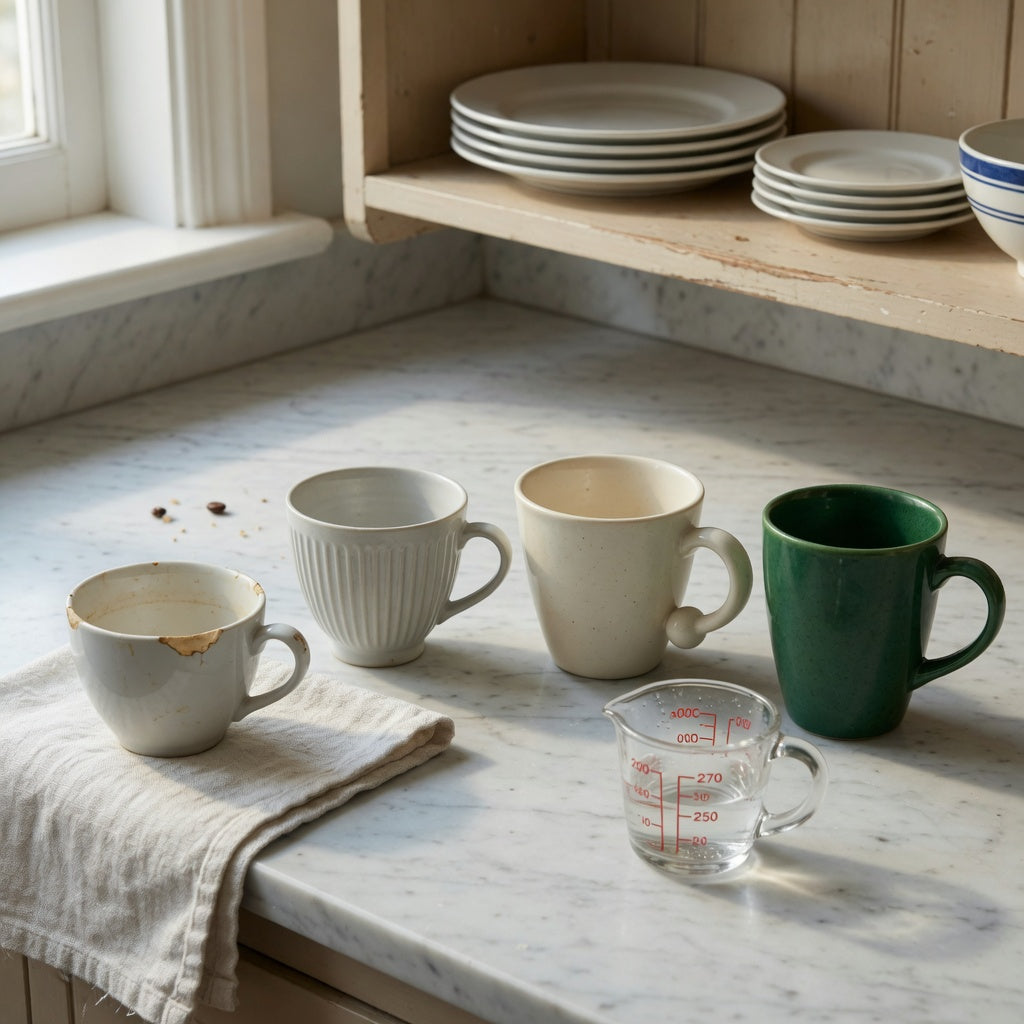
A rim chip at the drinking edge, a handle you no longer trust, or a usual milk pour that reaches the brim gives you a precise replacement brief. This flat white cup replacement purchase product shortlist guide starts with that failed detail and compares only three current capacity options: Pleated at 200 ml, Ball Handle at 250 ml, and Emerald at 270 ml.
In our store, we find that replacement decisions become easier once the shopper separates the old cup's actual limitation from everything it did well. The verified comparison here is capacity. We use that fact to discuss potential headroom, but we do not assign a required drink ratio, call any size a barista standard, or claim that a particular shape was purpose-built or cafe-tested.
What did the old cup get wrong at the rim, handle, or fill line?
Start with the cup you are retiring. If it has a sharp chip, visible crack, or loose handle, set it aside rather than making another drink in it. You can recreate your normal pour in a safe vessel and transfer it to a measuring jug to record the finished volume.
We use headroom to mean the space between the finished drink and the rim. It matters on a kitchen counter because a cup can technically hold your drink while still feeling too full to carry. A few minutes of measuring helps prevent a replacement that repeats the same problem.
- Record your usual finished volume: Measure the coffee and milk together, not just the coffee portion. This is your working volume rather than a prescribed recipe.
- Note the old fill line: Did the drink sit comfortably below the rim, or did foam and liquid reach the edge before you picked it up?
- Identify the replacement trigger: Capacity problems call for a different size. Accidental chips or a lost cup may not.
- Write down your grip preference: Decide whether you want to repeat the old handle style or deliberately try the Ball Handle format.
- Check the storage and washing routine: Measure cabinet clearance and note whether you need confirmed dishwasher or microwave compatibility.
A broken handle does not prove that every cup with that handle format will fail, just as a larger cup does not automatically solve damage caused by impact or crowded storage. We separate those issues before recommending a replacement.
How do 200 ml, 250 ml, and 270 ml change your capacity margin?
The three options sit within a 70 ml range, but the steps are uneven. The Pleated coffee and tea cup is 200 ml. The Ball Handled coffee and tea mug is 250 ml, which adds 50 ml over the Pleated. The Emerald coffee and tea mug is 270 ml, adding another 20 ml over the Ball Handle and 70 ml over the Pleated.
| Option | Verified capacity | Change from 200 ml | Choose when | Skip when |
|---|---|---|---|---|
| Pleated | 200 ml | Baseline | Your old 200 ml capacity worked and the replacement is due to loss or accidental damage | Your usual drink already crowded a 200 ml cup |
| Ball Handle | 250 ml | 50 ml more | You want a meaningful capacity increase and specifically prefer its handle format | You need the largest capacity in this three-product shortlist |
| Emerald | 270 ml | 70 ml more | Lack of room above your normal pour was the main problem | Your usual drink fits comfortably in 250 ml and the extra 20 ml has little value |
For a simple example, a finished drink measuring 180 ml leaves a nominal capacity margin of 20 ml in the Pleated, 70 ml in the Ball Handle, and 90 ml in the Emerald. That arithmetic is not a recommended fill level. Actual usable headroom also depends on internal shape, how capacity was measured, and how far below the rim you prefer to stop.
If your normal drink falls outside this compact range, do not force one of these three into the shortlist. Browse the wider unique coffee mugs collection for other current shapes and capacities.
A flat white cup replacement purchase product shortlist guide by scenario
Each recommendation below starts with the limitation of the cup being replaced. That matters more than choosing the largest option or the most distinctive design.
- Your old 200 ml cup felt too full: Shortlist the 270 ml Emerald mug because it provides the largest nominal capacity of these three. Skip it if a 250 ml cup already gives enough margin and you prefer the Ball Handle design; the difference between those two is only 20 ml.
- You want more room and a deliberately different handle format: Shortlist the 250 ml Ball Handle mug. It adds 50 ml over the Pleated and gives you a clearly different handle choice. Skip it if your priority is maximum capacity, and do not treat the handle name as a durability guarantee.
- Your old 200 ml capacity was right, but the cup was lost or damaged: Shortlist the 200 ml Pleated cup to stay in the same nominal capacity range while changing the appearance. Skip it if insufficient headroom contributed to spills; replacing 200 ml with another 200 ml will not create more capacity.
- You need a sealed commute cup, a much larger iced drink, or a highly specific cabinet footprint: Skip this three-product shortlist until those requirements are verified. Explore other unique mug shapes, or move to a different drinkware category if a leak-resistant lid is essential.
There is no universal best option here. The Pleated preserves the smallest verified capacity, the Ball Handle creates the largest step between adjacent options at 50 ml, and the Emerald provides the most nominal room. Your reason for replacing the old cup decides which difference is useful.
Which option fits a small cabinet, office desk, or iced drink?
Capacity does not reveal a cup's outside dimensions. A 270 ml vessel may gain volume through height, width, or a combination of both, so we do not use capacity as a substitute for cabinet measurements. Check the current product page for external dimensions and handle projection if shelf fit is a hard requirement.
- Small kitchen cabinet: Measure shelf height and the horizontal gap between neighboring handles. Choose capacity first, then confirm the live listing fits those limits. If exact dimensions are not stated, do not assume the 200 ml option has the smallest outside footprint.
- Office desk: The 250 ml and 270 ml options hold more than the 200 ml Pleated, which can be useful if your current cup feels undersized. These are cup and mug listings, not confirmed sealed travel vessels, so verify lid requirements separately before carrying a drink through an office.
- Iced coffee: Ice occupies part of the stated capacity. Put your normal amount of ice and liquid into a measuring jug; if the combined volume approaches 250 or 270 ml, this compact shortlist may still feel crowded.
- Replacing one cup in a visible set: Compare current product photos with the cups you already own under neutral light. A familiar product name or similar capacity does not guarantee an exact color, finish, or proportion match.
On a busy counter or desk, extra capacity only helps if you leave a practical carry line below the rim. Filling a larger cup to its maximum simply moves the same spill problem to a different vessel.
What must you verify about material, dimensions, and care before checkout?
Because we sell this category, we prefer to state where the verified facts stop. The supplied catalog facts establish the three capacities, but they do not establish a material, exact outside dimensions, dishwasher compatibility, microwave compatibility, or resistance to rapid temperature changes. Confirm those details on the current product page rather than inferring them from the product name or appearance.
- Material and finish: Check the listing for the exact material description and any finish-specific care. Do not assume two similarly styled cups require identical handling.
- Dishwasher instructions: Use a dishwasher only if the current care guidance permits it. If allowed, position the cup so the rim and handle cannot knock against adjacent items during the cycle.
- Microwave instructions: Look for explicit compatibility. Capacity alone says nothing about whether a cup should be microwaved.
- External measurements: Verify overall height, body width, base width, and handle projection where listed. These are the dimensions that decide cabinet, saucer, and dishwasher-rack fit.
- First-use inspection: Under bright side light, check the drinking rim, body, base, and handle attachment for a chip, hairline crack, or movement. Wash the cup according to its stated instructions before the first drink.
A dishwasher-safe description, if provided, does not make a cup impact-proof. Avoid wedging a handle between rack wires, stacking cups unless their shape and instructions support it, or letting the drinking rim contact another hard item. Those simple handling choices matter during repeated kitchen use.
Can this five-minute check prevent another poor replacement?
- Set aside any cup with a sharp chip, crack, or loose handle.
- Measure the volume of your normal finished drink in milliliters.
- Subtract that amount from 200, 250, and 270 ml to compare nominal capacity margin.
- Confirm the preferred product's material, care instructions, outside dimensions, and handle fit on its current page.
- Write one reason to choose and one reason to skip it. If the skip reason repeats the old cup's limitation, remove that option.
Used this way, the flat white cup replacement purchase product shortlist guide is not a ranking of three mugs. It is a filter that keeps an attractive option from slipping through when it does not fix the original problem. Once one cup passes all five checks, open its linked product page and verify the live details before ordering.
Frequently asked questions
How do I use a flat white cup replacement purchase product shortlist guide after a rim chip?
Do not use a sharply chipped cup for another test drink. Recreate your normal coffee-and-milk volume in a safe vessel, measure it in milliliters, and compare that amount with 200, 250, and 270 ml. Then verify material, dimensions, and care on the current product page.
Should I replace a cramped 200 ml flat white coffee cup with 250 ml or 270 ml?
The 250 ml Ball Handle adds 50 ml of nominal capacity, while the 270 ml Emerald adds 70 ml. Choose 270 ml if maximum headroom is the priority; choose 250 ml if that extra 20 ml is less important than the Ball Handle format. Neither size represents a required flat white ratio.
Is the 270 ml Emerald automatically the best cup for flat white?
No. It has the largest verified capacity in this shortlist, but the best cup for flat white is the one that fits your normal finished volume, preferred fill line, grip, storage space, and care routine. A 200 ml or 250 ml option may be the more practical replacement if the old cup's capacity was not the problem.
Can I assume the Ball Handle is stronger than a standard handle?
No durability comparison is established by the verified catalog facts. Choose the Ball Handle because you prefer its format and 250 ml capacity, not because the name proves greater strength. Check the current images and specifications for grip clearance before ordering.
What should I do if none of these three capacities fits?
Write down your minimum finished-drink capacity and maximum cabinet dimensions, then remove every option that misses either limit. Browse CoffeifyMug's full unique coffee mug collection with those two numbers in hand rather than buying the closest-looking replacement.
More from our blog
Read more
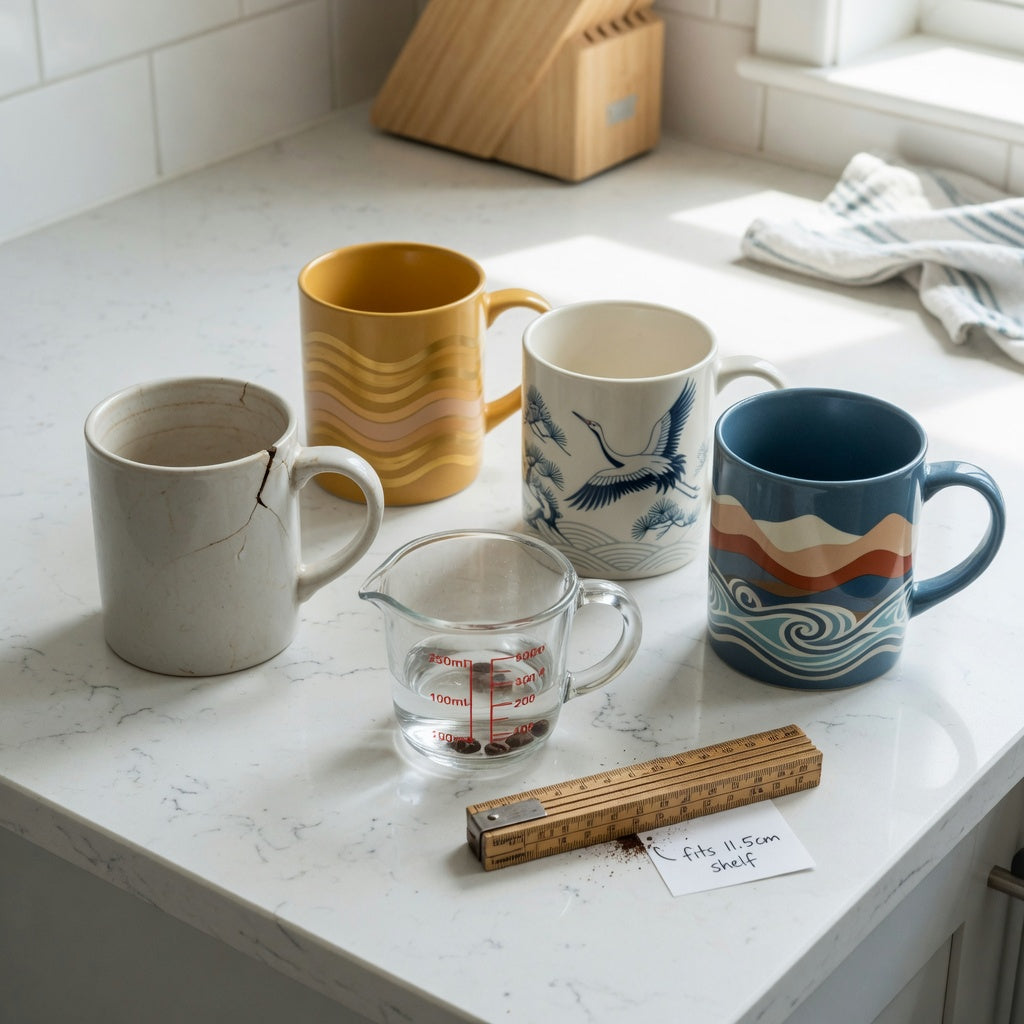
Coffee Mug Gift Idea Replacement Purchase Product Shortlist Guide
Replace the problem, not just the pattern. This scenario-based shortlist compares three CoffeifyMug designs while accounting for capacity, cabinet fit, grip, care routine, and the recipient's style.
Read more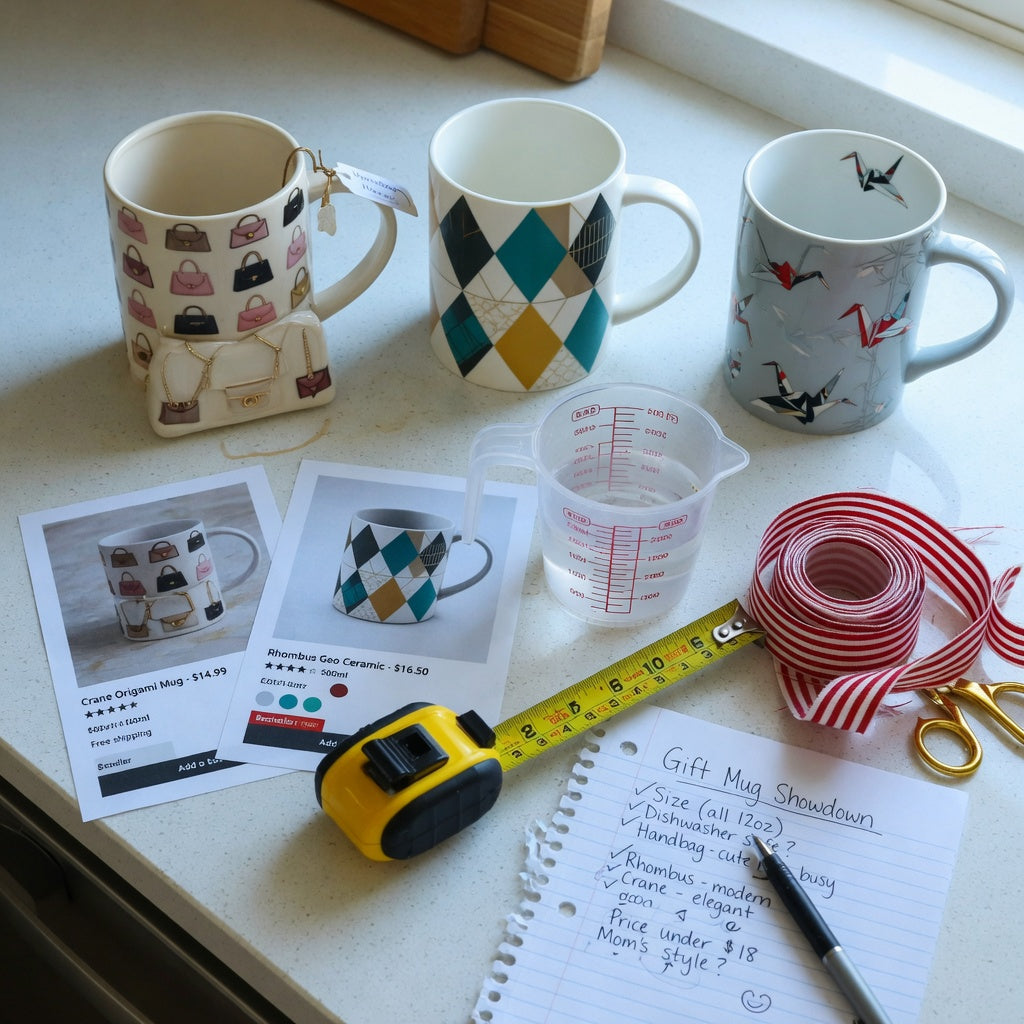
Unique Coffee Mugs for Gifts: First-Time Buyer Practical Checklist
Compare CoffeifyMug's Handbag, Rhombus, and Crane designs against the recipient's drink size, cabinet or desk space, grip, cleanup routine, and gifting expectations. Missing listing details stay ma...
Read more
Leave a comment
This site is protected by hCaptcha and the hCaptcha Privacy Policy and Terms of Service apply.