
Flat White Cup First Time Buyer Practical Purchase Checklist
Reading time: about 9 minutes
A cup can look compact in a product photo and still be wrong the moment you finish a morning pour. On the kitchen counter, the mismatch is obvious: milk and foam sit closer to the rim than expected, or the vessel leaves more empty capacity than you wanted. Our flat white cup first time buyer practical purchase checklist starts with measured capacity because that is the verified comparison available for these three CoffeifyMug options.
We sell this category, and our practical rule is to separate a listed fact from a visual impression. We can confirm capacities of 200 ml, 250 ml, and 270 ml. The supplied catalog facts do not confirm the material, external dimensions, weight, wall thickness, capacity-to-brim convention, or dishwasher and microwave status for every option. Those details belong on your checkout list rather than in a guess based on photos.
What does the flat white cup first time buyer practical purchase checklist verify?
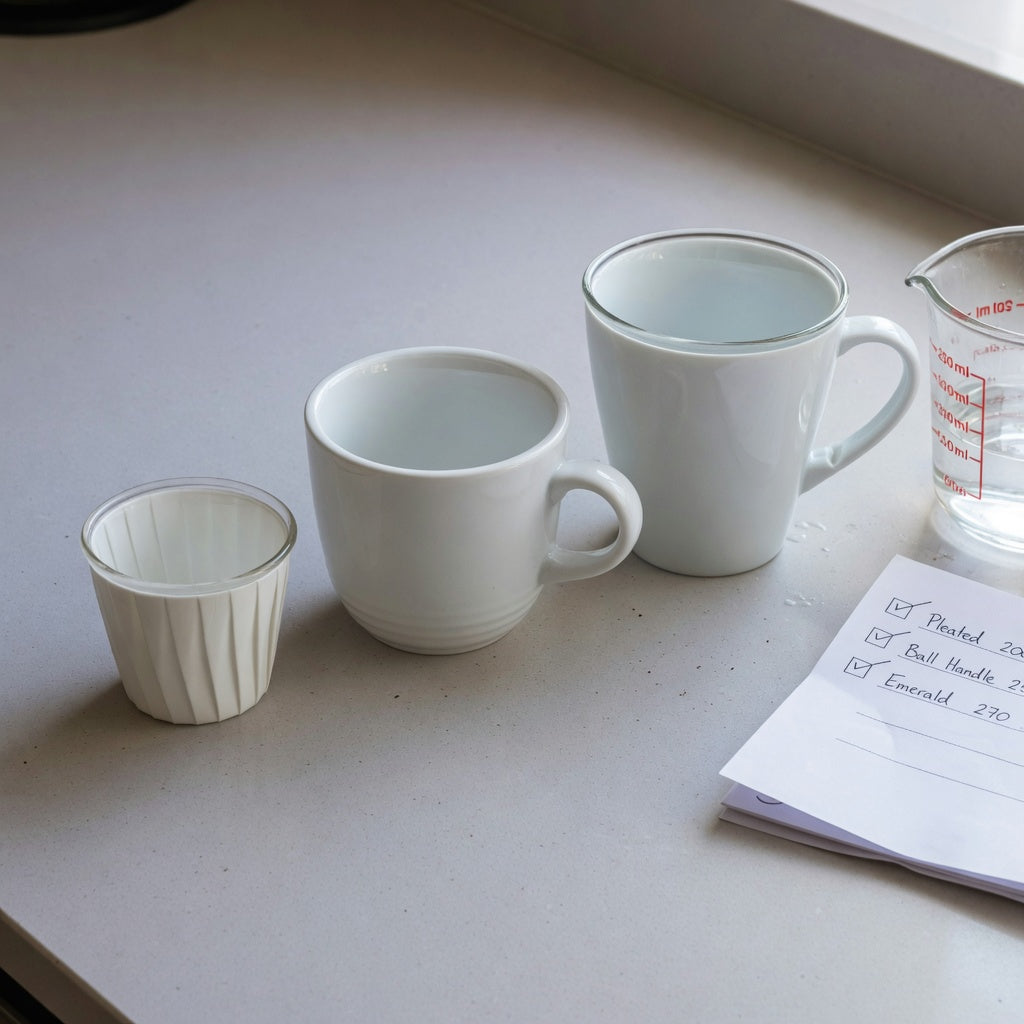
The Pleated coffee tea cup is listed at 200 ml, the Ball Handled coffee tea mug at 250 ml, and the Emerald coffee tea mug at 270 ml. For the same measured drink, the Ball Handled option provides 50 ml more stated capacity than the Pleated. The Emerald provides 70 ml more than the Pleated and 20 ml more than the Ball Handled.
| Option | Verified capacity | Same-pour comparison | Reason to shortlist it |
|---|---|---|---|
| Pleated | 200 ml | Least nominal unused capacity of the three | Your regular drink measures comfortably below 200 ml and you want the smallest stated capacity in this comparison |
| Ball Handled | 250 ml | 50 ml more capacity than the Pleated | You want a middle capacity with more tolerance for an inconsistent pour |
| Emerald | 270 ml | Most nominal unused capacity of the three | You want the greatest capacity margin while staying within this compact group |
These numbers support a capacity comparison only. They do not establish a required drink ratio, barista standard, purpose-built geometry, cafe-tested performance, heat retention, or a particular hand feel. Internal shape also affects the physical distance between the drink and rim, so a larger capacity does not tell us the exact rim clearance without dimensions.
How much capacity margin will your usual pour leave?
The useful starting number is the volume you actually make, not a generic recipe. Make your normal flat white in the cup you currently use, note the finished fill level, and later recreate that level with water. Transfer the water to a measuring jug marked in milliliters. This gives you a practical estimate without prescribing an espresso-to-milk ratio.
- Measure the volume that reaches your usual finished fill line.
- Subtract that number from 200 ml, 250 ml, and 270 ml.
- Consider how far you carry the cup and how variable your foam tends to be.
- Remove any option whose stated capacity is below your measured volume.
For example, a measured 180 ml fill would leave 20 ml of nominal unused capacity in the Pleated, 70 ml in the Ball Handled, and 90 ml in the Emerald. That is comparison math, not a recommended flat white size. Foam volume, internal width, wall shape, and whether a listing measures capacity to the brim can all change the usable margin.
Which cup fits a controlled pour, an office desk, or a gift?
- For a repeatable kitchen-counter pour: Shortlist the 200 ml Pleated cup if your measured drink sits comfortably below its stated capacity. Its reason for being on the list is simple: it is the lowest-capacity option here. The trade-off is less tolerance for extra milk or foam.
- For variable pours or a short walk to a desk: Consider the 250 ml Ball Handled mug. It adds 50 ml of stated capacity over the Pleated, which can provide more volume margin for the same drink. It is not confirmed as spillproof, and no lid or travel function is claimed.
- For the most capacity margin in this group: Check the 270 ml Emerald mug. It gives the same pour 70 ml more nominal space than the Pleated. That does not make it suitable for every large latte or iced drink.
- For a gift: Do not treat the middle size as a universal default. Check what the recipient already uses, how large their normal drink is, and whether the live listing confirms material, care, handle dimensions, and return terms.
In our store, we would not call one option the best cup for flat white drinks based on capacity alone. A buyer making a controlled 160 ml drink has a different requirement from someone whose morning pour changes from day to day.
Which live listing details must be confirmed before checkout?
A product name and capacity are not a complete specification. Open the current listing and verify these points before placing the order.
- Capacity wording: Confirm that the selected variant still shows 200 ml, 250 ml, or 270 ml. Check whether the page explains if this is a brim capacity or a comfortable serving capacity.
- Material: Do not infer porcelain, stoneware, glass, or another material from the finish in a photo. These terms are not interchangeable, and the verified facts supplied for this comparison do not identify the material.
- External dimensions: Look for total height, rim diameter, base diameter, handle projection, and handle opening. These measurements determine cabinet clearance, espresso-machine clearance, desk footprint, and finger space.
- Weight and wall thickness: If they are not listed, treat them as unknown. Photos cannot reliably establish how heavy the cup feels or how quickly it changes temperature.
- Care instructions: Dishwasher-safe and microwave-safe are separate claims. Confirm each one for the exact product or finish rather than assuming all drinkware shares the same care rules.
- Included pieces: Verify whether the order contains one cup or additional pieces. Do not assume a saucer, spoon, lid, or gift box is included unless the listing says so.
- Variation and returns: Read any finish-variation language, damage procedure, and current return terms. Decide before buying how much visual variation you would accept.
Photos remain useful for color and overall style, but they are not substitutes for dimensions or care instructions. If a required fact is absent, ask our store before ordering rather than filling the gap with an assumption.
What should you inspect before the first wash or gift handoff?
Our team recommends inspecting drinkware under good light before removing labels, washing it, or handing it to a gift recipient. That keeps the item in its arrival condition if you need to document a problem.
- Run your eyes around the rim and foot for chips, sharp spots, or visible cracks.
- Check both handle attachment points for a hairline crack, gap, or rough edge.
- Place the empty cup on a flat, dry counter and test for rocking. Rotate it and try a second surface before deciding the base is uneven.
- Inspect the interior drinking surface for visible cracks or rough, unfinished areas.
- Compare the product, finish, and number of pieces with the order confirmation.
These are standard inspection points for cups and mugs, not a claim that these products commonly arrive with defects. If you find an issue, photograph the item and packaging before use and follow the current store procedure. Only use a dishwasher or microwave after the live care instructions confirm that the specific cup is suitable; an appliance cycle should not be used as a compatibility test.
When is this compact 200-270 ml group the wrong match?
The 270 ml Emerald is the largest option in this comparison, but largest here does not mean large in every use case. These cups are not a strong match for someone who mainly makes high-volume milk drinks, needs substantial room for ice, or wants one vessel to hold a long tea serving.
Choose another style if you require a sealed commuting lid, confirmed stackability, exact under-machine clearance, a specified material, or a particular cup weight. Ice also displaces a surprising amount of liquid, so even the 270 ml option may feel restrictive for an iced coffee. In those situations, browse the unique coffee mugs collection and compare larger or differently shaped options rather than forcing a compact flat white coffee cup to do a larger mug's job.
Which boxes should be checked before you buy?
Use this flat white cup first time buyer practical purchase checklist with each product page open:
- My usual finished drink volume is measured rather than guessed.
- The selected capacity leaves a margin I am comfortable carrying.
- The live listing confirms the material I expect.
- Height, rim, base, and handle measurements fit my cabinet, machine, hand, and desk.
- Dishwasher and microwave instructions match my routine.
- The listing clearly states what is included in the order.
- I have read the variation, damage, and return terms.
- I am not relying on an unverified claim about geometry, heat retention, or cafe performance.
If a detail is essential and still unknown, remove that candidate or contact the store. A product photo can help you choose a style, but it cannot answer a missing measurement or care instruction.
Frequently asked questions
How do I use the flat white cup first time buyer practical purchase checklist?
Measure the volume of your normal finished drink, compare it with the verified 200 ml, 250 ml, and 270 ml capacities, and calculate the nominal unused capacity. Then confirm material, external dimensions, care instructions, included pieces, and return terms on the live product page.
Is a 200 ml flat white coffee cup too small?
Not automatically. It depends on the volume you make and how much carrying margin you want. A 180 ml fill would leave only 20 ml of nominal unused capacity in a 200 ml cup, so a variable pour may be easier to manage in the 250 ml or 270 ml option.
Is the 250 ml Ball Handled mug the best cup for flat white drinks?
No single capacity is best for every buyer. The Ball Handled mug is the middle option and provides 50 ml more stated capacity than the Pleated, but handle comfort, material, dimensions, and care must still be checked. We do not claim it follows a required flat white standard.
Are dishwasher and microwave use confirmed for these cups?
Those care details are not included in the verified catalog facts supplied for this comparison. Read the current care instructions for the exact product and selected finish. If either status is missing, ask the store before putting the cup through a dishwasher cycle or into a microwave.
Which option leaves the most headroom for the same pour?
By stated capacity, the 270 ml Emerald leaves the most nominal unused volume for the same measured drink. It provides 20 ml more capacity than the Ball Handled and 70 ml more than the Pleated. Exact physical distance below the rim remains unknown without internal dimensions and a stated capacity convention.
Measure one normal pour, then open the Pleated, Ball Handled, and Emerald listings side by side. Choose the smallest capacity that leaves a margin you can use and passes every material, dimension, care, and return check. If none does, move to the unique coffee mugs collection and compare a different size instead.
More from our blog
Read more
Wassail Mug Shared Household Practical Purchase Checklist: Size Guide
Shared households rarely agree on one pour. Compare The Flow 400 ml, Morning and Night 440 ml, and The Rock 480 ml by serving habit and handle comfort, then verify material, dimensions, and care de...
Read more
Coffee Mug Gift Idea First Time Buyer Practical Purchase Checklist
Buying a decorative mug online is easy until capacity, handle fit, care, and packaging are unclear. This first-purchase checklist separates general mug checks from the visible design details of thr...
Read more
Leave a comment
This site is protected by hCaptcha and the hCaptcha Privacy Policy and Terms of Service apply.