
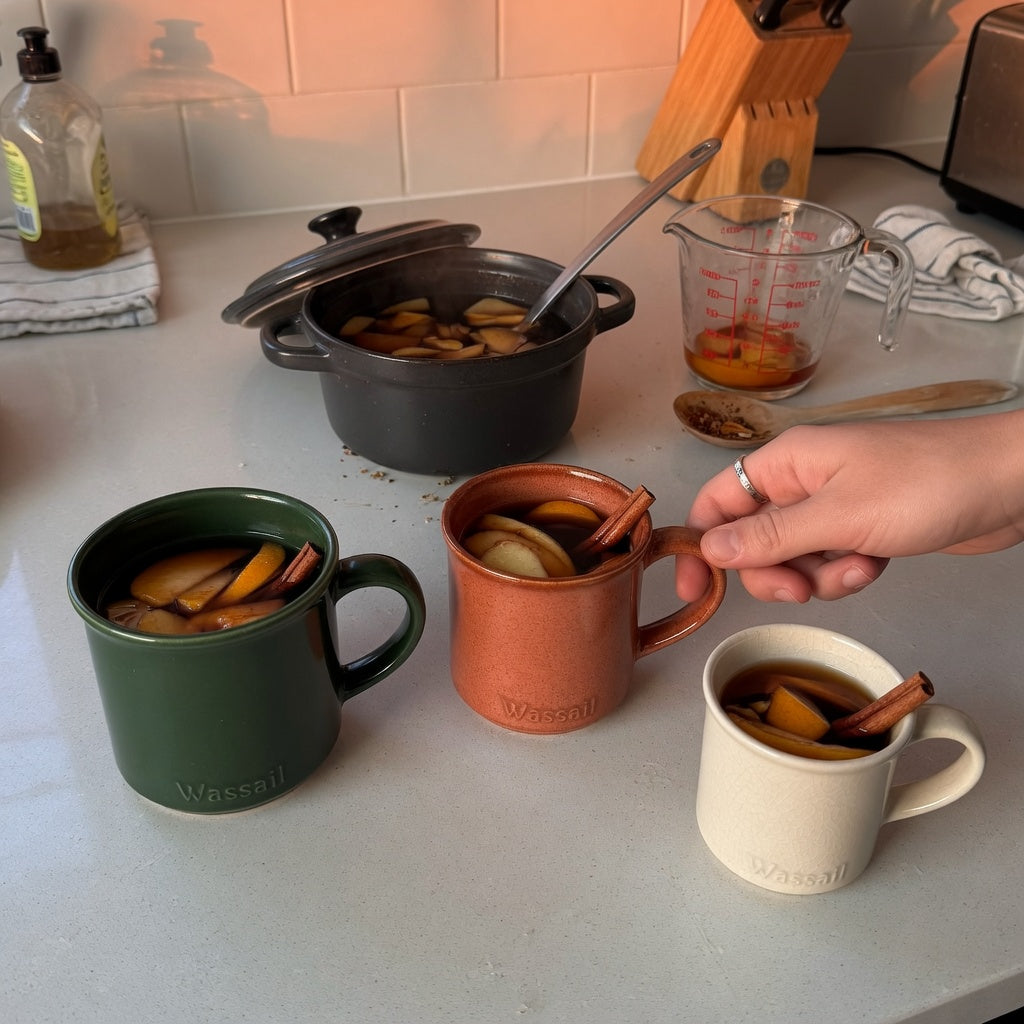
Wassail Mug Shared Household Practical Purchase Checklist: Size Guide
Reading time: about 10 minutes
At a shared kitchen counter, the first mug is rarely the last decision. One person wants a modest ladle, another expects a full pour, and the same handle may move from a smaller hand to a larger one. We see this during seasonal gift unboxings, after a crowded dishwasher cycle, and on office desks where a mug leaves the kitchenette and returns later. This wassail mug shared household practical purchase checklist keeps the choice tied to the three listed capacities and to handle comfort, while marking the details you still need to confirm on the product page.
Our team handles coffee and tea mugs at packing benches and on household counters. We have learned to judge a shared serving mug by workflow: how much gets poured, how often someone refills, how securely it is passed, and where it rests between uses. The largest capacity is not automatically the best choice; a consistent, comfortable pour is usually more useful than unused volume.
What changes when one wassail mug serves a shared household?
Start with the people who drink at the same time, not the total number of people in the home. A two-adult evening with one ladle each creates a different job for a mug than a five-person kitchen gathering where the pot stays near the stove. The same distinction shows up in a shared office: someone may fill once in the kitchenette and carry the mug to a desk, so capacity and a controlled grip matter more than a seasonal label.
- Light-pour households: A smaller first serving and regular top-ups make the lower listed capacity worth comparing.
- Refill households: A full first pour followed by another round makes the middle or largest listed capacity more practical to investigate.
- Mixed-hand households: The handle has to accommodate the smallest regular drinker without making the largest regular drinker pinch or twist the wrist.
Write down the pattern that describes most evenings. It gives you a better starting point than choosing by color, holiday wording, or the number of people who live in the house.
Which listed capacity matches your household's actual pour?
The verified comparison for this range gives us three listed capacities: 400 ml, 440 ml, and 480 ml. Those numbers support a useful first decision, but they do not establish a recommended fill line, recipe yield, heat retention, or serving size. Use your own ladle and routine to translate the label into a choice.
| Model | Listed capacity | Reader situation and why it fits | Next product page |
|---|---|---|---|
| The Flow | 400 ml | Compare this lower listed capacity first if most people take a smaller pour and expect to ladle again. | The Flow coffee tea mug |
| Morning and Night | 440 ml | Use the middle listed capacity as a compromise when preferences vary and the smaller option may feel tight. | Morning and Night coffee tea mug |
| The Rock | 480 ml | Compare the largest listed capacity first if drinkers usually want a fuller pour during longer shared servings. | The Rock coffee tea mug |
Measure one normal ladle into a measuring jug. Do not compare a brimful mug with a half-filled mug and call that a capacity problem. Listed capacity also does not tell you the mug's outside height or diameter, so check the product page if a cabinet shelf, dishwasher rack, or desk footprint is tight. These are separate model pages, not evidence of a bundled household set.
How can different hands judge handle comfort at the counter?
Handle comfort is the second decision, and it cannot be reduced to capacity. We do not assign a universal ranking to the three models without a published handle opening or grip measurement. In our store, we use a repeatable hand check so shoppers can compare what is shown on each product page or on a sample if one is available.
- Check two-finger clearance. Put two fingers through the handle opening and see if the knuckles clear the mug wall without being pressed together.
- Lift with cool water. Test an empty mug first, then add cool water to the household's normal fill level. Notice wrist angle and thumb stability without using a hot drink for the test.
- Pass it both ways. Move the mug across the counter from left to right and back. A shared handle should feel controlled for the person receiving it, not only for the person who picked it up.
- Set it down cleanly. Place the mug on the usual kitchen counter or office desk and release the handle. An awkward wrist turn or cramped finger position is useful evidence that the model is a poor fit.
For a smaller hand, a generous opening can feel loose; for a larger hand, a narrow opening can pinch. If you are shopping online, use the product photos and any published measurements rather than assuming that the 400 ml model has the easiest grip or that the 480 ml model has the most comfortable one. Capacity and handle comfort need separate checks.
What should you verify about material, dimensions, and care?
Capacity and handle comfort are the verified comparison points supplied for this article. Material, external dimensions, dishwasher or microwave suitability, and special temperature performance are not established here. We will not turn a product photo into a claim that a mug is ceramic, insulated, dishwasher-safe, or microwave-safe. Check the current product page for those specifics before checkout.
- Material: Find the exact material wording on the selected product page. Do not infer it from the mug's appearance or from the words coffee and tea mug.
- External dimensions: Capacity is internal volume, not cabinet height, base diameter, or handle width. Measure the shelf and dishwasher space if storage is limited.
- Care: Look for explicit dishwasher, microwave, and hand-wash instructions. If dishwasher use is stated, consider how the handle sits near rack tines; if no care instruction is clear, verify it instead of guessing.
- Unboxing condition: Our incoming-goods check covers rim chips, hairline cracks, an uneven base, and stress around the handle-to-body joint. Inspect before first use and photograph any damage while the packaging is still available.
- Quantity: Read the current ordering information on the product page. Do not assume that viewing three models means they arrive together or that ingredients and accessories are included.
This detail matters in a shared kitchen. A care instruction that suits one household's dishwasher routine may not suit a hand-wash-only setup, and a mug that fits a counter can still be awkward on an office desk. Treat the product page as the source for details outside the verified capacity and handle comparison.
Which single model fits a couple, a family table, or a gift?
Use the situation-first map below to choose one model to investigate. The links point to separate product pages; they are not a claim that the mugs are packaged as a set.
Two adults, smaller pours, and frequent top-ups
If your usual serving is deliberately modest, compare The Flow 400 ml coffee tea mug first. Its 400 ml listing gives you the lowest capacity in this comparison, so it is the logical starting point for a refill-friendly routine rather than an automatic choice for every couple. If your measured ladle nearly fills it, move up to the 440 ml page.
Mixed preferences at one table
If one person takes a light pour and another prefers more, start with the Morning and Night 440 ml mug. It sits between the two other listed capacities, making it a useful compromise to inspect before deciding that the largest option is necessary. Check its handle against both regular users' hands.
Fuller pours and longer shared servings
If the household usually chooses a fuller serving and returns for another round, compare The Rock 480 ml coffee tea mug. It is the largest listed option, which makes it the sensible page to inspect for volume first. Capacity alone does not establish heat retention, spill resistance, or handle comfort, so complete the hand and care checks.
Gift buyer with no reliable serving history
Open the unique coffee mugs collection and compare the three listed capacities side by side. A gift recipient's routine may favor a smaller pour, a middle option, or a fuller mug; the collection gives you a choice without pretending that one size suits every kitchen. Confirm current product details and quantity on the selected page.
When is this mug style a poor fit for your household?
Choose a different style if the main job is transport, spill control, or a specialized iced drink. The capacity figures here do not establish a lid, leakproof seal, car cup-holder fit, straw clearance, or ice capacity.
- Commute or car use: Use a travel mug designed for sealing and cup holders.
- Children's serving: Use a child-specific vessel if small size and spill resistance are the primary requirements.
- Iced coffee at a desk: A tall lidded tumbler may suit ice and transport better; do not infer those features from a capacity label.
- Tight storage: Check external dimensions and stacking behavior before choosing a shelf or dishwasher-rack solution.
Do not choose these links expecting spices, recipes, historical authenticity, or bundled ingredients. They are a starting point for comparing listed mug capacity and handle comfort for shared, open-table serving.
What belongs on a wassail mug shared household practical purchase checklist before checkout?
Run these checks in order. Each one removes a different kind of mismatch.
- Count simultaneous drinkers. Count the people likely to pour at the same time, not everyone who lives in the home.
- Measure the ladle. Pour one normal ladle into a measuring jug and compare the result with 400 ml, 440 ml, and 480 ml.
- Define the routine. Decide if most people prefer a light top-up, a full first pour, or repeated refills.
- Select a capacity to investigate. Use The Flow for the lower listed capacity, Morning and Night for the middle option, or The Rock for the largest listed capacity when that matches the routine.
- Test the handle. Check two-finger clearance, knuckle space, wrist angle, and handoff comfort for the smallest and largest regular hands.
- Verify missing details. Read the selected page for material, outside dimensions, care instructions, and current quantity information.
- Check the setting. Confirm the mug has a sensible home on the kitchen counter, office desk, shelf, or dishwasher rack. Choose a travel-specific style if it must go in a car or bag.
- Open the matching page. Start with the unique coffee mugs collection if you are undecided, then review the individual product page before buying.
For a quick decision, light pours point toward The Flow, mixed preferences toward Morning and Night, and fuller pours toward The Rock. Treat those as starting points, then let actual ladle volume and hand comfort decide.
Frequently asked questions
What belongs on a wassail mug shared household practical purchase checklist?
It should record simultaneous drinkers, the usual ladle volume, preferred pour size, handle clearance for the smallest and largest regular hands, and storage and care requirements. Compare the verified 400 ml, 440 ml, and 480 ml listings, then confirm material, dimensions, and care on the selected product page. Do not assume ingredients, historical authenticity, special temperature performance, or bundled items.
Is 400 ml enough for a shared-household wassail mug?
It can be, if most people take a smaller first pour and expect a refill. The Flow is the 400 ml option; if one normal ladle nearly fills it or the household prefers fuller servings, compare the 440 ml Morning and Night and 480 ml The Rock instead. Measure your own ladle before deciding.
How can I compare wassail mug handle comfort for different hands?
Look for a handle opening that gives the largest regular hand two-finger clearance without knuckle contact, while still giving a smaller hand control. If you cannot hold a sample, compare the product photos and any published measurements, and do not infer comfort from capacity alone. We treat handle comfort as a hand-specific check, not a universal model ranking.
Should I choose Morning and Night 440 ml or The Rock 480 ml?
Choose Morning and Night when your household sits between smaller and fuller pours and wants the middle listed capacity to test first. Choose The Rock when most drinkers prefer the largest listed capacity and refill less often. If the household is split, measure the ladle and test both handles before deciding; the numbers alone cannot settle grip comfort.
Are The Flow, Morning and Night, and The Rock sold as a matching household set?
Treat them as separate product-page choices, not as a confirmed matching set. The supplied catalog facts do not establish bundle contents or quantity, so do not assume the three models arrive together. If you need more than one mug, verify the current quantity information on the page for the model you select.
Write down your usual ladle volume, preferred pour, smallest and largest regular hand, and storage spot. Then open the unique coffee mugs collection and move to The Flow 400 ml, Morning and Night 440 ml, or The Rock 480 ml according to those notes. Verify material, outside dimensions, care, and quantity on the chosen page before buying.
More from our blog
Read more

Heavy Ceramic Coffee Mugs Shared Household Practical Purchase Checklist
A practical store-floor checklist for shared kitchens: compare weight, handle clearance, capacity, cabinet fit, ceramic care, and three individual CoffeifyMug mug options without assuming a matchin...
Read more
Flat White Cup First Time Buyer Practical Purchase Checklist
Compare CoffeifyMug's verified 200 ml, 250 ml, and 270 ml options by the capacity margin they leave for your usual pour. This checklist also identifies the material, dimensions, care details, and a...
Read more
Leave a comment
This site is protected by hCaptcha and the hCaptcha Privacy Policy and Terms of Service apply.