
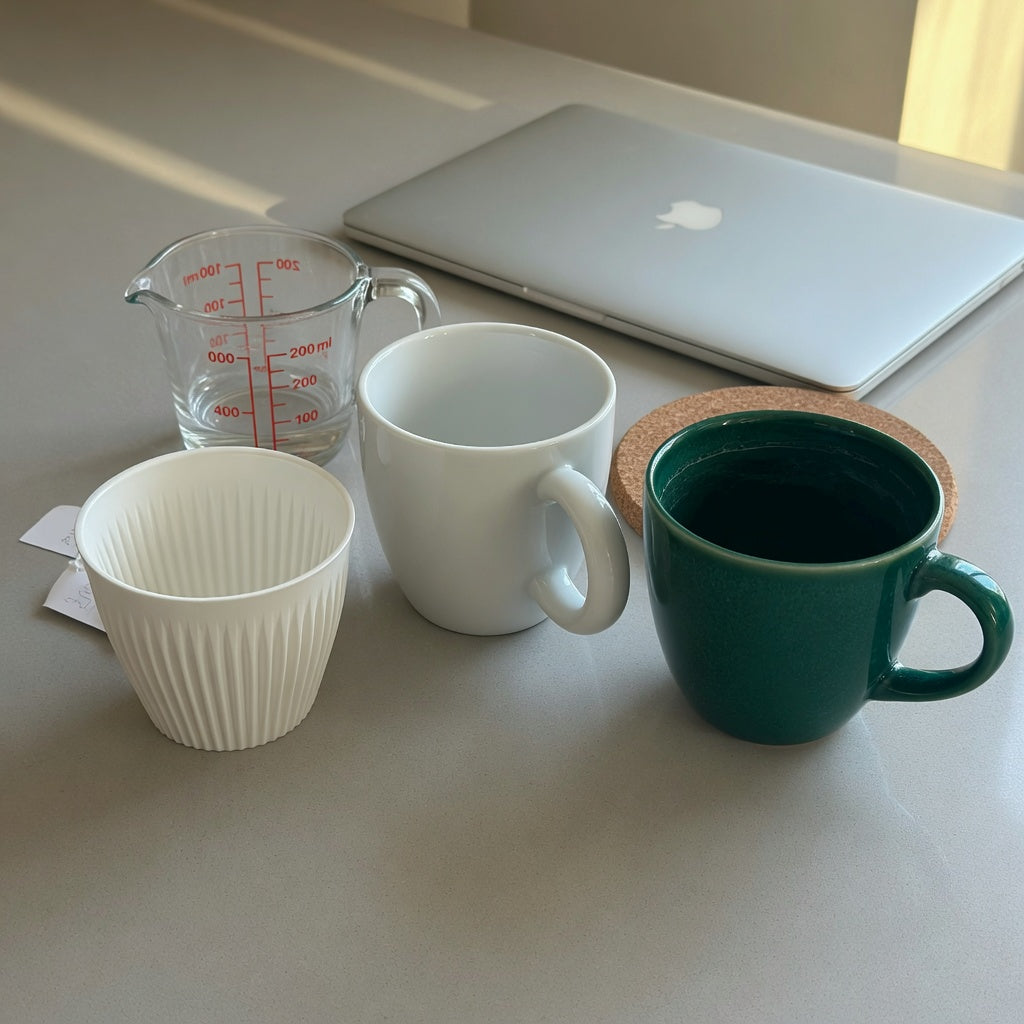
Flat White Cup Buying Priorities: Capacity, Shape, and Space
Reading time: about 9 minutes
A flat white cup can look compact on a product page and still become the cup that bumps your laptop, misses your coaster, or leaves no comfortable carrying margin above the drink. We use flat white cup buying priorities in a practical order in our store: measure the pour you already make, compare it with the listed capacity, inspect the visible shape, and check the space the whole cup needs, including its handle.
The three options covered here have verified listed capacities: Pleated at 200 ml, Ball Handle at 250 ml, and Emerald at 270 ml. Those figures give you a reliable starting point, but they do not establish a required flat white size, a drink ratio, or a barista standard. The useful choice is the cup that fits your own pour and the place where you use it.
Which flat white cup buying priorities should come first?
Start with the variables that can rule a cup in or out before color or styling influences the decision. In our experience, shoppers get a more useful comparison by ranking these four points:
- Actual drink volume: Measure the amount you normally pour, including milk and foam.
- Nominal headroom: Subtract that amount from the listed cup capacity, while remembering that brim-full capacity is not the same as spill-safe carrying capacity.
- Overall shape: Look at the exterior contours and handle projection, not just the cup body.
- Available space: Check your coaster, espresso tray, cupboard shelf, and the clear area beside your keyboard.
This order keeps the decision tied to daily use. A visually appealing flat white coffee cup is still a poor purchase if your usual drink reaches the rim or the handle occupies the space where your mouse needs to move.
How much headroom do 200 ml, 250 ml, and 270 ml provide?
Listed capacity is the cleanest direct comparison available for these three cups. The differences are modest but meaningful:
| Option | Listed capacity | Capacity difference | Likely priority |
|---|---|---|---|
| Pleated | 200 ml | Starting point | Less unused volume around a smaller measured pour |
| Ball Handle | 250 ml | 50 ml more than Pleated | Middle capacity with added room for variation |
| Emerald | 270 ml | 20 ml more than Ball Handle; 70 ml more than Pleated | Most nominal headroom of the three |
Suppose your finished drink measures 170 ml. The simple difference would be 30 ml in the Pleated, 80 ml in the Ball Handle, and 100 ml in the Emerald. That is comparison math, not guaranteed usable headroom: foam occupies volume, and a listed capacity may be measured closer to the rim than you would comfortably carry.
If your normal pour is close to 200 ml, the 200 ml option gives you little or no nominal margin. If your pour changes from one morning to the next, the 250 ml or 270 ml capacity is less restrictive. A drink well above 270 ml needs a different cup rather than an overfilled one.
Which visible shape suits your grip, shelf, and washing routine?
The Pleated name points to an exterior with repeated contours. That texture creates a different hand feel from a plain wall and gives the cup more visual detail, but grooves can also need an extra pass with a cloth or soft brush if residue collects along them. Choose it because you like the textured form, not because texture automatically guarantees a better grip for every hand.
The Ball Handle has a visibly distinctive handle element. Its projecting shape may suit someone who dislikes a conventional narrow loop, but it also deserves more attention when measuring lateral clearance. Look at where your fingers will sit and whether the handle will extend toward a laptop, neighboring cup, or cupboard wall.
Capacity alone does not reveal the Emerald cup's external footprint. Use the current product images and any dimensions listed on its page to judge the body and handle against your space. We do not infer exact width, height, or base diameter from a photograph because perspective can make a cup look smaller than it is.
Will the cup fit your espresso tray, coaster, and laptop zone?
A 200 ml capacity does not automatically mean the smallest base, and a 270 ml cup is not automatically the widest. Volume and exterior dimensions describe different things. For a tight setup, measure the actual resting place in millimetres and compare it with current product dimensions when they are listed.
- Coaster: Measure the usable top surface, not the decorative outer edge.
- Espresso area: Check vertical clearance from the tray to the spout and the space needed to place and remove the cup without tilting it sharply.
- Desk: Measure overall width including the handle, then leave enough clearance for your fingers.
- Cupboard: Check shelf height and depth, especially if handles from neighboring mugs overlap.
- Gift box or storage bin: Allow for the handle rather than measuring only the circular body.
If a listing provides only body diameter, that may not be enough for a narrow desk. Overall width including the handle is usually the more useful figure. One simple test is to mark the listed outline on scrap paper and place it beside your keyboard, coffee machine, or existing mugs.
Which CoffeifyMug option fits each daily routine?
Smaller measured pour with limited unused capacity
Start with the Pleated 200 ml coffee and tea cup if your measured drink sits clearly below 200 ml and you prefer a cup that does not leave a large amount of empty volume above it. Its visible pleated surface also suits shoppers who want texture rather than a plain exterior. It is not a good fit if your pour approaches the full listed capacity or you regularly add more milk after serving.
Variable morning pour and a middle capacity
The Ball Handle 250 ml mug gives you 50 ml more listed capacity than the Pleated option. That makes it the practical middle choice for someone whose drink volume changes or who wants more nominal carrying margin without moving directly to 270 ml. The trade-off is the distinctive projecting handle, which may be inconvenient on a tightly packed desk or shelf.
Maximum listed headroom among these three cups
Choose the Emerald 270 ml mug if capacity is your first priority and you want the largest listed option in this comparison. It provides 20 ml more than the Ball Handle and 70 ml more than the Pleated. It may be more cup than you need for a very small pour, and the capacity figure alone does not prove that it will fit your coaster or machine tray.
Larger drinks, substantial ice, or a different handle style
None of these three is a strong match for a drink that regularly exceeds 270 ml, especially an iced coffee where cubes consume much of the internal volume. A shopper who needs a larger vessel, a smoother exterior, or another handle arrangement should compare the broader unique coffee mug collection and verify each listing's capacity, dimensions, material, and care details before choosing.
What should you verify about material, care, and finish?
Material and care instructions should come from the current product page, not assumptions based on color or photography. Ceramic, stoneware, porcelain, and glass can look similar on a screen while differing in weight, wall thickness, heat response, and care. Do not assume dishwasher or microwave compatibility unless the listing states it.
At our packing table, the practical inspection points are the rim, base, finish, and handle attachment. These are also useful checks when your order arrives:
- Inspect the drinking rim under bright light for chips or rough spots. Do not run a bare finger over a suspected sharp edge.
- Look around the handle attachment for a hairline crack or separation.
- Set the empty cup on a flat surface and check for pronounced rocking. Minor variation can occur, but an unstable base matters beside electronics.
- If the cup has a glazed finish, inspect it for unexpected fine crack lines, often called crazing, and follow the seller's guidance if you see them.
- If dishwasher use is permitted, load the cup so it cannot knock against another hard item during the cycle. Dishwasher compatibility does not make drinkware impact-proof.
For routine cleaning, a soft sponge is the conservative choice for textured or decorated surfaces. Avoid abrasive scouring unless the product instructions specifically permit it. For a gift, perform the same checks before wrapping so the recipient's first look is not the moment a shipping issue is discovered.
What should you measure before adding a cup to cart?
Use this five-minute comparison rather than estimating from product photographs:
- Fill your current cup with water to the level you normally drink from, then transfer that water to a marked measuring jug.
- Record the volume and subtract it from 200 ml, 250 ml, and 270 ml to compare nominal headroom.
- Measure the coaster, tray, shelf, or desk area where the new cup will spend most of its time.
- Review the product images for pleating, handle projection, and the way your fingers would approach the cup.
- Confirm current material, dimensions, and care instructions on the linked product page.
- Reject any option that is too close to your usual fill level or too large for the available space.
Using flat white cup buying priorities this way turns a style choice into a repeatable buying decision. You are comparing the drink and setting you already have, not trying to reshape your routine around a new cup.
Frequently asked questions
What are the main flat white cup buying priorities?
Start with your measured drink volume, then compare nominal headroom, visible shape, and the space required by the entire cup and handle. Material and care instructions are the final checks before purchase. Color should come after the practical filters if the cup is intended for daily use.
Is a 200 ml flat white coffee cup too small?
A 200 ml cup is not automatically too small, but your finished drink should sit clearly below that listed capacity if you want carrying room. If your normal pour is close to 200 ml, compare the 250 ml and 270 ml options instead. Measuring one regular serving gives you a better answer than relying on a general drink-size rule.
Should I choose 250 ml or 270 ml for more headroom?
The 270 ml Emerald provides 20 ml more listed capacity than the 250 ml Ball Handle. That difference may matter if your pour regularly approaches 250 ml, but it is small enough that shape, handle clearance, and listed dimensions could decide the purchase. Choose 250 ml if it already leaves a comfortable margin and its visible handle suits your setup.
Can I assume these cups are dishwasher and microwave safe?
No. Confirm both points on the current product page because appearance and capacity do not establish care compatibility. If a care method is not stated, contact the store or use a conservative hand-washing approach rather than making an assumption.
Which flat white cup is best for a small office desk?
The best cup for a small desk is the one whose full outline fits beside your equipment while leaving room for your hand. The Pleated has the lowest listed capacity at 200 ml, but capacity does not prove it has the smallest footprint. Compare any listed overall width and handle projection with your measured desk area before ordering.
Measure one normal pour and one real resting space, then open the matching product page or compare other shapes in our unique coffee mug collection. Those two measurements will eliminate more poor fits than choosing by appearance alone.
More from our blog
Read more
Loose Leaf Tea Mug Buying Priorities: Capacity, Shape, Space
Compare the listed 250 ml, 390 ml, and 400 ml options by serving volume, visible opening, measured space, and accessory fit. Each mug is mapped to a practical desk, counter, or gifting routine.
Read more
Cappuccino Coffee Mug Buying Priorities: Size, Shape, Space
Compare the listed 170 ml Retro, 200 ml Pleated, and 270 ml Emerald by the drink you actually pour, the visible shape you prefer, and the space available. We also flag what capacity numbers and pro...
Read more
Leave a comment
This site is protected by hCaptcha and the hCaptcha Privacy Policy and Terms of Service apply.