

Cappuccino Coffee Mug Buying Priorities: Size, Shape, Space
Reading time: about 8 minutes
A cup can look neatly proportioned beside an espresso machine and still be the wrong purchase once your finished milk-coffee drink reaches the rim. Move the same cup to a crowded office desk, and handle clearance may matter as much as volume. Those are the practical cappuccino coffee mug buying priorities we hear in our store: measure the drink you actually make, compare the visible profile, and check the space where the cup will live.
At our packing bench, we can compare the products side by side, but we keep the claims narrow. The verified figures covered here are the listed capacities: 170 ml for the Retro, 200 ml for the Pleated, and 270 ml for the Emerald. Capacity does not establish external dimensions, usable fill lines, heat retention, foam performance, material, or care compatibility, so each of those needs its own check before checkout.
Cappuccino coffee mug buying priorities start with finished volume
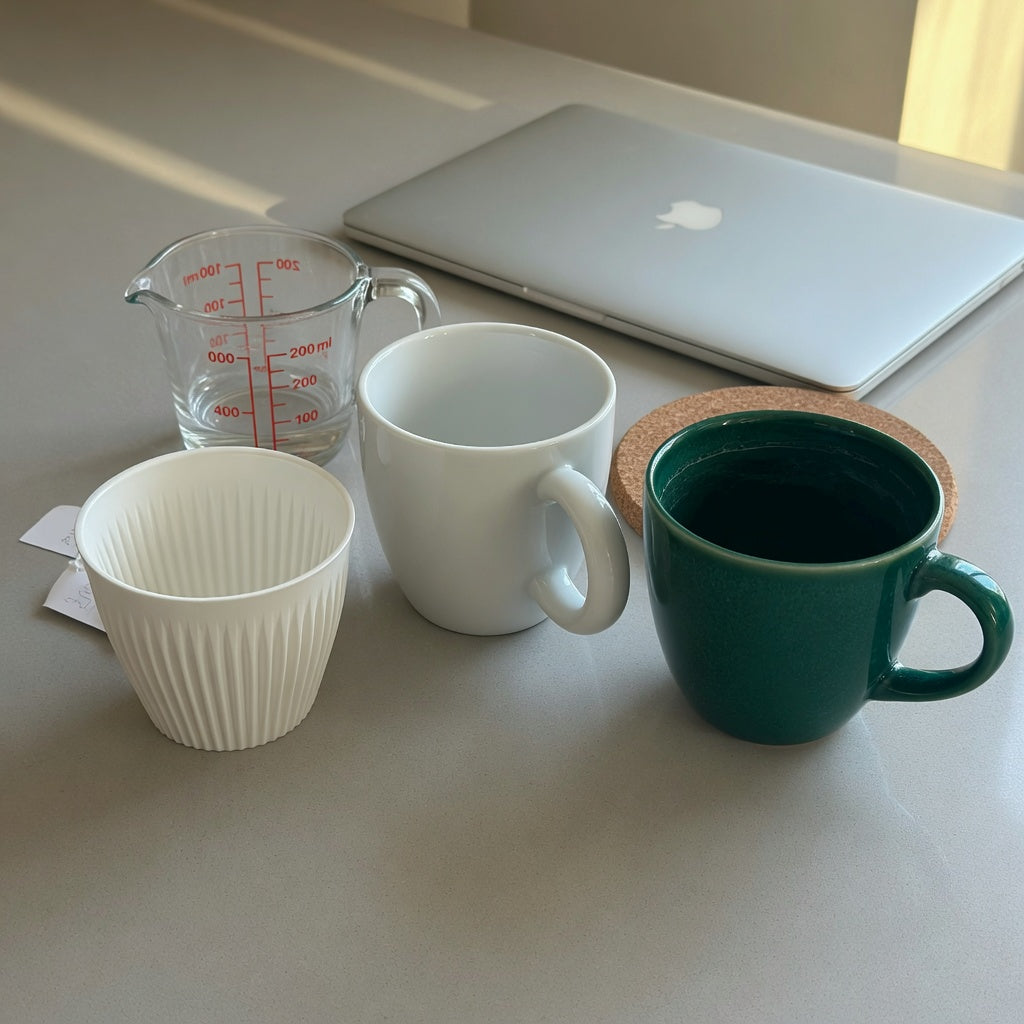
Measure the whole drink, not only the espresso portion. Milk, water, syrup, and any other additions count toward the volume that must fit in the cup. A small measuring jug is more reliable than comparing your existing mug by eye.
- Prepare the drink exactly as you do on an ordinary weekday.
- Measure the finished volume before choosing a listed cup capacity.
- Decide whether you are comfortable filling close to the top or prefer visible room below the rim.
- Repeat the measurement on another day if you normally pour milk without measuring it.
This distinction matters at the boundaries. A finished drink measuring 170 ml is not automatically a comfortable match for a cup listed at 170 ml because the two numbers leave no nominal margin. The 200 ml option may be the more practical shortlist in that situation. We do not convert listed capacity into a claimed fill line because that would require a separate product measurement.
170, 200, or 270 ml: where does each option fit?
The three capacities form distinct steps. The Pleated adds 30 ml over the Retro, while the Emerald adds 70 ml over the Pleated and 100 ml over the Retro. Those differences are useful only after you know your normal finished-drink volume.
| Current option | Listed capacity | Best starting situation | Main limitation |
|---|---|---|---|
| Retro coffee tea cup | 170 ml | A smaller drink that measures comfortably below 170 ml | Little flexibility for a pour close to the listed capacity |
| Pleated coffee tea cup | 200 ml | A mid-size drink or a smaller pour with more nominal room | Not a fit for a finished drink above 200 ml |
| Emerald coffee tea mug | 270 ml | A larger single drink measuring below 270 ml | May feel excessive if your usual serving is much smaller |
If your normal drink exceeds 270 ml, includes a substantial amount of ice, or needs a travel lid, these three should not be forced into the shortlist. Start with the broader unique coffee mugs collection and look for a different capacity or vessel style.
Desk, shelf, and espresso-machine space: what must you measure?
Milliliters describe internal volume, not the area a cup occupies. A 170 ml listing does not prove the smallest overall width, and a 270 ml listing does not provide the cup height. Without published dimensions, ranking exact footprints from capacity alone would be guesswork.
- Espresso-machine clearance: Check the vertical distance from the drip tray to the outlet and the usable depth of the tray.
- Desk parking space: Measure the clear area beside the keyboard and mouse, allowing room for the handle and any coaster you use.
- Cabinet fit: Check usable shelf height and depth, including door frames or shelf lips that reduce access.
- Shared counters: Allow enough room to lift the cup without catching nearby jars, utensils, or appliance cords.
If dimensions appear on the current product page, transfer them to the intended surface with a ruler before ordering. If they are not listed and clearance is critical, do not treat the product photograph as a scale drawing. That is especially relevant on compact desks and beneath low espresso-machine outlets.
Retro, pleated, or mug-shaped: which visible profile fits?
The Retro presents a rounded, traditional cup-like profile and the smallest listed capacity of the three. It makes sense for a shopper who prepares a genuinely small drink and wants that classic visual style. Its 170 ml capacity is the deciding fact; the appearance alone does not prove that it will occupy the least counter space.
The Pleated pairs a 200 ml listing with a visibly pleated exterior. That surface detail gives the cup a different look from a plain-sided vessel, which can matter for a desk cup or gift. We do not describe the pleating as tested slip resistance or promise that it will suit every grip.
The Emerald has the highest listed capacity and a more conventional mug presentation. It is the logical starting point for a finished drink above the useful range of the 170 ml and 200 ml options but still below 270 ml. A shopper who prefers a wide, shallow cup or a very small serving may find this format less suitable.
In our experience, product photos are good for comparing silhouette and surface detail, but they cannot settle finger clearance, balance, or sip comfort for every person. If handle proportions are a deciding factor, use listed dimensions where available instead of assuming that the highest-capacity mug will automatically be the most comfortable.
Material and care checks for ceramic-minded shoppers
Many shoppers search for a cappuccino cup ceramic option, but appearance is not proof of a specific material. Ceramic, porcelain, and stoneware should not be treated as interchangeable product labels. Confirm the exact material wording on the live listing before buying if composition matters to you.
Care requirements deserve the same discipline. This article does not claim that the Retro, Pleated, or Emerald is microwave safe or dishwasher safe. If dishwasher cycles are part of your daily routine, buy only after the current product page or included instructions explicitly support that use. A missing care statement is not permission to assume compatibility.
- Read the current material and care fields rather than relying on the product image.
- On delivery, inspect the rim, base, and handle attachment where present for chips, cracks, or transit damage.
- Set the empty cup on a flat counter and check that the base sits as expected before first use.
- For a gift, perform that inspection before wrapping so the recipient is not the first person to open the shipping package.
None of these products is presented here as designed, tested, or certified for cappuccino, professional barista service, foam performance, or heat retention. We are matching listed capacity and visible product format to ordinary drink routines.
Which cup fits weekday, office, gifting, or larger pours?
- Small weekday drink below 170 ml: The 170 ml Retro cup is the closest capacity match. Choose it for the smaller serving and rounded retro profile, then verify dimensions if machine or desk clearance is tight.
- Drink below 200 ml with desired rim margin: The 200 ml Pleated cup provides 30 ml more listed capacity than the Retro and adds visible surface detail. It is not suitable for a finished drink that already exceeds 200 ml.
- Drink above 200 ml but below 270 ml: The 270 ml Emerald mug is the relevant next step. It suits a larger single pour, but shoppers making much smaller drinks may prefer a closer capacity match.
- Crowded office desk: Shortlist by measured drink volume first, then compare published overall width and height. Do not select the Retro solely because 170 ml sounds compact.
- Gift with an unknown routine: Check the capacity marked on a cup the recipient already uses or discreetly measure it. The 200 ml option is the middle of this range, but being the midpoint does not make it universally safer.
- Large iced drink, travel use, or pour over 270 ml: Skip these three and compare other styles in the current coffee mug collection. Ice displacement and a required lid change the buying decision.
A 60-second shortlist before checkout
- Record your finished drink volume in milliliters.
- Remove every option smaller than that measurement.
- Decide how much visible room you prefer below the rim.
- Compare the Retro, Pleated, and Emerald profiles in the product photos.
- Check listed dimensions against your machine, desk, and shelf where dimensions are available.
- Confirm current material and care wording if either affects the purchase.
Applied in that order, these cappuccino coffee mug buying priorities keep capacity, appearance, and placement from becoming one vague decision.
Frequently asked questions
What cappuccino coffee mug buying priorities matter most for a small desk?
Start with the finished drink volume, then check overall width, height, and handle clearance against the open area beside your keyboard. Capacity alone cannot confirm desk footprint, so use current product dimensions where they are listed.
Is 170 ml or 200 ml better if my finished drink measures about 170 ml?
The 200 ml Pleated is the more practical shortlist if you want nominal room above a 170 ml drink. A 170 ml drink matched to the 170 ml Retro leaves no nominal difference between the measured pour and listed capacity, although neither figure establishes an exact comfortable fill line.
Can I assume these cups are microwave and dishwasher safe?
No. We make no microwave or dishwasher claim for the Retro, Pleated, or Emerald in this comparison. Check the current product page and included care instructions, and choose another listing if your required care method is not explicitly supported.
Which current option fits a larger milk-coffee drink?
The Emerald has the largest listed capacity at 270 ml, compared with 200 ml for the Pleated and 170 ml for the Retro. It is the relevant option if your finished drink is above 200 ml but remains comfortably below 270 ml.
Are these products specifically designed or tested for cappuccino?
We do not make that claim. This comparison uses listed capacity, visible shape, and everyday placement to help shoppers choose a coffee cup for cappuccino-style routines without implying foam, temperature, certification, or professional-use performance.
Measure your next finished drink, check the available surface, and keep only the capacity that clears both tests. Then compare the shortlisted product page with the unique coffee mugs collection before placing your order.
More from our blog
Read more
Flat White Cup Buying Priorities: Capacity, Shape, and Space
Compare CoffeifyMug's verified 200 ml, 250 ml, and 270 ml options by actual pour volume, nominal headroom, visible shape, and the space available on a desk, shelf, or coffee station.
Read more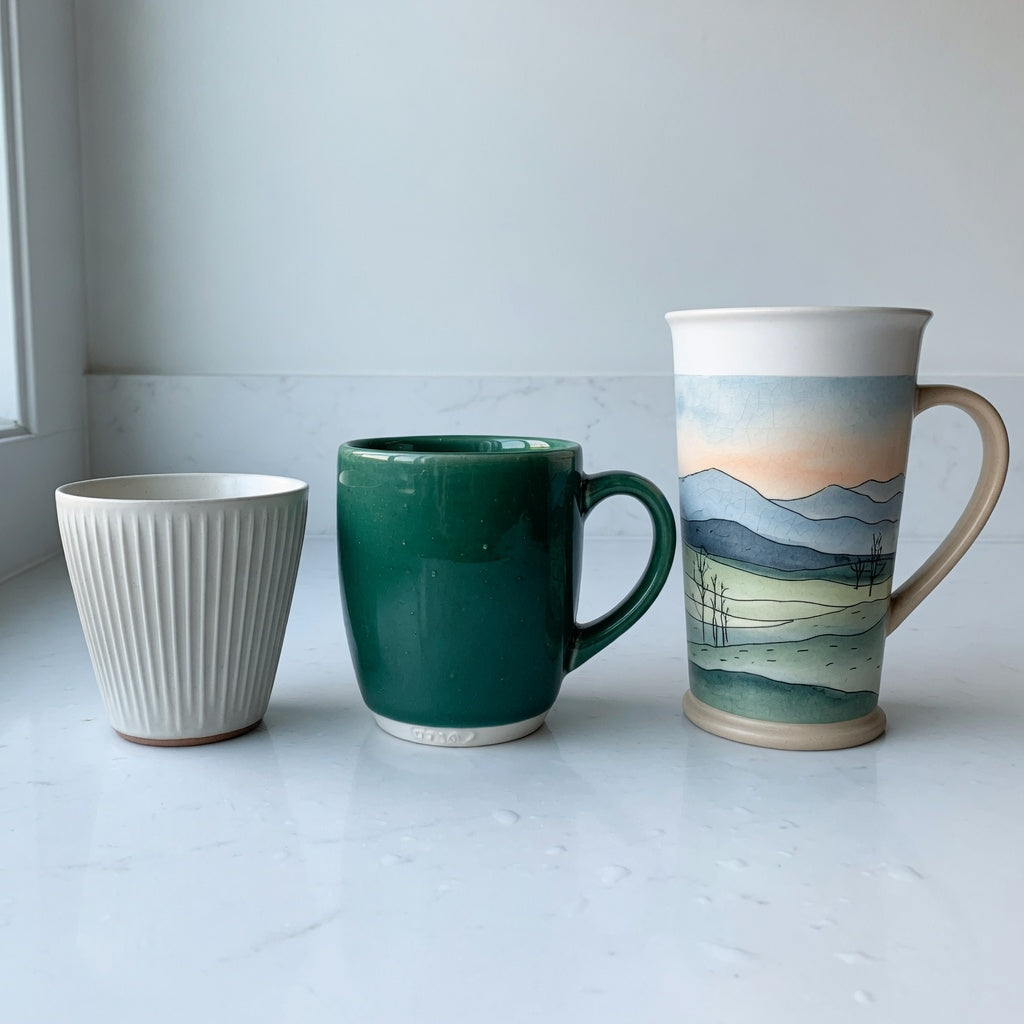
Americano Coffee Cup Current Product Facts: 200, 270, or 350 ml
Compare the verified 200 ml Pleated, 270 ml Emerald, and 350 ml Landscape Tall capacities without mistaking listed volume for a comfortable fill line. We explain nominal headroom, measurable size g...
Read more
Leave a comment
This site is protected by hCaptcha and the hCaptcha Privacy Policy and Terms of Service apply.