

Ceramic vs Porcelain Coffee Mugs: Everyday Rotation Checklist
Reading time: about 9 minutes
A mug earns its place in a daily rotation at 7:15 a.m., when the cabinet is crowded, the dishwasher is half-unloaded, and one hand is already holding the coffee bag. If its handle catches a neighboring cup, its base rocks on the counter, or it is too tall for the shelf, the material label will not rescue it. That cabinet-level friction is why we built this ceramic vs porcelain coffee mugs everyday mug rotation practical purchase checklist.
From our store perspective, broad claims about ceramic feeling sturdy or porcelain feeling refined are not enough to support a purchase. Porcelain is part of the ceramic family; retail comparisons commonly use ceramic as shorthand for non-porcelain bodies such as stoneware or earthenware. More importantly, a body-material label alone does not establish weight, wall thickness, capacity, heat behavior, chip resistance, or appliance compatibility. We treat those as item-level facts and only rely on what a current product page explicitly shows or states.
Use this ceramic vs porcelain coffee mugs everyday mug rotation practical purchase checklist
Run these checks in order. The first few eliminate mugs that cannot fit your routine, while the later checks help you choose between products that are both workable.
- Name the mug's job. Decide if it will handle quick breakfast coffee, slow tea, iced drinks, office refills, guests, or gifting. One mug does not need to cover every role.
- Measure the storage space. Record usable shelf height, closed-door depth, and the width available for each mug. Cabinet trim and hinges can reduce the space that looked available at first glance.
- Check the full footprint. Compare rim diameter, base diameter, total height, and handle projection. Capacity alone will not tell you if a mug fits beside the others.
- Account for filled weight. If no product weight is listed, fill a similarly sized mug at home and carry it to the desk. Material names are a poor substitute for this real-use check.
- Inspect the contact points. Look closely at the rim, foot ring, handle joints, and any raised decoration. These are the areas that meet shelves, racks, fingers, and neighboring mugs.
- Verify care statements separately. Dishwasher suitability, microwave suitability, and cleaning instructions are distinct product facts. Do not infer one from another.
- Treat missing information as unknown. If a must-have dimension or care detail is absent, ask before buying or choose a listing that answers the question clearly.
This process prevents a common rotation mistake: buying several matching mugs before confirming that even one fits the cabinet, hand, drink, and wash routine.
Does the material label predict everyday performance?
Not by itself. Porcelain, stoneware, and earthenware refer to ceramic body categories, but the experience of using a finished mug also depends on its wall and rim thickness, glaze, shape, handle geometry, firing, and workmanship. A porcelain mug is not automatically light, and a non-porcelain ceramic mug is not automatically heavy or more resistant to damage.
| Buyer variable | Useful comparison | Do not assume |
|---|---|---|
| Carry weight | Listed product weight or a comparable filled mug | Porcelain is always lighter |
| Rim comfort | Rim shape, thickness, and product images | A thinner rim suits every drinker |
| Heat at the hand | Wall thickness, handle clearance, and actual use | The material name guarantees heat retention |
| Surface care | Glaze, decoration, texture, and stated instructions | Every glazed mug has identical dishwasher care |
When we handle mugs, we check whether the foot sits evenly, whether two or three fingers fit the handle comfortably, and whether the rim feels natural during repeated sips. Online shoppers cannot perform every test, so dimensions, clear photographs, and explicit care information should carry more weight than a broad material preference.
Will the mug fit your cabinet and wash routine?
Daily rotations create repeated contact between mugs, shelves, and dishwasher racks. Four measurements catch most fit problems before checkout:
- Usable shelf height: Measure from the shelf surface to the lowest obstruction above it, not just the cabinet opening.
- Closed-door depth: Include the distance the handle projects from the body so the cabinet door can close without pushing the mug.
- Rim and base diameter: These determine the actual shelf footprint and where two mugs may touch.
- Dishwasher clearance: Check rack-tine spacing and clearance beneath the rack or spray arm used by your machine.
Do not assume a mug is stackable unless the listing states it or the form clearly supports it. Stacking places the foot of one mug against the interior or rim of another. A rough foot ring can create contact marks, while a small contact area can make a stack unstable. Those are general inspection points, not predictions that a linked CoffeifyMug design will develop a defect.
For daily washing, the product's stated care instructions take priority. Dishwasher-safe and microwave-safe are separate claims. In the dishwasher, leave enough space to keep rims and handles from striking adjacent pieces. After washing, check concave bases for pooled water and dry mugs before stacking. For hand washing, a non-abrasive sponge is a sensible default unless the maker specifies another method.
Rim chips, cracks at the handle joints, glaze crazing, and abrasion on decorated areas are common defect modes worth watching across this category. A sharp chip or structural crack is a reason to remove a mug from the everyday rotation rather than keep testing it.
Which CoffeifyMug design fits each rotation role?
The linked product names and pages give you design-specific candidates, but they should not be used to invent unlisted material, capacity, dimensions, or care claims. Match the situation first, then verify every essential fact on the current page.
| Reader situation | Why the design may fit | Product-page next step |
|---|---|---|
| You want a visually simple starting point for a mixed rotation | A rounded form provides a straightforward reference for comparing handle clearance, shelf fit, and drink use | Review the Round Coffee Tea Mug, then confirm its current material, dimensions, capacity, and care information |
| You want a mug that is easier to distinguish by surface detail | Pleated styling creates a different visual and potentially tactile role in the rotation, depending on where the detail sits | Inspect the images and specifications for the Pleated Coffee Tea Cup, paying particular attention to grip area, cup format, and care |
| You want a personal mug or gift with a more distinctive presentation | A landscape-led design can be identified quickly on an open shelf and gives the recipient a clear visual choice | Compare the decoration, dimensions, and stated care for the Landscape Coffee Tea Mug |
| None of the three clears your storage or use constraints | A wider comparison lets you prioritize another silhouette instead of forcing a poor fit | Browse our unique coffee mugs collection and apply the same measurements to each candidate |
In our experience, gift appeal and daily fit are separate tests. A decorated mug can make a strong first impression during unboxing, but it only becomes part of the recipient's rotation if it also fits the cabinet, hand, preferred drink, and cleaning routine.
Which daily drink job should decide the purchase?
- Fast breakfast coffee: Prioritize one-handed access, handle clearance, and a shape that is easy to rinse between uses.
- Office desk refills: Check the base footprint, filled weight, and whether the handle fits comfortably without crowding a keyboard, notebook, or coaster.
- Slow tea sessions: Give extra attention to rim feel and usable capacity. A material label cannot tell you if the sipping experience will suit you.
- Iced coffee: Verify that the opening and capacity suit your usual ice. Condensation also makes the actual grip area more relevant.
- Guest or gift use: Balance visual distinction with simple care. A recipient who relies on a dishwasher may not use a mug that requires special handling.
A mug can perform well in one role and poorly in another. An open ceramic or porcelain cup is also not a substitute for a sealed, insulated travel tumbler during a car commute, even if it is the right choice at a kitchen counter or office desk.
Where are ceramic and porcelain mugs the wrong tool?
Neither category is ideal for every shopper. Rough outdoor use calls for a different material and form. Households that need spill resistance should consider a lidded cup. Someone with limited grip strength may be better served by a lightweight mug with a broad, well-spaced handle, but that fit must be verified from the individual product rather than inferred from porcelain or ceramic.
If your cabinet requires mugs to stack several high, prioritize a design explicitly presented as stackable. If dishwasher or microwave use is non-negotiable, reject any listing that leaves that status unclear. A visually appealing mug is still the wrong purchase when it cannot meet a daily requirement.
Build the rotation by jobs instead of matching quantity
- Choose one workhorse candidate that clears your shelf, grip, drink, and care checks.
- Add a contrasting role only after identifying a real need, such as surface detail, easier visual identification, tea use, or gifting.
- Start with one unit when a key variable remains uncertain. Do not multiply an unanswered fit question across a full set.
Our ceramic vs porcelain coffee mugs everyday mug rotation practical purchase checklist works best as an elimination tool. Remove every mug that fails a frequent scenario, then compare the remaining designs on appearance and personal preference.
Frequently asked questions
What comes first on a ceramic vs porcelain coffee mugs everyday mug rotation practical purchase checklist?
Start with usable cabinet dimensions and the mug's primary job. Those constraints can eliminate a candidate before subjective material preferences matter. Next, verify capacity, handle clearance, and care information on the individual product page.
Is porcelain always lighter or more durable than ceramic?
No. Porcelain is a type of ceramic, and finished weight or resistance to damage depends on the specific body, wall thickness, rim, handle, glaze, firing, and form. Use listed product facts or a handled sample instead of treating the category name as a guarantee.
Can round, pleated, and landscape mugs be stacked?
The design names alone do not establish stackability. Check the rim, base, handle projection, dimensions, and any stacking guidance shown on each current product page. If stackability is essential and not addressed, treat it as an unanswered question.
Are CoffeifyMug mugs dishwasher and microwave safe?
Only rely on an explicit statement for the exact product you are considering. Dishwasher and microwave suitability are separate claims, so confirmation of one does not automatically confirm the other. Follow the current care instructions on each linked page.
Which CoffeifyMug mug should I buy first for an everyday rotation?
Start with the Round Coffee Tea Mug if you want to evaluate a simpler rounded design, the Pleated Coffee Tea Cup if surface detail is central to your choice, or the Landscape Coffee Tea Mug if visual distinction matters most. Before purchasing, confirm that the chosen page answers your non-negotiable questions about material, dimensions, capacity, and care.
Measure your shelf, assign one real drink role, and open the three product pages side by side. Eliminate any candidate that misses a requirement or leaves a must-have fact unknown; if none clears the checklist, return to the CoffeifyMug mug collection and compare the next shape using the same process.
More from our blog
Read more

Decaf Coffee Cup Home Coffee Station Product Shortlist Guide
Compare the Retro 170 ml, Pleated 200 ml, and Emerald 270 ml using verified capacity, serving preference, station space, and practical handle checks. Each recommendation gives a clear reason to cho...
Read more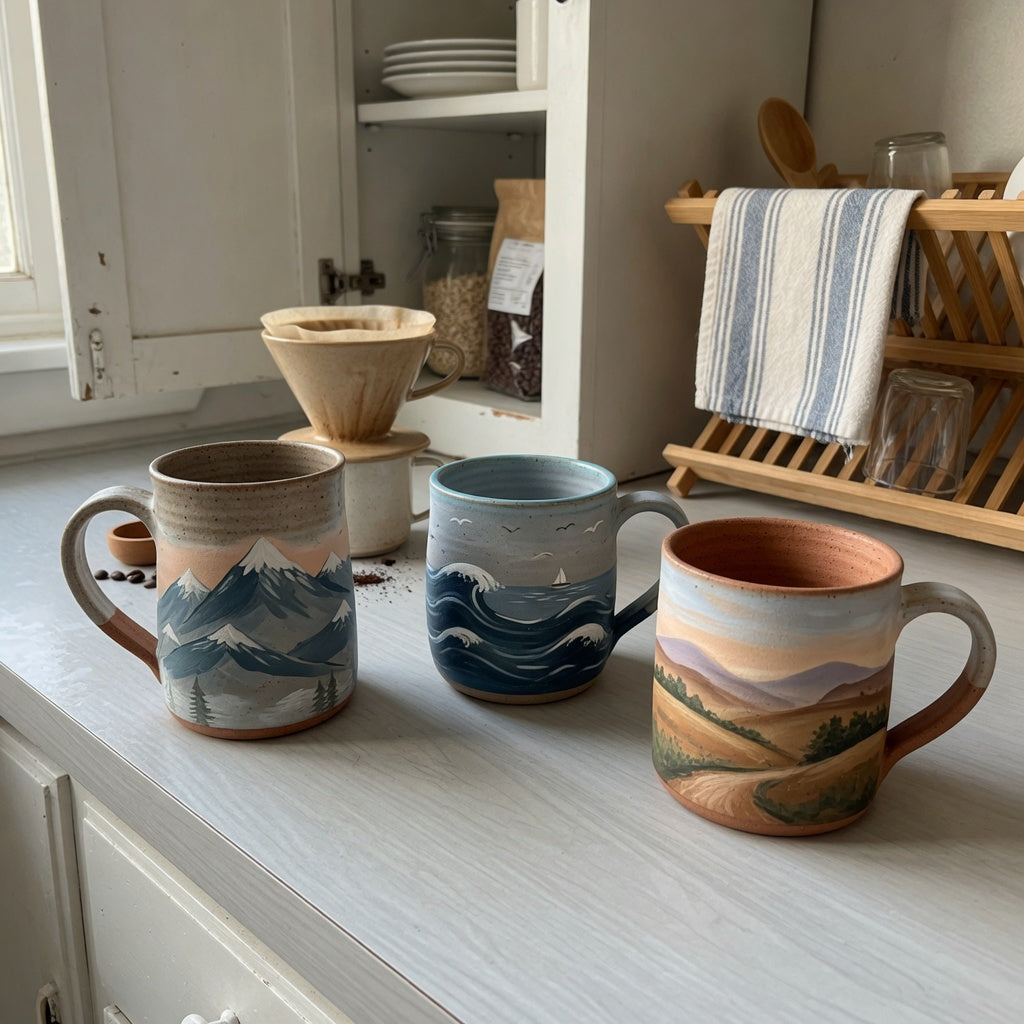
Clay Pottery Coffee Mugs Everyday Mug Rotation Product Shortlist Guide
Build a three-mug shortlist around shelf space, wash cycles, drink habits, and the visual role each mug must fill. Each recommendation includes a reason to choose it, a reason to skip it, and the p...
Read more
Leave a comment
This site is protected by hCaptcha and the hCaptcha Privacy Policy and Terms of Service apply.