
Decaf Coffee Cup Home Coffee Station Product Shortlist Guide
Reading time: about 8 minutes
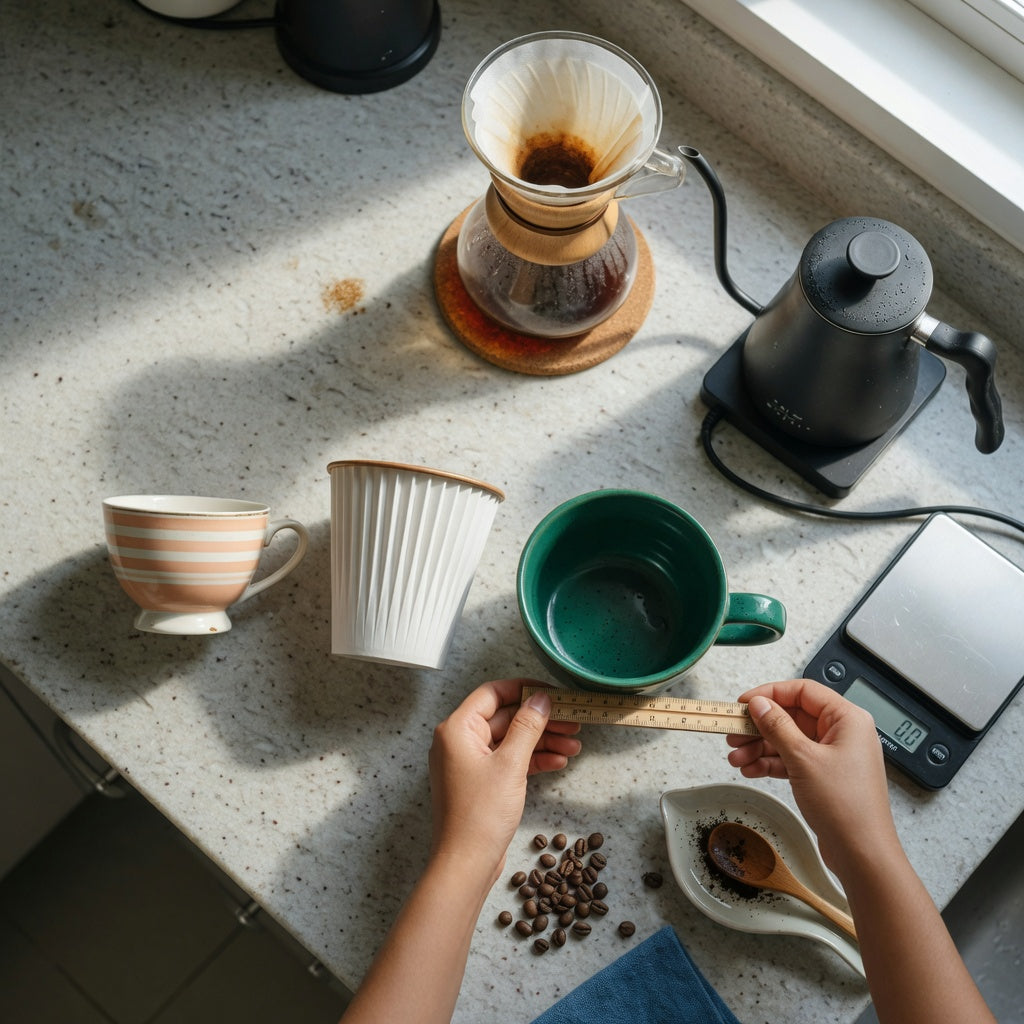
A cup can look perfectly proportioned on an empty counter and still become the awkward piece after the kettle, brewer, scale, spoon rest, and storage container return. We see this during our own product handling and in the setup questions shoppers bring to our store. This decaf coffee cup home coffee station product shortlist guide starts with the station in use, then compares the three verified capacities we can stand behind: Retro 170 ml, Pleated 200 ml, and Emerald 270 ml.
We keep the decision narrow: serving volume, the space needed to reach the handle, and how the cup moves through your routine. We also separate known facts from assumptions. Listed capacity is verified, but it does not prove exterior dimensions, handle fit, material, or care compatibility.
How much room remains after the station is fully set up?
Capacity and counter footprint are related, but they are not interchangeable. A low, wide cup can occupy more surface than a taller cup with greater volume, and the handle may be the limiting dimension. Measure the station with every item in its normal position rather than estimating from an empty tray.
- Place the brewer, kettle, scale, spoon rest, and containers where you actually use them.
- Set your current cup in the remaining area and measure its widest point, including the handle.
- Check that your fingers can reach the handle without pushing another item aside.
- Lift and return the cup from your normal approach direction, not only from directly above.
- If two people use the station together, test two cups in the space at the same time.
Do not use capacity to infer fit beneath a brewer or compatibility with an appliance. If vertical clearance or machine placement matters, compare verified cup dimensions with the appliance manufacturer's measurements. This shortlist does not establish that fit.
Which listed capacity matches your usual serving?
The three options cover a 100 ml span. That is enough to change how often you refill and how much unused volume you carry, even before handle shape or styling enters the decision.
| Option | Verified capacity | Difference within this shortlist | Reason to shortlist | Reason to skip |
|---|---|---|---|---|
| Retro | 170 ml | 30 ml below Pleated; 100 ml below Emerald | You want the smallest listed capacity | You regularly prefer more volume |
| Pleated | 200 ml | 30 ml above Retro; 70 ml below Emerald | You want the middle capacity | You need either end of the range |
| Emerald | 270 ml | 70 ml above Pleated; 100 ml above Retro | You want the largest listed capacity | You usually choose a smaller serving |
If you do not know your usual serving size, fill your current cup with water to the level you normally use, then transfer that water to a marked measuring jug. Treat the listed milliliters as a comparison point, not an instruction to fill a cup to its rim. Your comfortable fill line may be lower.
How does the decaf coffee cup home coffee station product shortlist guide work?
Each recommendation follows the same sequence: identify the reader situation, use verified capacity to explain the fit, flag what capacity cannot tell you, and give a clear reason to skip the option. Used properly, the decaf coffee cup home coffee station product shortlist guide should remove mismatches rather than declare one cup universally best.
Retro 170 ml for a smaller serving
Reader situation: You usually prepare a smaller serving and want the lowest listed capacity in this comparison. Why it fits: At 170 ml, Retro sits 30 ml below Pleated and 100 ml below Emerald, making it the direct capacity match for that brief. Verify: Capacity does not prove that it has the smallest exterior footprint, so check its full dimensions and handle reach if space is tight. Skip it: You frequently wish your current cup held more or prefer fewer refills. Review the Retro 170 ml coffee tea cup before deciding.
Pleated 200 ml for a middle-capacity station
Reader situation: A 170 ml cup feels limiting, but 270 ml is more capacity than you usually want. Why it fits: Pleated is the middle option in this three-product set, sitting 30 ml above Retro and 70 ml below Emerald. That makes it a practical first comparison for shoppers without a strong preference for either extreme. Verify: Inspect the current product images and dimensions for handle opening and outside width. Skip it: Your priority is specifically the smallest or largest listed capacity. See the Pleated 200 ml coffee tea cup.
Emerald 270 ml for the largest listed serving
Reader situation: You prefer more volume in one cup and your measured station area can accommodate the selected shape. Why it fits: Emerald has the largest verified capacity here at 270 ml, which is 70 ml above Pleated and 100 ml above Retro. Verify: Confirm exterior dimensions and handle clearance rather than assuming higher capacity guarantees a particular shape or grip. Skip it: You normally use a smaller fill or your completed station fails the space test. Compare the Emerald 270 ml coffee tea mug.
How should handle comfort change a capacity-first decision?
Handle comfort is personal, so we do not rank one handle as universally better. Hand size, preferred finger position, wrist angle, and the direction from which you reach across the station all affect the result.
- Inside opening: Decide whether you normally use one finger, two fingers, or a fuller grip.
- Knuckle clearance: Check whether your fingers can enter without pressing against the cup wall.
- Thumb control: Look for a position that lets you steady the cup without shifting your grip.
- Filled balance: Test your current cup with a similar measured volume, since an empty-cup grip can feel different.
- Counter approach: Make sure nearby equipment does not block your hand from reaching the handle.
Use a favorite cup as the reference and compare its handle measurements with any dimensions shown on the product page. A larger listed capacity does not automatically mean a larger handle. For a gift, check a cup the recipient already uses; choosing the middle capacity does not solve an unknown grip preference.
What should you verify at unboxing and before routine washing?
A station cup may be washed frequently, so its care requirements belong in the buying decision. We do not assume dishwasher or microwave compatibility from a product name, finish, or appearance. Confirm the stated material and current care directions for the specific item.
- Read the supplied care instructions before the first wash.
- Inspect the rim for chips and the finished surfaces for visible cracks or damage.
- Check both handle attachment points for hairline cracks or separation.
- Place the empty cup on a flat counter and confirm that the base sits steadily.
- Wash only by an approved method, then inspect the cup again after routine wash cycles.
If automatic dishwasher use is non-negotiable and the product information does not clearly authorize it, pause and confirm before ordering. A different style with explicit care information may suit your station better than a preferred design with uncertain care requirements.
What can you rule out in five minutes before ordering?
A useful shortlist removes products as quickly as it adds them. Run this final check with your station fully assembled.
- Measure the available cup area, including the direction the handle must face.
- Measure your normal serving with a marked jug.
- Choose the closest capacity lane: 170 ml, 200 ml, or 270 ml.
- Compare your preferred handle opening and grip with current product details.
- Verify the listed material, dimensions, and care instructions that matter to you.
- Apply the skip reason for each option, even if you prefer its appearance.
If two cups remain, let serving preference break the tie. More capacity is useful only when you regularly use it; less capacity is useful only when it does not create an annoying refill pattern.
Frequently asked questions
What size decaf coffee cup is best for a small home coffee station?
There is no universal size because capacity does not equal exterior footprint. Retro has the smallest verified capacity here at 170 ml, but confirm its full width, handle reach, and height against your measured station before treating it as the smallest physical option.
How do I use a decaf coffee cup home coffee station product shortlist guide?
Measure your usual serving and the station area first. Eliminate cups that miss your capacity preference, then verify outside dimensions, handle comfort, and care directions for the remaining options. The guide narrows the decision but cannot replace product-specific measurements.
Is 200 ml a practical middle option for a coffee station?
Pleated 200 ml is the middle listed capacity among these three products. It is 30 ml above Retro and 70 ml below Emerald, so it makes sense for shoppers who find 170 ml too limited but do not need 270 ml.
How can I judge coffee cup handle comfort online?
Measure the handle opening and outside reach on a cup you already find comfortable, then compare those measurements with the current product information. Also consider how you approach the cup on the counter, since nearby equipment can make an otherwise comfortable handle difficult to reach.
Can I assume these cups are dishwasher or microwave safe?
No. Check the current product page and supplied care instructions for the individual cup before using either appliance. If that information is unclear and appliance use is essential, confirm it with the store or select a product with explicit care directions.
Take one final measurement with your current cup in place, select the nearest verified capacity, and eliminate any option whose skip reason describes your routine. Then compare the remaining shapes in our unique coffee mugs collection and choose the cup that earns its space on the station.
More from our blog
Read more
Abstract Coffee Mug Home Coffee Station Practical Purchase Checklist
Choosing an abstract mug for a working coffee station starts with capacity and counter fit, not the product photo. Compare the 250 ml Rhombus with the 400 ml Gradient and The Flow, then verify mate...
Read more
Ceramic vs Porcelain Coffee Mugs: Everyday Rotation Checklist
A decision-ready ceramic vs porcelain coffee mugs everyday mug rotation practical purchase checklist covering cabinet fit, grip, drink roles, care labels, and what to verify on each CoffeifyMug pro...
Read more
Leave a comment
This site is protected by hCaptcha and the hCaptcha Privacy Policy and Terms of Service apply.