
Unique Espresso Cups Home Coffee Station Product Shortlist Guide
Reading time: about 9 minutes
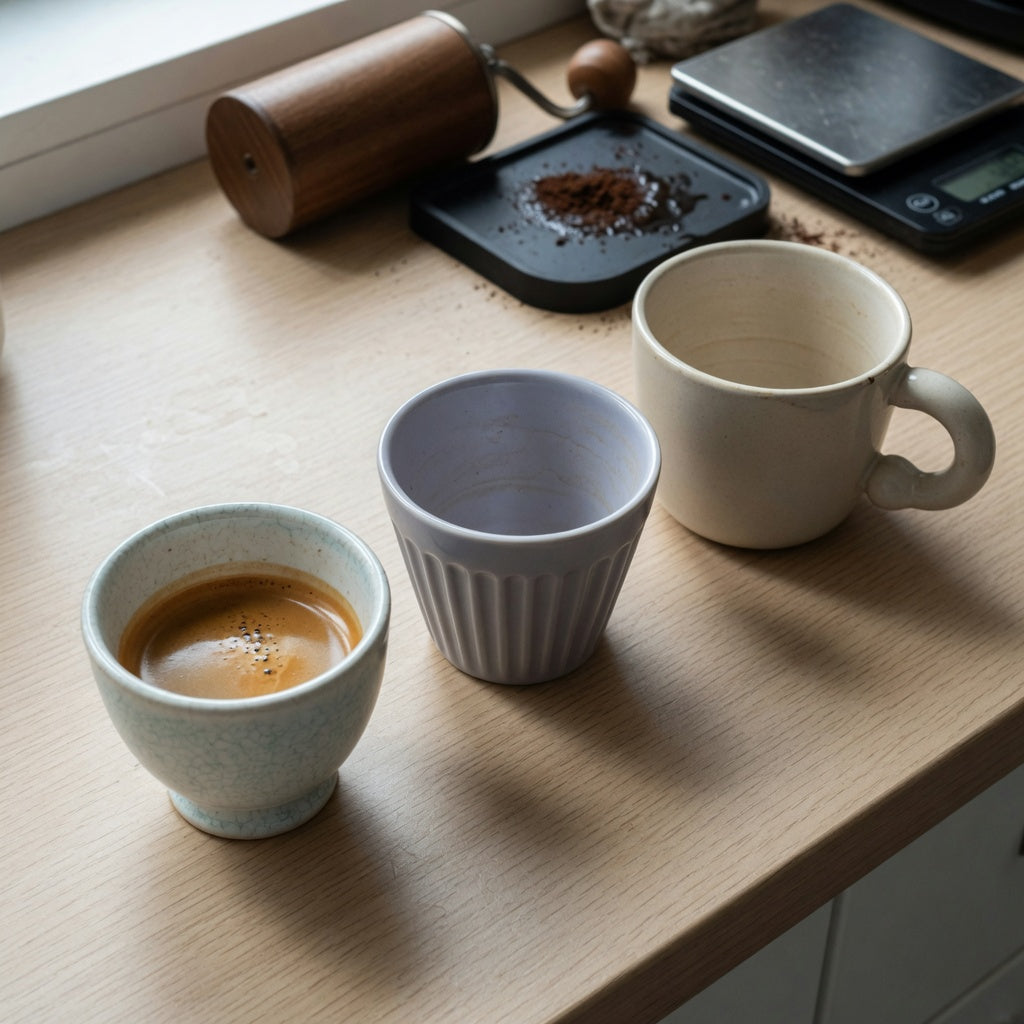
Three cups live on the shelf above our demo grinder: a squat 170 ml ceramic, a fluted 200 ml one, and a ball-handled mug with noticeably more room. Customers pick each of them up, turn them over, check the foot ring, and ask the same question — which one actually gets used every morning? All three do. Just not by the same person. This is our unique espresso cups home coffee station product shortlist guide: three vessels, three routines, and a stated reason to skip each one.
We sell these, so we have a bias. We also see the returns, and most of them are people who bought a gorgeous cup that did not fit their machine, their shelf, or the drink they make four times a day. That is the problem worth solving before a glaze catches your eye.
Why the prettiest cup on the shelf is often the least-used one
Espresso is a small, hot drink. A certified Italian espresso is roughly 25 ml, and specialty definitions commonly sit around 25–35 ml. Nobody serves that in a 25 ml cup — you need headspace for crema and a rim wide enough to smell the shot before you sip it. This is where shoppers get lost. A listing that says 3 oz is describing roughly 90 ml of cup, not 90 ml of coffee.
Classic demitasse guidance clusters much lower, around 50–100 ml. Our cups run larger than that on purpose, and it is worth naming the trade-off up front: if you want a strict 60 ml ristretto cup, none of these three is it. What they give you instead is a compact ceramic vessel that handles a double shot or a cortado without turning into a mug. If that is the routine you actually have, the extra headroom is the feature, not the flaw.
One habit we recommend regardless of which cup you choose: rinse it with hot water while the puck is still in the portafilter, then tip it out. A thick ceramic wall pulls heat out of a 25 ml shot quickly, and a cold cup will flatten a good extraction. That is also why you see cups stored on top of the machine in cafés — residual warmth does real work.
The unique espresso cups home coffee station product shortlist guide, in one table
If you want to browse the wider range first, our unique coffee mugs collection shows the full shelf. Otherwise, start here:
| Cup | Listed capacity | Routine it fits | Skip it if |
|---|---|---|---|
| Retro Coffee & Tea Cup | 170 ml | Double shot, macchiato, espresso with a splash | Your daily drink is a 6 oz milk coffee |
| Pleated Coffee & Tea Cup | 200 ml | Cortado, small flat white, double with more milk | You only pull ristretti and want a bite-size cup |
| Ball Handle Coffee & Tea Mug | 250 ml | Longer blacks, tea, guest drinks, desk duty | Shelf space is tight or you want a matched demitasse set |
You pull two doubles before work: when the 170 ml Retro cup is the right call
This is the cup for someone with a short, repetitive morning. Grind, dose, pull, knock the puck, repeat. At 170 ml there is visible headroom above a double, so the crema layer stays intact and a splash of steamed milk does not push the drink over the rim. The retro finish is the reason it looks good on an open shelf rather than hidden in a cupboard.
Where it stops working: if your second drink of the day is a 6 oz flat white, 170 ml will feel tight and you will be topping up twice. It is also not a demitasse in the traditional sense — the shot will not fill it, and that half-empty look bothers some people more than they expect. If you like a small cup that looks full, size down. If you like crema with room to breathe, this is the one.
Before ordering, check one thing: the outer height against the clearance under your group head and spout. Capacity and height are different numbers, and a cup that fits your shelf can still foul the spout. We would rather answer that question by email than process a return.
Cortado and small-milk drinkers: where the 200 ml Pleated cup wins
Add milk and the arithmetic changes. A cortado is roughly equal parts espresso and steamed milk, and 200 ml gives you room for that without the drink cooling in a wide, empty bowl. The pleated exterior is the visual reason to pick it — the ridges catch light and read as texture on a shelf where everything else is smooth. Whether those ridges help you grip a hot cup is something you will only know in hand, so treat the look as the known and the grip as the unknown.
Two honest limits. First, a 200 ml cup holding a single ristretto leaves a lot of bare wall, and more exposed interior surface means the drink sheds heat faster. Second, this is a softer, more decorative silhouette, so if you are matching cups to a machine aesthetic, look at the photos alongside your setup before you commit. Skip it if you drink milk-free shots only; you will be paying for volume you never use.
One espresso drinker, one tea drinker: the 250 ml Ball Handle mug
Every station eventually serves someone who does not drink espresso. The 250 ml Ball Handle mug is the one we point to when a household has one espresso drinker and one tea drinker, or when the same cup has to survive a desk, a sofa, and a video call. It holds a longer black coffee, a small pot of tea, or a double with a generous pour of milk, and the ball handle is the obvious reason it is easier to carry across a room than the two smaller cups.
What it is not: an espresso cup. A single shot will look lost in 250 ml, and a larger ceramic body is worth preheating more diligently than the smaller two. The handle is also the variable to confirm before you buy — on a narrow counter with a low group head, check the outer height and whether the handle clears your drip tray rather than fouling it. If you want a matching set for tasting flights, the smaller two are the more natural candidates; this one is a workhorse, not a flight cup.
Four fit checks that decide whether a unique cup survives daily use
Most product pages for distinctive cups stop at a lifestyle photo and a capacity. These are the details that decide whether a cup gets used, and the ones we would ask about if we were buying:
- Outer height against the clearance under your group head and spout — not the same number as capacity.
- Base diameter against your drip tray grate. A wide foot can rock on a narrow grate, and a foot ring that traps water stays damp on the shelf.
- Interior colour. A white or light interior lets you read crema — pale, dark-flecked, or thinning at the edge. A dark or metallic interior hides exactly the information you want.
- Care instructions. Ask directly about dishwasher and microwave use. Gold rims, lustre finishes, and hand-painted decoration are the usual casualties, and glass scratches when it rubs against ceramic in a crowded rack.
If a listing does not answer these, ask before you order. That is the whole point of a shortlist: fewer options, better questions.
The handmade-glaze question: what to ask before a bright cup joins your shelf
Charm is exactly where the questions should get sharper. The FDA's guidance on lead-glazed traditional pottery notes that lead in glaze or decoration can leach into food and drink when a piece is not properly fired, that washing or boiling will not remove lead, and that some pottery labelled lead free has still shown extractable lead at or above FDA action levels. The agency's chemical-contaminant listing sets an action level of 0.5 µg/ml leaching solution for ceramicware cups and mugs.
The FDA also flags the riskier categories: handmade pieces with a crude or irregular look, antiques, damaged or worn ware, flea-market finds from unknown makers, and ware brightly decorated in orange, red, or yellow. Under 21 CFR 109.16, ornamental ceramicware that could be mistaken for food-use ware must carry a conspicuous Not for Food Use label or a hole through the food-contact surface.
Practically, that means: if a bright reactive glaze is the reason you love a cup, ask the seller for the food-contact statement or test documentation rather than assuming. We keep our own listings to what we can support — listed capacity and the visible ceramic finish — and we will not claim a safety certification a page cannot back up.
Frequently asked questions
What size espresso cup should I buy for a double shot?
Something in the 150–200 ml range leaves room for crema and a small splash without spilling. Our 170 ml Retro cup is the closest fit for a straight double, while the 200 ml Pleated cup suits a double you routinely stretch with milk.
Do I need to preheat a thick ceramic espresso cup?
Yes, and it takes ten seconds. Fill the cup with hot water while you grind, then tip it out before the shot lands. Thick ceramic holds heat well once warm but pulls it out of a small shot fast when cold, which mutes aroma and makes the crema collapse sooner.
Does the interior colour of the cup really change the drink?
It changes what you can see, which changes how you taste. A light interior shows the crema's colour and how it thins at the rim, so you notice an under-extracted shot before you drink it. Dark or mirrored interiors look striking on a shelf and hide that signal entirely.
Are brightly glazed or handmade cups safe for hot coffee?
Not automatically. The FDA warns that improperly fired glazes can leach lead, that washing cannot remove it, and that brightly decorated orange, red, or yellow ware and irregular handmade pieces carry higher risk. Ask for the seller's food-contact statement, and never use a piece marked Not for Food Use for coffee.
How do I narrow down unique espresso cups home coffee station options without overbuying?
Match capacity to the drink you make most often, then check height and base diameter against your machine before you fall for a finish. Start with the unique coffee mugs collection and pick the 170 ml cup unless milk or tea is a daily habit in your house — then the 200 ml or 250 ml makes more sense.
More from our blog
Read more
14 oz Ceramic Coffee Mugs Gift Choice Product Shortlist Guide
A 14 oz mug is a size claim, not a guarantee of a comfortable pour. This shortlist pairs three current mugs with real routines and says plainly when to choose or skip each one.
Read more
Ceramic Mug Shapes Replacement Purchase Product Shortlist Guide
A complaint-first shortlist for replacing a mug: name what the old one got wrong, match it to a silhouette, then confirm capacity and handle clearance. Three specific pieces, each with a clear reas...
Read more
Leave a comment
This site is protected by hCaptcha and the hCaptcha Privacy Policy and Terms of Service apply.