

Minimalist Ceramic Mug Replacement Purchase Product Shortlist Guide
Reading time: about 12 minutes
The replacement mug usually becomes obvious at the sink: a small rim chip catches the spoon, a hairline crack appears where the handle meets the body, or the base no longer feels steady beside the office keyboard. Our minimalist ceramic mug replacement purchase product shortlist guide starts with that limitation, not with a broad search for something new. The goal is to restore the old routine or correct one specific annoyance without creating another.
In our store, replacement shoppers often know the useful details already. They can describe the fill line they used each morning, the handle opening that fit three fingers, or the shelf where a taller mug would hit the cabinet above. We use those details to compare four practical variables: listed capacity, ceramic material, visible shape, and handle. Here, minimalist is a shopper-facing description of the current forms, not a formal design classification. We do not infer premium quality, durability, dishwasher suitability, microwave suitability, or any other performance attribute that is not stated on the product page.
That narrow scope matters. A mug can look like a close match in a photograph and still be wrong for the space under your coffee machine, the drying rack beside the sink, or the normal pour you carry to your desk. The three options below are relevant alternatives, but each has a clear reason to choose it and a clear reason to skip it.
What limitation from the broken mug should decide the replacement?
Start by naming the problem with the old piece. A replacement should be judged against the mug's real job, not against an imagined upgrade. A chipped rim may call for a clean visual match. A cracked handle join makes the handle opening and attachment area worth close attention. Repeated refills point to capacity, while a mug that never fit its shelf points to height and width before style.
These are the inspection points our team uses when a shopper sends a photo or describes a lost favorite:
- Rim: Look for the spot where a spoon, stack, or sink contact caused a chip. Record whether the old lip was narrow, broad, or simply familiar to your drinking routine.
- Handle: Note the opening size, the distance between the handle and body, and the place where the handle joins the ceramic. A ruler or a side-by-side photo can make this comparison more reliable than memory.
- Capacity: Mark the usual fill line. If you still have the same model elsewhere, compare that fill line with the listed capacity on the replacement page rather than choosing a larger size by instinct.
- Storage: Measure the old mug's overall height and widest body width, then check the clearance in the cabinet, shelf, or drying rack where it lived.
A surface scuff, a hairline line at the handle join, and an uneven contact point at the base are common places to inspect on a used ceramic mug. They are replacement filters, not defect claims about the products linked in this article. The point is to identify what must stay familiar and what you are deliberately willing to change.
How does this minimalist ceramic mug replacement purchase product shortlist guide narrow the choice?
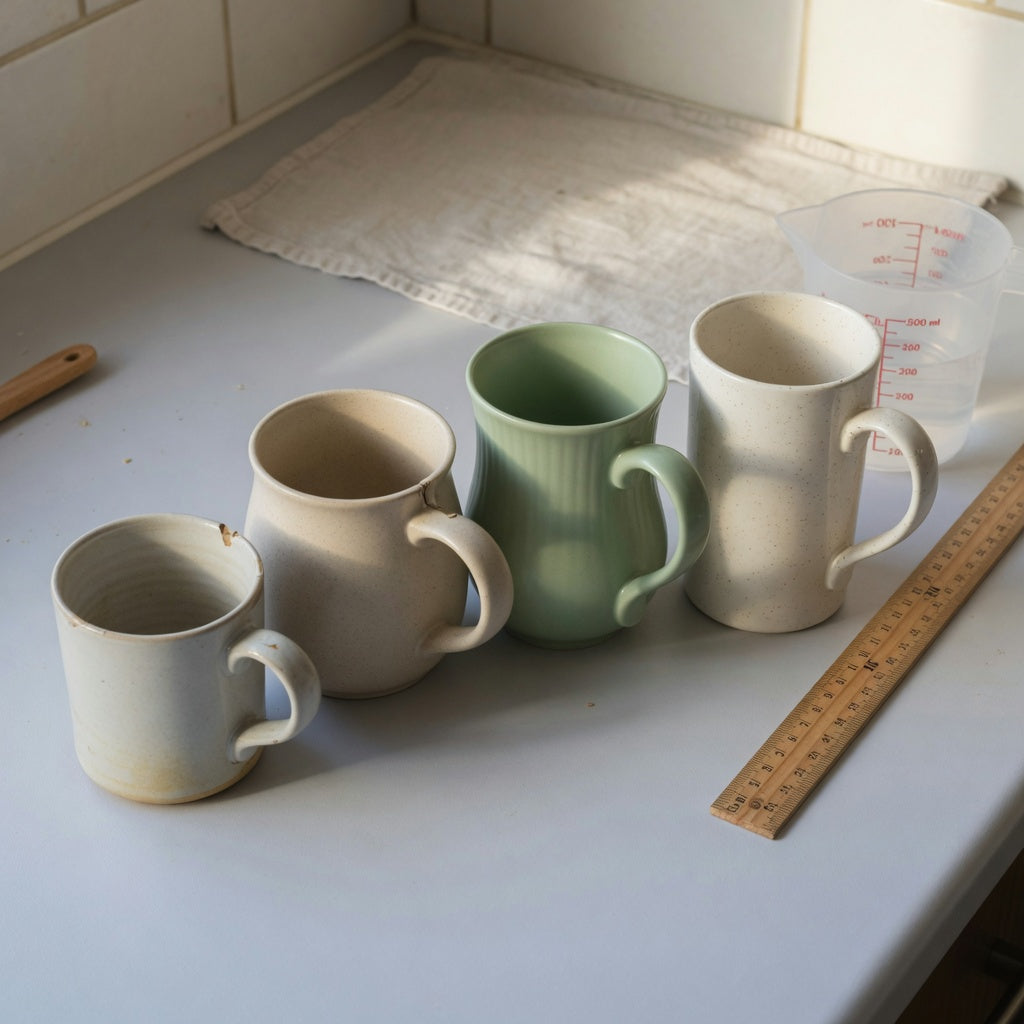
Keep the comparison to the information a current listing can support. Capacity tells you how closely the new mug can reproduce the old pour. Material confirms that ceramic is still the category you want, but the word ceramic alone does not confirm a care routine or performance level. Shape separates the smooth round, pleated, and retro-looking forms. Handle details determine how much the replacement changes the hand position you already use.
| Variable | Record from the old mug | Verify on the current listing | Skip the option if |
|---|---|---|---|
| Capacity | Usual fill line and number of refills | Listed capacity and any stated dimensions | The normal coffee or tea pour would become inconvenient |
| Material | Whether you want another ceramic vessel | Listed material and any stated care information | You actually need an insulated, sealed, or travel-specific category |
| Shape | Round, textured, curved, or set-matching outline | Product photos and the described form | The new outline conflicts with your shelf or existing set |
| Handle | Opening, position, and body clearance | Handle photos and dimensions if provided | The handle requires a different grip or does not suit the user |
The live product page is the source of truth for current capacity, dimensions, and care wording. We do not repeat a capacity number here when the replacement decision depends on the listing you are viewing and on the fill line of the mug you are replacing. This keeps the shortlist useful if catalog details change and prevents a guessed specification from becoming part of your buying decision.
Which current ceramic option matches each replacement scenario?
These products are not ranked from best to worst. Each one answers a different replacement problem. Open the relevant page, compare its listed details with your notes, and use the skip rule before you let the visible form make the decision for you.
1. The plain round mug that needs the closest visual match
If the lost piece had a straightforward round body and a loop handle, begin with the round coffee tea mug. Its visible round form is the clearest starting point for a kitchen counter already holding simple shapes, or for an office desk where you want the replacement to introduce as little visual change as possible. The product page gives you the place to verify its ceramic material, listed capacity, and handle details.
Choose it when: the old mug was round, the handle opening felt familiar, and the listed capacity is close to your normal coffee or tea pour. Skip it when: the original problem was a completely smooth exterior, a distinctive curved body, or a handle that sat too close to the mug. A round outline alone does not guarantee a matching hand feel or storage fit.
Next step: open the product page and compare the listed capacity and product photos with the old mug's fill line, height, widest width, and handle opening. If one of those measurements is non-negotiable, treat a mismatch as a reason to stop.
2. The smooth mug that needs a more defined exterior
If the old mug's smooth surface was the part you disliked, inspect the pleated coffee tea cup. The visible pleats change the ceramic surface while keeping the form within an everyday coffee or tea profile. That makes it relevant for a shopper who wants a tactile or visual distinction without moving straight to a highly sculptural shape. The pleats are a shape decision, not proof of improved grip, durability, or easier cleaning.
Choose it when: the limitation was a completely smooth outside, or you want the replacement to be easy to distinguish from other mugs on a crowded counter. Skip it when: you need an uninterrupted flat exterior, your existing set depends on identical body lines, or a changed profile would complicate a tight storage arrangement. Check listed dimensions where they are provided instead of assuming the pleated form occupies the same space as the old mug.
Next step: use the product listing to verify capacity, ceramic material, visible handle placement, and any listed dimensions. Then compare those facts with the mug that broke. The word pleated should narrow the shape choice, not replace the capacity check.
3. The softer curve that suits a mixed set or a considered gift
If the replacement needs more shape than a plain cylinder, inspect the retro coffee tea cup. Its visible retro profile and loop handle make it the relevant candidate for a mug that previously had a softer curve, or for a gift recipient whose kitchen mixes newer and older-looking forms. The product name identifies coffee and tea use, but the listed capacity still needs to match the recipient's normal serving.
Choose it when: the lost mug had a gently curved outline, a mixed set is acceptable, or the gift decision is driven by form rather than exact uniformity. Skip it when: every mug on the shelf is straight-sided, the replacement must blend into a matching set, or the old piece was chosen for a very specific handle proportion. A retro visual cue does not guarantee that the handle, height, or width will match another mug.
Next step: compare the product photos and any listed dimensions with the old mug's height, widest width, and handle opening. If the curve changes how you store or carry the piece, treat that as a real trade-off rather than a minor decorative detail.
What changes when the replacement lives on an office desk, kitchen shelf, or in a gift box?
The surrounding space can turn a good visual match into an awkward replacement. Our team has seen shoppers match a body shape and then discover that the new height conflicts with a shelf, the handle occupies the only clear space beside a keyboard, or the profile sits differently in a rack. These are fit checks, not claims about the products' performance.
- Office desk: Compare listed dimensions, where available, with the space beside your keyboard, papers, or monitor stand. If you drink iced coffee, confirm that the listed capacity and opening suit the serving you actually make. Do not treat a ceramic coffee or tea mug as a leak-resistant commuter tumbler unless the listing explicitly supports that need.
- Kitchen shelf: Measure the old mug's height and widest width against cabinet clearance, shelf depth, and drying-rack slots. If you use a dishwasher, verify the stated care guidance for the specific product before ordering; the material name alone does not answer that question.
- Gift unboxing: Match the recipient's usual pour and the shapes already in their kitchen. A round form may blend into a plain set, while a pleated or retro form makes a more deliberate visual change. Confirm capacity before choosing a replacement for someone who regularly fills a large morning mug.
If the real requirement is a sealed lid, leak resistance, an extreme travel capacity, espresso-scale size, or a specialty handle, do not force one of these ceramic options into that job. A travel mug or another explicitly specified style is a better category to investigate. The right replacement sometimes begins with a clear decision to skip the minimalist ceramic shortlist.
What should you verify about ceramic care before the first wash?
Care is a frequent source of mistaken assumptions. Ceramic describes the material; it does not automatically confirm dishwasher, microwave, oven, or temperature-change suitability. In our store, we direct shoppers to the care wording on the individual product page and recommend following that wording exactly. If dishwasher use or another care requirement is non-negotiable, leave the order undecided until the listing answers it.
- Before the first use, inspect the rim, the handle-to-body join, and the foot or base contact area in good light.
- Place the new mug beside the old one, if you still have a matching piece, and compare height, widest width, handle opening, and the amount you normally pour.
- Use only the care method stated for the specific item. A dishwasher cycle can be part of your routine, but it is not evidence that every ceramic vessel has identical instructions.
- After washing, check again for a visible chip, hairline crack, or contact point that does not sit as expected. Follow the seller's support process if the item arrives with a problem.
This check takes less time than reorganizing a cabinet around a mug that was the wrong size from the beginning. It also keeps a replacement purchase grounded in observable details instead of broad material claims.
What is the fastest final check before placing a replacement order?
The useful part of this minimalist ceramic mug replacement purchase product shortlist guide is the stop rule: a candidate must match the old routine on the variables that mattered most. Run the following list with the product page open:
- Does the listed capacity match the fill line or serving you actually use?
- Is ceramic still the right material for the job, or do you need a sealed or insulated travel vessel?
- Does the visible body shape fit the old mug, your existing set, and the available storage space?
- Does the handle opening and position suit the same hand placement?
- Do the listed dimensions, if provided, fit the machine clearance, shelf, drying rack, or desk?
- Have you checked the specific care instructions instead of assuming them from the material?
- Does the option solve the original limitation without introducing a more serious one?
If two options pass, choose the one that changes the fewest variables. If none pass, scan the unique coffee mugs collection for another visible form, but carry the same measurements and care question with you. A wider catalog should expand the shortlist only after you know why the three scenario matches fail.
Frequently asked questions
How do I use this minimalist ceramic mug replacement purchase product shortlist guide if I cannot measure the old mug?
Use a photo beside a familiar object, the shelf space the mug occupied, and the fill line you remember. Start with the visible shape that looks closest, then verify the listed capacity and handle details on its product page. If the fit is critical and those details remain unknown, ask the seller before ordering rather than relying on a guessed match.
Should I match the old mug's listed capacity exactly?
Match the serving you actually pour, not the label alone. The closest listed capacity is usually the sensible starting point when the old routine worked well; a larger or smaller option is a deliberate change that may affect refills, storage, and hand feel. Check the current product listing before treating any capacity as a match.
Is the pleated coffee tea cup a better office mug than the round coffee tea mug?
There is no universal better choice. The pleated option is relevant if you want a visibly defined exterior, while the round option is the closer shape check for a plain mug. Compare the listed capacity, dimensions where provided, and handle photos with the space on your desk before deciding.
Can I put these ceramic mugs through a dishwasher cycle?
Check the care instructions on the individual product page and follow them. This article does not infer dishwasher suitability from the fact that the vessels are ceramic. If dishwasher use is essential to your routine, confirm that detail before placing the order.
When should I choose a different mug style instead?
Choose another category when you need a sealed lid, leak resistance, an extreme travel capacity, an espresso-sized vessel, or a specialty handle that these three forms do not clearly provide. A travel mug or another explicitly specified style is a better starting point for those requirements. The same replacement method still applies: write down the limitation first, then compare only products that address it.
Before you order, write down the old mug's approximate fill line, target capacity, ceramic material, body shape, handle opening, and any care requirement you cannot compromise on. Then open the round coffee tea mug, pleated coffee tea cup, or retro coffee tea cup page and reject any candidate that misses a non-negotiable. Use the unique coffee mugs collection only when those three forms do not fit, keeping the same checklist in hand.
More from our blog
Read more
Ceramic Tea Mug Replacement Purchase Practical Purchase Checklist
Replace the mug that failed without repeating its problems. Compare ceramic material, current listed capacity, visible form, and handle shape while treating unstated details as unknown.
Read more
Emerald Green Coffee Mug Replacement Purchase Product Shortlist Guide
Start with the limitation of the mug you are replacing, then compare the current emerald and round coffee tea mug listings by color availability, listed capacity, visible form, and handle shape. Th...
Read more
Leave a comment
This site is protected by hCaptcha and the hCaptcha Privacy Policy and Terms of Service apply.