
Ceramic Tea Mug Replacement Purchase Product Shortlist Guide: 3 Picks
Reading time: about 10 minutes
A replacement search often starts at the sink: a rim chip catches your eye, a fine crack appears near a handle attachment, or the mug that seemed acceptable online still presses against your knuckles every morning. This ceramic tea mug replacement purchase product shortlist guide begins with that specific failure and narrows the choice to three current CoffeifyMug options using only facts supported by the listings: ceramic material, listed capacity, visible form, and handle shape.
We handle these mugs in our store, and the useful comparison happens in an ordinary setting, such as a kitchen counter or office desk. We do not treat a rounded form as proof of stability, a handle photo as a universal comfort guarantee, or ceramic material as evidence of unlisted care performance. The goal is to find the candidate that corrects your old mug's main limitation without making claims the product pages cannot support.
What should this ceramic tea mug replacement purchase product shortlist guide fix?
Start with one must-fix problem and one secondary preference. Trying to improve every detail at once usually turns a replacement purchase into another long catalog search.
- Capacity mismatch: Note whether the old mug regularly ran empty too soon or held more than you normally served.
- Handle geometry: Record where the grip failed. Your fingers may have felt pinched inside the opening, or your knuckles may have touched the ceramic body.
- Body form: Decide whether you want to replace a tall upright profile with a rounded or tapered shape, or keep the familiar vertical form.
- Evidence gap: If the old mug developed glaze crazing, an uneven base, or a crack at an attachment point, do not assume a different silhouette prevents the same issue. These listings do not provide comparative durability data.
At our packing table, form and handle differences are easy to see side by side. Long-term performance is a separate question. That is why this shortlist uses visible, listing-backed distinctions and keeps style as the tiebreaker rather than the starting point.
Which four listing facts deserve space in the comparison?
A short product list only works if every variable can be checked. Use the same four fields for all three mugs.
| Buyer variable | How to use it | What it cannot prove |
|---|---|---|
| Ceramic material | Confirms that each current option stays in the same broad vessel category as the mug being replaced. | It does not establish glaze durability, impact resistance, or unlisted care compatibility. |
| Listed capacity | Compare the current product-page figure with the amount you normally pour. | A listing capacity does not show where you personally leave headspace. |
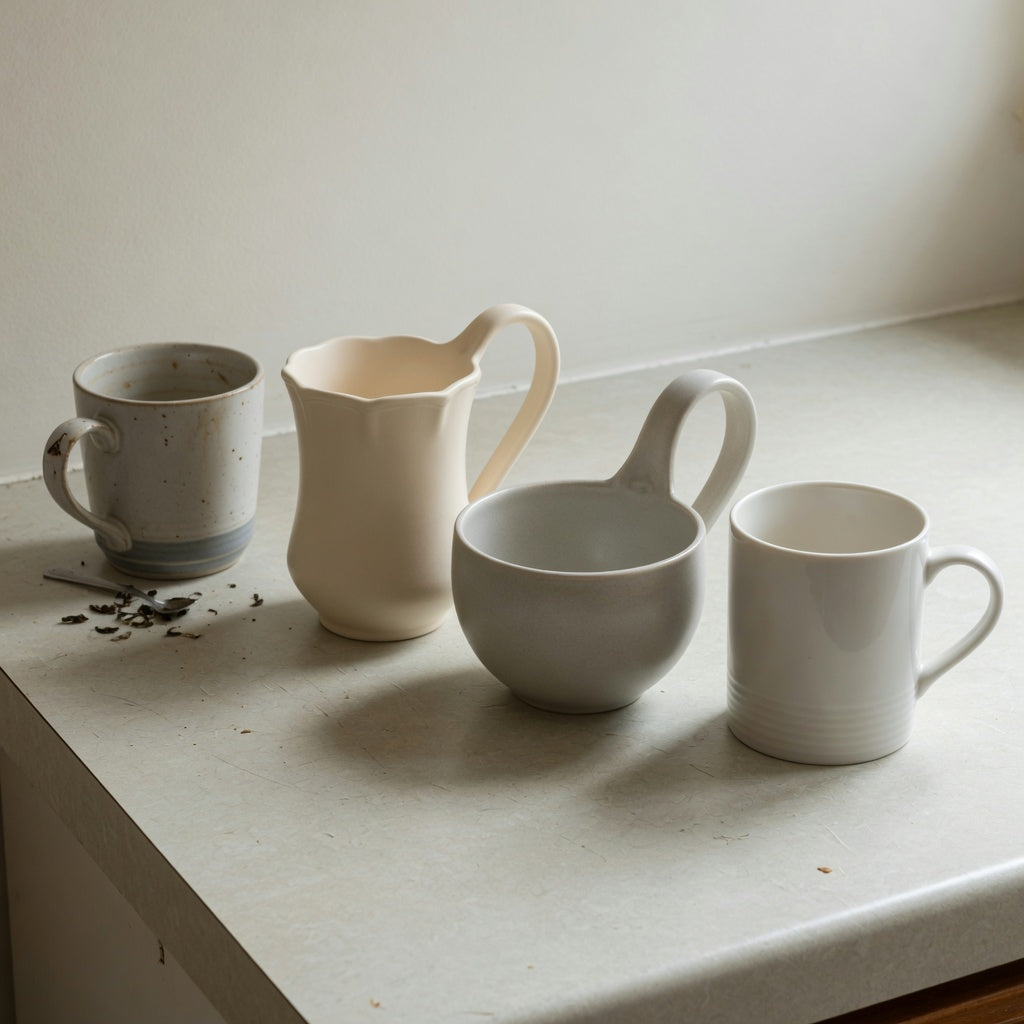
| Visible form | Distinguish among a flowing tapered body, a rounded bowl profile, and an upright cylindrical form. | Form alone does not guarantee exact dimensions, stackability, or resistance to tipping. |
| Handle shape | Use the curved, loop, or C-shaped outline to reject geometry that resembles the old problem. | A photo cannot guarantee finger count, knuckle clearance, or comfort for every hand. |
For a concrete baseline, measure the old handle opening at its narrowest point and note the gap between the handle and mug body. If the old mug is intact and suitable to handle, fill it only to your normal serving level and transfer that amount to a measuring cup. Do not use a damaged mug for this step; an order record, capacity marking, or similar intact mug is a better reference.
Which of the three mugs matches your replacement problem?
On a side-by-side handling check, these three products separate most clearly by silhouette and handle design. Each recommendation below maps one reader situation to a first candidate, followed by a reason to skip it.
Cramped grip or knuckle contact: start with The Flow
Put The Flow Coffee Tea Mug first if the old handle felt narrow or awkward against your hand. Its listing identifies a ceramic vessel with a stated capacity, while the visible design uses a flowing tapered body and a softly curved handle. The curved path is the relevant comparison because it changes how the fingers approach the cup, although the photo cannot establish exact clearance for your hand.
Choose it when: Handle shape is the main reason for replacing the old mug, and you prefer a tapered body over a straight cylinder. Skip it when: Your first priority is the largest listed capacity in this group, or you specifically want a low, rounded bowl form. Do not assume the taper makes it suitable for stacking unless the product listing confirms that separately.
Tall profile no longer suits you: compare the Round mug
The Round Coffee Tea Mug belongs on the shortlist if you want a clear visual change from a tall, upright mug. The current listing presents a ceramic body with a stated capacity, a fully rounded bowl profile, and a classic loop handle. In our handling comparison, its rounded silhouette is the feature that distinguishes it immediately on a kitchen counter.
Choose it when: A rounded body and familiar loop handle are more important than maximizing volume. Skip it when: Your old mug's main failure was insufficient capacity or you prefer the curved handle treatment of The Flow. A rounded appearance can look more planted, but it is not a promise of stability; base contact, fill level, and the surface beneath the mug still matter.
Not enough tea for the routine: check Morning Night
Start with the Morning Night Coffee Tea Mug if the old mug regularly ran empty before your morning or desk routine was finished. Its listing-backed capacity is the larger choice in this three-product comparison. The visible form is upright and cylindrical, paired with a C-shaped handle.
Choose it when: Listed capacity is the deciding variable and you are comfortable keeping an upright profile. Skip it when: A low, rounded appearance is more important, or the mug must fit within an exact height restriction. This comparison does not provide external dimensions, so it cannot confirm fit beneath a shelf, cabinet, or beverage machine.
How much capacity change is enough for your normal pour?
Capacity is useful only when the old and new numbers describe the same thing. Your normal fill level may sit below the brim, while the product page may state the vessel's nominal capacity. Keep that difference in mind rather than judging volume from the photograph.
- Record how much you usually serve, using an intact vessel and a measuring cup.
- Write a pass-or-fail target. If the old mug was too small, the replacement's listed capacity must leave enough room for your normal serving.
- Open each linked product page and use the current listed value. Do not estimate capacity from the height or width shown in an image.
- If capacity eliminates two options, stop there. If several still qualify, use handle shape and visible form as the tiebreakers.
That is the core discipline behind this ceramic tea mug replacement purchase product shortlist guide: capacity acts as a gate, while form and handle shape decide among the products that pass. For a volume-led purchase, Morning Night is the first comparison. For a form-led purchase, Round and The Flow provide more distinct alternatives.
What can a handle photo tell you before an online purchase?
A product image can show the handle's overall outline, its attachment points, and the visible space between the handle and ceramic wall. It cannot tell you exactly how many fingers will fit or how the filled mug's weight will sit in your hand.
- Compare the narrowest part of the opening with the same point on your old handle.
- Look at the stand-off distance between the inner handle edge and the mug body, especially where your knuckles normally sit.
- Note whether the handle follows a curved path, forms a regular loop, or uses a more upright C shape.
- Do not treat a thick-looking handle as proof of strength. The listings do not provide handle stress-testing data.
We can compare these shapes directly while handling the mugs in our store, but comfort remains personal. Gift buyers should pay particular attention to the recipient's current mug. A design can make a strong first impression during unboxing and still be the wrong replacement if it repeats the same cramped grip.
When should you skip all three and browse a wider mug collection?
These options are current ceramic coffee and tea mugs for ordinary serving. They are not the right shortlist if you need an insulated travel vessel, an integrated brewing accessory, a verified stacking design, exact external dimensions, or a particular care claim that is not stated on the product page. The same applies if preventing glaze crazing or handle-joint cracking is your primary requirement; the available listing facts do not support that comparison.
A wider style search also makes more sense when you are buying a gift without access to the recipient's old mug. In that case, browse CoffeifyMug's unique coffee mugs collection and let visible design lead the first pass. Return to capacity, form, and handle shape before placing the order so the gift still works as an everyday vessel.
Which five steps turn the comparison into one purchase?
- Write down the old mug's single biggest limitation: capacity, handle geometry, or body form.
- Measure your normal serving amount or recover the old mug's stated capacity from a reliable record.
- Put The Flow first for a curved-handle comparison, Round first for a rounded-body comparison, or Morning Night first for the larger listed-capacity comparison.
- Read the skip reason for that candidate. Reject it if it recreates another limitation you already know you dislike.
- If no candidate passes, move to the collection instead of compromising on the problem that triggered the replacement.
The result should be one preferred mug and, at most, one backup. More choices usually mean the original must-fix requirement has not been defined tightly enough.
Frequently asked questions
How do I use the ceramic tea mug replacement purchase product shortlist guide if my old mug is broken?
Do not fill or handle a cracked mug just to measure it. Check an old order, a capacity marking, or an intact mug that held a similar serving, then compare that figure with the current product listings. Use a side-on photo of the broken mug to record its body form and handle shape.
Is a rounded ceramic tea mug automatically more stable on an office desk?
No. A rounded body can be a useful visual preference, but it does not prove how much of the base contacts the desk or how the mug behaves when filled. Choose the Round mug for its listed ceramic material, capacity, visible rounded form, and loop handle, not as a guaranteed tip-resistant product.
Which ceramic mug handle is best if my knuckles touch the cup?
There is no universal best handle because hand size and grip vary. Start by comparing The Flow's curved handle with the opening and body clearance on your old mug. The Round mug's loop and the Morning Night mug's C-shaped handle provide two visibly different alternatives if the curved form does not suit you.
Can these ceramic mugs be used for both tea and coffee?
The linked listings present all three products as coffee and tea mugs. This shortlist is limited to ordinary serving in the current vessel and does not add claims about brewing accessories, included contents, temperature performance, or care compatibility.
Which option is best for a replacement gift?
If you know the recipient disliked a cramped handle, start with The Flow. Choose Round for a known preference for rounded forms, or Morning Night when a larger listed capacity is the clear need. If you do not know what failed about the old mug, the broader collection is a more sensible first step.
Place the old mug, or a clear photo of it, beside the three product pages now. Mark one must-fix problem and one preference, reject any candidate that fails the capacity check or repeats the old handle or form issue, then choose the single mug that remains. If none survives, return to the collection rather than accepting the same limitation twice.
More from our blog
Read more

Ceramic Mug With Wooden Handle Replacement: Practical Purchase Checklist
Replacing a wooden-handle ceramic mug is easier when you compare the old mug's normal pour, visible vessel profile, and grip shape. This checklist maps those details to Mountain Sea II, The Cloud, ...
Read more
Ceramic Mug With Wooden Handle Gift Choice Product Shortlist Guide
Compare the listed 12 oz Mountain Sea II and 14 oz The Cloud by the recipient's current mug capacity, visible vessel form, and preferred handle outline. Each option has a clear reason to choose, sk...
Read more
Leave a comment
This site is protected by hCaptcha and the hCaptcha Privacy Policy and Terms of Service apply.