

Ceramic Mug Shapes Everyday Mug Rotation Practical Purchase Checklist
Reading time: about 9 minutes
There is a mug in every cabinet that never quite makes it into the rotation. It looked right on the shelf. Then the first full pour happened — the handle pinched a knuckle, the rim left a brown trail down the outside, or the base was too wide to sit beside the kettle. Those are shape decisions, and they get made long before anything chips.
We handle these mugs every week in our store, and the questions at the counter are almost never about glaze colour. They are about whether a 250 ml mug holds a full flat white, whether two fingers fit through the handle, and whether the thing clears a machine spout. So this is not a style gallery. It is a ceramic mug shapes everyday mug rotation practical purchase checklist — six checks, run in order, written for people who pour two or three drinks a day.
What each silhouette actually changes at 7 a.m.
Retail vocabulary is loose. "Barrel," "belly," and "diner" describe different profiles depending on who is selling them, and two mugs sharing a name can differ by 80 ml and a rim width. The older regulatory language is a firmer starting point: U.S. FDA guidance describes cups and mugs as small ceramic hollowware for hot drinks such as coffee or tea, normally holding about 240 ml (8 fl oz) and normally made with a handle, and it separates a cup — a base with curved sides — from a mug with cylindrical sides.
Past that definition, silhouette changes five things you feel every single morning:
- Straight-sided cylinders. Even wall, no interior corners, predictable stacking. The easiest body to live with if you load a dishwasher or nest two high. Also the least forgiving of a clumsy handle, because there is nothing else to grip.
- Belly and barrel profiles. Volume sits at the widest point and the wall draws in toward the rim. More surface for your hand, less open area at the top. Check the widest diameter before assuming it nests.
- Tapered and bowl-like latte cups. They trade depth for opening width. Good when you pour milk and want to watch the surface; poor when you want volume in a narrow footprint, because they eat shelf width.
- Flared rims. The lip turns outward. A flare only helps if the edge is finished cleanly — a thick, blunt flare can feel worse against the mouth than a plain rounded rim.
- Handleless forms. Genuinely practical for tea drinkers and anyone who cups the body with both hands, and a poor choice for a near-boiling pour into a thin wall. Wall thickness decides it, not the aesthetic.
To see how far those silhouettes diverge on one shelf, browse our unique coffee mugs collection and compare the profiles rather than the patterns.
The ceramic mug shapes everyday mug rotation practical purchase checklist
Run these six in order. Most purchases are settled by check three.
- Silhouette — cylinder, curved cup, belly or barrel, tapered or flared, handleless.
- Listed capacity against the pour you actually make, not the one you think you should make.
- Handle opening, cross-section, and clearance from the body.
- Rim thickness and opening width.
- Storage — stack height, shelf depth, spout clearance, whether it sits flat when stored rim-down.
- Glaze, food-use status, and interior detail — corners that trap residue, visible seams, decoration near the lip.
Matching your plates is preference. It belongs at the bottom of the list, not the top.
Does your real pour fit 200 ml, 250 ml, or 400 ml?
Convert before you compare. NIST treats 1 fluid ounce as 29.57 ml and a household cup as roughly 240 ml, so a 400 ml mug is about 13.5 fl oz — noticeably bigger than the "standard" mug most shoppers picture. At the small end, specialty-coffee sizing runs the other way: espresso cups sit well under 90 ml, while cappuccino, flat white, and latte commonly land in a 150–240 ml band depending on the milk and foam ratio.
Here are three from our own catalog, using only listed capacity and what the silhouette tells you:
| Mug | Listed capacity | What to verify on the listing | Reader it suits |
|---|---|---|---|
| Pleated Coffee & Tea Cup | 200 ml | Rim profile, and whether the pleats continue inside the cup or stop at the outer wall | One flat white or a slow afternoon tea; small kitchens with shallow shelves |
| Ball Handle Coffee & Tea Mug | 250 ml | Internal handle opening and how far the ball stands off the body | The middle of the range — milk coffee, a larger tea, one-handed desk use |
| The Flow Coffee & Tea Mug | 400 ml | Overall height against your spout clearance, plus wall thickness and rim finish | Large lattes, iced drinks, long desk sessions |
Two caveats apply to every listing, ours included. Listed capacity is not usable capacity — leave 15–20 mm of headspace for foam and a 400 ml mug delivers closer to 330–350 ml of drink. And a small cup is not a downgrade. If your daily pour is a 150 ml flat white, a 400 ml mug makes it look thin and cools it faster than you can finish it. If your rotation already lives in the middle of the range, our 12 oz ceramic mug rotation checklist works through that band in more detail.
How much finger room does a handle need before a mug gets a daily slot?
The baseline most adults describe as comfortable: index finger through the opening, thumb resting on top of the handle, knuckle clear of the body. That is measurable before you buy. Estimate the internal opening from the listing photos, then compare it with the width across your index finger plus a couple of millimetres of clearance.
Geometry matters as much as opening size. A round or ball-shaped handle spreads pressure across the fingers instead of concentrating it on one edge, which is why it feels good in a shop. The trade-off is protrusion — a ball handle stands further off the body than a flat C-handle, which changes both the balance when full and the cabinet depth it needs. A 250 ml mug at capacity is roughly 250 g of liquid before you count the ceramic, so picture it tilted in your hand: a handle set too high makes the cup feel like it is rotating away from you.
Hand size is the variable no listing states. Large hands often settle for a two-finger grip they tolerate rather than enjoy. Our guide to ceramic mugs with large handles explains how to read handle proportions from photos when you cannot test one in person.
Will it stack, clear the spout, and dry upside down?
Three measurements retire more mugs than any aesthetic objection:
- Spout clearance. With the drip tray in place, measure from tray to brew spout. A tall 400 ml body plus a thick wall can be a few millimetres too much, and no amount of tilting fixes that.
- Shelf spacing. Stacking works with straight sides and handles that stay inside the mug's footprint. A ball handle or an oversized loop usually rules out stacking two high, so plan that shelf as a single row.
- Upside-down drying. Storing rim-down keeps dust out, but it only works if the handle does not prop the mug up at an angle. Faceted and square bodies are the worst offenders — striking on an open shelf, irritating in a drying rack.
Contoured shapes are not decorative-only, but they demand more from your storage. If counter space is tight, keep one sculptural mug and make the rest of the rotation straight-sided.
What the silhouette cannot fix: heat loss, clay body, and glaze safety
Shape gets credit for things it does not control. Heat loss depends on surface area, wall thickness, how warm the ceramic is when you pour, and how open the top is. An open mug loses heat largely through evaporation, and no belly profile stops that. Thicker walls slow transfer at the wall and a larger volume of liquid holds more heat, but we have not seen credible evidence that a named silhouette keeps coffee meaningfully hotter across a ten-minute desk session. The same skepticism applies to claims that a particular shape makes coffee sweeter, more acidic, or more floral. Sellers repeat it; the authoritative sources we reviewed do not support it.
Keep material separate from shape, too. Stoneware, porcelain, and earthenware differ in body and porosity, and porous earthenware depends on a sound glaze to hold liquid — a fact that has nothing to do with whether the mug is a cylinder or a bowl. Our comparison of ceramic mugs for coffee and tea drinkers covers body and finish in more depth.
On food contact, FDA Compliance Policy Guide Sec. 545.450 sets a lead guideline for ceramic cups and mugs of 0.5 micrograms per millilitre of leaching solution in any one of six units, examined by methods including ASTM C738 — an acetic-acid extraction the agency describes as a severe test unlikely to be matched in ordinary use. FDA also states there is no known safe level of exposure to lead, with fetuses, infants, and children particularly vulnerable. Leaching is a glaze-and-firing question, never a shape question. If a listing does not state food-use status, ask before you buy.
Frequently asked questions
Do I need a wide, bowl-shaped ceramic cup to pour latte art?
A wide, shallow cup makes the surface easier to see and gives the milk somewhere to spread, which helps when you are learning. It is not required. A 250 ml mug with a clean rim and enough headspace works fine — milk texture and pitcher control matter more than silhouette.
How many fingers should fit through a mug handle?
For most adults, one finger through with the thumb resting on top and the knuckle clear of the body is the comfortable baseline. Larger hands usually want room for two. If the internal opening is not clear from the photos, ask before ordering — it is the most common fit complaint we hear.
Does the shape of a ceramic mug change how the coffee tastes?
Shape changes temperature, aroma delivery, and how much you get per sip, and those influence perception. Claims that a specific silhouette makes coffee sweeter or less acidic are not established by the authoritative sources we reviewed, so treat them as marketing rather than a buying reason.
Is a handleless ceramic cup practical for hot coffee?
It depends on wall thickness and serving temperature. Handleless cups work well for tea poured slightly cooler or for drinks you hold with both hands, and poorly for a fresh near-boiling pour. Check the wall thickness on the listing before giving one a daily slot.
Is there a ceramic mug shapes everyday mug rotation practical purchase checklist I can run before checkout?
Yes — silhouette, listed capacity against your real pour, handle opening and clearance, rim thickness and opening width, storage and spout clearance, then glaze and interior detail. If a mug fails two of the six, it belongs on the shelf, not in the rotation.
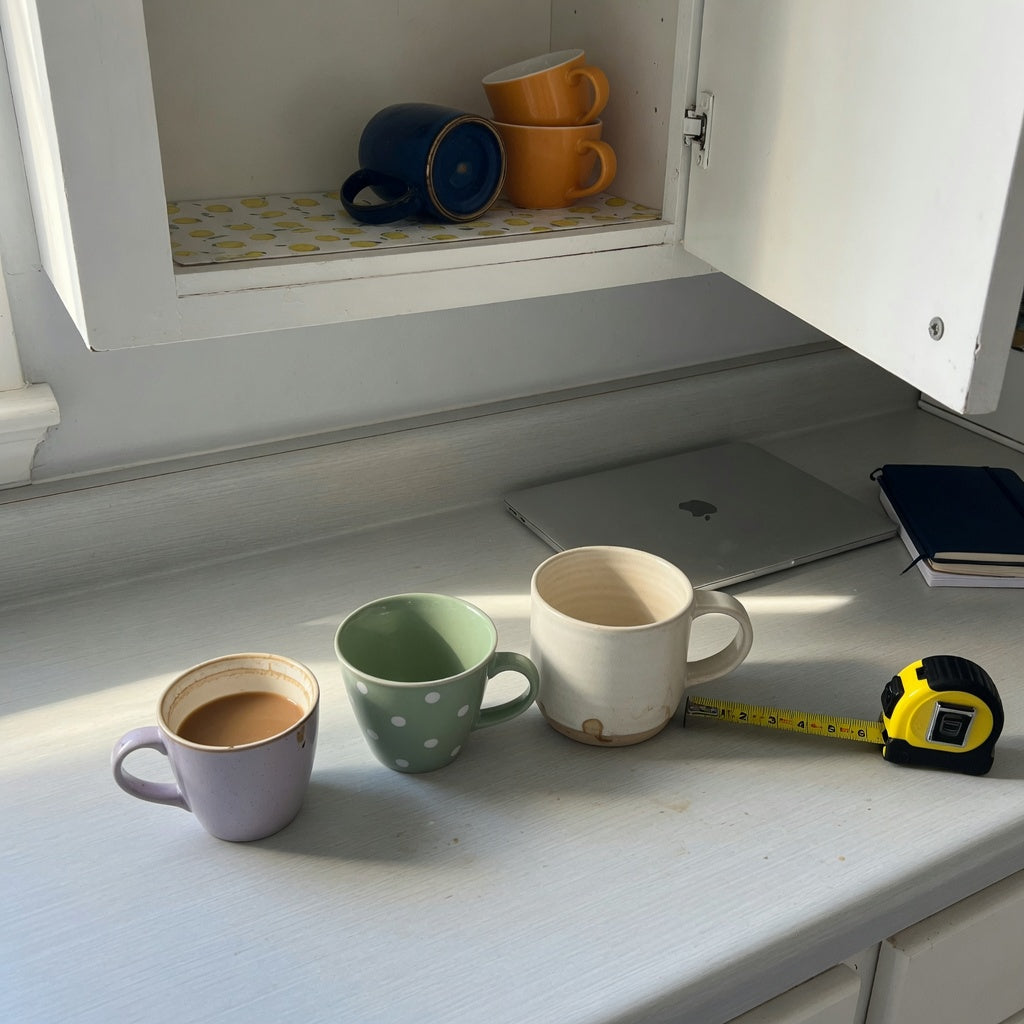
Start with the mug you reach for most and measure it: capacity by filling it and pouring into a measuring jug, rim thickness with a ruler, handle opening across the inside, and total height. Then hold those numbers against the 400 ml Flow mug, the 250 ml Ball Handle mug, and the 200 ml Pleated cup. Whichever matches two of your three measurements is usually the one that stops living in the cabinet.
Read more
Big Latte Mug Everyday Mug Rotation Product Shortlist Guide
A rotation-first shortlist of three big latte mug sizes — 400 ml, 440 ml and 480 ml — with the exact reason to pick or skip each, plus the fill-line, handle and clearance checks that decide it.
Read more
14 oz Ceramic Coffee Mugs: Home Coffee Station Purchase Checklist
A 14 oz label rarely tells you how much coffee you can actually pour. Our checklist covers brim versus working fill, handle clearance, glaze testing and station fit before you add another mug to th...
Read more
Leave a comment
This site is protected by hCaptcha and the hCaptcha Privacy Policy and Terms of Service apply.