
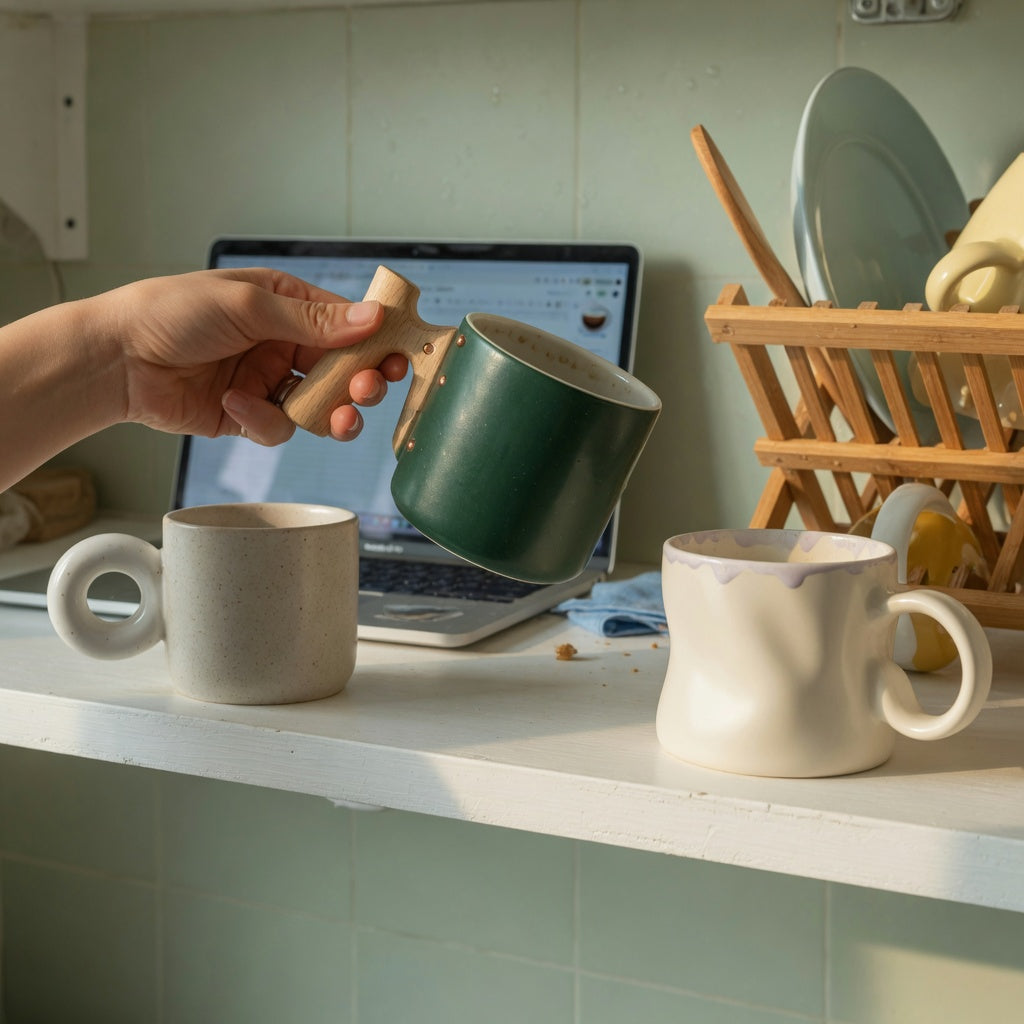
Ceramic Coffee Mugs With Large Handles: Everyday Mug Rotation Checklist
Reading time: about 10 minutes
At 6:45 a.m., the front mug has to clear its neighbor, leave the cabinet door shut, and give your fingers a relaxed path through the handle. By Thursday, one mug may be on the office desk, another in the sink, and a third waiting clean on the shelf. That is where a large handle either earns a permanent place or becomes the mug everyone skips. We built this ceramic coffee mugs with large handles everyday mug rotation practical purchase checklist around that ordinary week: grip, storage, washing, and the difference between a good product photo and a good fit at home.
Our team handles these mugs during photography, order checks, and packing. In our store, we pay attention to handle joins, rim edges, base stability, and the room each shape needs beside another mug. The linked product pages are the source for each item's listed dimensions, capacity, materials, and care instructions; if a detail is not listed there, this article treats it as an open question rather than filling the gap with a guess.
Will the handle clear the cabinet you open every morning?
Start with the storage location, not the mug photo. Measure the usable depth from the back wall to the closed door or front edge, then measure shelf height and the side-to-side gap available for the handle. Include the handle's widest projection. A cup body can fit while the handle catches the neighboring rim, collides with a cabinet frame, or leaves the door slightly open.
- Closed upper cabinet: Check clearance with the mug sitting at the angle you will use to pull it out.
- Open shelf: Leave enough side space to lift one piece without dragging the next handle along with it.
- Counter or office desk: Measure the footprint beside a kettle, keyboard, notebook, or sink before assigning the mug a permanent spot.
Large handles trade storage efficiency for grip access. That trade can be worthwhile for larger hands or for anyone who wants more room around the fingers, but it is frustrating in a shallow cabinet. Decide which constraint wins in your kitchen before comparing finishes.
What belongs in a ceramic coffee mugs with large handles everyday mug rotation practical purchase checklist?
Use the same checks for every candidate, including pieces already in your cupboard. They separate a mug that looks comfortable in a listing from one that still feels right after the third refill.
- Match the listed capacity to your actual pour. Compare the product page's stated volume with your usual coffee, tea, or iced drink. Leave headroom for a hot drink; do not assume a tall-looking body holds more.
- Check finger and knuckle clearance. Hold the empty mug by the handle, then imagine the weight of a full drink. Your fingers should not pinch against the ceramic, and your knuckles should not press into the inner curve.
- Measure the widest point, not just the cup. Record handle projection and the gap needed between neighboring mugs. This number controls cabinet fit, shelf spacing, and how many pieces can share a tray.
- Test the base on the surfaces you actually use. Set it beside the kettle and beside a keyboard. Look for rocking, an awkward footprint, or a handle that reaches into a cable path. A comfortable grip does not compensate for a mug that is always in the way.
- Read the care instructions line by line. Ceramic care and wood-handle care may not be interchangeable. Treat dishwasher compatibility, hand washing, drying, and temperature guidance as product-specific facts, not assumptions based on appearance.
- Inspect the mouth and inner curve. A wide opening can make adding ice and cleaning by hand easier; a more contained opening may suit slower sipping. Use the photos and listed measurements to decide, rather than treating one shape as universally better.
- Assign a rotation role. Mark each candidate as weekday, office, weekend, guest, or gift use. A special handle can be ideal for one slot and inconvenient as the only mug everyone must use.
We recommend writing these answers down before checkout. The short record is especially useful when several mugs have similar silhouettes but very different handle footprints.
Which CoffeifyMug handle shape fits a weekday desk, a weekend cup, or a gift?
The three linked product pages give shoppers different visual starting points. We use the situation-to-feature match below, then send the buyer back to the page to verify the dimensions, capacity, material details, and care information actually listed there. These are recommendations by use case, not a claim that one style suits every hand or shelf.
| Reader situation | Why the style may fit | Product-page next step |
|---|---|---|
| You want a rounded, distinctive grip and have open shelving or extra side clearance. | The Ball Handled Coffee Tea Mug is identified by its ball-handled form. That shape is worth comparing if a rounded grip matters more to you than tight nesting. | Check the page's listed size and care details, then compare the widest handle point with your shelf measurement. |
| You want a wood accent for a slower coffee or tea ritual, or a more distinctive gift. | The Mountain Sea II Coffee Tea Mug with Wooden Handle explicitly includes a wooden handle. It adds a separate material and care question to the purchase. | Review the page's instructions for the wooden component before assigning it to a high-frequency wash slot. |
| You move one mug between the kitchen and an office desk and prefer a flowing profile. | The Flow Coffee Tea Mug is the page to inspect for a continuous silhouette if the ball-style handle is not your preference. | Compare the shown projection and any listed measurements with your cabinet and desk footprint. |
For a mixed set, open our unique coffee mugs collection after you have measured the storage spot. It is a practical next step when you know the grip or clearance you need but want to compare more than one handle and surface direction. Keep the same checklist beside each product page so visual variety does not replace a fit decision.
What changes on wash day for ceramic bodies and wooden handles?
An everyday rotation turns care into a repeated workflow. Before putting any linked mug through a dishwasher, read that item's care section and check whether the handle changes the loading pattern. A large loop can contact a rack tine, crowd the spray arm, or block a neighboring glass even when the mug physically fits. A single test placement tells you about rack geometry; it does not establish the manufacturer's care approval.
- At unboxing: Check the rim, the handle-to-body join, and the foot ring by sight and touch. Look for a sharp edge, hairline crack, visible surface pinhole, or wobble before adding the mug to daily use.
- After washing: Look at the same points again and dry the area where handle and body meet. If you notice fine glaze lines, consider whether they are part of the described finish or something to ask the store about.
- For wood: Do not transfer the ceramic body's care assumption to the wooden handle. Follow the product page's instructions for that component and choose a lower-frequency role if the routine requires more attention than your weekday schedule allows.
Those checks are not a durability promise and they are not a claim that any linked item has a defect. They are the quick inspection habits we use when a mug is moving from a shipping box into a busy rotation.
Does one large-handle mug work for coffee, tea, iced drinks, and an office desk?
The drink is often less limiting than the surrounding routine. The same handle that feels generous beside a kettle may be inconvenient beside a laptop, and a mug that suits hot tea may not have the opening or listed capacity you want for ice. Compare the actual use case instead of labeling a shape all-purpose.
- Morning coffee: Prioritize a secure grip, a stable place to set the mug down, and enough listed capacity for your normal pour without filling to the rim.
- Tea: Check the product page for dimensions and care details, then consider how the rim feels during slower sips and how the handle sits when the mug is held for several minutes.
- Iced coffee: Confirm that the opening can accept the ice you use and that the listed volume leaves room for liquid and ice. A large handle does not tell you either measurement.
- Office or gifting: Measure the desk footprint and ask who will handle care. A distinctive wooden accent can be a thoughtful gift, but a recipient with limited storage may prefer a simpler profile.
Do not treat any of these mugs as a leakproof travel vessel unless the relevant product page explicitly says so. For a commute, choose a purpose-built travel option and keep ceramic for a stationary desk or kitchen rotation.
When is a large handle the wrong choice for an everyday rotation?
Large-handle ceramic mugs are not a good fit for every home. Choose a slimmer or purpose-built alternative when:
- your only shelf is shallower than the handle's measured projection;
- you need tight nesting for a dorm, RV, seasonal cupboard, or shared break room;
- the same mug must fit several different hand sizes and the oversized handle opening feels awkward to one user;
- you need a sealed commute container rather than an open ceramic cup; or
- your wash routine cannot accommodate a separate material such as wood.
That is a fit decision, not a judgment on the style. A large handle earns its space when grip access is the priority; a compact handle wins when storage density, portability, or one-step care matters more.
How can you compare the three product pages in five minutes?
- Measure the shelf, counter, and desk locations and write down the maximum width, depth, and height.
- Write the drink and wash routine: coffee or tea, hot or iced, hand wash or dishwasher, daily or occasional.
- Open the Ball Handled Coffee Tea Mug, Mountain Sea II Coffee Tea Mug with Wooden Handle, and The Flow Coffee Tea Mug pages. Copy only the dimensions, capacity, material, and care details that are actually listed.
- Eliminate any page that fails the storage or care test, then use the unique coffee mugs collection to compare remaining styles without changing your criteria.
For a first rotation, choose the style that solves the most frequent problem in your home, not the one with the most dramatic silhouette. Recheck the page just before ordering if a measurement or care detail is still blank; an honest unknown is a reason to verify, not a reason to guess.
Frequently asked questions
What should I measure before buying a large-handle ceramic mug for daily use?
Measure the usable shelf depth, height, and side-to-side gap with the cabinet door closed, then measure the mug's widest handle projection from the product page. Add the desk or counter footprint if the mug will travel during the day. Those measurements are the core of our ceramic coffee mugs with large handles everyday mug rotation practical purchase checklist.
Can large-handle ceramic mugs fit in a dishwasher rack?
Physical fit varies by rack, handle shape, and neighboring dishes. Test one empty placement for contact with the rack tines or spray arm, but follow the individual product page for care approval; a mug fitting in the rack is not the same as it being dishwasher-approved.
How should I care for the Mountain Sea II mug with its wooden handle?
Use the care directions shown on the Mountain Sea II product page and treat the wooden handle as a separate material. Do not assume instructions for a ceramic body automatically apply to wood; if the required routine is more involved than your weekday wash cycle, assign it to occasional or weekend use.
Which CoffeifyMug mug suits a kitchen-to-office rotation?
For a rounded grip, compare the Ball Handled Coffee Tea Mug; for a wooden accent, review the Mountain Sea II Coffee Tea Mug with Wooden Handle; for a flowing profile, inspect The Flow Coffee Tea Mug. Measure first, copy the listed care details, and then use the unique coffee mugs collection to make the final comparison.
More from our blog
Read more
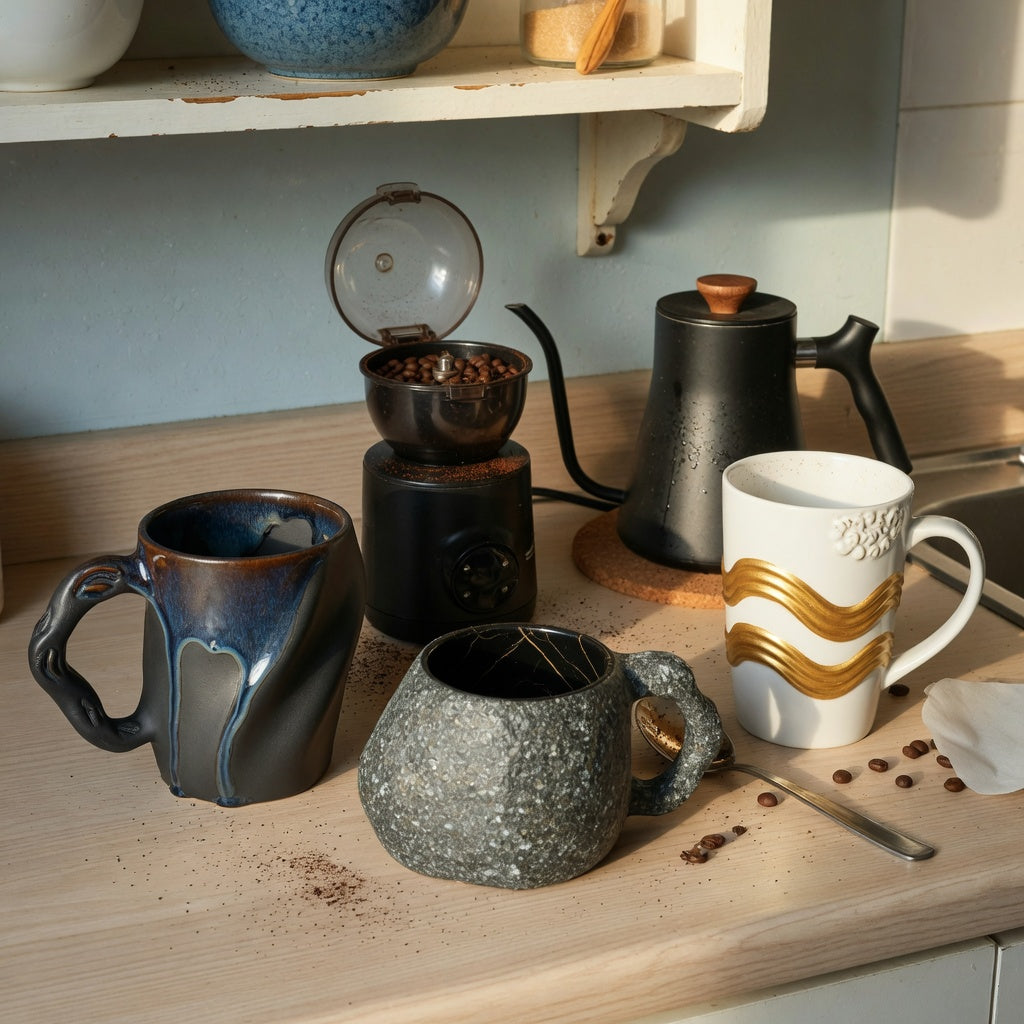
Large Unique Coffee Mugs Home Coffee Station Product Shortlist Guide
Compare three CoffeifyMug designs by counter clearance, footprint, visual role, care routine, and storage. Each recommendation includes a clear reason to choose it, skip it, or continue comparing.
Read more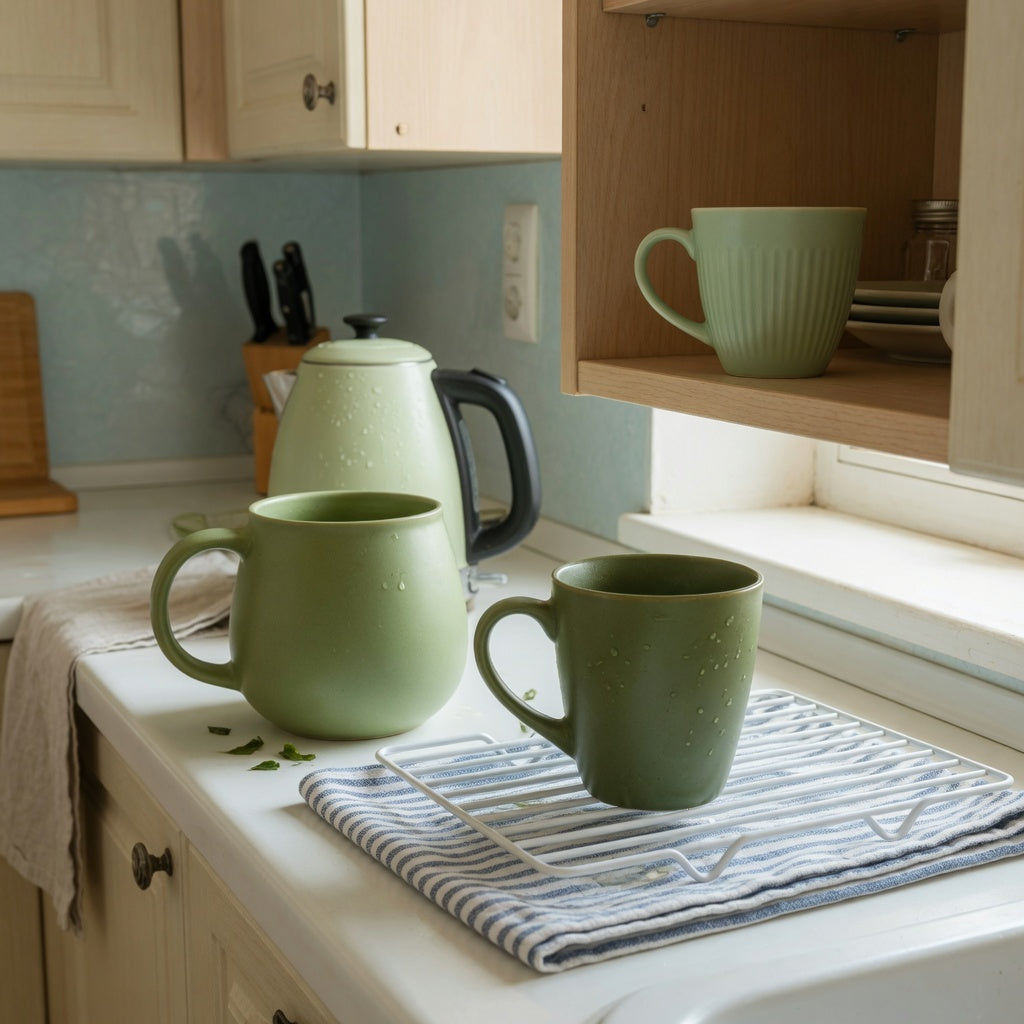
Green Tea Mug Everyday Mug Rotation Practical Purchase Checklist
Compare the Retro 170 ml, Pleated 200 ml, and Emerald 270 ml using the refill, shelf, rack, and care checks we use with shoppers. This checklist separates verified capacity and visible shape from f...
Read more
Leave a comment
This site is protected by hCaptcha and the hCaptcha Privacy Policy and Terms of Service apply.