
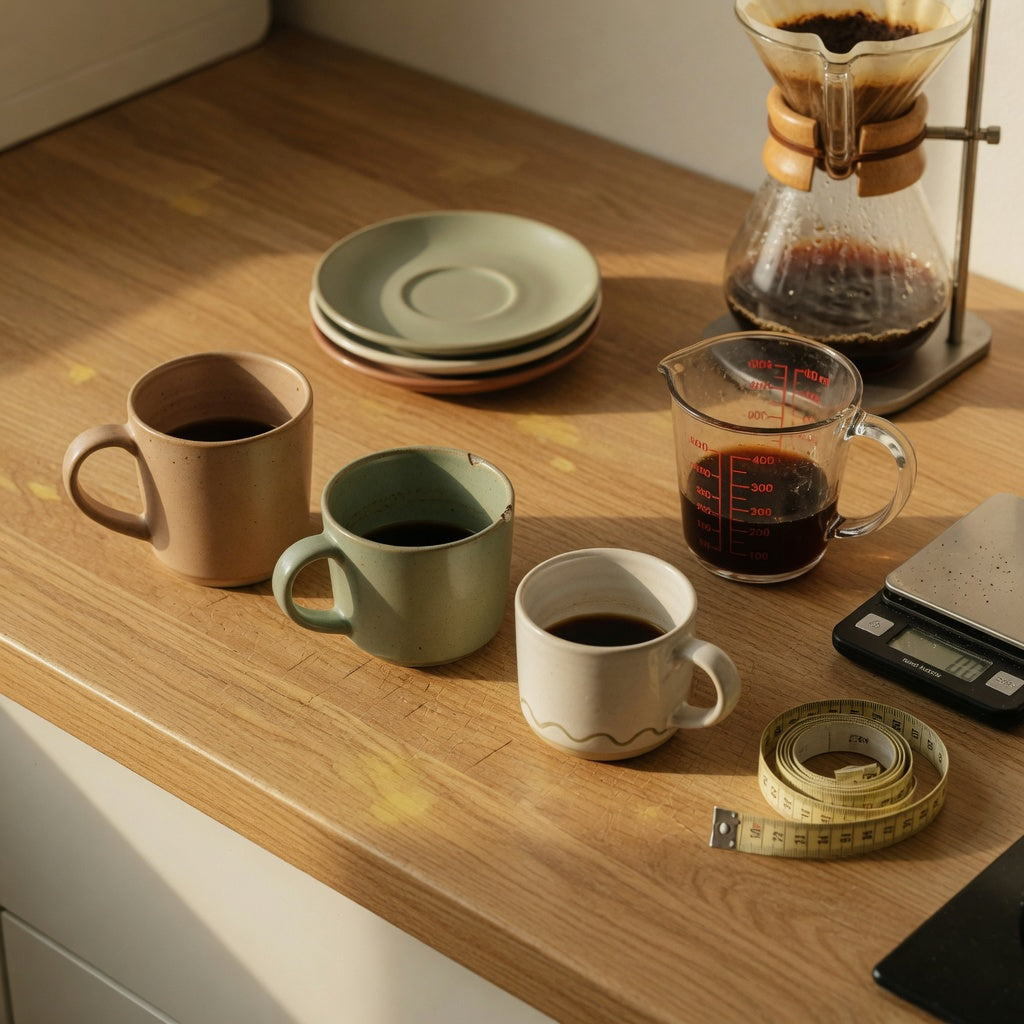
14 oz Ceramic Coffee Mugs: Home Coffee Station Purchase Checklist
Reading time: about 11 minutes
A mug listed at 14 oz arrives, gets filled to the same line as the old 12 oz mug, and the coffee sits higher up the wall than anyone expected. We hear some version of that from customers most weeks. Fourteen ounces is where a café-sized cup stops feeling generous and starts creating fit problems — and it is also where the listed number and the pour you can actually drink drift apart. This is the 14 oz ceramic coffee mugs home coffee station practical purchase checklist we use in our own store before we recommend a size.
What does 14 oz mean once a ceramic mug is full?
Fourteen US fluid ounces is about 414 ml; NIST lists the US fluid ounce at 29.57353 ml. That matters because ceramic mugs are often specified in millilitres at the factory and converted to ounces for the listing, then rounded. Sometimes the rounding goes upward.
For scale, FDA compliance guidance describes cups and mugs as small ceramic hollowware normally around 240 ml (8 fl oz), usually with a handle. A 14 oz mug is roughly 1.7 times that reference. It is still small hollowware for ceramicware purposes — the large-hollowware cutoff is 1.1 liters — but it is a genuinely large everyday cup.
The number also splits in two:
- Brim capacity — the volume to the very top edge. This is what many listings quote and what product photos imply.
- Working fill — what you can pour and carry without coffee sloshing over the handle side. Usually 30–60 ml less, depending on how much headroom you like.
If your reference is a 12 oz café drink at about 355 ml, a 14 oz brim mug may be barely bigger in practice. If it gives you a 14 oz working fill, it is a genuinely large mug. Ask which one the listing means.
Which of our three sizes lands closest to a 14 oz target?
We publish capacity in millilitres because ounces get rounded at every step. Three mugs in our unique coffee mugs collection sit on either side of the 14 oz mark:
| Mug | Stated capacity | Approx. fluid ounces | Reader scenario |
|---|---|---|---|
| The Flow | 400 ml | ~13.5 fl oz | You want a 14 oz brim mug and plan a 10–12 oz working pour |
| Morning and Night | 440 ml | ~14.9 fl oz | You want the closest match to a comfortable 14 oz pour |
| The Rock | 480 ml | ~16.2 fl oz | You make milk-heavy lattes, iced coffee, or tend to top off |
If your target is a comfortable 14 oz pour with headroom, the 440 ml Morning and Night mug is the closest fit in our lineup. It leaves room after a full 14 oz pour instead of filling to the lip. If 14 oz is your brim target, the 400 ml The Flow mug is just under it; fill it to the top and you are at about 13.5 fl oz, so a 10–12 oz coffee is more realistic. The 480 ml The Rock mug overshoots by design: better for a milk-heavy latte or iced drink, less ideal for an 8 oz black coffee because the extra surface area cools a small pour faster.
We stop at capacity deliberately. Handle dimensions, empty weight, wall thickness and care marks belong to the exact listing and can change between production runs. Confirm those on the product page for the mug you are buying, not on a styled photo.
The 14 oz ceramic coffee mugs home coffee station practical purchase checklist
Work down this list before you order, and again when the parcel arrives.
- Write your target in millilitres. 14 US fl oz is about 414 ml.
- Decide brim or working fill. Subtract 30–60 ml for headroom if the listing quotes brim capacity.
- Check the lid. If the mug has one, ask whether capacity was measured with the lid inset; a lid can steal ounces.
- Find empty weight. Add roughly 400 g for a 400 ml pour. A mug that feels fine empty can feel very different one-handed at 7 a.m.
- Measure the handle opening, not handle length. You want fingers clearing the hot wall when the mug is full; if you wear rings or have larger knuckles, give yourself more room.
- Measure the base diameter. Check it against your cup holder, brewer tray and kitchen scale platform.
- Measure shelf clearance. Include the handle; a wide handle can cost more cabinet space than a tall body.
- Read care marks for the exact item. Microwave, dishwasher, oven, broiler and freezer are separate claims.
- Ask for a leach test statement. A Lead Free badge is not the same as test data against FDA action levels.
- Look at rim and lip decoration separately. Decoration on top of the glaze deserves its own check, especially at the lip.
Why a full 14 oz mug can fail the hand test even when it fits the shelf
Three numbers decide comfort, and almost no listing includes them.
- Handle opening. Measure the gap, not the handle length. A generous-looking handle with a narrow opening still puts knuckles against a hot wall.
- Empty weight. A thick-walled mug can weigh two or three times what a thin porcelain one does. Add roughly 400 g for a 400 ml pour and you understand why the same mug feels different at 7 a.m. than it did on the shelf.
- Foot diameter. The base decides cup-holder fit, stability on a narrow brewer tray and whether the mug nests neatly in the cabinet.
Measure stack height too if you store mugs in a row. A handle that juts out further than the body quietly costs shelf space, and a 14 oz body with a wide handle often needs more clearance than a taller, slimmer mug. If the mug needs to travel in a car, be honest about the tool: a handled ceramic mug is often the wrong shape for a cup holder, no matter how good it looks on the counter.
Are the care instructions the same for every mug in a set?
No. Care claims travel badly. A collection page can say dishwasher safe while one shape in the range has a metallic rim that is not, and the difference is invisible in a thumbnail.
- Microwave. Gold handles, metallic paint and some overglaze decals can make a mug microwave-unsafe on a body that is otherwise fine. California’s health department also says not to microwave dishes that contain or might contain lead, because heating speeds leaching.
- Dishwasher. Abrasive detergent plus repeated cycles is the usual route to dulled glaze and faded rim decoration. On leaded ware, the same guidance notes dishwashing can damage the glaze and make later leaching more likely.
- Oven, broiler, freezer. Treat these as separate claims. A mug rated for the microwave is not automatically oven safe, and a freezer-to-microwave jump is a real thermal-shock failure mode.
- Crazing and staining. Fine crackles in the glaze hold coffee oils. A glossy interior keeps looking clean longer than a matte one, and a chip on the rim ends the mug’s food-contact life whether or not the edge still feels sharp.
Read the care row on the exact product page for the exact mug you are buying, then check the mark on the base when it lands. Two mugs from the same range can carry different instructions.
What should you check on lead, cadmium and “lead free” labels?
You cannot judge this by looking. California’s Department of Public Health says lead is rarely a concern in plain white dishes, but damaged or chalky glaze, decoration sitting on top of the glaze, and bright colour on the food-contact surface are patterns worth scrutinising. For ware that contains or might contain lead, coffee’s acidity is one reason it appears among acidic foods that increase the chance of leaching.
- FDA’s action level for leachable lead in cups and mugs is 0.5 micrograms per millilitre of leaching solution, judged on any one of six units tested with an acetic-acid method such as ASTM C738.
- For cadmium, the action level is 0.5 micrograms per millilitre for small hollowware and 0.25 for large hollowware.
- Decorative ceramicware that looks food-usable must either carry a Not for Food Use warning or be physically disabled for food contact — a rule that exists because glazes and decals can release lead into food.
Two distinctions matter. Lead free and lead safe are not synonyms: lead-safe ware may contain some lead but does not leach above California’s Proposition 65 thresholds, and ware above those levels can still be sold there with a written warning. And the FDA has found imported pottery labelled Lead Free that still released extractable lead above those action levels — the label is a claim, the test is the evidence.
A small peer-reviewed pilot study of ceramic mugs found lead in brewed coffee ranging from 0.2 to 8.6 micrograms per litre depending on the mug, and estimated that for one of five mugs the daily dose from regular use exceeded California’s 0.5 microgram-per-day maximum allowable dose level even while estimated leaching stayed inside the FDA cup-and-mug limit. That is one small study, not a verdict on ceramics as a category, but it explains why we treat a test statement as more useful than a badge on the box.
Will a 14 oz handled mug fit your brewer, shelf and cup holder?
These are common return reasons and the least published specifications. Measure your setup before comparing mugs.
- Brewer clearance. Measure from the drip tray up to the dispenser. A tall 14 oz mug can foul a single-serve brewer’s spout; a shorter, wider one may clear it. We cannot confirm that from a product photo.
- Cabinet shelf height. Measure the gap under the shelf above, handle included.
- Car cup holder. Measure the base diameter. Handled mugs frequently do not fit holders at all; if commuting is part of the plan, a lidded travel mug is the right tool.
- Scale footprint. If you brew by weight, check the base against your scale platform before you commit.
None of that is glamorous. All of it is cheaper than a return label.
Drip, tea, latte or iced: which pour should drive the size?
Capacity should follow the drink, not the shelf.
- Black drip coffee, 10–12 oz. A 400 ml mug with headroom works well; a 480 ml mug leaves a lot of empty wall and the coffee cools faster.
- Milk-heavy latte, 14–16 oz. Milk and foam take volume. Most latte drinkers are happiest between 440 and 480 ml.
- Tea. Tea drinkers tend to want a wider opening, a handle they can hold clear of the wall, and a lighter mug, since steeping happens over several minutes.
- Iced coffee. Ice displaces far more volume than people expect. A 480 ml mug holds a sensible iced drink; a 400 ml one holds a small one.
If you drink two different things in a day, one 440 ml mug is usually a better compromise than two mugs that each do a single job. If you mostly drink 8 oz of black coffee, a 14 oz mug may simply be too big for you; a smaller mug will keep that pour hotter.
Frequently asked questions
Is a 14 oz ceramic mug the same as 14 oz of drinkable coffee?
No. Many listings quote brim capacity, and a comfortable pour usually leaves 30–60 ml of headroom. Use the 14 oz ceramic coffee mugs home coffee station practical purchase checklist above and treat 14 oz as a starting spec, not a guaranteed pour.
Which CoffeifyMug size is closest to 14 oz?
The Flow is 400 ml (about 13.5 fl oz), Morning and Night is 440 ml (about 14.9 fl oz), and The Rock is 480 ml (about 16.2 fl oz). For a comfortable 14 oz pour with headroom, start with Morning and Night; if 14 oz is your brim target, The Flow is the closer match.
Can I put a 14 oz ceramic mug in the microwave or dishwasher?
It depends on the exact mug, not the collection. Plain glazed bodies often handle both, but metallic rims, gold handles and some overglaze decals can make an otherwise similar mug microwave-unsafe. Check the care row on the exact product page and the mark on the base when it arrives.
How can I tell whether a ceramic mug is lead free?
You cannot tell by looking. California’s health department says lead is rarely a concern in plain white dishes, but damaged or chalky glaze, decoration on top of the glaze and bright colour on the food-contact surface deserve more scrutiny. Ask for a leach test statement against FDA action levels rather than accepting a Lead Free badge alone.
Will a handled 14 oz mug fit a car cup holder?
Often not. The base diameter and the handle are the limiting factors, and holder sizes vary by car. Measure the base before buying; if commuting is part of the plan, a lidded travel mug is the better tool than a handled ceramic mug.
Pick the capacity first, then verify the details on the exact listing
Start with the drink you make most often, convert your target to millilitres, and decide whether you are shopping for a brim measurement or a working fill. Then compare handle clearance, empty weight, base diameter, care marks and any leach test statement on the exact product page.
If you want a shortlist rather than a research project, browse the unique coffee mugs collection and compare the three capacities above. Then open the exact page for The Flow, Morning and Night or The Rock and confirm the details before you order a set of four. That order of operations is boring, but it is the difference between a mug that earns counter space and one that ends up at the back of the cabinet.
More from our blog
Read more
Ceramic Mug Shapes Everyday Mug Rotation Practical Purchase Checklist
Two mugs can hold the same volume and feel completely different in the hand. Here is the six-step ceramic mug shapes everyday mug rotation practical purchase checklist we actually run in our store,...
Read more
14 oz Ceramic Coffee Mugs Home Coffee Station Product Shortlist Guide
A practical shortlist for shoppers comparing 14 oz ceramic coffee mugs, built around real pour volume, handle clearance, glaze care, and three CoffeifyMug sizes that bracket the category.
Read more
Leave a comment
This site is protected by hCaptcha and the hCaptcha Privacy Policy and Terms of Service apply.