



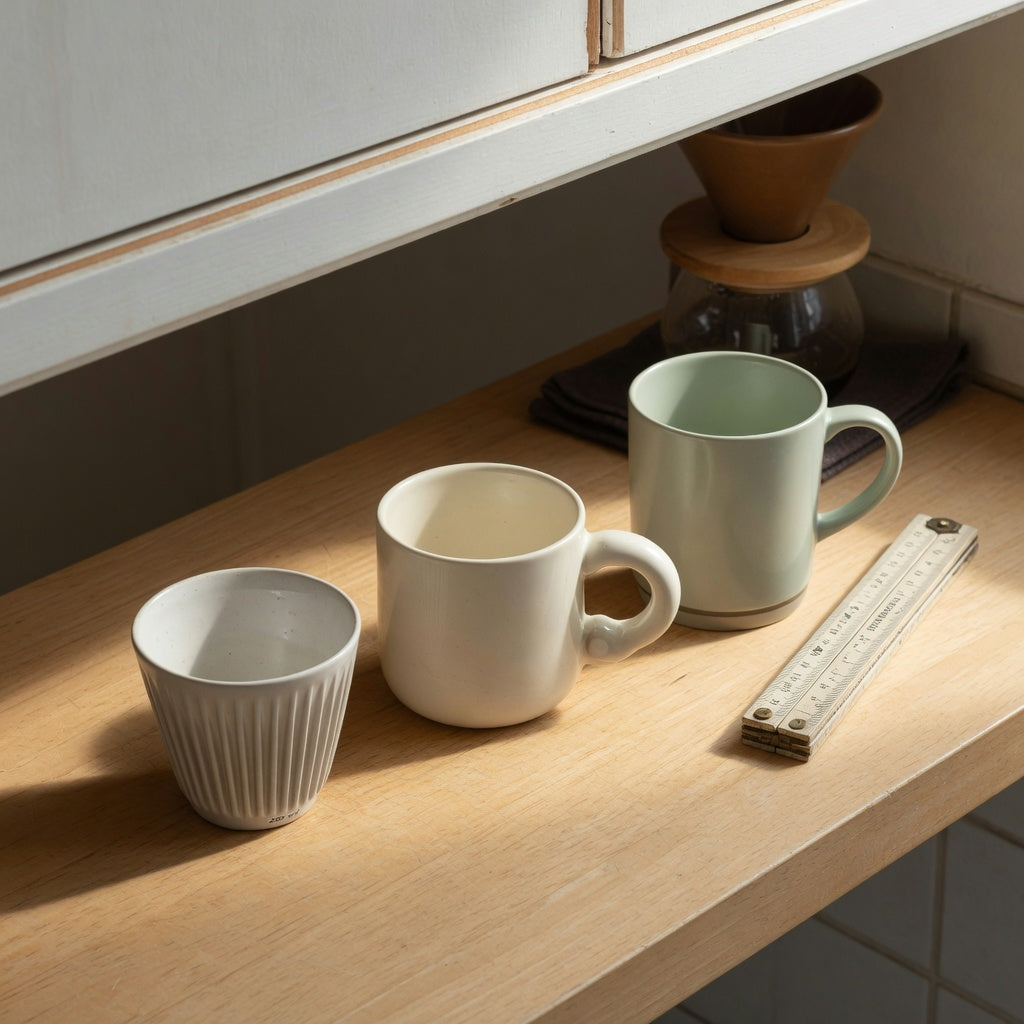
Ceramic Mug Shapes Compact Kitchen Product Shortlist Guide
Reading time: about 12 minutes
A 30 cm strip of counter, an upper cabinet that stops a hand's width above the worktop, and four mugs competing for the same patch of light. That is the setup in a lot of the kitchen photos customers send us, and it is why we built this ceramic mug shapes compact kitchen product shortlist guide around three mugs instead of thirty.
The logic is blunt. A mug earns counter space if it clears the cabinet door with the handle attached, fits under the spout you brew into, holds the pour you make most mornings, and does not need a second wash because coffee pooled in its foot ring. Glaze names and the silhouette that photographs best come second in a kitchen this size. Below are the three shapes we stock, each with one clear reason to buy and one clear reason to walk away.
Why does the handle, not the body, decide whether a mug fits?
Buyers measure the body and forget the handle. Then the mug fouls the cabinet door every time someone reaches past it, or it will not sit beside the kettle. Body diameter rarely fails first. Handle projection usually does. Four measurements settle the question:
- Body diameter at the widest point. On a belly or barrel profile that point sits below the rim, so measure the middle, not the opening.
- Handle projection — from the wall of the mug to the outer edge of the handle. A long strap handle can add close to half the body width again; a compact loop adds far less.
- Stored height. Storing upside down means body height plus the foot ring, and a rounded rim will rock on the shelf instead of sitting flat on it.
- Spout gap. Brewing straight into the mug? Measure from the counter to the underside of the spout, not to the top of the machine.
One habit worth adopting: decide how much counter depth you will give up permanently. A mug you have to move before you can reach the kettle is a mug that migrates into a cupboard within a month. We hear that version of the story often enough that we now ask about counter depth before recommending a shape.
Curved cup or straight-sided mug? What the 240 ml default hides
U.S. FDA guidance for ceramic hollowware draws a line most shoppers have never met. Cups normally have a base and curved sides; mugs have cylindrical sides. Both normally, but not exclusively, hold about 240 ml (8 fl oz) and are made with a handle. So 240 ml is the middle of the road, not a large size — useful context when a product page quotes millilitres and your reference point is a thick diner mug.
Convert with NIST's figure of 1 fluid ounce = 29.57 ml and the spread across our range becomes obvious:
- 200 ml is roughly 6.8 fl oz — short-drink territory.
- 250 ml is roughly 8.5 fl oz — a medium coffee with a little headroom.
- 400 ml is roughly 13.5 fl oz — a genuine large, close to a travel-cup fill.
Specialty-coffee training commonly places espresso in a 60–90 ml cup and cappuccino, flat white and latte somewhere in the 150–240 ml band, with the milk-to-foam ratio doing most of the differentiating rather than the vessel. If your usual order lives in that band, a 250 ml mug is a better default than a 400 ml one you half-fill every day. A tapered latte mug or a wide bowl-shaped cup gives you surface for pouring art; it also exposes more liquid to the air, which matters if you sip slowly rather than drink fast.
200 ml Pleated cup: right for short pours, wrong as an only mug
This is the smallest listed capacity of the three, and the body takes its name from the pleated wall — vertical ridges running the height of the cup. In a tight kitchen that does two useful things: it gives your fingers something to work against if you carry the cup by the body instead of the handle, and it reads differently on an open shelf than a plain cylinder. It also gives a milky drink somewhere to sit, so wipe the outside after a latte rather than trusting the dishwasher to reach into every groove.
Choose it when:
- Your daily drink is espresso-length, a cortado, or tea poured in small stages.
- Shelf height is the binding constraint and you want the smallest body in the cupboard.
- Your cabinet layout punishes handles that stick out and you often carry a cup by the wall.
Skip it when:
- You drink 10–12 oz coffees. Two pours every morning gets old by week two.
- You want a single mug to do everything — take the 250 ml and accept the extra shelf space.
- You brew straight into the cup under a spout sized for a taller mug. Measure that gap before you commit.
Rim thickness and wall thickness change how a cup feels on your lip, and photography flatters both. Check the current Pleated coffee and tea cup listing for dimensions and care guidance rather than judging from the hero shot.
250 ml Ball Handle mug: grip geometry first, capacity second
At roughly 8.5 fl oz, this one lands just above the FDA's typical 240 ml, which makes it the safest single-mug bet in a household with mixed habits — filter coffee one morning, a flat white the next. The body is unremarkable on purpose. The handle is the entire decision: a rounded, ball-form grip rather than a flat strap, which changes both how your fingers sit and how much room the mug claims on a shelf.
Choose it when:
- You want a handle but not a long one. A compact rounded grip is less likely to foul a cabinet wall or the mug beside it.
- You lift with a pinch grip — one or two fingers — rather than a full-hand wrap.
- One mug has to cover filter coffee, a modest latte and tea without spilling over.
Skip it when:
- You nest mugs in a drawer. Rounded handles prop the stack open and waste the vertical space you were trying to save.
- You have large hands and want four fingers through the opening. Two fingers on a small grip concentrates pressure in one spot, and you will feel it once the mug is full.
- Your morning pour is 12 oz. You will be refilling before you sit down.
How many fingers the opening actually takes is the first thing to confirm, and it is a question we field regularly because photos rarely answer it. Ask us before ordering, or start with the 250 ml ball-handled coffee and tea mug listing and compare its handle against a mug you already own.
400 ml The Flow: one-fill capacity that needs measured clearance
At roughly 13.5 fl oz, this is the mug that changes how a kitchen gets used: one fill, one trip, one mug to wash. It is also the body most likely to foul a low cabinet, and the heaviest to lift when full — 400 ml of coffee weighs about 400 g before the ceramic contributes anything.
Choose it when:
- You drink one large coffee rather than two medium ones.
- You build iced coffee or a latte and want room for ice and foam in the same vessel.
- You have measured shelf height and spout clearance for a taller, wider body.
Skip it when:
- Your shelf clears the cabinet door by a couple of centimetres. This is the body most likely to foul it.
- You preheat with hot water. More ceramic means more hot water and a longer wait before the mug is up to temperature — a smaller cup wins that routine.
- You drink 6–8 oz. A large mug half filled cools at the surface while the rest stays hot underneath.
Whether the interior wall is smooth or ledged is worth verifying on the Flow coffee and tea mug listing rather than inferring it from the name. Smooth interiors are easier to wipe; ledges and facets give residue somewhere to hide.
Ceramic mug shapes compact kitchen product shortlist guide: the side-by-side view
Every figure in the capacity column is a listed capacity, converted at 29.57 ml per fluid ounce. Silhouette and handle notes describe what is visible and stated, nothing more.
| Shape | Listed capacity | Silhouette and handle | Strongest fit | Skip it if |
|---|---|---|---|---|
| Pleated cup | 200 ml (about 6.8 fl oz) | Pleated wall with vertical ridges; smallest body of the three | Short pours, tight shelves, body-grip carriers | You drink 10–12 oz, or you want one mug for everything |
| Ball Handle mug | 250 ml (about 8.5 fl oz) | Rounded ball-form handle; opening size to verify on the listing | Medium coffee, pinch-grip lifters, households with mixed drink habits | You need four fingers through the handle, or you nest mugs in a drawer |
| The Flow | 400 ml (about 13.5 fl oz) | Largest listed capacity; interior profile to confirm on the listing | One-fill drinkers, iced coffee, latte with room for foam | Shelf or spout clearance is tight, or you preheat every cup |
Which ceramic mug shapes drop off a small-counter shortlist?
Not every interesting shape survives a narrow worktop, and it is fairer to say so up front than to bury it in a footnote.
- Handleless cups and yunomi. Lovely for tea poured at a drinkable temperature, poor for a just-boiled pour and for anyone with heat-sensitive fingers — the wall is your only interface with the drink.
- Square and faceted bodies. Interior corners trap residue where a smooth round interior does not, exterior edges chip first, and they rarely stack or nest.
- Wide bowl-shaped latte cups. Worth it if you pour latte art every morning and have the shelf to store them; awkward under a low cabinet and quick to cool at the surface.
- Thick-walled diner mugs. They feel substantial and hold warmth in the walls, but they are heavy at full weight and often wider than expected once the handle counts.
If contours are the appeal anyway, read our comparison of ceramic mugs for coffee and tea drinkers before trading shelf space for character.
Stacking, cleaning, and the one defect worth returning
Storing upside down only works if the rim is flat enough to sit on the mug below without rocking. A flared rim or a rounded lip will not, and the tower collapses every time someone opens the cabinet. Foot rings matter for the same reason at the other end: a deep recessed foot gives coffee somewhere to pool and dry, which is exactly the ring you find still sticky after a short cycle.
Shape does not decide food safety — the glaze and how it was fired do. FDA Compliance Policy Guide Sec. 545.450 sets a lead guideline of 0.5 micrograms per millilitre of leaching solution in any one of six units for ceramic cups and mugs, and cites ASTM C738 among the examination methods; that standard describes an acetic-acid extraction as a severe test unlikely to be matched in ordinary use. FDA also states there is no known safe level of lead exposure and that fetuses, infants and children are especially vulnerable. A decorative mug and a food-use mug can look identical on a shelf, so ask any seller, us included, for food-use confirmation whatever the silhouette.
When the box arrives, look inside for crazing — the fine web of glaze cracks that holds residue no dishwasher cycle reaches. That is a defect, not a design choice, and it is worth a return.
Before you add to cart: three measurements and one pour test
- Does it clear the shelf, the cabinet door and the spout? Measure with the handle in place, not just the body.
- Can your hand hold it comfortably when it is full? A mug you lift by the fingertips at full weight stays in the cupboard.
- Does your usual pour fit in one go? If you routinely fill past the widest point, size up. If you routinely leave a third behind, size down.
Two yeses out of three is usually a keeper. In a two-drinker household, buy one 250 ml and one 400 ml rather than two of the same — a capacity spread settles more arguments than a matching pair, and it costs you one extra shelf slot.
Every shape we currently carry sits in our unique coffee mugs collection, where comparing listed capacities side by side is faster than guessing from photographs.
Frequently asked questions
Is a 200 ml mug too small for coffee?
It depends entirely on the pour. At roughly 6.8 fl oz, 200 ml suits espresso, a cortado or a small tea and is a poor fit for a 12 oz drip coffee. If you already drink two 200 ml cups most mornings, take the 250 ml instead and save yourself the second trip.
Do wide, bowl-shaped mugs keep coffee hot longer?
We would not claim that. Heat leaves through the walls and through the open surface, and a wide opening exposes more liquid to the air, so a bowl-shaped cup generally cools at the top faster than a narrow one. Wall thickness and a lid matter more than silhouette, and no body shape has been shown to change how coffee tastes.
Can I stack ceramic mugs with rounded or ball handles?
Usually not tightly. A rounded handle props the stack open, which wastes the vertical space you were trying to save. Stack upside down only if the rim is flat enough to sit on the mug below without rocking — check that on the first mug before you build a tower.
What does this ceramic mug shapes compact kitchen product shortlist guide leave out?
Deliberately, handleless yunomi, square and faceted bodies, and wide bowl latte cups. All three can work beautifully; they are simply the shapes most likely to cost shelf space or cleaning time on a narrow counter. If one of them is what you actually want, browse the collection and apply the same handle-projection and stored-height measurements as a filter.
Which of the three should I start with?
If you drink one medium coffee a day and want a single mug, start with the 250 ml Ball Handle mug. If your pours are short and espresso-style, start with the 200 ml Pleated cup. If you fill once and drink slowly through a morning, start with the 400 ml Flow — after you have measured the shelf.
More from our blog
Ready to pick your mug? Two ways to save on today's order:
Ordering 1–3 mugs? Get an extra 10% off your 1st order with code 10_OFF Apply 10% Off & Shop Wooden-Handle Mugs →
Gifting 4+ mugs? Buy 3, Get the 4th Free applies automatically at checkout (no code needed; offers do not stack) · Free standard shipping (Nov pre-Christmas delivery: 15–20 calendar days US) · Free replacement if chipped in transit.
Popular mug buying guides: Ceramic Tea Cups & Infuser Mugs · Ceramic Mugs with Lids Compared · Wooden-Handle Tea Infuser Mugs Compared · Christmas & Secret Santa Mugs 2026 · Espresso & Cortado Cups Guide · Cup & Saucer Gift Sets · All 25 Mugs Spec Table · Mug Size Guide · Shipping & Promo FAQ
FIRST ORDER 10% OFF (CODE: 10_OFF) · OR BUY 3, GET THE 4TH FREE


Read more
Big Latte Mug Compact Kitchen Product Shortlist Guide: 3 Sizes
This big latte mug compact kitchen product shortlist guide matches three listed capacities — 400, 440 and 480 ml — to real constraints: shelf gaps, desk footprints, handle room and filled weight, p...
Read more
14 oz Ceramic Coffee Mugs Compact Kitchen Practical Purchase Checklist
A 14 oz mug can fit a compact shelf or fight it. This 14 oz ceramic coffee mugs compact kitchen practical purchase checklist compares our 400 ml, 440 ml, and 480 ml mugs against fill line, handle c...
Read more
Leave a comment
This site is protected by hCaptcha and the hCaptcha Privacy Policy and Terms of Service apply.