



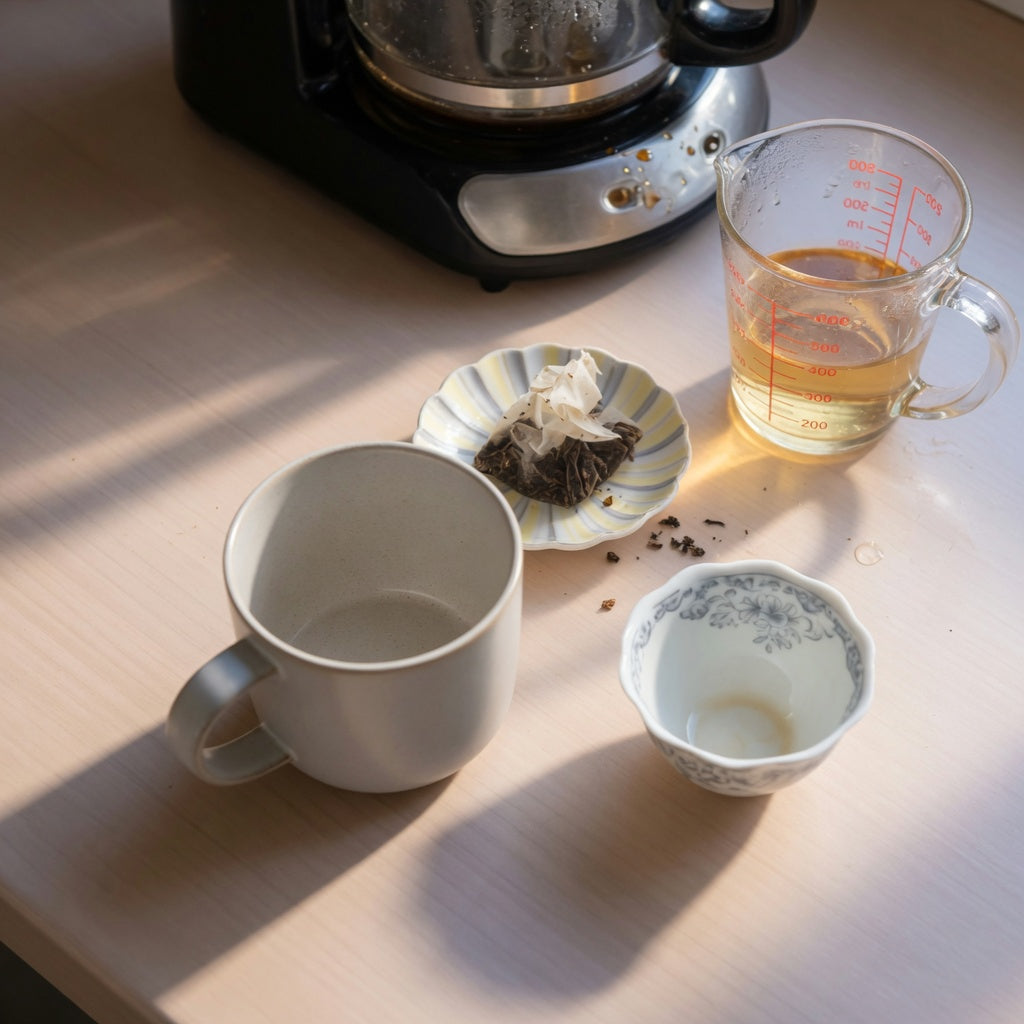
Coffee Mug vs Tea Mug Size Checklist: 7 Checks Before You Buy
Reading time: about 11 minutes
Pull two mugs off the shelf and both say 12 oz. One takes a full, comfortable pour of tea with an inch to spare. The other looks half empty until you top it up near the rim. Same number on the box, two completely different drinks — and that mismatch is where most mug purchases go wrong.
The coffee mug vs tea mug size checklist we walk customers through in our store does not start with ounces. It starts with the drink, then the usable fill, then the machine and the cabinet. Work through it in that order and the number mostly picks itself. Skip ahead and you end up owning three mugs that all hold 'about a cup' and none that fits how you actually drink.
Which cup is the number on the listing actually measuring?
No regulator publishes a standard household mug size. What exists instead is a stack of overlapping references that shoppers blend into one figure — and once you see them apart, most of the confusion disappears.
| Label you see | What it describes | Volume to work from |
|---|---|---|
| U.S. fluid ounce | The unit itself | 29.57353 mL (NIST Handbook 44, Appendix C) |
| FDA labeling cup | Nutrition-label household measure | 240 mL, written as 8 fl oz — a labeling convention, not a mug |
| Coffee brewing cup | Water volume behind a brew ratio | Commonly cited around 6 fl oz |
| Drip-machine carafe cup | Printed marks on the carafe | Often nearer 5 fl oz on at least one major brand — read your own carafe |
| FDA reference amount | One eating occasion of flavored, sweetened coffee or tea | 360 mL, printed as 12 fl oz |
| Printed mug capacity | Whatever the seller chose to measure | Frequently brim-full; a safe hot pour sits lower |
Run the conversions once and keep them: 8 fl oz is roughly 237 mL, 12 fl oz about 355 mL, 16 fl oz about 473 mL, and 20 fl oz about 591 mL. Those come from U.S. fluid ounces. British fluid ounces run slightly larger, and weight ounces are a different measurement entirely — a mug labelled 12 oz does not hold 12 oz of coffee by weight.
One caution on that 12 fl oz figure. It describes a serving of a packaged flavored drink for labeling purposes. It is not a target for how much you should brew, and a 16 oz mug is not officially 'two servings' of anything.
Coffee mug vs tea mug size checklist: seven checks before you add to cart
Most disappointing mug purchases happen because the shopper jumps to check five and skips the first four.
- Name the drink. Espresso and cortado are measured in tens of millilitres. Cappuccino and small lattes are traditionally served in vessels well under a pint. Drip coffee, builder's tea, chai, and hot chocolate are the drinks that genuinely want 10 to 16 oz. Decide the drink and the band narrows fast.
- Estimate your real pour, not the brim. Watch yourself make the drink tomorrow morning. If you stop an inch below the rim because you have to carry it to a desk, that inch is the number that matters.
- Reserve headspace for what you add. Milk, foam, ice, whipped cream, a spoon, and a tea bag string all consume volume. A latte wants an inch or more of clear wall. Iced coffee needs room for cubes that displace liquid as they melt.
- Check the dosing system, not just the volume. Coffee is dosed by water volume. Tea is dosed per bag or per rounded teaspoon per cup. Those two systems scale very differently once the mug grows, which is exactly why a large mug can flatter coffee and flatten tea.
- Measure the brewer. Tray surface to spout, then add the mug's base thickness. Some machines let you pull the drip tray for tall cups; confirm yours before you assume.
- Measure the shelf and your grip. Overall height including the highest point of the handle, handle span for a larger or gloved hand, and the gap to the shelf above. A mug that fits the brewer but not the cabinet still lives on your counter.
- Be honest about refill habits. Nurse one mug for an hour and a wide, oversized vessel works against you. Drink fast and refill often and capacity barely registers.
Usable fill vs brim capacity: run the 30-second jug test
Here is the check we would run on any mug before trusting its listing, ours included. Fill it with water to the line you would naturally stop at with a hot drink in it. Pour that water into a measuring jug, or weigh it — 1 g of water is essentially 1 mL. Compare the result with the capacity printed on the page.
A gap of an ounce or two is normal, healthy headspace. A gap of three or four ounces means the mug is bigger in practice than the number implies, and your portions, your tea strength, and your caffeine estimate all shift with it.
That is the test we would apply to our Morning & Night Large Ceramic Coffee Mug, which is built around a two-drink job: coffee in the morning, tea at night, one vessel on the counter instead of two. The listing title tells you it is a large ceramic mug for both drinks. What a title cannot tell you is the stated ounce capacity, whether that figure is brim or working fill, the overall height with the handle, the base diameter, or the care instructions. Those belong to the current product page and can change between batches — read them there before ordering rather than inferring from a photo.
Where a large mug is the wrong tool: if your idea of tea is a small cup cradled in one hand, a large ceramic mug will feel like a bucket and a single bag will taste thin in it. If your pod machine sits under a low cabinet, measure clearance first. And if a 6 oz pour is your whole morning coffee, you will be staring at a lot of empty ceramic. If the shape is the problem rather than the volume, browse the unique coffee mugs collection and compare silhouettes, rim styles, and handle spans before committing to a large one.
How much tea belongs in a 12 oz, 16 oz, or 20 oz mug?
This is where the coffee mug vs tea mug size checklist earns its keep. Brewing instructions on most tea packaging dose one bag or one rounded teaspoon per cup. That 'cup' is not your 16 oz mug. Drop one bag into double the water, steep it the same time, and you get a thinner, flatter drink — not because the tea is poor, but because you diluted the leaf.
Scale the leaf to the water you actually measured:
- 8 oz of water: one bag or one rounded teaspoon is the baseline.
- 12 oz of water: roughly one and a half times that dose if you want comparable strength.
- 16 oz of water: two bags or two rounded teaspoons, or brew strong in half the water and top up with hot water afterwards.
- 20 oz and above: treat it as a small pot, not a cup, and dose accordingly. A half-filled oversized mug is not the same experience as a smaller mug filled properly.
For iced tea, brew a concentrated batch in a third to half the final volume and dilute over ice so the flavour does not wash out as the cubes melt. Follow the temperature and steep time printed on your own package rather than a generic chart — leaf size and processing change the answer. ISO 3103:2019, the standard people cite for tea preparation, is a laboratory sensory-testing method, not a shopping rule for mug ounces. Our guide to ceramic mugs for coffee and tea drinkers covers the shared-mug scenario if two people with different habits are buying one vessel.
Will the mug clear the spout, the warmer plate, and the shelf?
Take three measurements before ordering anything tall.
- Spout height. Measure from the drip tray surface to the dispensing spout, then add the mug's base thickness. Height is the spec that usually rules a mug out, not capacity.
- Base diameter and foot ring. A base wider than the warmer plate will not sit stable, and an oversized foot may not drop into the machine's cup recess at all. Narrow foot rings also tip more easily on a soft tea towel.
- Shelf clearance. Measure the gap between shelf and the underside of the shelf above, then add the mug's height including the top of the handle arc.
No seller can confirm appliance fit from a listing photo, and we will not pretend otherwise. Measure your machine. If the mug is going to live on a coffee station rather than under a brewer, our guide to normal coffee mug size walks through tray footprint, handle clearance, and stacking.
Does a bigger mug stay hot longer, or just go cold more slowly?
Size alone does not decide heat retention. Any guide claiming a 16 oz mug always outlasts a 12 oz mug is skipping the variables that matter more.
- Fill level. A jumbo mug filled a third of the way exposes a large surface relative to its volume and sheds heat fast. A smaller mug filled properly often wins.
- Wall thickness and construction. Thick ceramic holds heat once warmed but takes longer to get there. Double-wall construction insulates; a thin single wall does not.
- Rim opening and rim thickness. A wide, thin rim releases heat and aroma quickly — lovely for a pour-over you intend to smell, less lovely for a drink you plan to nurse. A rolled, thicker rim drinks differently against the mouth.
- Preheating. Fill the mug with hot tap water for 30 seconds, dump it, then brew. On ceramic this does more than a couple of extra ounces of capacity ever will. It also reduces the thermal shock of pouring near-boiling water into a cold, thick-walled vessel.
If heat loss is your main complaint, the fix is usually shape and preheat habit, not a bigger number.
The decision shortcut: match the vessel to the drink, then dose to the water
| What you drink | Vessel band to shop | What trips people up |
|---|---|---|
| Espresso, cortado | Small — tens of millilitres | A 12 oz mug makes a normal shot look like a mistake |
| Cappuccino, small latte | Noticeably smaller than a drip mug | Home pours creep larger than café serves |
| Drip coffee, 8–10 oz | 8 oz filled near the top, or 12 oz filled to a line | Carafe 'cups' are often smaller than shoppers expect |
| Bagged or loose western tea | 8–12 oz keeps one bag proportional | Above 12 oz you must add leaf or brew concentrated |
| Latte, chai, hot chocolate, iced coffee | 14–16 oz earns its keep | You are buying headspace, not just volume |
One last layer: caffeine. FDA notes that 400 mg a day — roughly two to three 12 fl oz cups of coffee — is not generally associated with negative effects for most adults, with wide individual variation. Its typical-amount table lists green tea around 37 mg, black tea around 71 mg, and regular brewed non-specialty coffee spanning 113 to 247 mg, and it warns that product and container sizes vary. Decaf still carries roughly 2 to 15 mg per 8 fl oz. A 16 oz mug holds more than one 12 fl oz reference serving, so if you are counting cups, count the pour rather than the vessel. If you are pregnant, on medication, or sensitive to caffeine, talk to a clinician rather than a mug chart.
Frequently asked questions
Is a 12 oz mug the same as a 12 oz cup of coffee?
No. A mug's printed 12 oz is usually brim capacity, while a drip machine's carafe 'cup' is often closer to 5 fl oz. Pour one carafe cup into a 12 oz mug and it can look alarmingly small. Compare like units before deciding a mug is too big or too small.
On a coffee mug vs tea mug size checklist, which line matters most?
Usable fill, not brim capacity. The amount you can comfortably pour and carry governs your tea strength, your milk headspace, and how many caffeine servings you are actually drinking. Everything above it is a label.
Is a 16 oz mug too big for tea?
It can be, if you use one bag. Sixteen ounces is roughly two standard cups of water, so use two bags or two rounded teaspoons of leaf, or brew concentrated in half the water and top up. Steep time stays similar; the leaf amount changes.
Will a large ceramic mug fit under my coffee maker?
Only a measurement answers that. Measure tray surface to spout, add the mug's base thickness, and check the base diameter against the warmer plate or cup recess. We cannot promise fit from a product page, and a seller who does is guessing.
Do bigger mugs keep drinks hot longer?
Not by size alone. Fill level, wall thickness, rim width, and whether you preheated the ceramic matter more. A large mug filled halfway usually loses heat faster than a smaller mug filled properly.
Ready to put the checklist to work? Start with the Morning & Night Large Ceramic Coffee Mug if you want one vessel for morning coffee and evening tea, and check the stated capacity, dimensions, and care line on the current listing against the seven checks above before you order. If a smaller pour or a different silhouette suits your counter better, the unique coffee mugs collection is the next place to look.
Ready to pick your mug? Two ways to save on today's order:
Ordering 1–3 mugs? Get an extra 10% off your 1st order with code 10_OFF Apply 10% Off & Shop Wooden-Handle Mugs →
Gifting 4+ mugs? Buy 3, Get the 4th Free applies automatically at checkout (no code needed; offers do not stack) · Free standard shipping (Nov pre-Christmas delivery: 15–20 calendar days US) · Free replacement if chipped in transit.
Popular mug buying guides: Ceramic Tea Cups & Infuser Mugs · Ceramic Mugs with Lids Compared · Wooden-Handle Tea Infuser Mugs Compared · Christmas & Secret Santa Mugs 2026 · Espresso & Cortado Cups Guide · Cup & Saucer Gift Sets · All 25 Mugs Spec Table · Mug Size Guide · Shipping & Promo FAQ
FIRST ORDER 10% OFF (CODE: 10_OFF) · OR BUY 3, GET THE 4TH FREE


Read more
Ceramic Mug Pair for Home Coffee Station: What Buyers Compare
Two mugs have to survive a shared counter, a spout clearance measurement, and a few hundred dishwasher cycles. Here is how we would compare capacity, glaze claims, body material, and wear before ad...
Read more
Unique Ceramic Art Mugs Gift: Glaze, Capacity and Handle Checks
A gift mug can look right in the photo and disappoint on the counter. Here is how we compare glaze safety, listed capacity, handle fit, motif, and shipping care before recommending a unique ceramic...
Read more
Leave a comment
This site is protected by hCaptcha and the hCaptcha Privacy Policy and Terms of Service apply.