
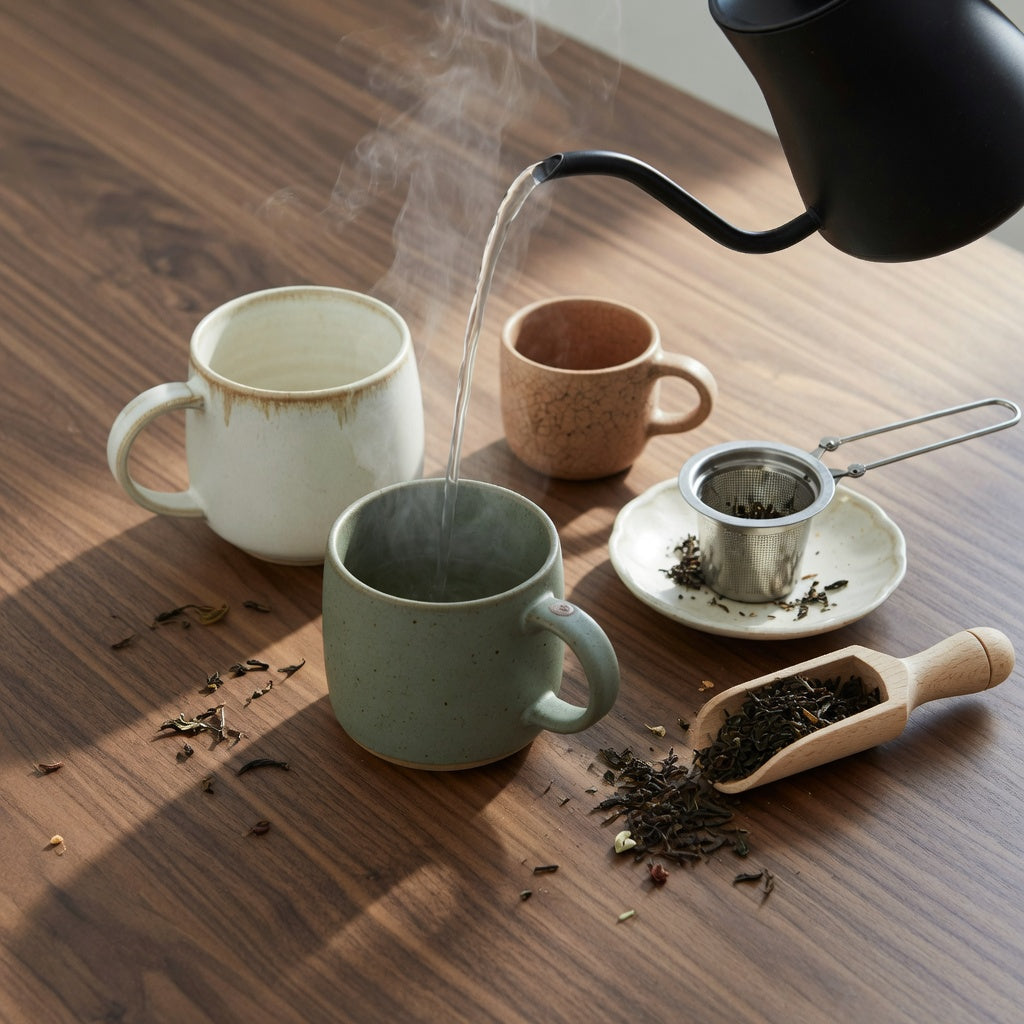
Ceramic Loose Leaf Tea Mug: What to Compare Before You Buy
Reading time: about 9 minutes
What actually makes a mug a ceramic loose leaf tea mug?
Half the emails we get about the Ball Handled mug start the same way: 'where does the strainer sit?' It doesn't. Our mugs are the vessel, and the infuser is a separate decision. A typical all-in-one ceramic loose leaf tea mug bundles three parts: a ceramic body, a removable stainless basket that holds the leaves, and a lid that doubles as a drip rest for the wet basket once the steep ends. Knowing that anatomy tells you exactly what a listing includes — and what it doesn't — before money changes hands.
Everything featured here is drinkware only. No filters, lids, or brewing accessories ship with the Ball Handled mug, the Round mug, or the Spittoon mug. Some shoppers read that as a gap. We'd call it a trade-off worth naming: sourcing the basket yourself lets you match mesh fineness to the teas you actually drink — open weave for large oolong leaves, ultra-fine for rooibos — instead of living with whatever strainer came in the box. If you want a true one-purchase setup, a dedicated infuser-mug set from another maker will serve you better, and we would rather say that up front.
Which capacity fits your routine: 250 ml, 390 ml, or 400 ml?
Capacity is the first thing we walk customers through in our store, because it shapes the whole workflow. A 250 ml mug (roughly 8.5 oz) suits short steeps and back-to-back infusions of the same leaves. The 390 ml Round and 400 ml Spittoon (about 13 and 13.5 oz) hold one generous pour that lasts through a long stretch of desk work. Neither approach is better; they solve different mornings.
| Mug | Listed capacity | Shape and opening | Best suited to | Trade-off |
|---|---|---|---|---|
| Ball Handled mug | 250 ml (≈8.5 oz) | Listed 11.2 cm diameter; ball-tipped handle the name refers to | Short steeps, repeated re-steeps, small desks | You refill more often |
| Round mug | 390 ml (≈13 oz) | Classic rounded profile | One long morning cup, office sessions | Heavier when full; check basket fit |
| Spittoon mug | 400 ml (≈13.5 oz) | Spittoon-inspired silhouette | Big herbal infusions, slower sipping | Confirm the mouth opening in the listing photos |
Dosing scales with volume. Start near one level teaspoon of dry leaf (about 2 g) per 250 ml of water, then adjust to taste; a 400 ml Spittoon takes closer to 3 g for the same strength. We keep that guidance loose on purpose, because leaf cut and personal preference move the number more than any chart does. Curious how a mid-size pours? Our 350 ml ceramic tea mug comparison covers the sizing math in between.
Shapes read differently in person than on a spec sheet. Our unique coffee mugs collection lays the silhouettes side by side, and if you are outfitting a desk specifically, the best ceramic tea mug for office use guide covers handle and spill considerations in more depth.
Will your infuser actually fit the opening?
Basket infusers rest on the rim from the inside, so fit is a measurement question, not a style question. The Ball Handled mug lists an 11.2 cm diameter — but before you size a basket to that figure, check the current listing and photos to confirm whether it refers to the outer edge or the interior rim. Interior widths run narrower than outer diameters, and a basket sized to the outer number will slide straight into your tea. Our listings compare capacity and the opening you can see in the photos; interior depth and wall thickness are not in our specs, so measure rather than assume.
Three fit details most buyers skip:
- Rest width: measure across the flat lip of your basket. You want a few millimetres of overhang inside the rim so it cannot tip when you nudge it.
- Clearance underneath: a basket whose base hovers a finger's width above the mug floor lets water circulate under the leaves instead of stewing them against the bottom.
- Room to swell: wet leaves expand well past their dry bulk. Fill the basket a third to half full, max — an overstuffed basket of oolong can wedge against the walls and take two hands to pull out.
Which glaze questions should you ask before buying handmade ceramics?
Run a finger around the interior first. A fully glazed, glass-smooth inside cleans easily and keeps flavor neutral cup after cup; raw or rough clay absorbs tannin and aroma, which suits a dedicated single-tea pot but frustrates anyone whose mug carries Earl Grey one morning and jasmine the next.
For handmade or imported pieces, ask the seller directly whether the glaze is food-safe and whether it has been tested for lead and cadmium. A California Proposition 65 warning on the packaging is a prompt to ask exactly what it covers, not something to guess about. On our own products, glaze and care details live on each listing page — read them before ordering rather than assuming every ceramic mug is built the same, because they are not.
Staining is normal, not a defect. A brown tannin film lifts with a paste of baking soda and warm water worked gently by a soft sponge; set-in stains yield to a 15-minute soak in warm water with a spoonful of citric acid. Skip steel wool on glossy interiors entirely — the micro-scratches it leaves hold the next stain faster.
How do you brew and re-steep loose leaf tea right in the mug?
- Dose the basket. Around one level teaspoon of dry leaf per 250 ml of water is a fair starting point for most black and green teas.
- Match the water to the tea. Freshly boiled water suits black tea and herbal blends; let it cool a few minutes, to roughly 75–80°C, before it touches delicate greens.
- Cover while steeping. Any small saucer works as a lid, since ours ship without one — trapping heat keeps extraction steady for black tea and oolong. Uncover delicate greens if they turn bitter fast.
- Lift and rest. Pull the basket and set it on the saucer so the wet leaves do not sit in the finished cup.
- Re-steep the same leaves. Add fresh hot water and shorten or extend the next round to taste. Smaller mugs shine here: 250 ml gets drunk before it cools, so three or four rounds can run back to back.
One exception worth knowing: large, wiry whole leaves can steep loose in the mug without any basket at all, sinking once saturated. Fine-cut teas will float into every sip, so they always need the strainer.
Microwave and dishwasher: what should you confirm first?
The metal basket never enters a microwave — remove it every time, no exceptions. Plain water in a smooth ceramic vessel can also superheat and erupt when disturbed, so heat in stages or leave a wooden stir stick standing in the mug. Care instructions differ piece to piece, so confirm microwave and dishwasher guidance on each product listing rather than generalizing. In our experience, years of harsh dishwasher detergent and high-heat dry cycles dull a gloss finish and bake mineral spots that make tannin stains harder to lift; a quick hand wash with mild soap keeps the interior slick far longer. And never pour boiling water into a mug that just came in from a cold car — warm it first with hot tap water to avoid thermal shock.
Ceramic, glass, or double-wall glass for daily tea?
Ceramic holds steeping temperature steadily through a long steep and survives daily sink duty, at the cost of weight and breakability. It is the wrong tool for a commute or a backpack — a travel tumbler wins there, full stop. Single-wall glass lets you watch the leaves unfurl but sheds heat quickly; double-wall glass insulates better yet stays thin and can feel awkward carrying a full 400 ml. If your cup sits on a desk for forty minutes while you work, ceramic earns its heft.
Frequently asked questions
Do CoffeifyMug mugs include an infuser basket or lid?
No. The Ball Handled (250 ml), Round (390 ml), and Spittoon (400 ml) mugs are standalone drinkware, and no filters or brewing accessories ship with them. Pair them with a basket you size to the opening, which also lets you choose the mesh fineness your teas need.
Which ceramic loose leaf tea mug works best at an office desk?
For one long cup that stays warm through a work block, the 390 ml Round or 400 ml Spittoon fits the job. If you re-steep the same leaves in short rounds, the 250 ml Ball Handled gets finished before it cools. Our office mug guide above walks through the desk-specific trade-offs.
How much loose leaf tea goes into a 250 ml mug?
Start with about one level teaspoon, roughly 2 g of dry leaf, per 250 ml of water and adjust after the first cup. Large whole-leaf oolongs often taste better slightly lighter and re-steeped several times. Fine-cut teas need basket headroom more than dose precision, so never overfill the strainer.
Can I microwave the mug with a stainless steel infuser inside?
No — metal baskets come out before anything enters a microwave, always. Smooth ceramic can also superheat plain water, which can erupt when disturbed, so heat in stages or rest a wooden stir stick in the mug. Confirm your specific mug's care guidance on its listing as well.
How do I remove black tea stains without scratching the glaze?
Rub a paste of baking soda and warm water over the film with a soft sponge, then rinse clean. Set-in stains lift with a 15-minute soak in warm water plus a spoonful of citric acid. Avoid steel wool on gloss interiors, because the micro-scratches it leaves hold the next stain faster.
A 60-second checklist before you order
- Match capacity to pace: 250 ml for repeated short steeps, 390–400 ml for one long pour.
- Measure your basket: compare its rest width against the listed diameter, and verify on the listing whether that number is the outer edge or the interior rim.
- Check the glaze: smooth, fully glazed interior; ask the seller about food-safety testing on handmade pieces.
- Confirm care: read the listing for microwave and dishwasher guidance, and pull the metal basket before any microwave use.
If those four boxes check out, the rest is taste. Browse the full drinkware lineup and pick the shape that matches how you actually drink tea.
More from our blog
Read more
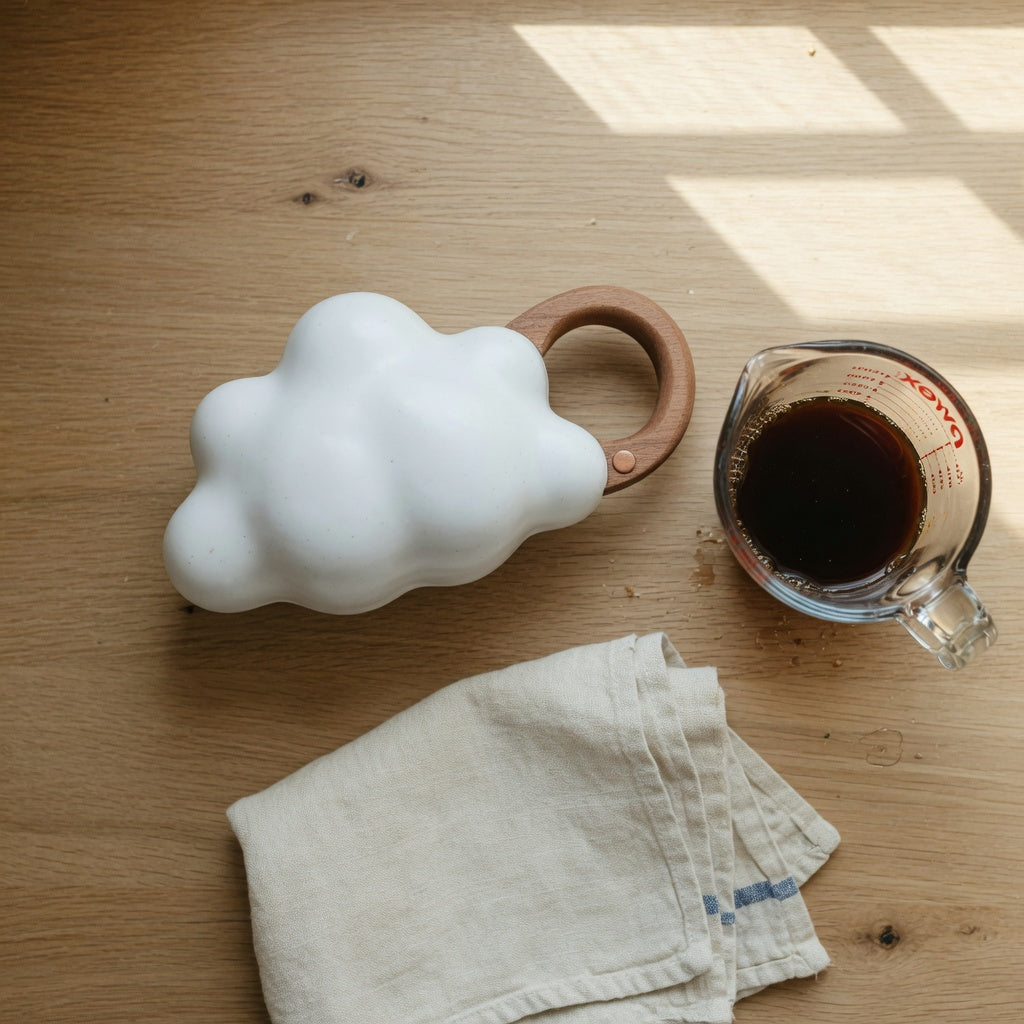
Ceramic Cloud Mug Buying Guide: Clay, Glaze, Capacity, Care
We compare cloud mugs the way we evaluate them for the shop: clay body, glaze food safety, rim finish, handle style, true capacity in ounces, and long-term care. Each check includes the trade-offs,...
Read more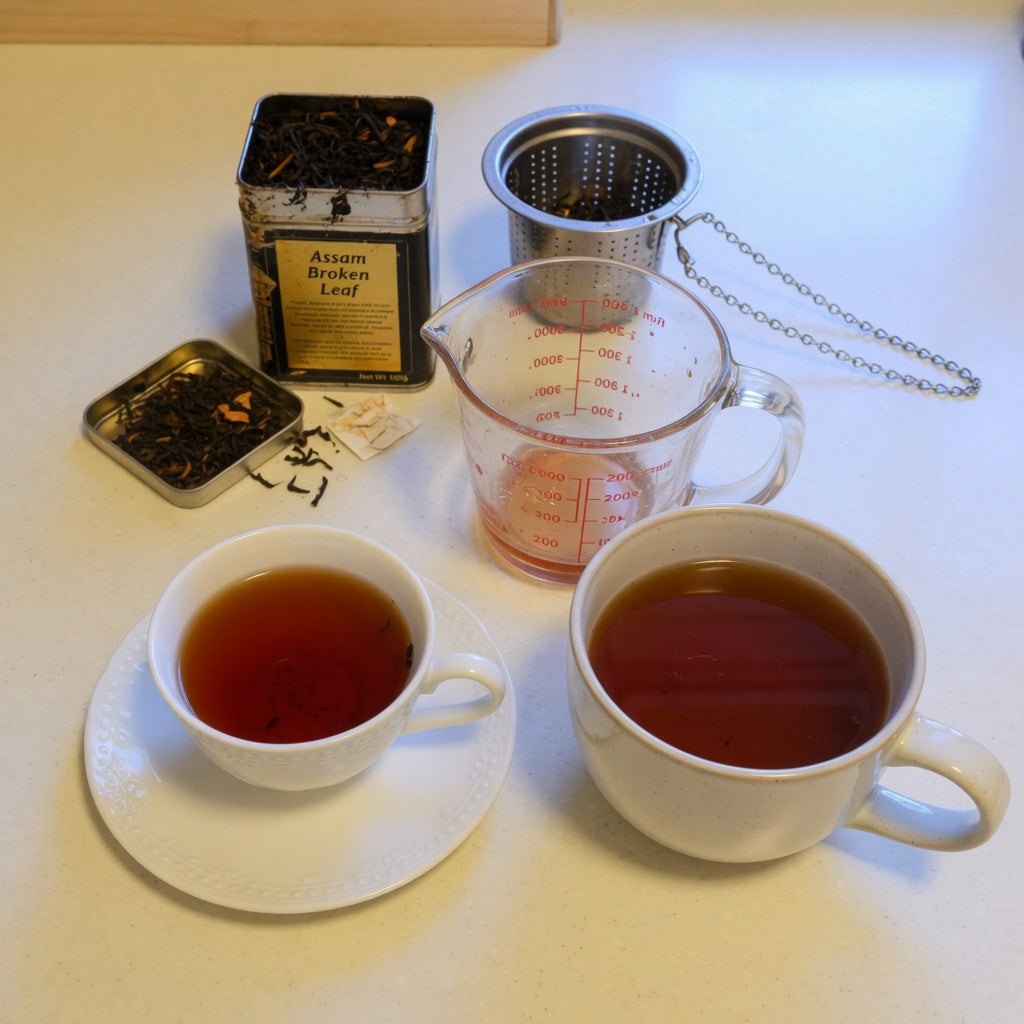
Black Tea Cup vs Mug Size: mL, Oz, and Which to Buy
A classic black tea cup holds 150–180 ml while standard mugs run 300–450 ml — nearly double. We compare real capacities in mL and oz, explain why teacups are smaller, and map where a 390–400 ml mug...
Read more
Leave a comment
This site is protected by hCaptcha and the hCaptcha Privacy Policy and Terms of Service apply.