
Black Tea Cup vs Mug Size: mL, Oz, and Which to Buy
Reading time: about 8 minutes
Every few weeks a customer asks us the same thing in different words: the tea tin promises “makes 40 cups,” their new mug fills a kitchen jug to 400 ml, and the math seems broken. It isn't broken — the tin and the jug are measuring two different things. That mismatch is the entire story of black tea cup vs mug size, and once you see it, choosing between a cup and a mug stops being a gamble.
A classic teacup holds about 150–180 ml (5–6 oz). A standard mug holds roughly double: 300–450 ml (10–15 oz). Same tea, same brewing rules, completely different pacing — small hot refills versus one long pour that travels with you to the desk.
Black tea cup vs mug size at a glance
| Vessel | Typical capacity | In ounces | Typical build | Best for |
|---|---|---|---|---|
| Tasting cup (gongfu-style) | 30–60 ml | 1–2 oz | Small porcelain, quick pours | Repeated short pours, judging aroma |
| Classic teacup | 150–180 ml | 5–6 oz | Thin porcelain or bone china, saucer | Formal service, small hot refills |
| US “labeling cup” | 240 ml | ~8 oz | A definition, not a vessel | Recipe and nutrition math |
| Standard mug | 300–450 ml | 10–15 oz | Thicker ceramic, wide rim | Everyday sipping, milk, desk refills |
| Oversized mug | 500 ml+ | 17+ oz | Thick, heavy ceramic | Big breakfast pours, long sessions |
Everything below builds on that table: where the official numbers come from, which mug-class sizes actually suit black tea, and the trade-offs most listings skip.
Why does tea packaging say “cups” while mugs are listed in ml?
Because “cup” is a legal measurement before it is teaware. On US nutrition labels, a cup is defined as 240 ml — about 8 fluid ounces. When tea packaging says “makes 2 cups,” it means 480 ml by that labeling definition, not two dainty teacups. Recipes work the same way.
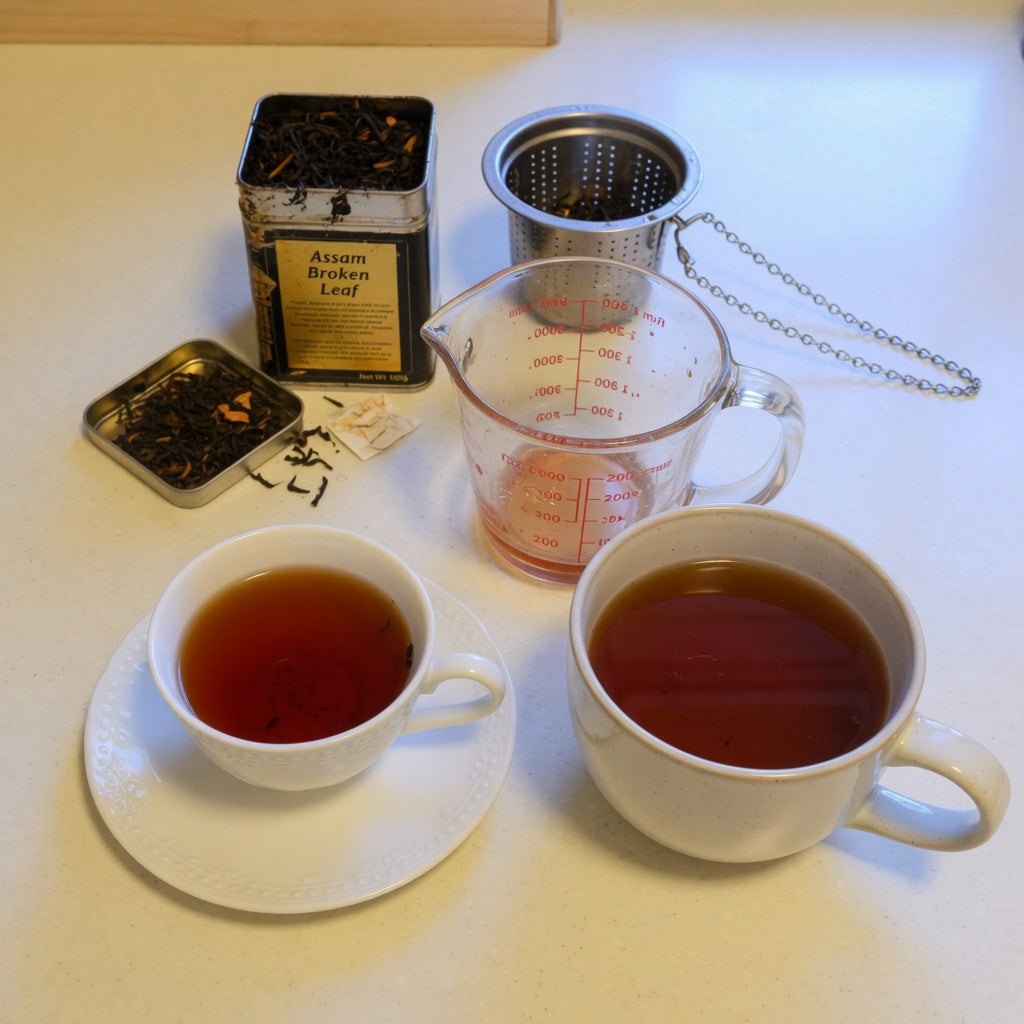
Teaware ignores that standard almost entirely, which is why we list our mugs in milliliters: “cup” can mean anywhere from 150 ml to 450 ml depending on who wrote the listing. Conversions worth saving:
- 150 ml ≈ 5 oz — a small classic teacup
- 240 ml ≈ 8 oz — the labeling cup, and a generous teacup
- 390 ml ≈ 13 oz
- 400 ml ≈ 13.5 oz
- 500 ml ≈ 17 oz
Measure your everyday mug once with a kitchen jug and the guessing stops for good. Most people are surprised to find their daily driver holds 1.3 to 1.6 labeling cups per fill.
Which mug size fits which black tea habit?
The three mugs we currently list sit in the same 390–400 ml band — standard-mug class, with catalog descriptions that support tea use, so none of them are coffee vessels pressed into service by accident. What differs is the fill, and here is how we would map each to a real routine:
- Stepping up from teacups: the Round Coffee Tea Mug (390 ml) is the smallest listed capacity of the three — one step up from a large teacup without committing to a full oversized pour.
- Desk mornings and fewer refills: the Gradient Coffee Tea Mug (400 ml) sits at the top of the listed range, so a single fill carries you through the longest stretch between meetings.
- Mug-class volume, undecided on looks: The Flow Coffee Tea Mug (400 ml) matches the Gradient's capacity, so the practical choice between the two comes down to shape and handle feel — which raises the honest limitation.
What no spec sheet can tell you: how a handle sits in your hand, how thick the walls are, how heavy the mug is when full. Those details live in each listing's photos, and we would rather you check them than take a comparison chart's word for it. To weigh more shapes side by side, browse the unique coffee mugs collection.
Two things these mugs are not: teacups, and thermal vessels. If you want a saucer-and-pot table setting, or tea that stays hot untouched for an hour, you are shopping in a different category — better we say that now than after the box is open.
Why are teacups smaller than mugs?
Because tea is brewed, and judged, by ratio. The ISO 3103 tasting standard — the method used to compare teas fairly — works at roughly 2 g of leaf per 100 ml of water: small vessel, controlled ratio, repeatable strength. Everyday teacups grew out of that logic. A smaller pour keeps the leaf-to-water balance tight, gets finished while still hot, and earns a fresh refill.
A 400 ml mug isn't a bad teacup. It's a different teacup — one built for lingering instead of noticing.
Aroma plays a part too. A narrow rim pools the scent of the liquor just under your nose; a wide mug opening lets it drift across the table. Heat behaves differently as well: thin porcelain sheds warmth faster than thick ceramic, which is why teacup sessions run short and mug sessions run long. For the ounce-by-ounce breakdown across drink types, see our coffee mug vs tea mug size comparison, and our Round tea cup vs coffee mug comparison covers shape and heat behavior in more depth.
How material and rim shape change a cup of black tea
Capacity decides how much you pour. Material decides how the pour drinks:
- Thin porcelain and bone china heat fast and cool fast — the tea drinks hot, the session stays short, and aroma reads clearly.
- Thick stoneware and heavy ceramic hold temperature longer and feel substantial in the hand. Trade-off: more weight, and a first sip that can still be scalding minutes after porcelain has cooled.
- Narrow rims concentrate aroma at the nose; wide openings make milk and casual sipping easier but scatter scent.
We don't generalize material or wall thickness across our listings — those are per-product details, so read them on each product page rather than assuming the whole category behaves one way.
When is a mug the better black tea vessel — and when is it not?
In our experience, mugs win more often than tea purists admit:
- Milk-forward breakfast tea: a 390–400 ml mug takes a full brew plus milk without overflowing. Our breakfast cup vs mug size guide maps the exact fill levels.
- Long sipping: one 400 ml fill replaces two teacup refills — genuinely useful at a desk.
- Casual mornings: no saucer, no ceremony, no warming the pot first.
Where mugs fall short, plainly:
- Formal service: a 400 ml mug does not replicate a teacup-and-saucer table. Don't buy one expecting it to.
- Aroma-focused drinking: wide openings scatter the scent you would catch off a narrow rim.
- Leaves left steeping in the mug: the last third of a 400 ml pour goes tannic. Lift the leaves out when the steep ends, or accept the trade-off.
How much caffeine is in a full mug versus a teacup?
The FDA's consumer caffeine guidance pegs plain brewed tea at roughly 30–50 mg per 8 oz cup, and steep time, leaf quantity, and leaf cut all move that number — treat it as a range, not a promise. The same guidance points most healthy adults toward staying under 400 mg per day, so the useful math is per fill:
- A 400 ml mug filled to about 80% holds roughly 320 ml — about 1.3 labeling cups
- At typical strength, that works out to roughly 40–65 mg per fill
- Three fills across a day lands around 120–195 mg, comfortably under the 400 mg guidance for most healthy adults
If you also drink coffee, count each mug fill as more than “one cup” — closer to 1.3. When customers want the full picture, we point them to the FDA's caffeine guidance and MedlinePlus's caffeine overview.
Teacup or mug: a 30-second decision checklist
- Straight black tea and aroma matter → classic teacup, 150–180 ml
- Milk in the cup, sipping for an hour → a 390–400 ml mug like the Round or Gradient above
- Desk worker who hates refills → 400 ml-class mug plus a removable infuser
- Hosting formal tea → a teacup and saucer set; our mugs aren't that and won't pretend to be
- Tracking caffeine → count fills, not cups; one mug fill is about 1.3 cups
- Gifting a daily tea drinker → pick from the unique coffee mugs collection by matching capacity to how they drink
Frequently asked questions
How many ounces is a black tea cup?
Most classic teacups hold 5–6 oz (150–180 ml). The US labeling standard defines a “cup” as 8 oz (240 ml), which is what recipes and tea packaging mean. Tasting cups run much smaller, around 1–2 oz each.
Why are tea cups smaller than mugs?
Tea drinking is built around ratio and pacing. A smaller cup keeps the leaf-to-water balance tight and is finished while hot, then refilled fresh — the ISO 3103 tasting standard works at roughly 2 g of leaf per 100 ml for the same reason. Mugs trade that precision for volume and fewer refills.
Can you drink black tea from a coffee mug?
Yes. The black tea cup vs mug size difference is about pacing, not rules — a 390–400 ml mug like our Round or Gradient suits milk-added tea and long sipping. Just lift the leaves out when the steep ends, or the back half of the mug will over-extract and turn bitter.
How much loose-leaf black tea should I use per mug?
Start with about 2 g (one level teaspoon) per 240 ml of water and scale to roughly 3 g for a 390–400 ml mug. The ISO tasting ratio of 2 g per 100 ml is calibrated for evaluating tea, not everyday drinking, and will taste intense to most people.
What size mug is best for black tea with milk?
A 390–400 ml mug handles a full brew plus a splash of milk with headroom at the rim. That is exactly the class our Round (390 ml), Gradient (400 ml), and Flow (400 ml) occupy.
One last step before you buy: fill your current favorite vessel from a measuring jug and note the milliliters. Under 250 ml and a teacup-style pour is already your habit; 350 ml or more and a 390–400 ml mug will feel like no change at all. Start from capacity, check the listing photos for handle feel, then choose from the collection.
Read more
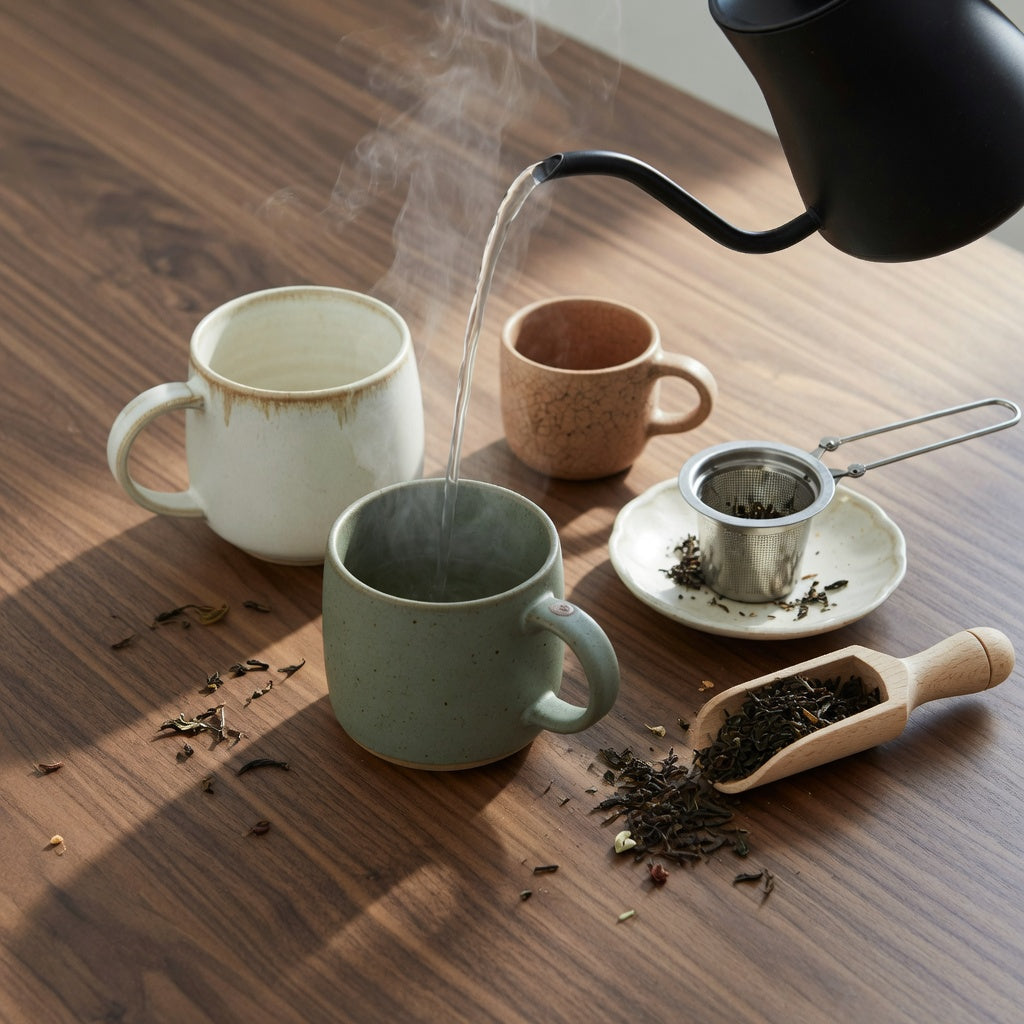
Ceramic Loose Leaf Tea Mug: What to Compare Before You Buy
Capacity, opening width, glaze finish, and infuser fit all change how a ceramic loose leaf tea mug steeps. We compare our 250 ml, 390 ml, and 400 ml shapes and name the trade-offs of each size.
Read more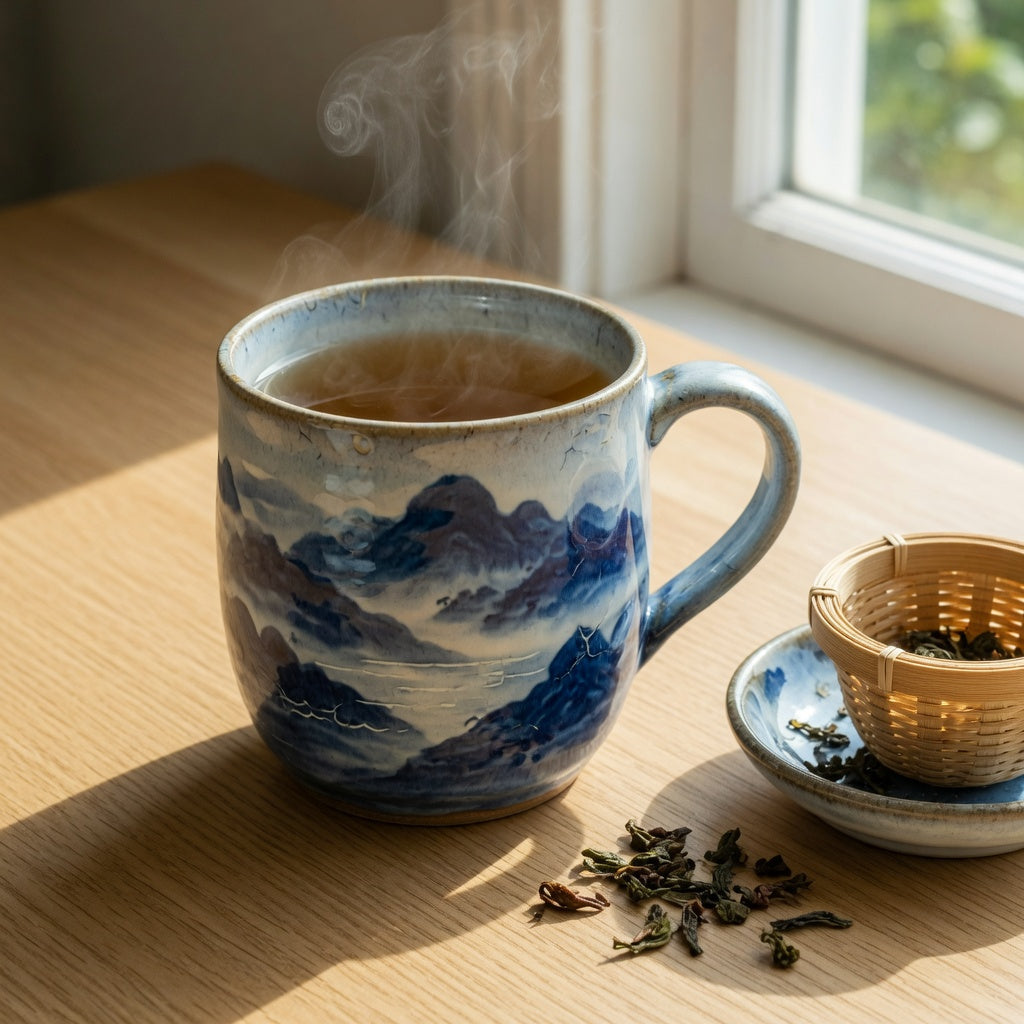
Mountain Sea Ceramic Tea Mug: 7 Things to Compare Before You Buy
The seven checks our team runs before recommending any mountain sea ceramic tea mug: capacity in both oz and ml, glaze-safety questions worth asking, why handmade variation beats the photos, care f...
Read more
Leave a comment
This site is protected by hCaptcha and the hCaptcha Privacy Policy and Terms of Service apply.