

Best Ceramic Tea Mug for Office: 7 Things Buyers Should Compare
Reading time: about 9 minutes
The mugs that come back to haunt office tea drinkers are rarely the ones that arrived broken. They're the ones that broke on the job: a handle chipped in a crowded communal dishwasher rack, a bright glaze gone tannin-brown by November, a gold-rimmed piece that sparked in the office microwave. We sell these mugs every day, and that last failure comes up more often than you'd expect. It also captures why choosing the best ceramic tea mug for office use is a different exercise from picking one for your kitchen cabinet — a desk mug gets bumped next to keyboards, reheated twice a day, and washed in a machine you don't control. It deserves to be compared on survival, not on how it photographs.
What separates the best ceramic tea mug for office use from a kitchen-cabinet mug?
Seven variables do most of the work. Our team sorted them by how often each one ends a purchase conversation at our counter: capacity and microwave compatibility come up constantly, while lid choice decides things for the keyboard-adjacent crowd.
| Compare this | Why it matters at a desk | What to check before you buy |
|---|---|---|
| Capacity | Every refill is a walk to the kitchenette | Listed fluid ounces — roughly 12 oz for compact setups, roughly 16 oz for fewer trips |
| Base diameter | Drawer dividers, desk caddies, and hot-water dispensers all have width limits | The listed or measured base width, not just the rim |
| Handle clearance | Laptop stands and monitor arms shrink your landing space | Whether the handle leaves knuckle room for your hand |
| Microwave compatibility | Half-finished tea gets reheated, not repoured | An explicit statement on the listing; metallic rims are out |
| Dishwasher compatibility | Shared racks are where handles go to die | Rack-placement guidance and how the handle sits when loaded |
| Glaze safety | Hot tea sits in the mug for an hour or more | Glaze stated for food contact; read any warning label |
| Lid and heat retention | A lid slows cooling and blocks keyboard splashes | Whether a lid is offered and how it sits when removed |
Notice what isn't on the list: brand story and shape trends. Those sell a gift. They don't keep tea warm or keep a handle attached.
Is your desk mug's glaze actually food-safe for hot tea?
This is the question almost every office listicle skips. The FDA and the CPSC have both warned that lead and cadmium can leach from ceramic glazes, and the risk concentrates in handmade, vintage, and decorative pieces — exactly the mugs people gravitate toward when they want a bit of personality at work. Heat and time make leaching worse, and hot tea sitting in a mug for an hour is both.
Verification is mostly about who you buy from. Sellers who intend a mug for daily hot drinks say so plainly and can point to glazes formulated for food contact. A Prop 65 warning label isn't an automatic disqualification — it tells you the piece contains a listed chemical, and it's on you to decide whether that belongs in your daily routine. Our store's rule is simpler:
If a mug is beautiful but the listing never says it's meant for food, it becomes a pen cup, not a tea mug.
The microwave check: metallic rims don't survive office kitchens
USDA and FDA microwave guidance specifically flags metallic trim — gold and silver bands along a rim are a spark risk, not a style detail. Plenty of decorative mugs carry them. If you reheat half-finished tea at your desk, choose a plain-glaze rim. If you already own a gold-rimmed favorite, keep it for cold drinks and hand washing only. That's a real trade-off: some of the most striking designs on any shelf are the ones you can't safely reheat in.
How much capacity does a desk tea mug really need?
Two tiers cover nearly everyone. Around 12 oz suits a compact desk where the mug lives in a drawer between meetings; around 16 oz suits people who'd rather refill less and don't mind the footprint. A full 16 oz of tea weighs roughly a pound before you add the mug itself, so the larger option gets awkward fast if you drink one-handed while typing.
- Compact (roughly 12 oz): fits drawer dividers and shallow caddies, cools faster, refills more often
- Large (roughly 16 oz): fewer kitchen runs, wider base, and it won't fit every mug tree or the clearance under a shared hot-water dispenser
Base diameter matters more at a desk than anywhere else in the house. Measure the drawer divider or caddy before you order, and if you fill up at the office machine rather than a kettle, check how much room sits under its spout. One honest limitation: ceramic doesn't seal. If your tea travels between meeting rooms, a lidded tumbler is the better tool, and no open mug fixes that.
Heat retention: ask for the method, not the number
Search results quote heat-retention times constantly and almost never disclose the conditions — lid on or off, starting water temperature, room temperature. A number without a protocol is decoration. When we check mugs at our counter, we keep it simple and repeatable:
- Same kettle, same starting temperature, same room
- One run with a lid, one without
- Note when the outside wall feels just warm, not hot
- Repeat once and discard any result the two runs disagree on
The pattern shows up every time: wall thickness and a lid do more than any printed claim, and preheating the mug with a swish of hot water before you pour is the cheapest upgrade available. A lid also blocks the splash that ends a keyboard — which is why the lid row in the table above earns its place.
Three of our ceramic mugs, matched to three real desk setups
We're a store built around ceramic coffee and tea mugs, so when shoppers ask us which is the best ceramic tea mug for office desks, we answer with scenarios rather than a single winner. One caveat before the recommendations: check each product page for the listed capacity, care statements, and any accessory notes before you order for office use. We can't see your drawer; the seven checks above are exactly what to run against each listing.
- The keyboard-adjacent desk. You want one distinctive mug that stays put beside your laptop and reads clearly as yours on a shared shelf. The Flow coffee and tea mug is the piece we hand that customer first — verify the listed size and the microwave and dishwasher statements on the page before checkout, and if the listing offers no lid, know that splashes remain your problem to manage.
- The all-week desk mug. Some people keep a single mug at the office Monday to Friday and want it to feel like theirs. The Morning Night coffee and tea mug — going by the name, framed for both ends of the workday — suits that habit; confirm the listed capacity matches how much tea you actually drink per sitting.
- The tight-storage desk. A rounder body changes how a mug sits in your hand and whether it clears a drawer divider. The Round coffee and tea mug leans on that curved silhouette, as the name suggests — the trade-off is that curved bodies ask for a wider slot in a divided drawer, so measure first.
Comparing finishes and shapes side by side is easier in our unique coffee mugs collection, where every listing is a ceramic mug made for coffee and tea service.
Care habits that keep an office mug from turning tannin-brown
In our experience, most of the glaze damage customers describe was preventable, and none of it takes special products:
- Rinse soon after finishing. Tea tannins set over hours; a thirty-second rinse at the end of the day prevents most staining.
- Lift set stains with a baking-soda paste and a soft cloth. Skip abrasive scouring pads — they dull a glaze long before they chip it.
- Dishwasher top rack, handle angled in, not touching another cup. Handles chip when they knock; crowding is the cause, not the detergent.
- Mind thermal shock. A mug that rode over in a cold car wants a minute on the desk before boiling water goes in. Sudden temperature swings are how hairline cracks start.
- Rinse any infuser basket the same day. Wet leaves left overnight in an office kitchen turn into a scraping project.
We keep the fuller version of this process in our coffee mug buying guide checklist, including the ten checks we'd run on any mug before it earns desk duty.
The 60-second check before you order
Run this list against the product page, not against marketing copy:
- Capacity is listed in ounces and matches your refill habits
- Base diameter fits your drawer, caddy, or dispenser clearance
- The handle leaves knuckle room for your hand and your desk layout
- Microwave use is confirmed safe, and the rim carries no metallic band
- Dishwasher guidance appears on the page, with rack placement you can follow
- The glaze is stated for food contact, and any warning label has been read, not ignored
- Lid and heat-retention needs match the splash risk around your keyboard
If you want the same process applied with desk measurements and grip checks, our comparison of a ceramic tea mug for office desk setups goes deeper. Otherwise, pick your scenario above, open the collection, and let the seven checks decide — that's genuinely all it takes to end up with a desk mug that outlasts the fiscal year.
Frequently asked questions
What capacity should a ceramic tea mug for an office desk have?
Most desk drinkers settle between two tiers: roughly 12 oz if the mug lives in a drawer and you don't mind refilling, and roughly 16 oz if fewer kitchenette trips matter more. A full 16 oz weighs about a pound before the mug itself, so test the heft one-handed. If your desk runs tall with risers and stacked trays, our guide to tall ceramic mugs for the home office covers capacity and grip in detail.
Are ceramic mugs with gold or silver rims microwave-safe?
No. USDA and FDA microwave guidance treats metallic trim as unsafe because metal can spark or arc. Decorative mugs frequently carry gold or silver bands, so read the product description rather than trusting the photo. For a mug you'll reheat at your desk, a plain-glaze rim is the practical choice.
How can I tell if a ceramic mug's glaze is safe for daily hot tea?
Buy from sellers who state the glaze is formulated for food contact, and be careful with handmade, vintage, or clearly decorative pieces — the FDA and CPSC have warned that lead and cadmium can leach from poorly formulated glazes, and hot liquid sitting for an hour increases exposure. A Prop 65 warning isn't an automatic no, but read it and decide whether it belongs in your daily routine.
What is the best ceramic tea mug for office use if I drink loose-leaf tea?
Look for a lidded mug with a deep infuser basket whose lid doubles as a drip tray when you lift the leaves out. Verify any infuser claim on the product page itself — if a listing doesn't mention a basket, treat that mug as a plain vessel and pack a separate one. Rinse the basket in the office kitchen the same day; leaves left overnight set hard.
Read more

Tall Mountain Coffee Mug Gift: 7 Checks Before You Buy
A tall mountain coffee mug gift lands well only when the size, material, and care instructions match the person drinking from it. We sell these mugs weekly — here is the seven-point comparison our ...
Read more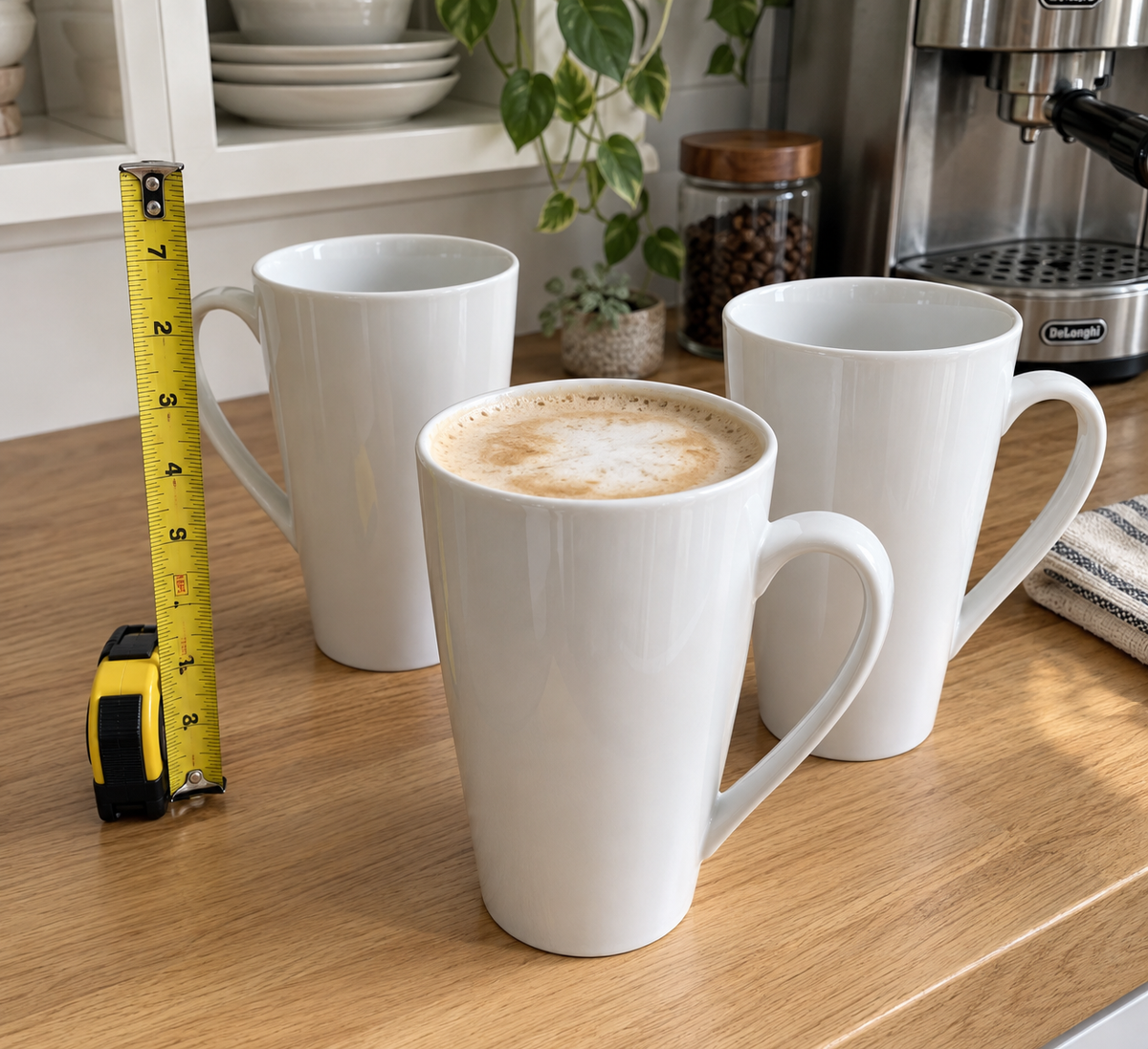
Tall White Ceramic Coffee Mugs: What to Compare Before You Buy
Tall white ceramic coffee mugs look interchangeable online, but shelf clearance, real capacity, glaze care, and handle fit decide whether one earns a place in your kitchen. Here is the exact six-po...
Read more
Leave a comment
This site is protected by hCaptcha and the hCaptcha Privacy Policy and Terms of Service apply.