



Ceramic Latte Cups Size Decision Guide: 250, 400 or 440 ml?
Reading time: about 11 minutes
A customer set our 440 ml Morning and Night next to her old mug on the counter last month, certain the extra capacity would end her mid-morning refills. She poured her usual latte and stopped two-thirds up the wall. More cup did not change her drink; it changed how much empty glaze she looked at every morning. That is the real question behind this ceramic latte cups size decision guide: not which capacity is the right one in some absolute sense, but which of our three listed capacities matches the pour you already finish.
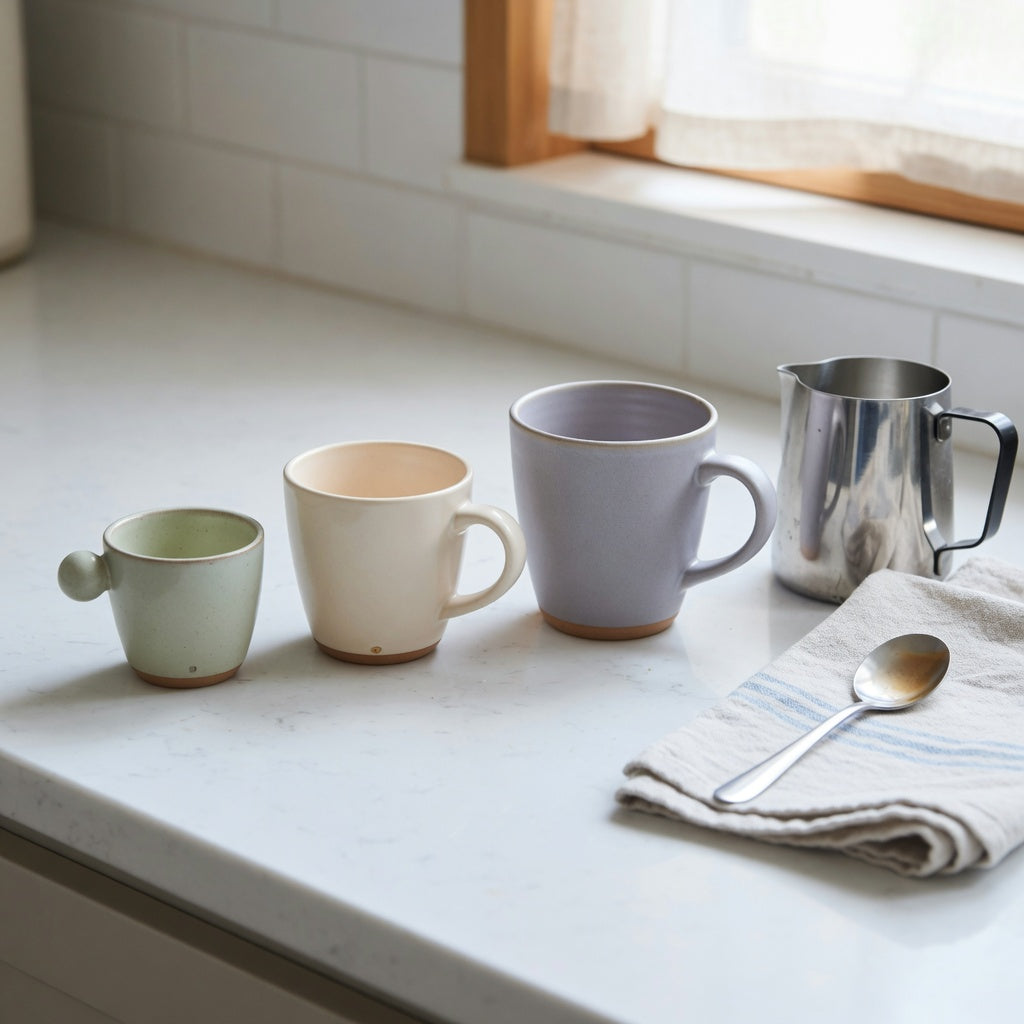
We stock three ceramic latte cups in the current lineup: the Ball Handle at 250 ml, The Flow at 400 ml, and Morning and Night at 440 ml. Those are listed capacities and nothing more. They do not tell you where your foam line will land, whether the handle clears your knuckles when the cup is full, or whether the base fits the coaster beside your laptop. We handle these cups daily in our store, and the questions we get are almost never about the number itself — they are about fit.
Ceramic latte cups size decision guide: which listed capacity matches your pour?
Answer two things before you compare numbers. How much do you actually drink in one sitting, and how much counter, desk, or shelf space can this cup claim? Get those two answers and the choice usually collapses to one option.
The short version, before the detail:
- 250 ml Ball Handle — the smallest current option, for short milk drinks and tight spaces.
- 400 ml The Flow — the middle option, for buyers who want more surface and more volume than 250 ml without the largest vessel.
- 440 ml Morning and Night — the largest listed capacity, for long pours and readers who want a substantial cup on the desk.
Everything below is the reasoning behind those three lines, plus the specs a capacity figure quietly hides.
Why does a cup listed at 440 ml never pour like 440 ml?
Listed capacity measures the vessel, not the serving. Depending on the maker, it can mean the volume to the rim, the volume to a molded fill line, or the volume before you leave headspace for foam. The FDA's own description of a ceramic cup or mug settles on roughly 240 ml (8 fl oz) as typical while noting that is normal but not exclusive — a useful reminder of how loose cup sizing is, even at the regulatory level.
Before you compare 250, 400, and 440, check four things on the exact listing:
- Whether capacity is measured brim-full or to a comfortable fill line.
- How much headspace you personally leave for foam.
- Base diameter and overall height — the two numbers that decide whether the cup fits your space.
- Handle opening and listed weight, which decide how it feels once it is full.
If a listing does not answer one of those, ask. We would rather answer a dimension question than have you guess from a product photo and return the cup.
When is the 250 ml Ball Handle the more practical cup?
The 250 ml Ball Handle is the smallest listed capacity we currently carry, and it earns the purchase in three situations:
- You drink a short milk drink — a single shot with a modest stretch of steamed milk — and want the cup to look full rather than half empty.
- Your cup lives on a narrow desk, a crowded café table, or a shelf with limited headroom.
- You are buying for someone who already owns oversized mugs and wants something smaller for the afternoon.
Be honest about what it is not. At 250 ml there is less room for a long pour and less surface for a wide latte-art pattern, so a reader who drains a big morning drink will refill it or drift back to an old mug. It is also not the cup to buy if you like a heavy, substantial feel in the hand.
One caution from our own counter: Ball Handle names a handle style, not a measurement. The opening may suit one hand and pinch another, so confirm handle clearance and base diameter on the current listing before you commit, and check what is actually included in the box.
When does The Flow at 400 ml make more sense than either end?
The Flow 400 ml is our middle capacity, and the middle is where undecided buyers usually land — but it should earn the choice for a reason, not because it sits between two numbers. Pick it if 250 ml leaves you wanting a second cup, or if you want more surface to pour into without committing to the largest cup we carry.
Volume also shifts the espresso-to-milk balance in the cup. More milk per shot means a milder drink; if you like your latte coffee-forward, the smaller cup gets you there with the same shot. That is a taste decision, not a quality one, and it is worth settling before you buy.
What The Flow does not do is fix a bad fit. If your only complaint about your current mug is footprint, swapping one mid-size cup for another will not solve it — drop to the 250 ml instead. And if you routinely finish 400 ml and still want more, the 440 ml is the honest answer.
Who should take the 440 ml Morning and Night, and who should not?
Morning and Night at 440 ml is the largest listed capacity in the lineup. It suits readers who consistently want more volume, who build a long milk drink and hate refilling, or who simply prefer a substantial cup sitting on the desk. It also gives you more surface area than the 250 ml option, which matters if a wide pour is part of why you are upgrading.
It is the wrong pick in three cases. Shallow shelves and low cabinet clearance punish taller cups. A full 440 ml cup is heavier, and that weight lands on the handle and your wrist. And if you sip slowly, a large volume of milk drink sits longer — we do not publish heat-retention rankings for these cups, because wall thickness, preheating, room temperature, and drink volume all move the result, and the public comparisons we found do not agree on a winner. Buy this one for volume and presence, not for a warmth claim.
Handle geometry, base diameter, and desk footprint — what the capacity number hides
These are the three specs buyers ask about after the cup arrives, not before. Use the table as a starting point, then verify the open questions on each product page.
| Current cup | Listed capacity | Reader it usually fits | Confirm before ordering |
|---|---|---|---|
| Ball Handle | 250 ml | Short milk drinks, tight desks, small-shelf kitchens | Handle opening, base diameter, box contents |
| The Flow | 400 ml | Buyers who want more surface and a middle volume | Interior curve, rim width, filled weight |
| Morning and Night | 440 ml | Long pours, larger volume, more presence on the desk | Overall height, handle clearance, base diameter |
Two details get underestimated. Desk footprint is not only base diameter — a handle that projects far enough can eat more usable space than a slightly wider base, especially on a shared café table. And vessel shape is invisible in a capacity figure: two cups can hold the same volume with a rounded interior and a straighter side wall, and they pour differently. Look at the interior curve and rim width on the exact listing instead of inferring shape from a product name.
Is a ceramic latte cup microwave-safe and dishwasher-safe?
Piece by piece, not category-wide. The FDA notes that microwaves are reflected by metal and pass through ceramic, glass, paper, and plastic — which is why plain ceramic generally goes in, and why metallic trim, gold luster, or a metal handle is the case to keep out. A hairline crack in the glaze changes the answer too.
For the dishwasher, follow the care mark on the exact piece. Do not borrow a claim from a similar mug or from a general article about ceramic being dishwasher-safe; glazes and applied decoration differ from piece to piece. If a listing does not state microwave or dishwasher suitability, treat that as unconfirmed and ask us before you buy — we would rather you hand-wash a favorite cup than ruin the glaze in week two.
Retire cracked or crazed cups. A network of fine cracks in the glaze gives residue and moisture somewhere to sit and makes the cup harder to clean properly, whether the capacity is 250 ml or 440 ml.
What should a food-safe glaze claim actually tell you?
Food safety is a separate decision from size, and it is the one place where a vague label deserves pushback. The FDA's action level for leachable lead in ceramic cups and mugs is 0.5 micrograms per milliliter of leaching solution, applied to any one of six units tested. For cadmium, the action level for small hollowware is 0.5 micrograms per milliliter.
Lead free is not self-proving. The FDA states that ceramicware containing extractable lead under its test method should not carry a lead-free label, and it has reported traditional pottery labeled lead free that still tested at or above action levels — often because a glaze was not fired properly. Decorative ware is the other trap: under 21 CFR 109.16, ornamental ceramicware that looks suitable for food use is treated as food-use unless it carries specific warnings or has a hole through the potential food-contact surface. A handle does not make a decorative cup a drinking cup.
The FDA cites ASTM C738 for this testing, an acetic-acid extraction method the standard itself describes as severe and unlikely to be matched in ordinary use. That is useful context when a seller waves a test report at you. We cannot verify a batch from a product photo, and neither can you, so if a food-contact claim matters in your household, ask for current documentation before ordering. A serious seller should not flinch at the request.
A five-minute fit check before you pick a capacity
- Measure the pour you actually finish in your current cup — not the brim, the amount you drink.
- Decide the direction: less volume (250 ml), the middle (400 ml), or more volume (440 ml).
- Measure the spot where the cup will live: width for the handle, height for the shelf or cabinet.
- Picture the cup full and heavy, then judge the handle opening against your own grip.
- Confirm care instructions, glaze details, and what is included on the exact product page.
Still torn after that? Start with The Flow at 400 ml — it is the easiest capacity to compare against a mug you already own. To see all three together, browse the unique coffee mugs collection and line up the listed capacities, base diameters, and care marks side by side before you commit.
Frequently asked questions
How do I use this ceramic latte cups size decision guide if I already own a 12 oz mug?
Measure how much your current mug holds at your normal fill, then compare that number against 250, 400, and 440 ml. If your mug feels slightly too small, The Flow at 400 ml is the next step up in our lineup; if it already feels like more cup than you need, the 250 ml Ball Handle is the smaller option. Handle clearance and base diameter still need checking on the listing.
Why does my 440 ml cup look half empty after I pour?
Because listed capacity usually measures the vessel, not your serving. Most people leave headspace for foam and stop short of the rim, so a 440 ml cup can hold a noticeably smaller drink at a comfortable fill. Check whether the brand measures to the brim or to a fill line before you size up.
Is a smaller cup better for latte art?
Not automatically. A smaller cup gives you less surface to pour into but also less distance for the milk to travel, while a larger cup offers a wider canvas and asks for more milk to fill it. Interior curve and rim width affect the pour as much as volume, so check those on the exact listing instead of buying on capacity alone.
Can I put a ceramic latte cup in the microwave or dishwasher?
Only if the exact piece says so. Plain ceramic generally lets microwaves pass, but metallic trim, gold luster, and cracked glaze are different situations, and dishwasher tolerance varies by glaze and decoration. Check the care mark on the listing, and hand-wash anything that has started to craze.
Do these cups ship with saucers or lids?
Do not assume accessories are included. Our three current capacities are the Ball Handle 250 ml, The Flow 400 ml, and Morning and Night 440 ml, and the contents of each box should be stated on its product page. If it is not listed, ask before ordering.
More from our blog
Ready to pick your mug? Two ways to save on today's order:
Ordering 1–3 mugs? Get an extra 10% off your 1st order with code 10_OFF Apply 10% Off & Shop Wooden-Handle Mugs →
Gifting 4+ mugs? Buy 3, Get the 4th Free applies automatically at checkout (no code needed; offers do not stack) · Free standard shipping (Nov pre-Christmas delivery: 15–20 calendar days US) · Free replacement if chipped in transit.
Popular mug buying guides: Ceramic Tea Cups & Infuser Mugs · Ceramic Mugs with Lids Compared · Wooden-Handle Tea Infuser Mugs Compared · Christmas & Secret Santa Mugs 2026 · Espresso & Cortado Cups Guide · Cup & Saucer Gift Sets · All 25 Mugs Spec Table · Mug Size Guide · Shipping & Promo FAQ
FIRST ORDER 10% OFF (CODE: 10_OFF) · OR BUY 3, GET THE 4TH FREE


Read more
Cute Espresso Cups Buying Priorities: Capacity, Shape, and Space
A practical order of operations for cute espresso cups: match listed capacity to the shot you actually pull, judge visible shape and handle comfort in your hand, then confirm spout and shelf cleara...
Read more
Cute Espresso Cups Current Product Facts: 170 vs 200 vs 250 ml
The cute espresso cups current product facts we publish are simple: 170 ml, 200 ml, and 250 ml ceramic cups, all larger than a classic demitasse. Here is what each capacity means at the machine, pl...
Read more
Leave a comment
This site is protected by hCaptcha and the hCaptcha Privacy Policy and Terms of Service apply.