

Ceramic Cortado Cup Size Decision Guide: 170, 200 or 270 ml?
Reading time: about 8 minutes
A 160 ml finished drink creates the size decision shoppers often underestimate. In a 170 ml cup, that pour leaves only 10 ml before the listed capacity; in a 200 ml cup, it leaves 40 ml; and in a 270 ml cup, it leaves 110 ml. This ceramic cortado cup size decision guide uses that straightforward comparison to help you choose among CoffeifyMug's current Retro, Pleated, and Emerald options without treating one drink recipe as a universal standard.
In our store, we sell and handle ceramic drinkware, and the useful conversation starts with the amount a shopper actually pours. A smaller listed capacity keeps unused volume low. A larger capacity allows more room for milk, foam, stirring, or an inconsistent preparation. We keep the claims narrow: capacity can guide the decision, but it cannot establish heat retention, extraction performance, exterior dimensions, care compatibility, or suitability for a particular professional setting.
How does this ceramic cortado cup size decision guide estimate headroom?
First, measure the complete drink as you normally prepare it, including coffee, milk, water, foam, syrup, or other additions that occupy space. Then subtract that amount from the cup's listed capacity. We call the result nominal unused capacity because it provides a practical comparison without pretending to predict the exact visible distance between the liquid and rim.
| Finished drink volume | Retro 170 ml | Pleated 200 ml | Emerald 270 ml |
|---|---|---|---|
| 140 ml | 30 ml unused | 60 ml unused | 130 ml unused |
| 160 ml | 10 ml unused | 40 ml unused | 110 ml unused |
| 190 ml | 20 ml over listed capacity | 10 ml unused | 80 ml unused |
These figures are arithmetic differences, not recommended fill lines. The internal profile of a ceramic cup affects how high a given volume sits, so 40 ml of unused capacity does not guarantee the same vertical rim clearance in every shape. If you want room to stir or tolerate normal movement, avoid choosing a listed capacity that merely equals your measured drink. The amount of extra room you prefer is personal, which is why we do not prescribe a single headroom standard.
When is the 170 ml Retro the sensible smaller option?
The Retro 170 ml cup makes sense when your finished drink remains meaningfully below 170 ml and you deliberately want less unused capacity. A consistent 140 ml preparation, for example, leaves a nominal 30 ml difference. That can be a practical match for someone who makes a measured short drink and rarely adds anything after the initial pour.
The limitation appears quickly as volume rises. A 160 ml drink leaves only 10 ml before the listed capacity, while a drink measuring 170 ml leaves no arithmetic buffer at all. The Retro is therefore not a forgiving choice for variable milk pours, later top-ups, or ingredients that push the total close to 170 ml. Also, do not assume that the smallest capacity automatically has the smallest exterior footprint. Check the current product details if shelf depth, desk space, or physical dimensions decide the purchase.
Why does the 200 ml Pleated suit moderately variable pours?
The Pleated 200 ml cup is the numerical middle option. At a 160 ml finished volume, it provides 40 ml of nominal unused capacity compared with 10 ml in the Retro. At 180 ml, it leaves 20 ml. That makes it the practical step up for a shopper whose regular pour is too close to 170 ml but who does not need the 270 ml capacity of the Emerald.
This option is not automatically spacious. A drink that reaches 190 ml leaves only 10 ml before the listed capacity, and a 200 ml preparation leaves none. It is also less closely matched than the Retro for a consistently small pour. Choose the Pleated because your measurements fit its middle capacity, not because 200 ml is a universal cortado size.
When does the 270 ml Emerald provide useful extra room?
The Emerald 270 ml mug is the practical choice when your normal preparation approaches or passes 200 ml, or when your total volume varies enough that the smaller options leave little margin. A 190 ml drink leaves 80 ml of nominal unused capacity. Even a 220 ml preparation leaves 50 ml before the listed 270 ml capacity.
That flexibility has a clear trade-off. A 140 ml drink leaves 130 ml of the stated capacity unused, so the vessel may feel less closely matched to a short serving. The Emerald is not a better cortado ceramic cup by default, and its larger capacity does not prove anything about beverage performance. It suits shoppers who value capacity flexibility more than a close match between their usual drink volume and the number on the product page.
How do milk, foam, ice, and shared kitchens change the answer?
Your least precise preparation is often more useful than your most carefully measured one. In our experience, shoppers make a clearer decision after recording several normal drinks rather than measuring a single ideal pour. Use a marked vessel appropriate for the liquid temperature, and compare the largest finished volume with all three capacities.
- Consistent short drinks: Consider the Retro if your largest regular preparation plus your preferred margin remains below 170 ml.
- Small changes in milk or foam: Consider the Pleated if 170 ml feels tight but 200 ml still leaves useful unused capacity.
- Frequent top-ups or longer drinks: Consider the Emerald when 200 ml does not leave the margin you want.
- Shared household: Compare the cups with the largest regular preparation, not the household average. A cup that fits one person's measured pour may frustrate someone who pours more freely.
- Iced drinks: Ice occupies space, but the displacement depends on the amount and shape used. Test the complete preparation and verify the product's current care guidance before assuming suitability for temperature changes.
- Office desk or kitchen cupboard: Capacity does not reveal exterior width, height, handle clearance, or stackability. Confirm those physical details separately instead of using milliliters as a substitute for dimensions.
Foam is another reason to leave personal margin. Its volume can be less convenient to measure than liquid, so do not treat a capacity calculation as millimeter-perfect. If your preparation changes from day to day, choosing the next listed capacity can be more practical than repeatedly filling a smaller option close to its limit.
What should you verify about ceramic care and condition?
All three current choices in this comparison are ceramic, but material and capacity do not answer every ownership question. We are not claiming that the Retro, Pleated, or Emerald was purpose-built, tested, or certified for cortado. This guide also does not infer extraction performance, heat retention, cafe suitability, microwave use, or dishwasher safety.
Before planning microwave reheating or regular dishwasher cycles, read the current care wording on the relevant product page. If a use is not explicitly addressed, ask our team rather than assuming that all ceramic drinkware can be handled the same way. This matters for a personal purchase and for gifting, where the recipient may not have seen the original listing.
During the first unboxing, inspect any shipped ceramic piece before use. Look around the rim for chips, check the body for hairline cracks, and place the cup on a flat counter to confirm that the base sits steadily. These are sensible inspection steps for ceramic drinkware in general, not reported defect claims about these products.
If none of the three capacities leaves the margin you want, browse our unique coffee mugs collection and compare the currently listed product details. A measured volume outside this compact 170 to 270 ml group, or a strict physical-space requirement, is a good reason to consider a different style instead of forcing one of these options to fit.
Frequently asked questions
What size ceramic cortado cup should I buy for a 160 ml drink?
A 160 ml drink leaves a nominal 10 ml before the Retro's listed capacity, 40 ml in the Pleated, and 110 ml in the Emerald. Choose the Retro only if that narrow difference suits your routine; choose the Pleated for moderate extra room or the Emerald for substantially more flexibility.
Is a 170 ml ceramic cortado cup too small?
Not if your complete drink stays comfortably below 170 ml and you do not need much extra capacity. This ceramic cortado cup size decision guide does not define 170 ml as correct or incorrect by recipe; it compares that capacity with the amount you actually pour.
Should I choose 270 ml if I sometimes add more milk or ice?
Choose 270 ml only if the complete preparation and your desired margin make 200 ml too restrictive. Measure the milk and ice as part of the finished drink, and confirm the product's care guidance before making assumptions about iced or changing-temperature use.
Can I use the listed capacity as my normal fill line?
A listed capacity is a comparison reference, not a promise of comfortable working room at that exact volume. If your finished drink equals the stated capacity, the arithmetic leaves no margin for stirring, foam, additions, or normal variation.
Are the Retro, Pleated, and Emerald dishwasher or microwave safe?
This size comparison does not establish either type of care compatibility. Review the current instructions on each linked product page and follow only the uses that are explicitly stated.
Next step: Measure three normal preparations, keep the largest result, and decide how much unused capacity feels practical. Then compare that number with 170, 200, and 270 ml and open the product page that fits; if none does, move to the collection rather than compromising on a poor size match.
More from our blog
Read more

Ceramic vs Porcelain Coffee Mugs Current Product Facts: Sizes & Shapes
Compare what the current Round, Pleated, and Landscape listings establish, plus the material, capacity, dimension, and care details that still require confirmation. Includes practical next steps fo...
Read more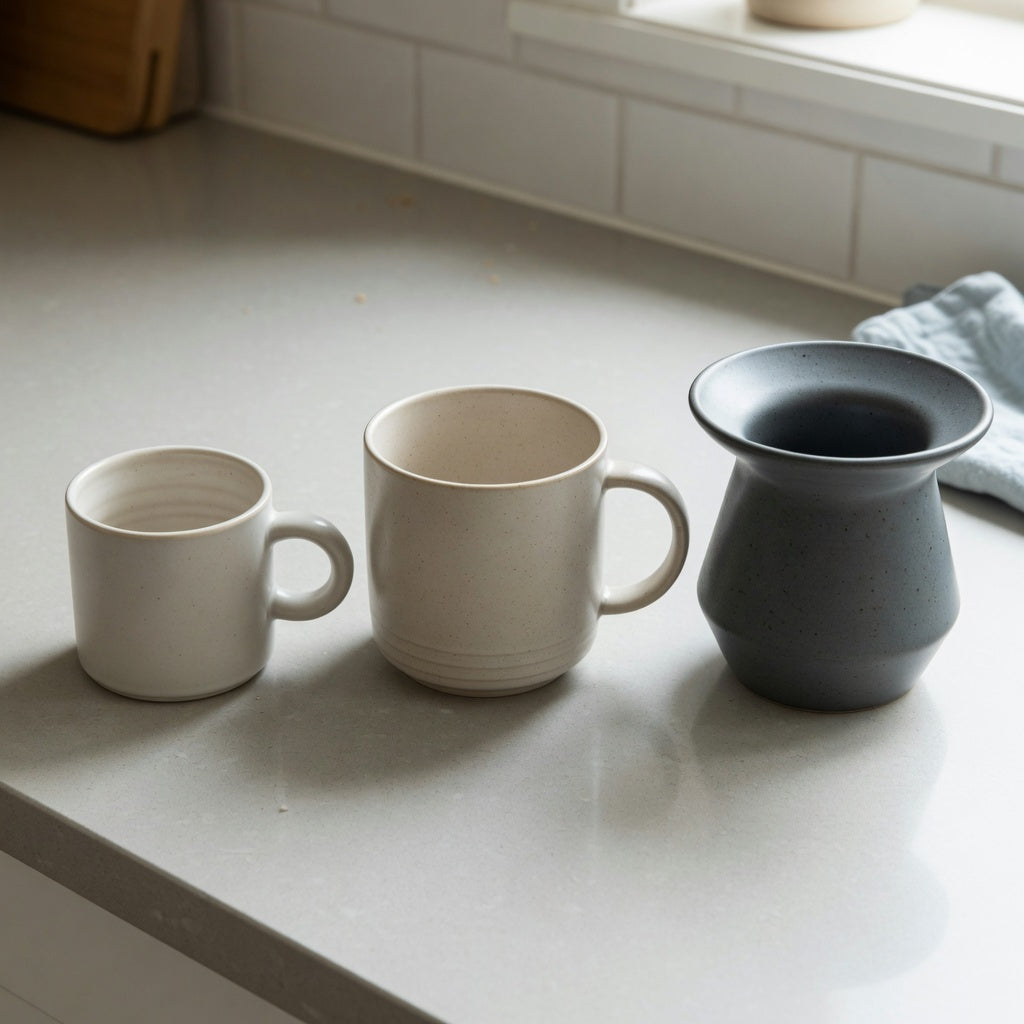
Loose Leaf Tea Mug Size Decision Guide: 250, 390 or 400 ml
Compare CoffeifyMug's 250 ml Ball Handle, 390 ml Round, and 400 ml Spittoon mugs by listed capacity, visible opening, real pour habits, and infuser fit.
Read more
Leave a comment
This site is protected by hCaptcha and the hCaptcha Privacy Policy and Terms of Service apply.