



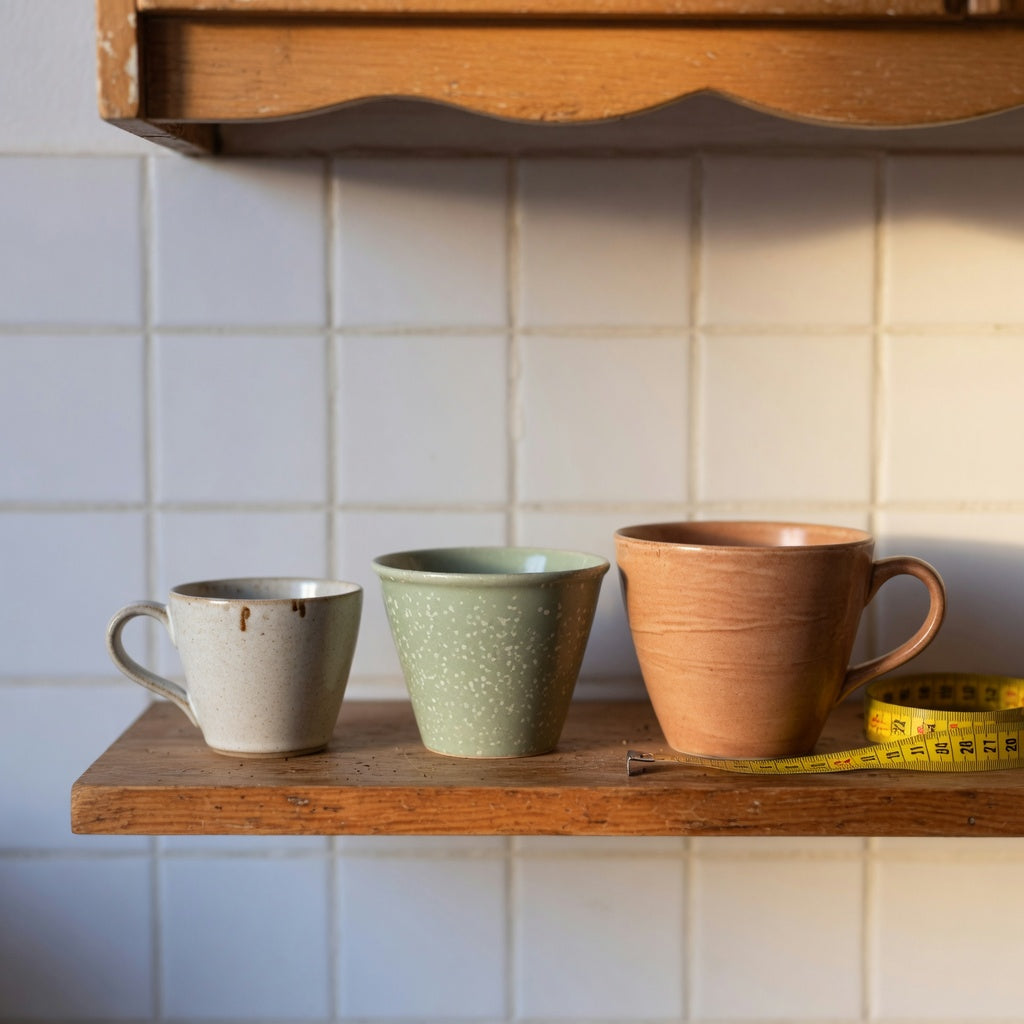
Ceramic Latte Cups Compact Kitchen Product Shortlist Guide (250–440 ml)
Reading time: about 11 minutes
Picture the counter run in a small apartment kitchen: maybe 45 cm of free workspace between the sink and the kettle, one upper shelf you can reach without a step stool, and a dishwasher you run twice a week. A ceramic latte cup has to earn that space. It does not get a shelf of its own.
We sell these cups, and the returns we see are rarely about the drink. They are about fit: a handle that catches the cabinet door, a base that eats the whole counter, a cup that turns out to be smaller at a comfortable fill line than the listing suggested. That is why this ceramic latte cups compact kitchen product shortlist guide is built as three scenarios, not a top-ten list. We will name the cup we would suggest, the reader it suits, and the reason to skip it.
Why does a “latte cup” label tell you almost nothing about fit?
The US FDA’s compliance guidance defines cups and mugs as small ceramic hollowware for hot drinks, normally holding about 240 ml (8 fl oz) and made with a handle; cups have a base and curved sides, mugs have cylindrical sides. That is a legal reference point, not a barista standard. No government body or standards organisation defines the ideal latte cup volume or interior shape. Café practice and buyer guides disagree across roughly 6–16 oz.
What matters in a compact kitchen:
- Your actual drink volume. A latte is espresso, steamed milk, and foam. If you pour 250 ml of liquid into a 250 ml cup, the foam has nowhere to go.
- Brim-full versus fill line. Listings disagree. Reviews of ceramic drinkware regularly describe a cup sold as 10 oz holding closer to 8 oz at a sensible fill level. Treat every published capacity as a ceiling.
- Shelf clearance. The gap between shelves, minus cup height, minus finger room. A shallow shelf is the most common reason a large cup lives permanently on the counter.
- Base diameter and handle swing. The handle is part of the footprint. It adds width when cups sit side by side and catches on cabinet doors.
Which three measurements shrink the shortlist before you compare cups?
Before you look at a single product photo, write down three numbers from your own kitchen:
- Shelf gap. Measure the clear space between shelves. Subtract the tallest cup height you are considering and at least 2 cm for fingers. If the result is negative, that cup is a counter cup, not a cabinet cup.
- Counter patch. Measure the stretch of counter you are willing to give up. A wide base is stable, but it costs more area per cup.
- Handle clearance. Open the cabinet door and watch where it swings. A chunky handle adds real width, and it is the part that hits first.
Here is how the three cups in our catalogue line up on the only specification we can state plainly — listed capacity. Everything else about the base, wall, and handle needs to come from the current product page.
| Cup | Listed capacity | Best-fit scenario | Skip it if |
|---|---|---|---|
| Ball Handle coffee and tea mug | 250 ml | Small milk drink, shallow shelf, tight counter | You routinely drink 300 ml or more of milk |
| The Flow coffee and tea mug | 400 ml | Full-size latte with foam headroom, desk or counter | Your shelf gap is tight or you want a small cup |
| The Morning and Night coffee and tea mug | 440 ml | Large drinks, double shot plus a full pitcher of milk | You are buying three and have a shallow cabinet |
Scenario 1 — a 250 ml flat white and a shallow shelf
Our Ball Handle coffee and tea mug is listed at 250 ml. That is near the FDA’s roughly 240 ml cup reference point and squarely in flat white, cortado-adjacent, and small-latte territory.
Why it fits: it has the smallest listed capacity of the three, so it is the logical starting point when the cabinet gap is the binding constraint. In our experience, smaller cups usually take less shelf and counter area, but capacity alone does not guarantee footprint. Verify the base diameter and height on the listing.
Why we would tell you to skip it: if your real drink is 300 ml or more of milk, you will be pouring to the rim and pushing foam against the edge. Step up to the 400 ml. Also check the posted handle span against your own hand — handle comfort is personal, and a 250 ml cup is the size where a small handle can feel tight for larger hands.
Do not assume the name tells you the handle geometry. “Ball Handle” is the product name, not a published measurement. Open the listing and look for handle span and base diameter before you buy.
Scenario 2 — a full-size latte at a desk: 400 ml or 440 ml?
Two listings cover the full-size end. The Flow coffee and tea mug is listed at 400 ml, roughly 13.5 US fl oz. The Morning and Night coffee and tea mug is listed at 440 ml, roughly 14.9 US fl oz. Neither is small, and neither is pretending to be.
Choose The Flow (400 ml) if you want a genuine latte with room for a foam cap, but your shelf or desk has every centimetre spoken for. It is the smaller of the two full-size options by listed capacity.
Choose Morning and Night (440 ml) if your drinks run large — a double shot, a full pitcher’s worth of milk, and a foam cap — and you have the vertical clearance to store it. The 40 ml difference is worth treating as headspace, not as extra coffee.
On a narrow desk, a full-size cup plus its handle claims a defined patch of real estate that nothing else can use. That is a trade, not a defect. If you need the cup to fit under a monitor stand or beside a keyboard, measure the base and handle swing first. We do not publish heat-retention claims for these cups, and we would not choose between them on that basis without a controlled test.
If you are cross-shopping the common 12 oz size (about 355 ml), the 400 ml Flow sits above it and the 250 ml Ball Handle sits below it. That 355 ml midpoint is exactly where a lot of “medium latte” orders land.
What should you not buy these cups for?
Acknowledging the limits is cheaper than processing a return.
- Iced coffee by the glass. These are hot-drink vessel shapes. If most of your drinks are iced with a full glass of ice, a tall tumbler holds the ice and the volume more sensibly.
- Commuting. Nothing on this shortlist is a travel cup. Lids, seals, and leak resistance are a separate question that these listings do not answer.
- Three large cups in a shallow cabinet. Buying the 440 ml in triplicate is how a tidy kitchen becomes a countertop of mugs. If you want three cups, mix a 250 ml into the set.
- Anyone who needs certainty about a specific material. The body material, firing details, and care marks are stated on each product page. Check them rather than assuming all three cups share one identical body and finish.
Glaze and food safety: what the FDA lead and cadmium limits actually mean
The FDA sets an action level for leachable lead in ceramic cups and mugs — small hollowware — of 0.5 micrograms per millilitre, applied to any one of six units tested. For cadmium, the action level is also 0.5 micrograms per millilitre for small hollowware, and 0.25 for large hollowware. The extraction method the agency cites, ASTM C738, uses acetic acid and is described in the guidance as a severe test unlikely to be matched in ordinary use. That is why everyday factory-made tableware is generally treated as low risk.
What the FDA also says is less comfortable. If a glaze is not fired properly, lead may never fuse into the glaze, and the agency has found traditional pottery labelled “lead free” that still released extractable lead at or above its action levels. Ceramicware that tests above the action level should not carry a Lead Free label at all. Washing, boiling, and scrubbing do not remove lead from a glaze.
The practical version for a shopping trip:
- Prefer factory-made commercial ceramicware over handmade, antique, flea-market, or brightly orange-, red-, and yellow-decorated pottery, which the FDA flags as higher-concern categories.
- Treat “lead free” as a claim to verify, not proof. Most listings publish no batch test results — that is a gap in the whole market, not a red flag on one seller.
- Retire a cup once the glaze crazes or chips. The FDA names damaged pieces as a higher-concern category, and a cracked food-contact surface is a different risk conversation than a chip on the base.
Can you microwave or dishwasher a ceramic latte cup with metallic trim?
Microwave suitability is piece-specific, not category-wide. The FDA explains that microwaves are reflected by metal and pass through ceramic, which is why plain ceramic can go in and anything with metallic trim, gold banding, or a lustre finish should stay out. If a cup has metal decoration on the rim, keep it out of the microwave regardless of what the packaging implies.
For our three listings, read the care marks on the current product page before you assume anything — material, firing, and dishwasher guidance live there, and they are not automatically identical across a catalogue.
Dishwasher reality check from handling this category: tall cups with substantial handles consume more top-rack space than their capacity suggests, and decorated rims are usually the first detail to dull. In our experience, many customers hand-wash the handled cups simply to keep the finish looking the way it did on day one.
How do you build a ceramic latte cups compact kitchen product shortlist guide that fits your shelf?
Use the same four-step check we use when we compare samples:
- Write down your actual drink volume in millilitres, not the cup size you think you want.
- Measure the shelf gap and the counter patch, then compare against listed cup height and base diameter.
- Check handle span, and ask whether the cup is still comfortable when full — the heaviest drink is the one that decides.
- Read the product page for material, care marks, and any food-contact or testing statements. Buy one cup before committing to a set.
If you would rather see the three sizes together in context, browse our collection of unique coffee mugs and compare them side by side. Start with the 250 ml if your shelf is shallow, the 400 ml if you want one full-size latte cup, and the 440 ml only if you have measured the clearance. Buy one first. Measure it in your own cabinet. Then decide whether the set makes sense.
Frequently asked questions
Is a 250 ml ceramic latte cup big enough for a latte?
It is enough for a flat white, a cortado-style drink, or a deliberately small latte, and it leaves almost no foam headroom if you pour a full 250 ml of liquid into it. If your normal drink is 300 ml or more of milk, move up to the 400 ml option instead of filling a small cup to the rim.
Why does a cup listed as 12 oz only seem to hold about 8 oz?
Because listing conventions are not standardised — some sellers measure to the brim, others to a comfortable fill line below it, and others include the foam layer in the number. Reviews of ceramic drinkware describe exactly this gap. Treat the published capacity as the maximum, and expect your working fill to sit below the rim once foam is involved.
Do I need a rounded-bottom cup to pour latte art?
No. It is practice, not the vessel. That said, a curved interior transition gives the milk somewhere to swirl as you pour, which is why latte-art cups tend to be bowl-shaped rather than straight-sided. A straight mug will still produce a decent pour — it is simply less forgiving.
Can a ceramic latte cup with a gold or metallic handle go in the microwave?
No. Microwaves are reflected by metal, so metallic trim, gold banding, and lustre finishes should stay out. Plain undecorated ceramic is the safer case, but check the individual product’s care marks before you assume a specific cup qualifies.
How do I fit a ceramic latte cups compact kitchen product shortlist guide into a narrow cabinet?
Measure the shelf gap once and write the number down, then buy a mixed set rather than four identical large cups. This ceramic latte cups compact kitchen product shortlist guide exists because capacity is rarely the constraint — handle swing, base diameter, and vertical clearance are what force cups onto the counter. A 250 ml cup, a 400 ml cup, and a 440 ml cup together usually fit where three 440 ml cups do not.
More from our blog
Ready to pick your mug? Two ways to save on today's order:
Ordering 1–3 mugs? Get an extra 10% off your 1st order with code 10_OFF Apply 10% Off & Shop Wooden-Handle Mugs →
Gifting 4+ mugs? Buy 3, Get the 4th Free applies automatically at checkout (no code needed; offers do not stack) · Free standard shipping (Nov pre-Christmas delivery: 15–20 calendar days US) · Free replacement if chipped in transit.
Popular mug buying guides: Ceramic Mugs with Lids Compared · Wooden-Handle Tea Infuser Mugs Compared · Christmas & Secret Santa Mugs 2026 · Espresso & Cortado Cups Guide · Cup & Saucer Gift Sets · All 25 Mugs Spec Table · Mug Size Guide · Shipping & Promo FAQ
FIRST ORDER 10% OFF (CODE: 10_OFF) · OR BUY 3, GET THE 4TH FREE


Read more
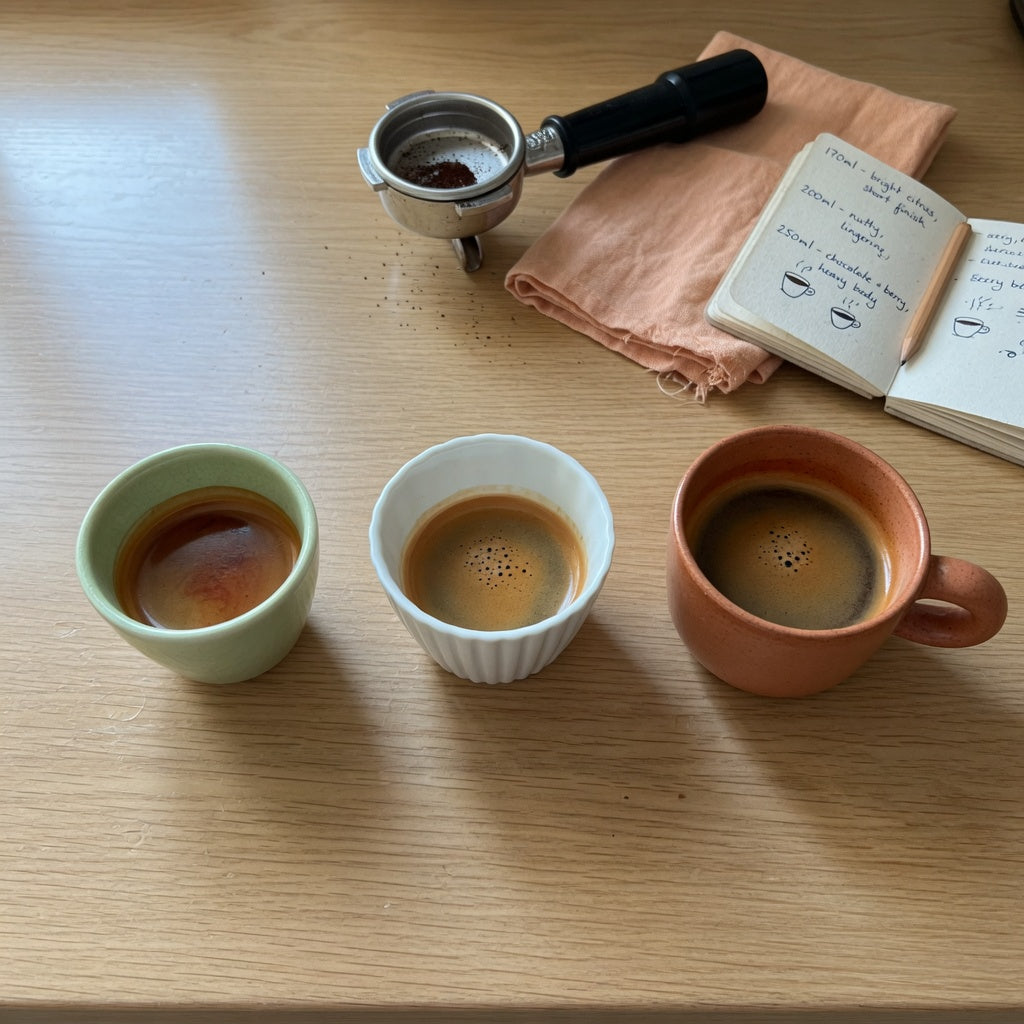
Cute Espresso Cups Weekend Coffee Product Shortlist Guide: 3 Picks
A practical shortlist of three compact ceramic cups at 170 ml, 200 ml and 250 ml, with one plain reason to choose each and one plain reason to skip it before your next slow Saturday pour.
Read more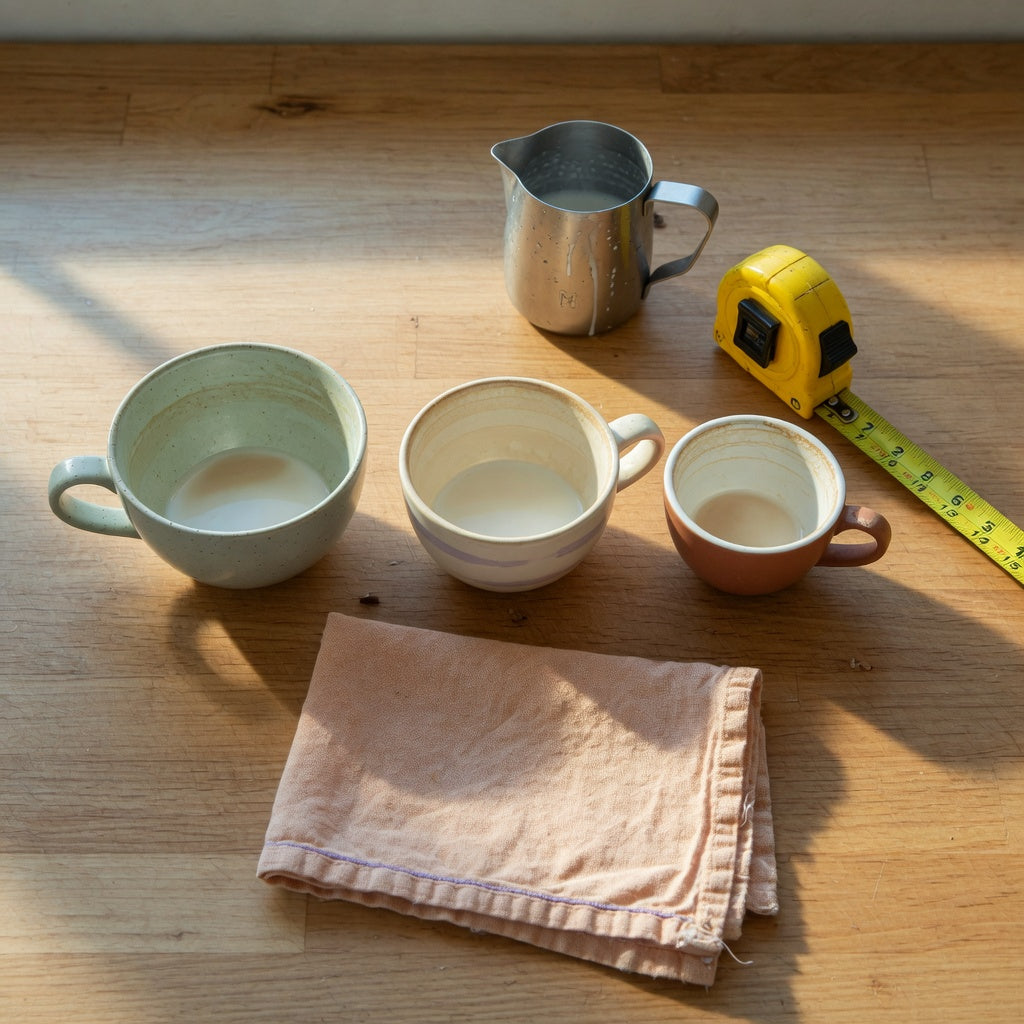
Ceramic Latte Cups Weekend Coffee Product Shortlist Guide (250-440 ml)
A scenario-based shortlist of the three ceramic latte cup capacities we stock — 250 ml, 400 ml, and 440 ml — with plain reasons to choose or skip each, plus the listing details worth verifying befo...
Read more
Leave a comment
This site is protected by hCaptcha and the hCaptcha Privacy Policy and Terms of Service apply.