
Ceramic Espresso Cup Everyday Mug Rotation Practical Purchase Checklist
Reading time: about 9 minutes
At 7:30 a.m., a short coffee lands in an oversized breakfast mug because the compact cups are buried behind taller mugs or still waiting by the sink. That is the mismatch this ceramic espresso cup everyday mug rotation practical purchase checklist is designed to prevent: the cup should suit the amount you pour, the number of times you use it, and the place it occupies between drinks.
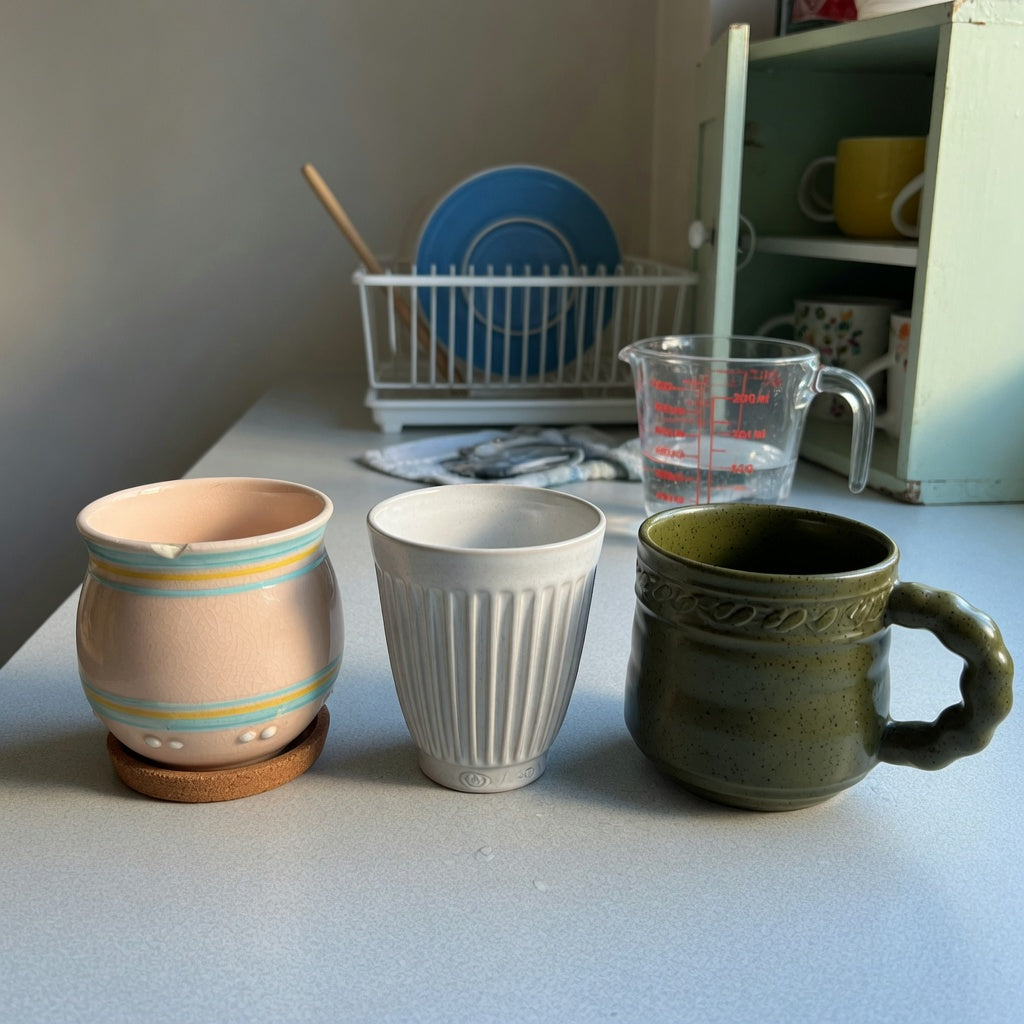
As the team selling and handling this category, we start with the facts we can verify. CoffeifyMug lists three ceramic vessels in this group: Retro at 170 ml, Pleated at 200 ml, and Ball Handle at 250 ml. These may be larger than a traditional single-shot demitasse. We do not treat capacity as proof of heat retention, espresso-machine fit, dishwasher compatibility, stackability, or drink-specific performance.
Which listed capacity matches your repeat pour?
Measure the finished drink, not just the espresso shot. Include the water, milk, or other additions that normally enter the cup. For an iced drink, measure the liquid and account for the space taken by ice; a nominally suitable small espresso cup can become cramped quickly once cubes are added.
| Your everyday pattern | Decision logic | Relevant next step |
|---|---|---|
| You make a very short drink and want the lowest listed capacity. | At 170 ml, Retro is the smallest of these three options. Confirm that your complete pour still leaves comfortable carrying room below the rim. | Review the 170 ml Retro coffee tea cup. |
| Your measured drink needs more room than the smallest option, but you do not want the highest listed capacity. | The 200 ml Pleated cup occupies the middle capacity position and has a visibly textured form. | Compare the 200 ml Pleated coffee tea cup. |
| Your short drink regularly approaches the upper end of this compact range. | The Ball Handle option has the highest listed capacity at 250 ml and a visibly prominent handle form. | Inspect the 250 ml Ball handled coffee tea mug. |
Treat each listed capacity as a comparison figure, not a target fill line. A cup carried from the kitchen counter to an office desk needs room below the rim. The listings also do not establish whether the stated number represents brim capacity or a preferred working fill, so avoid choosing an option that only works when filled completely.
Can the cup earn a fixed place on your shelf and drying rack?
Capacity does not reveal exterior height, diameter, base width, or total width across a handle. Those measurements determine whether a coffee cup for espresso remains easy to reach or disappears behind the full-size mugs. Before ordering, assign the cup a specific storage address and measure that space.
- Cupboard: record clear shelf height, usable depth, and side-to-side width. Include the space needed to grasp the vessel without moving its neighbors.
- Drying rack: check the gap between pegs and the resting surface. Do not assume a handle will hang securely from a rack based on capacity.
- Office desk: identify the available area beside the keyboard, notebook, monitor stand, and charging cables. A lidless ceramic vessel needs a stable location away from electronics.
- Open shelf or mug tree: compare the widest visible point of the form with the available clearance. Product dimensions should be confirmed rather than estimated from a photograph.
The rounded ball handle deserves particular attention because its visible form differs substantially from a conventional loop. Pleated walls do not establish that cups will nest, and a Retro name does not guarantee a smaller exterior footprint. Unless stackability is expressly stated, plan for a stable single-layer row instead of a tower.
Ceramic espresso cup everyday mug rotation practical purchase checklist
We use the following sequence in our store because it turns an attractive cup into a role-based purchase rather than another item competing for shelf space.
- Measure the complete drink: use a marked measuring jug on several normal coffee days. Record espresso, water, milk, and any other addition together.
- Count daily reaches: note how many short drinks you make before the cup is normally washed. This tells you whether one vessel can support the routine or whether quantity becomes part of the decision.
- Leave carrying room: match the measured drink to 170 ml, 200 ml, or 250 ml without planning to fill the ceramic vessel to its rim.
- Assign a storage location: measure the cupboard, open shelf, tray, or desk where the cup will spend most of the day.
- Check your preferred hold: observe whether you normally use a handle, cradle the cup body, or alternate between both. Visible form can guide the comparison, but it cannot guarantee comfort for every hand.
- Verify appliance clearance: measure from the espresso machine's drip tray to the dispensing point and compare that with current exterior dimensions if they are provided. Capacity alone cannot confirm fit.
- Read the care information: confirm dishwasher, microwave, and temperature guidance from the current product instructions. Ceramic material by itself does not answer those questions.
- Choose the rotation role: decide whether the new piece replaces an existing cup, handles one specific short pour, or appears only for guests. Buy for that role rather than an imagined future routine.
A useful rotation has a clear order of use. If the new cup duplicates the capacity, shape preference, and storage demands of a vessel you already avoid, changing the exterior style alone may not move it to the front of the shelf.
Retro 170 ml, Pleated 200 ml, or Ball Handle 250 ml?
Retro 170 ml for the shortest measured routine
Choose Retro when your complete drink fits comfortably within the lowest listed capacity and you prefer its visible retro form. The reason is specific: 170 ml is the smallest verified capacity in this group, not a promise that the cup occupies the least shelf space or fits a particular machine. The product page is the next check for a shopper seeking a compact short-pour role.
Pleated 200 ml for a middle-capacity role
Choose Pleated when 170 ml leaves too little working room, 250 ml is more vessel than your routine needs, and the visibly pleated exterior suits your taste. The texture is a form detail, not evidence of certified grip performance. This option makes the most sense after your measured pour and storage space both support the middle listed capacity.
Ball Handle 250 ml for the highest listed capacity
Choose Ball Handle when your usual drink needs the most room available in this trio and you actively prefer the rounded handle form. Confirm counter, shelf, and drying-rack clearance first. A distinctive handle can be the reason a shopper enjoys reaching for a cup, but its appearance does not establish ergonomic fit for every hand.
Gift buying requires the same discipline. At an unboxing, the recipient will notice the visible form immediately, but only their routine determines whether 170 ml, 200 ml, or 250 ml becomes useful. We do not assume matching accessories, special packaging, or a saucer is included unless the current listing expressly says so.
What must be confirmed about care, stacking, and machine clearance?
An everyday cup encounters sink rinses, drying racks, cupboard contact, and possibly repeated dishwasher cycles. None of that makes an unstated care claim acceptable. Our verified facts cover the ceramic vessel, listed capacity, and visible form, so daily-care compatibility remains a pre-purchase checkpoint.
- Dishwasher and microwave use: do not infer either from the word ceramic. Follow the current product page and instructions supplied with the vessel.
- Conservative hand care: unless the product directions say otherwise, use mild dish soap and a non-abrasive sponge, then dry the cup before returning it to a crowded shelf.
- Arrival inspection: look at the rim, base edge, surface, and handle junction where a handle is present. Set aside a vessel with a chip, visible crack, or loose-feeling connection rather than placing it into service.
- Stacking: confirm that bases and rims sit securely before stacking. Visible pleats or a rounded handle can affect how pieces meet, and no stackability claim is made here.
- Temperature changes: avoid abrupt hot-to-cold or cold-to-hot transitions unless the product guidance supports them. We do not claim thermal-shock testing or a certified cycle rating for these cups.
The same restraint applies to espresso equipment. Measure the physical clearance, including any need to angle the cup into place. We cannot promise compatibility with a machine, cup warmer, saucer, mug tree, or vehicle holder without verified dimensions and equipment-specific testing.
Who should skip these compact ceramic cups?
A different vessel is the better purchase if the role conflicts with the known facts. Skip these options if:
- You want the scale of a traditional single-shot demitasse rather than a listed capacity of 170-250 ml.
- Your normal finished drink exceeds 250 ml or uses enough ice to consume much of that volume.
- You need a sealed travel lid, insulation, or a cup intended for use while walking or driving.
- You require guaranteed clearance under a specific espresso machine but cannot verify exterior dimensions.
- You need stated dishwasher-cycle data, certified food-service performance, or included accessories that are not named in the listing.
A true demitasse better suits a traditional small serving. A full-size mug makes more sense for long coffee, generous milk drinks, or iced coffee. A lidded travel vessel is the practical answer for commuting and moving between rooms.
Frequently asked questions
What should a ceramic espresso cup everyday mug rotation practical purchase checklist include?
It should cover the complete drink volume, required rim clearance, daily use frequency, storage measurements, preferred form, appliance clearance, and verified care instructions. It should also identify unknowns instead of turning them into assumptions. Capacity, material, and visible style are not substitutes for exterior dimensions or tested compatibility.
Are 170 ml, 200 ml, and 250 ml cups too large for traditional espresso?
They may be larger than a traditional single-shot demitasse, particularly if you want a closely scaled serving vessel. Their listed capacities can suit shoppers who make a short drink with extra water, milk, or another pour, but no drink-specific performance claim is implied. Choose from your measured finished volume rather than the espresso label alone.
Are the CoffeifyMug ceramic espresso cups dishwasher and microwave safe?
Dishwasher and microwave compatibility are not among the verified facts used for this checklist. Check the current product page and the instructions supplied with the selected vessel. Do not assume that every ceramic cup accepts the same cleaning method or temperature exposure.
Will one of these cups fit beneath my espresso machine?
Capacity cannot answer that question because two 200 ml vessels can have different heights and widths. Measure from the drip tray to the dispensing point, including the angle needed to insert and remove a cup. Compare those measurements with confirmed current product dimensions before buying.
Which option is most practical for an everyday rotation?
Retro is the capacity-first candidate for a shopper whose measured drink fits comfortably below 170 ml. Pleated provides the middle listed capacity at 200 ml, while Ball Handle provides the highest at 250 ml and the most visually prominent handle of the three. The practical choice is the one that clears both your pour-volume test and your storage test.
Measure your next normal drink, mark the exact shelf space, and eliminate any option that fails either check. Then compare those results with CoffeifyMug's unique coffee mugs collection and choose only the ceramic form that has a defined place in your everyday rotation.
More from our blog
Read more
A mocha mug home coffee station product shortlist guide: 400-480 ml
Compare The Flow 400 ml, Morning and Night 440 ml, and The Rock 480 ml using your actual drink volume, preferred headspace, and station measurements. Each option includes a clear reason to choose o...
Read more
Chai tea mug gift choice product shortlist guide: 3 size picks
Compare The Flow at 400 ml, Morning and Night at 440 ml, and The Rock at 480 ml by the recipient's real pour, carrying habits, and storage. Each option includes a clear reason to choose it and a re...
Read more
Leave a comment
This site is protected by hCaptcha and the hCaptcha Privacy Policy and Terms of Service apply.