

Ceramic cappuccino mug vs cup: 170, 200, or 270 ml
Reading time: about 12 minutes
A customer sets two ceramics on the packing table and asks which one is for cappuccino. Both are glazed. Both have a handle. One is a low cup that would meet a short milk-coffee pour near the rim. The other is a taller mug that would still show bare wall after the same pour. Shoppers typing ceramic cappuccino mug vs cup are usually trying to stop that mix-up before they pay. In our store the useful split is portion and shape first. Material comes after.
A traditional cappuccino cup is often a smaller, wider-rimmed ceramic or china bowl, frequently paired with a saucer and filled close to the brim. An everyday mug is usually taller, straighter, and built so a full hand can carry it without a saucer. The title on the product page does not tell you which one you are holding.
Ceramic cappuccino mug vs cup: what changes before the clay does
Mug and cup get used almost interchangeably in search, and that is where orders go sideways. In cafe service a cup is often wider than it is tall, with a smaller handle and a saucer that holds a spoon and a drip. A mug is what many people already keep beside a keyboard: more volume, steeper walls, a handle that takes several fingers.
We walk this through on the counter with people who already love a big mug and assume any ceramic will behave the same for a short milk coffee. It will hold the liquid. It will not keep the same balance of coffee to milk if brim capacity is nearly double the drink they meant to make. That is a portion problem, not a glaze problem.
Shape and clay are separate decisions. A wide porcelain cup and a wide stoneware cup can share a silhouette. A tall mug can be made in either body. Capacity tells you whether the vessel is big enough. The rim and the fill line tell you whether it will drink like the small cup you remember from a cafe, or like the mug you already use for filter coffee.
Where 170 ml, 200 ml, and 270 ml sit against a small milk coffee
Cafe notes often describe a classic cappuccino as a white cup around 150 to 160 ml, sometimes stretching toward 180 ml, filled near the brim. A commonly repeated build is a short espresso around 25 ml plus about 100 ml of milk, steamed out toward roughly 125 ml, so the finished drink lands near that 150 to 160 ml line. We have not tested that recipe in these pieces. We are not saying any of them was designed, certified, or checked for cappuccino. It is only the portion people mean by a small cappuccino, set against a milk-heavy mug.
Retail labeling is looser. Plenty of ceramics sold as cappuccino mugs land around 8 to 12 fl oz, roughly 237 to 355 ml. A 160 ml pour sits low in that mug. Topping it up until the wall disappears makes a different drink, closer to a latte. That mismatch is what we watch for at the packing table, not a special property of ceramic.
The only capacities we will stand behind here are the listed ones. Compare them as everyday cup fit, nothing more. Fluid ounces in the table are rounded conversions of those milliliters, not a second measurement.
| Listed piece | Listed capacity | About fl oz | Everyday fit | Poor fit when |
|---|---|---|---|---|
| Retro coffee and tea cup | 170 ml | 5.7 | Small cup near a 150 to 180 ml pour | You want one large drip serving |
| Pleated coffee and tea cup | 200 ml | 6.8 | Slightly larger short cup for milk coffee or tea | You need almost no headspace, or one 300 ml mug |
| Emerald coffee and tea mug | 270 ml | 9.1 | Modest mug with room above a small pour | You want the drink to meet the rim |
The Retro coffee and tea cup at 170 ml is the closest listed capacity to a 150 to 180 ml pour. Filled near the brim, it sits in small-cup territory, with only a thin margin above a 160 ml drink. It is not a breakfast mug. A 12 fl oz drip is about 355 ml, so this cup means a second pour, not one long sitting. It is also a weak gift if the recipient lives on a large desk tumbler. It fits someone who already likes a short cup and would rather refill than stretch the drink with extra milk.
The Pleated coffee and tea cup at 200 ml sits 30 ml above the Retro, about two tablespoons. That is one extra sip, not a new category. It still reads as a short cup for milk coffee or tea, with a little spare room if you dislike liquid at the rim on a short walk to the table. Pass on it for a strict 150 ml line with almost no headspace, and pass again if one vessel must cover a 300 ml filter coffee. The name is not a heat claim or a foam claim. The listed fact is capacity.
The Emerald coffee and tea mug at 270 ml is where mug behavior starts among these three. A 160 ml pour leaves about 110 ml unused. That room helps if the same piece also carries a modest black coffee or tea, so you are not switching vessels at lunch. It is a poor match for a brim-full small drink: the wall stays visible, and it is easy to keep adding milk until the mug looks finished. Headspace changes the serving. It is not evidence of foam performance, heat retention, microwave safety, dishwasher safety, or barista use. None of the three is a 12 oz shop mug.
Put the same roughly 150 ml drink in each and leftover room is the weekday comparison. The 170 ml cup leaves about 20 ml, a splash. The 200 ml cup leaves about 50 ml, a visible band of wall. The 270 ml mug leaves about 120 ml, enough that the drink can look unfinished unless you wanted the space. Overfilling the small cup so it catches the mug is how rims get knocked between the counter and the table.
For other silhouettes we stock, start with the unique coffee mugs collection and read capacity on the current listing. Listings change. Do not borrow a milliliter figure from a similar name, a marketplace photo, or an older page.
Wide rim or straight wall: the check a photo does not finish
A cappuccino-style cup is often wide at the rim and narrower toward the base, so the drink's surface has room and you can see the edge from above. Straight walls change that picture. A low fill shows a smaller surface. A high fill shows more. We do not have measured rim, height, or base figures for the Retro, Pleated, or Emerald pieces, so we will not invent them from a photo. On the listing, compare rim width with height, then picture the interior wall left after a 160 ml pour.
Interior color sits beside shape. Traditional service favors a white, plain inside so the edge of the drink is easy to judge. A dark or patterned interior makes that edge harder to see. A colored exterior does not prove the inside is light. Confirm it on current photos if the look of the drink matters. We are not assigning an interior color to these three.
Do not turn shape into a foam claim. A wide rim can change how a drink sits and how much surface you see. It does not mean a piece was tested for latte art, crema, or cafe service. If that is the reason you are shopping, this page will not settle it.
Porcelain, stoneware, and the ceramic label shoppers mix up
Porcelain is a ceramic. It is a vitrified body, usually white, and often slightly translucent at a thin rim. Earthenware is the more porous end of the family and leans on its glaze to stay watertight in daily use. Stoneware sits in a less tidy middle: dense, usually opaque, fired hot, and hard to tell from porcelain once glaze covers the clay.
Shoppers ask for ceramic rather than porcelain as if the words were opposites. They are not. In our experience the difference you feel is wall thickness, weight, and whether the lip is thin or rounded. A thin cup feels light between machine and table and wants a quieter shelf. A heavier mug sits still on a busy counter and takes more cupboard room. Neither fact picks capacity. We will not say a thick mug keeps this drink hotter than a thin cup. That claim shows up in reviews without a shared preheat, wall measurement, or headspace. Warming a cup with hot water is a habit, not a listing spec.
Glaze safety is a separate check. The U.S. FDA has explained that lead may be present in the glaze or decoration of some traditional pottery and can leach into food or drink if the ware is not manufactured properly. Fired at the proper temperature for the proper time, essentially all of that lead is bound into the glaze. Fired poorly, lead may contaminate the drink. Choose food-use ware from a traceable listing, not a decorative piece never meant to be drunk from. That is general FDA guidance, not a lab result for any glaze we sell. If the page is silent on food-contact use, ask before it becomes a daily cup.
Handles, saucers, and what a weekday kitchen actually needs
Handle clearance is where a handsome cup fails on a weekday. A one-finger cafe handle belongs with a saucer and a small spoon. It is awkward across a kitchen in a full hand, or when fingers do not fit the opening. A full-hand handle is steadier on that walk and clumsier if you wanted a low saucered service.
A saucer catches a drip and holds a spoon, and it spends desk space. On a small office surface a lone mug usually wins. On a breakfast tray the saucer usually wins. Stacking is the dull risk we watch in a cupboard: a flared rim can chip when cups are nested hard, and a straight mug can stick if the foot is stacked wet. We are not saying these three chip, stick, or include a saucer. Check the live page.
Heat retention, microwave use, and dishwasher use stay off this comparison on purpose. Ceramic is not automatically safe in either appliance. Read the live listing for:
- Brim capacity in ml, not the name in the search result
- Whether a saucer is included
- How many fingers the handle opening accepts
- Interior color, if you care how the drink looks from above
- Any stated dishwasher, microwave, or hand-wash instruction
- Food-use language rather than a decorative-only finish
Silence on care is not a yes. Do not copy an answer from a similar cup.
Match the pour you actually make to 170, 200, or 270 ml
That is the practical ceramic cappuccino mug vs cup difference on a home counter: the pour you make, then whether you want it near the rim.
Take the 170 ml Retro cup when you want a small serving and would rather refill than dilute. Take the 200 ml Pleated cup when you want a little more room and still do not want a mug. Take the 270 ml Emerald mug when the same piece also has to cover a modest tea or black coffee, and you accept headspace on a short milk coffee.
Skip all three if you need a 12 to 16 oz work mug, a travel lid, or proof from this article that a piece is dishwasher-safe. Those answers are not here. Skip them as well if you are shopping for a tested latte-art cup. Listed capacity does not speak to that.
Run this pass before you buy:
- Write down the drink volume you pour, in ml.
- Set it beside 170, 200, and 270.
- If your number is under the capacity, decide whether leftover headspace will bother you on a weekday, not only in a photo.
- If your number is over the capacity, pick another vessel. Do not overfill a small cup to catch up.
- Confirm saucer, handle, interior, and care on the current page.
Frequently asked questions
Is the ceramic cappuccino mug vs cup choice mostly about size?
Size is the first split, and shape is the second. A smaller cup filled near the brim holds a different serving than a taller mug with empty wall above the same pour. Clay changes weight and lip feel. It does not fix a capacity that is nearly double the portion you wanted.
Can I use a regular ceramic mug for cappuccino at home?
You can pour the drink into it. In an 8 to 12 fl oz mug, a 150 to 160 ml portion sits low, and filling the mug makes the drink milkier. Among the sizes listed here, 170 ml is the closer everyday fit for a small serving filled near the brim. That is a capacity comparison, not a claim that the Retro cup was made for cappuccino.
Is 270 ml too big for a small cappuccino?
It is too big if you want liquid near the rim of a 150 to 180 ml cup. At 270 ml the Emerald mug holds that pour with clear headspace, which suits someone who also wants a modest mug for tea or black coffee. It is a poor pick if spare room usually leads you to add more milk.
Are these cups dishwasher-safe or microwave-safe?
We are not stating either. Those answers depend on the specific body and glaze, and this comparison only covers listed capacity and everyday fit. Read the current Retro, Pleated, or Emerald listing. If care is not printed there, do not assume a yes.
Is porcelain better than everyday ceramic for this drink?
Porcelain is a type of ceramic, usually vitrified and white, not a separate non-ceramic material. A thin porcelain cup and a heavier stoneware mug can both be the right everyday piece. Choose by capacity, rim, handle, and whether you want a light saucered cup or a sturdier mug. We are not ranking them by heat.
When one capacity is left standing, open that listing from the unique coffee mugs and check that the live page still shows the same milliliters. Buy the fit you will pour tomorrow morning, not the name that showed up in search.
More from our blog
Read more
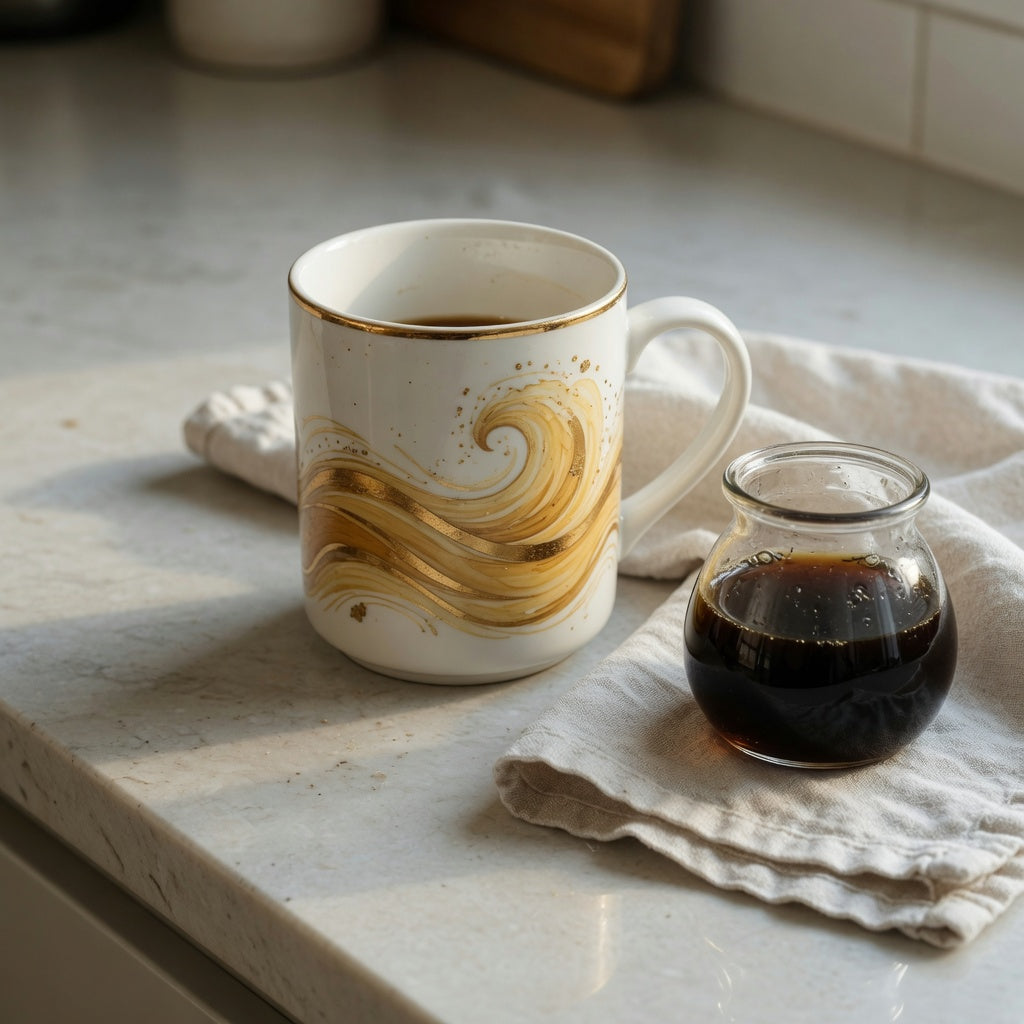
Decorative Golden Waves Ceramic Coffee Mug: What to Compare
A decorative golden waves ceramic coffee mug may be printed wave art or real metallic gold, and those are different buys. Compare food-use marks, microwave and dishwasher labels, usable fill, and w...
Read more
The Flow Coffee Tea Mug Size: What Buyers Should Compare
Shoppers asking about the Flow Coffee Tea Mug size usually want a measured capacity, not the catalog word large. We compare brim fill with a comfortable pour, coffee versus tea headroom, and the li...
Read more
Leave a comment
This site is protected by hCaptcha and the hCaptcha Privacy Policy and Terms of Service apply.