
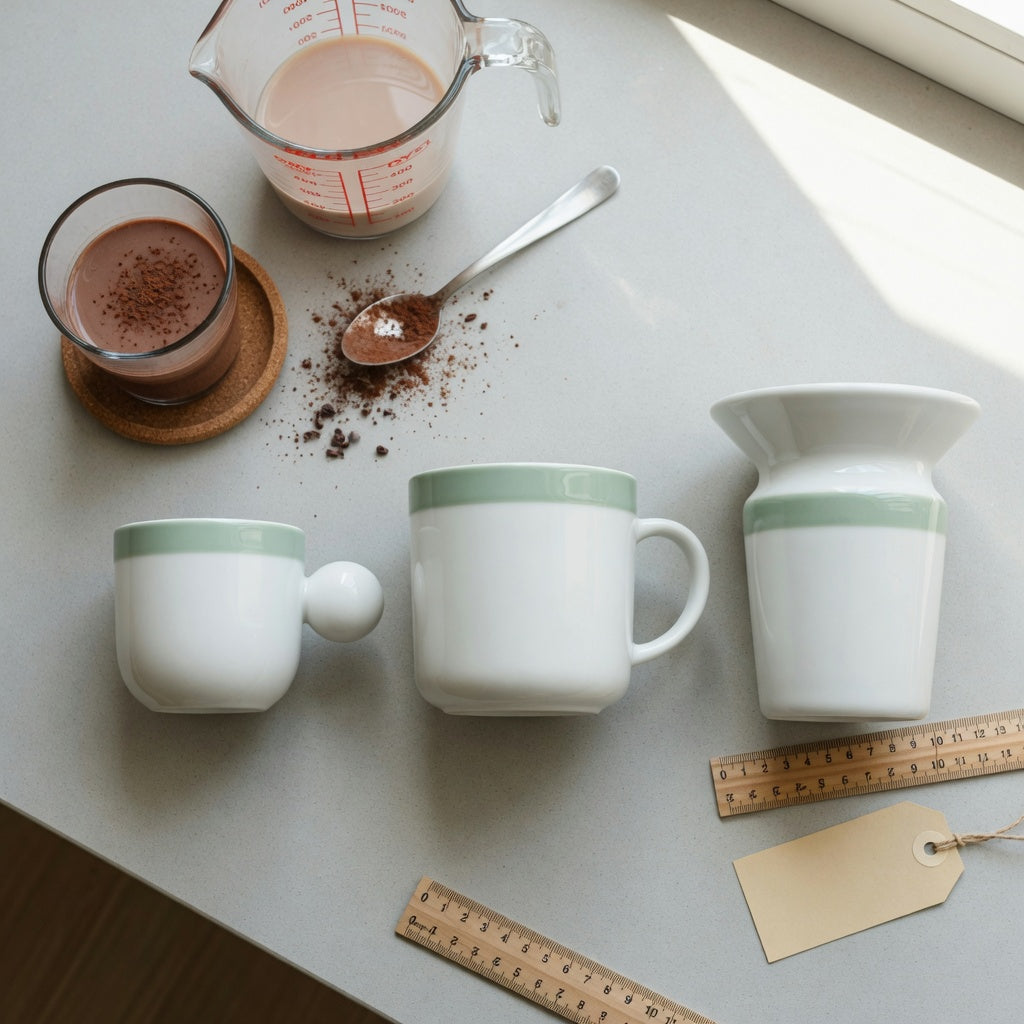
Cacao Cup Gift Choice Practical Purchase Checklist: 3 Sizes
Reading time: about 11 minutes
A 250 ml cup can look generous in a product photo, then feel cramped once the recipient adds cacao, milk, and a spoon. A 400 ml cup gives a larger stated capacity, but it may be more cup than a short evening serving needs. This cacao cup gift choice practical purchase checklist starts with that practical mismatch: the gift has to suit the drink the recipient actually makes, the space where it will sit, and the care routine they will follow.
In our experience selling drinkware, the most useful gift decisions come from comparing verified specifications instead of assigning a story to a cup. The catalog facts available for this comparison are specific: the Ball Handle has a listed 250 ml capacity and 11.2 cm diameter, the Round is listed at 390 ml, and the Spittoon is listed at 400 ml. We treat all three as everyday drinkware that can be considered for cacao. We do not present them as traditional, ritual, certified, or purpose-built cacao vessels.
Start with the drink they make, not the gift occasion
The recipient's normal serving is the strongest first filter. A mug chosen for a birthday, holiday, or housewarming still has to work on an ordinary Tuesday at the kitchen counter or office desk. Before selecting a capacity, find out how much liquid goes into the recipient's current cup and what they add after the initial pour.
- Measure the water or milk used for one normal serving with a marked jug.
- Include additions such as extra milk, foam, or a second ingredient that raises the finished volume.
- Notice whether the recipient mixes in the serving cup or prepares the drink elsewhere.
- Leave practical stirring room rather than matching the finished drink exactly to the listed capacity.
- Record where the cup usually lives: open shelf, cupboard, desk, coaster, or cup warmer.
A listed capacity is not automatically the same as a comfortable working fill line unless the product listing says so. A drink that measures close to 250 ml may need a larger cup if it is stirred vigorously or carried between rooms. A serving clearly below 250 ml makes the smaller option more plausible, but capacity alone still does not establish the cup's footprint or handle clearance.
Cacao cup gift choice practical purchase checklist: which size passes first?
The three options separate clearly at 250 ml versus roughly 400 ml. The difference between the two larger cups is much smaller, so those should not be chosen on capacity alone.
| Product | Verified catalog fact | Useful decision signal | Detail still worth checking |
|---|---|---|---|
| Ball Handle coffee and tea mug | 250 ml capacity; listed 11.2 cm diameter | Fits recipients whose measured serving sits comfortably below 250 ml | What the diameter measures, plus height, base size, weight, material, and care guidance |
| Round coffee and tea mug | 390 ml capacity | Adds 140 ml of stated capacity over the Ball Handle | External dimensions, opening measurements, material, weight, and care guidance |
| Spittoon coffee and tea mug | 400 ml capacity | Largest listed capacity of these three, but only 10 ml above the Round | External dimensions, opening measurements, material, weight, and care guidance |
If none is an immediate match, compare their current photos and listing details in the unique coffee mugs collection. Looking at the options together makes the 250 ml versus 390-400 ml split easier to judge.
Does the 11.2 cm diameter fit their shelf, coaster, and desk?
The Ball Handle's listed 11.2 cm diameter is the only external measurement supplied for this comparison. Do not silently reinterpret it as the rim diameter, opening diameter, or base width. Confirm what the measurement refers to on the current product page before using it to approve a cupboard slot or accessory.
Our store's practical rule is to check the whole place where a cup will be used. Measure shelf depth and height, then allow for the handle and the hand that has to retrieve it. On a crowded office desk, check the coaster area and the distance from a keyboard. For a cup warmer, the base measurement matters more than the body's widest diameter, so 11.2 cm does not establish compatibility by itself.
This is also why the 250 ml option should not automatically be called the most compact. It has the lowest listed capacity, but footprint, height, and handle projection are separate variables. If the recipient has a tightly packed cupboard, obtain those dimensions before ordering rather than making the gift recipient solve the storage problem.
How should the visible opening affect stirring and cooling?
Cacao is often mixed in the cup, so the visible opening deserves more attention than it gets in a standard mug comparison. Look at each product's current top and side photos. A recipient who uses a full-size spoon needs enough access to stir without repeatedly striking the rim, while someone who adds foam or another topping may value visible room above the drink.
A broader exposed liquid surface can cool more quickly than a narrower one under otherwise similar conditions. We do not have measured opening dimensions or controlled cooling results for these three products, so we would not rank them for heat retention from photographs alone. Use the visible opening to judge access and preferred drinking shape, not as a performance guarantee.
If slow cooling is the recipient's main requirement, a specifically insulated or lidded vessel is a more defensible gift than any untested everyday cup. Likewise, someone who carries cacao through a commute needs a sealed travel design. These three options should be considered for stationary use only after the recipient's routine and the current product details line up.
Round 390 ml or Spittoon 400 ml: does 10 ml settle the choice?
No. The stated difference is only 10 ml, so capacity is a weak tie-breaker between the Round and Spittoon. If a recipient's serving fits one comfortably, it is likely to sit in the same general volume range for the other, subject to how each capacity was measured.
For a fuller drink, start by viewing the 390 ml Round mug and the 400 ml Spittoon mug side by side. Let the recipient's taste in form, the visible opening, confirmed external dimensions, handle shown in the listing, material, and care instructions decide between them. If the person needs meaningfully more room than 390 ml, an extra 10 ml may not solve the problem; a genuinely larger style would be the better category to shop.
Which product fits each recipient routine?
| Recipient situation | Why it matters | Practical next step |
|---|---|---|
| They make a short serving that measures comfortably below 250 ml | The lower capacity avoids giving them an unnecessarily large cup, while the 11.2 cm listed diameter can be checked against their storage space | Review the 250 ml Ball Handle product details |
| The finished drink needs more room than a 250 ml cup provides | The Round increases stated capacity to 390 ml, leaving a much larger capacity range to evaluate | Check the 390 ml Round listing for current dimensions and care facts |
| They prefer the Spittoon's visible form and need roughly a 400 ml cup | Its 400 ml listing is the largest here, although the 10 ml difference from the Round should not be overstated | Inspect the 400 ml Spittoon listing |
| They use a high-temperature dishwasher cycle or microwave every day | Material and explicit appliance guidance are more important than appearance | Choose only after the exact product page confirms compatibility; select another style if it does not |
| They drink while commuting or moving between meetings | An open everyday cup does not replace a sealed travel vessel | Choose a lidded, travel-oriented design instead |
| You do not know their serving size or preferred form | Guessing between 250 ml and roughly 400 ml creates a large capacity risk | Measure their current favorite cup, then compare the full mug collection |
What should you verify about material, care, and gift presentation?
Capacity does not establish material, finish, wall thickness, weight, microwave compatibility, or dishwasher suitability. Those details can vary, and care assumptions should not be transferred from another mug that merely looks similar. Read the exact product page available at checkout and use its current wording.
- Material and finish: Confirm the listed material instead of identifying it from a photograph.
- Care: Look for explicit dishwasher and microwave instructions. If either is absent, do not promise that use to the recipient.
- Dimensions: Confirm height, widest point, base size, and handle projection where those measurements affect storage or accessories.
- Capacity basis: Check whether the listing defines how capacity is measured, especially if the normal serving is close to the stated limit.
- Included presentation: Do not assume a gift box, gift wrapping, note, or personalization unless the current listing expressly offers it.
We also recommend an inspection before the cup is wrapped. Under good light, examine the rim, body, base, and handle attachment points for chips or hairline cracks. Place the empty cup on a clean, flat counter and check that it sits steadily. Wash it only according to the product's stated care instructions, and do not give or use a cup that arrives chipped or cracked.
That inspection reflects how our team handles rigid drinkware: the rim and handle joints matter because they are repeated contact and load points, while a base that rocks can be frustrating on a desk. It is a quality check at unboxing, not a claim that a particular defect is common in these products.
Which recipients need a different kind of cup?
These options are not the right recommendation for every cacao drinker. Choose a different category if the recipient needs a leak-resistant commuter cup, documented insulation performance, an oversized accessibility handle, or verified compatibility with a specific appliance. The product name Ball Handle does not by itself establish ergonomic suitability for limited grip strength or joint mobility.
A specialist vessel is also the better route for someone explicitly asking for a traditional or ceremonial cacao cup, a particular origin, or a certification. The products compared here are everyday coffee and tea drinkware being evaluated by capacity and visible form. A thoughtful gift does not require stretching those facts into claims the listings do not support.
A two-minute check before placing the order
- Measure the recipient's normal finished serving.
- Allow room for stirring and additions rather than filling to a theoretical maximum.
- Choose between the 250 ml range and the 390-400 ml range.
- For the larger pair, treat the 10 ml capacity difference as secondary.
- Confirm what the Ball Handle's listed 11.2 cm diameter measures.
- Check cupboard, desk, coaster, and base-size constraints.
- Verify material, care, appliance compatibility, and external dimensions on the exact listing.
- Make no assumptions about gift packaging, personalization, ritual purpose, or certification.
- Inspect the rim, handle joints, body, and base before wrapping the cup.
This cacao cup gift choice practical purchase checklist works best when one unknown is allowed to stop the purchase. If dishwasher compatibility, storage fit, or serving capacity cannot be confirmed, another cup with explicit details is a better gift than an attractive guess.
Frequently asked questions
How do I use a cacao cup gift choice practical purchase checklist?
Measure the recipient's usual finished drink, note any stirring room they need, and compare that amount with the listed 250 ml, 390 ml, and 400 ml capacities. Then verify the cup's external dimensions, visible opening, material, and care instructions on its current product page. Rule out options that do not fit the recipient's storage or daily routine.
Is the 250 ml Ball Handle too small for a cacao gift?
It is too small if the recipient's finished drink and required stirring space exceed its usable room. It can be the more proportionate choice for a serving that sits comfortably below 250 ml. Also check the listed 11.2 cm diameter against their shelf or desk instead of assuming lower capacity means the smallest footprint.
Should I choose the 390 ml Round or 400 ml Spittoon?
Do not decide from the 10 ml difference alone. Compare their current product photos, visible openings, confirmed external dimensions, materials, care instructions, and the recipient's style preference. If 390 ml is genuinely insufficient, 400 ml may not represent a meaningful enough increase.
Are these traditional or ceremonial cacao cups?
We are comparing them as everyday coffee and tea drinkware that may suit a cacao serving. We do not describe them here as traditional, ceremonial, certified, or purpose-built cacao vessels. A shopper who needs one of those attributes should choose a specialist product with explicit supporting information.
Can these cacao cup options go in a dishwasher or microwave?
Capacity and appearance cannot answer that safely. Check the care and material statements on the exact product page before buying, as this comparison does not supply verified dishwasher or microwave guidance. If the listing does not confirm the recipient's required care method, select a product that does.
Take one concrete next step: measure the recipient's current serving and available storage space. Then open the CoffeifyMug unique coffee mugs collection, use 250 ml versus 390-400 ml as the first filter, and let verified dimensions, care details, and visible form finish the decision.
More from our blog
Read more
Ceramic Wide Bottom Coffee Mugs: Practical Rotation Checklist
Compare wide-bottom ceramic mugs by actual shelf footprint, daily use frequency, shape, care requirements, and handling details. This checklist also identifies the product information to confirm be...
Read more
Decaf Coffee Cup Gift Choice Practical Purchase Checklist
Match the recipient's usual pour, grip, desk or kitchen routine, and care expectations to the verified 170 ml Retro, 200 ml Pleated, and 270 ml Emerald options. This checklist also identifies which...
Read more
Leave a comment
This site is protected by hCaptcha and the hCaptcha Privacy Policy and Terms of Service apply.