
Affogato Cup Compact Kitchen Practical Purchase Checklist: 170–270 ml
Reading time: about 8 minutes
A cup can look modest in a product photo and still become the piece that jams a shallow cabinet: its widest point presses against a neighboring mug, the rim meets the shelf above, or the door closes only after you rotate it. Use this affogato cup compact kitchen practical purchase checklist from the cabinet outward, not from the product photo inward.
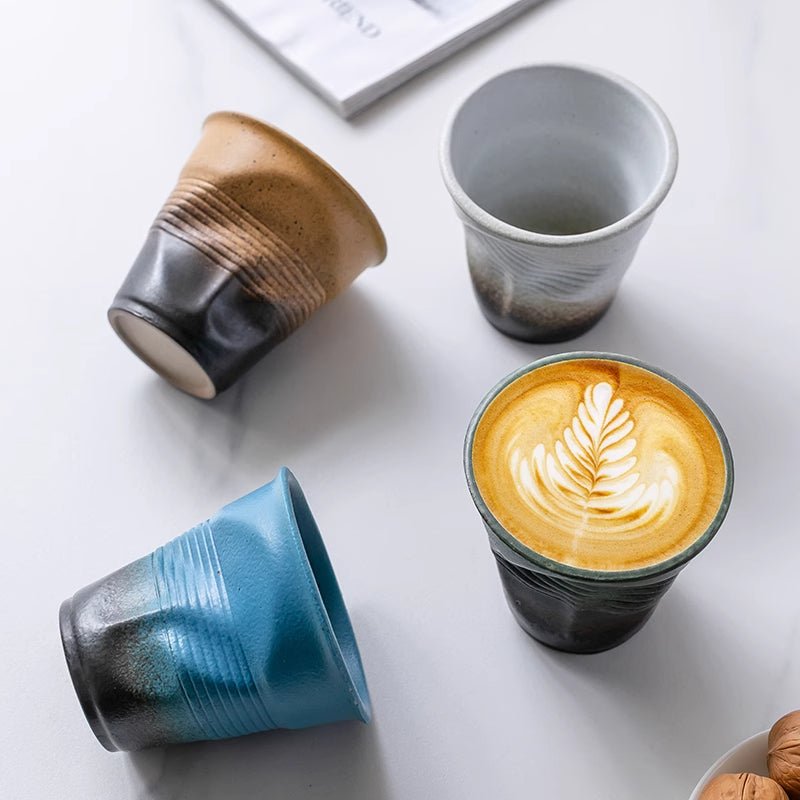
In our store, we start with what can be verified: the Retro Coffee Tea Cup is 170 ml, the Pleated Coffee Tea Cup is 200 ml, and the Emerald Coffee Tea Mug is 270 ml. Use the unique coffee mugs collection if you want to compare other silhouettes first. This article compares capacity and visible shape only. The supplied facts do not establish exterior dimensions, exact material, weight, stackability, care compatibility, temperature-change performance, or included pieces. We use “affogato cup” as a shopper use case, not a claim of drink-specific engineering.
Your affogato cup compact kitchen practical purchase checklist: which spaces count?
In our experience helping shoppers with small drinkware storage, the cabinet opening is often a tighter constraint than the shelf itself. Measure the slot in its normal state, with neighboring items still in place.
- Cabinet opening: Record usable width and height at the narrowest point. A hinge, frame, or shelf lip can reduce access even when the interior looks roomy.
- Usable shelf depth: Measure from the back of the shelf to the closed door, not merely to the front edge.
- Retrieval clearance: Check how far a cup must rise before it clears the shelf edge. A low shelf can require tilting even when the cup fits while standing.
- Counter landing zone: Mark the clear area where you normally assemble and serve an affogato. Leave space for your fingers around the cup's widest visible point.
- Quantity and route: Plan for the number of cups in regular rotation, then check the path from cabinet to counter and table without moving other items.
Write your actual width, depth, and height in one consistent unit. The listed capacities of 170 ml, 200 ml, and 270 ml cannot be converted into exterior dimensions. If a current product page does not state a measurement your cabinet requires, ask before ordering rather than estimating from a photograph. Our affogato cup comparison for small coffee setups covers the same space-first approach in a broader preparation area.
170 ml, 200 ml, or 270 ml: how much capacity earns its shelf space?
Capacity should match the serving you actually make. It should not be used as a shortcut for predicting the cup's external footprint.
| Current option | Capacity comparison | Best first fit | Do not assume |
|---|---|---|---|
| Retro Coffee Tea Cup | 170 ml; 30 ml below Pleated and 100 ml below Emerald | A deliberately small serving and a buyer trying to limit unused capacity | That the smallest listed capacity also has the smallest cabinet footprint |
| Pleated Coffee Tea Cup | 200 ml; 30 ml above Retro and 70 ml below Emerald | A routine where 170 ml feels restrictive but 270 ml is more than needed | That its visible pleating proves anything about width, height, or stackability |
| Emerald Coffee Tea Mug | 270 ml; 70 ml above Pleated and 100 ml above Retro | A shopper wanting the most listed volume among these three options | That it suits a large iced coffee or has the largest external footprint |
Those differences come only from the verified capacities. Measure your usual recipe in milliliters and allow the headroom you prefer instead of planning a brim-level fill. If capacity is the deciding variable, use our detailed 170 ml, 200 ml, and 270 ml affogato cup capacity guide before choosing.
Visible profile, shelf clearance, and cabinet-door fit
The word compact describes a relationship between the cup and your storage space. A low, broad silhouette can solve one clearance problem while creating a side-to-side problem; a taller, narrower form can reverse that trade-off.
- Locate the widest visible point, including any handle or projection shown in the current photos.
- Compare the rim and base. A flare at either end can affect neighboring-cup clearance.
- Check total height plus the extra lift needed to remove the cup from the shelf.
- View the side profile when judging whether the cabinet door can close in the cup's normal orientation.
- Do not infer nesting or stackability from taper, pleating, or a single camera angle.
Product photos are useful shape references, but they are not rulers. Once you have verified external width and depth, mark that storage envelope on paper and place it in the intended cabinet and counter locations. A strip of card cut to the verified height can test vertical clearance. For more detail on reading silhouettes and projections, see our affogato cup shape and handle comparison.
Material, care, and package contents: what remains unverified?
A compact kitchen makes overlooked product details obvious. A cup that cannot follow your normal care routine may end up occupying drying-rack or counter space, while an assumed accessory can alter the storage plan. Confirm these points instead of reading them into the product name or styling.
| Buyer question | Current claim boundary | Checkout action |
|---|---|---|
| Will it fit? | No verified exterior width, depth, height, or weight is supplied for this comparison. | Check the current listing or ask our store for the measurement your space requires. |
| What is it made from? | No exact material or finish fact is used here. | Verify the stated composition if material affects your purchase. |
| How can it be cleaned or heated? | No dishwasher, microwave, or temperature-change performance is claimed. | Follow only the care directions stated on the product page or packaging. |
| What comes in the package? | No saucer, spoon, food, drink, or other accessory is assumed. | Read the listing's included-content details before ordering. |
Before the first wash or dishwasher cycle, set the dry cup on a flat counter. Inspect the rim for nicks, chips, or rough spots, check whether the base sits evenly without rocking, look for visible surface damage, and compare the received shape and contents with the listing. These are ordinary incoming drinkware checks, not claims that these products commonly have defects. For a gift, complete the same check before wrapping so a storage or contents surprise is not passed to the recipient.
If your routine depends on dishwasher use, microwave use, stacking, or rapid temperature changes, an unanswered specification is a reason to verify—not permission to assume.
Which option fits a small serving, a middle ground, or more room?
Small, deliberate servings: start with Retro 170 ml
If your normal serving is modest and you want the lowest listed capacity, open the Retro 170 ml cup first. It fits this situation because it holds 30 ml less than Pleated and 100 ml less than Emerald. It is not the right choice if your recipe routinely needs more volume, and we cannot call it the smallest storage footprint without exterior dimensions.
Middle-capacity compromise: check Pleated 200 ml
If 170 ml seems restrictive and 270 ml is more than you want, the Pleated 200 ml cup is the direct middle option. Its extra 30 ml over Retro may be enough for your routine without moving to Emerald's capacity. Choose it only after its visible pleated profile and verified external measurements pass your cabinet test.
Most listed room: consider Emerald 270 ml
If serving volume matters more than minimizing unused capacity, the Emerald 270 ml mug provides the most room among these three. Shoppers searching for an affogato mug may naturally begin here. It is not automatically suitable for a large iced coffee with substantial ice, and a crowded shelf still requires an exterior-dimension check.
If exact footprint, confirmed stackability, or a substantially different capacity matters more than these three choices, another style would suit you better. Browse the current unique coffee mugs collection and apply the same verification steps to any alternative.
Five checks to complete before checkout
Use this short pass-or-pause test while the cabinet measurements and product pages are in front of you.
- Serving check: Measure your normal recipe and compare it with 170 ml, 200 ml, and 270 ml.
- Storage check: Record cabinet-opening width and height, shelf depth, retrieval clearance, and the number of cups you plan to store.
- Counter check: Confirm that the cup's verified storage envelope leaves room for your hand and normal preparation sequence.
- Specification check: Verify exterior dimensions, material, care, temperature-change guidance, stackability, and package contents where they matter.
- Fit check: Choose Retro for the lowest listed capacity, Pleated for the middle option, or Emerald for the largest only after its silhouette passes your space test.
Frequently asked questions
What should an affogato cup compact kitchen practical purchase checklist include?
Record cabinet-opening width and height, usable shelf depth, retrieval clearance, counter space, and normal recipe volume. Compare that recipe with the verified 170 ml, 200 ml, and 270 ml capacities. Confirm external dimensions, material, care, and included contents before buying.
Is the 170 ml Retro automatically the smallest cup in a cabinet?
No. Retro has the smallest verified capacity among these three, but capacity is not an exterior dimension. Its width, depth, height, and widest visible projection still need to fit your measured cabinet slot.
What is the practical difference between 170 ml, 200 ml, and 270 ml?
Pleated adds 30 ml over Retro, while Emerald adds 70 ml over Pleated. The total difference between Retro and Emerald is 100 ml. Choose according to your measured serving rather than assuming that more capacity is always better.
Can I assume these cups are dishwasher safe or include a spoon or saucer?
No. This comparison does not make a dishwasher, microwave, temperature-change, or included-accessory claim. Check the current product listing and follow only the stated care and package-content information.
What should I do if none of these cups passes my cabinet check?
Do not force a purchase simply because one capacity is close. Browse the unique coffee mugs collection, then repeat the same dimension, care, and included-content checks on any different style you consider.
Read more
Oversized Ceramic Coffee Mugs: Morning Routine Purchase Checklist
Measure your finished drink, refill tolerance, grip, storage space, and care needs before choosing a large mug. This checklist also shows which CoffeifyMug pages to compare without assuming unliste...
Read more
Your cacao cup morning routine practical purchase checklist
Compare CoffeifyMug’s listed 250 ml, 390 ml, and 400 ml cups by finished drink volume, morning timing, visible opening, and refill tolerance. It also flags care, material, and fit details to verify...
Read more
Leave a comment
This site is protected by hCaptcha and the hCaptcha Privacy Policy and Terms of Service apply.