
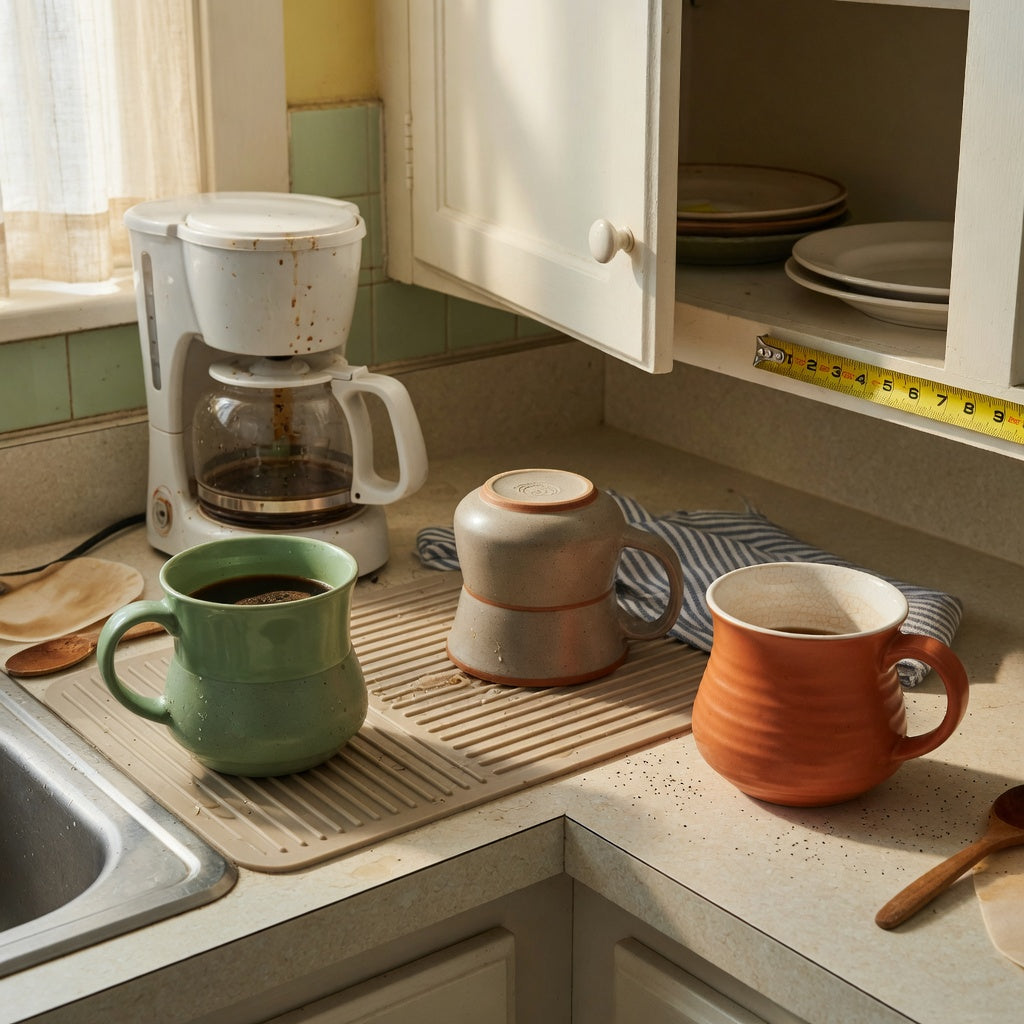
Ceramic Wide Bottom Coffee Mugs: Practical Rotation Checklist
Reading time: about 10 minutes
A mug can pass the first-pour test and still lose its place in the cabinet by Friday. The usual reasons are practical: its base consumes too much shelf width, the handle catches the mug beside it, or its care needs do not match the household routine. Our ceramic wide bottom coffee mugs everyday mug rotation practical purchase checklist starts with those repeat-use problems, not with a styled product photo.
In our store, we find that shoppers make better comparisons after separating visible product facts from assumptions about the category. The linked product pages are the source of truth for each mug's current dimensions, capacity, material description, and care instructions. If a detail is not stated there, treat it as unknown and ask before ordering rather than assuming every ceramic mug performs the same way.
How many mugs need space before the cabinet becomes the constraint?
Start with the rotation you actually use. One person may reuse a single mug throughout the day, while another reaches for separate mugs for breakfast coffee, afternoon tea, and an evening drink. A shared household can move several pieces through the sink and drying area before any of them return to the shelf.
Track one ordinary day, then measure the places where mugs pause between uses. Three measurements matter:
- Clear shelf width: measure the usable space between cabinet walls, hinges, shelf supports, and neighboring dishes.
- Shelf depth and opening height: include the cabinet frame and door hardware, not just the board itself.
- Maximum outside mug width: account for the handle as well as the ceramic body. The handle often determines how closely two mugs can sit side by side.
If the product page supplies dimensions, mark the stated maximum width and depth on paper and place that template on the shelf. This simple check is more reliable than judging scale from a close product photograph. Do not plan to stack a mug unless its page specifically describes or shows it as stackable; a broad lower body, rim shape, or projecting handle can make stacking impractical.
Does a wide bottom suit the counter, drying rack, and desk?
A wider lower profile can provide a larger footprint on a level surface, but body width and actual surface contact are not always the same thing. The foot ring is the part that touches the counter. Its diameter, flatness, and finish matter alongside the mug's overall silhouette, height, handle position, and liquid level.
That distinction is easy to miss online. A mug can look broad in a side photograph while resting on a smaller foot ring. We therefore do not treat the words wide bottom as a promise of wobble-free performance, impact resistance, or a particular service life.
Map the footprint to the real station where the mug will spend time:
- On a kitchen counter, leave enough room to lift the mug without clipping a kettle, canister, or another handle.
- On a drying mat, allow air around the pieces instead of pressing damp foot rings edge to edge.
- At an office desk, check the space between the keyboard, mouse, notebook, and monitor stand. A broader mug may claim more working area than expected.
- For a car console, compare the base measurement with the narrowest part of the cup holder. There is no universal cup-holder size.
- For iced coffee, verify both listed capacity and opening size. A broad exterior does not automatically mean that the mug holds more liquid or accepts the ice you normally use.
Round, Spittoon, or The Rock: which role is missing?
The three linked products should be compared by the information and photographs shown on their own pages. We do not infer exact weight, capacity, care status, or durability from a product name. The useful question is which visible form fills a specific role in your current rotation.
If you are replacing a familiar everyday cup and want a visually straightforward reference point, inspect the Round Coffee Tea Mug first. Its round presentation makes it a sensible page to compare with the conventional mugs already in your cabinet. Confirm the current measurements, handle clearance, capacity, and care text before deciding that it will fit the same space.
If people in a shared kitchen identify their mugs by silhouette, compare the Spittoon Coffee Tea Mug. Its visibly distinctive profile may be easier to pick out from a mixed rotation. The trade-off is that a more pronounced outline may need different shelf or handle clearance, so use the displayed specifications rather than assuming it occupies the same space as the round option.
If the recipient or daily user prefers a more characterful object, open The Rock Coffee Tea Mug and inspect its current page photographs from every available angle. Its name should not be read as evidence of extra weight, toughness, or chip resistance. Choose it for the form shown and only after its listed practical details suit the intended shelf and drink routine.
Shoppers who have not settled on a silhouette can compare these options with the broader unique ceramic coffee mug collection. That is the better next step for someone building a visually mixed set rather than trying to make one product serve every person and every drink.
| Reader situation | Useful starting point | Detail to confirm |
|---|---|---|
| Replacing a conventional daily mug | Round Coffee Tea Mug | Maximum width, capacity, handle clearance, and care text |
| Making mugs easier to distinguish in a shared kitchen | Spittoon Coffee Tea Mug | Lower-body footprint and spacing beside other handles |
| Choosing a visually expressive desk or gift mug | The Rock Coffee Tea Mug | Scale, weight if listed, finish, capacity, and care text |
| Building a mixed rotation from several shapes | Unique Coffee Mugs collection | Which options fit the same measured storage area |
Which ceramic and care details need confirmation before checkout?
Ceramic is the category material, but that alone does not answer the daily-use questions. Look for a stated capacity, maximum dimensions, weight if provided, glaze or finish description, and explicit dishwasher and microwave guidance. Capacity also needs context: if the page does not say whether a figure is measured to the brim or to a practical fill level, do not assume the two are identical.
The underside deserves attention because it is both a storage and handling surface. Check page photos for the foot ring and look for any description of its finish. An unglazed or textured contact area may benefit from a coaster on a delicate desk, but do not claim a particular mug has that feature unless its page shows or states it clearly.
For washing, follow the product-specific instructions. If dishwasher use is expressly permitted, position the mug so its rim and handle cannot strike neighboring dishes during the cycle. If that permission is absent, hand washing with a nonabrasive sponge is the cautious route. Avoid sudden temperature changes, direct flame, oven use, or freezer-to-hot-liquid transitions unless the page explicitly approves the relevant use.
What should you inspect during gift unboxing and first use?
A gift mug needs the same practical inspection as a mug bought for your own counter. We recommend opening it in good light before discarding the packaging. This is not an assumption that defects are common; it is a sensible check for any ceramic item that has traveled through a delivery network.
- Set the empty mug on a clean, flat counter and check for obvious rocking.
- Run a fingertip carefully around the rim and foot for a chip, sharp spot, or rough area.
- Inspect both handle junctions for a visible crack.
- Look across the glazed surface under side light for a hairline crack or unexpected glaze separation.
- Wash according to the product page, dry the base, and test the handle with the user's normal grip before adding it to the daily rotation.
Decorative variation should only be treated as intentional when the product description or photos support that interpretation. If the delivered piece differs materially from the listing, keep the packaging while the issue is reviewed.
Ceramic wide bottom coffee mugs everyday mug rotation practical purchase checklist: the final screen
Use this final screen for every candidate. A mug earns a place in a frequent-use rotation only if the answers work together.
- Count the mugs used during a normal day and identify where they wait between pours.
- Measure clear cabinet width, shelf depth, opening height, drying space, and desk or counter space.
- Compare those measurements with the product's stated maximum dimensions, including its handle.
- Confirm the listed capacity suits coffee, tea, or an ice-heavy drink without assuming exterior width equals volume.
- Choose a silhouette for a defined role: familiar daily use, easy visual identification, or a more expressive desk or gift piece.
- Read the exact dishwasher, microwave, and other care instructions on that product page.
- List any missing specification as an unknown. Do not fill the gap with a category assumption.
- Inspect the rim, handle junctions, glaze, and foot ring when the mug arrives and before it enters repeated use.
This is also where frequency matters. A mug used several times a day needs convenient storage and care that fits the household's routine. A decorative mug used occasionally may justify a less efficient footprint, but that same compromise becomes frustrating when repeated after every wash.
When is a narrower mug or travel vessel the better buy?
A wide-bottom ceramic mug is not the default answer for every routine. Choose a narrower profile if side-by-side cabinet density is the main constraint. Choose a compatible travel vessel if the drink regularly leaves the house, needs a lid, or must fit a specific vehicle holder. A lightweight option may also suit someone who finds a broad ceramic form uncomfortable, but compare listed weights rather than judging heft from photographs.
For a very small kitchen, buying fewer pieces can be more practical than forcing a large rotation into limited storage. For a shared household, distinct shapes may help with identification, but coordinated colors or names can solve the same problem with less variation in footprint.
Frequently asked questions
What does the ceramic wide bottom coffee mugs everyday mug rotation practical purchase checklist confirm?
It confirms how many mugs enter daily use, where they are stored and dried, and whether each product's stated dimensions, capacity, shape, and care instructions fit that routine. It also records missing details as unknowns so a buyer does not mistake a broad category claim for a product specification.
Do wide-bottom ceramic mugs fit standard car cup holders?
There is no single standard that guarantees a fit. Measure the narrowest internal diameter and depth of your holder, then compare those figures with the mug's stated base and lower-body dimensions; if the page does not provide enough information, do not assume compatibility.
Can these ceramic coffee mugs go in a dishwasher or microwave?
Only follow the care status stated on the individual product page. Ceramic as a material does not automatically establish that every glaze, decoration, or mug construction is dishwasher-safe or microwave-safe.
How many wide-bottom mugs will fit on my cabinet shelf?
Divide the usable shelf width by each mug's maximum outside width, then allow extra room for handles and comfortable retrieval. A paper footprint based on published dimensions gives a more realistic answer because mugs may need alternating handle directions rather than a tight straight row.
Which CoffeifyMug shape should I try first?
Start with the Round Coffee Tea Mug for a familiar visual baseline, the Spittoon Coffee Tea Mug when easy silhouette recognition matters, or The Rock Coffee Tea Mug when a more expressive form is the priority. In every case, the right first mug is the one whose current listed measurements, capacity, and care guidance clear your checklist.
Your next step: measure one shelf, one drying area, and the surface where the mug is used most. Then compare CoffeifyMug's unique mug shapes against those numbers and order the first option that clears every required check without relying on an unknown specification.
More from our blog
Read more
Flat White Cup Home Coffee Station Practical Purchase Checklist by Size
Compare verified 200 ml, 250 ml, and 270 ml cup capacities against your usual pour, counter clearance, and care needs. This checklist separates known product facts from details to confirm before ch...
Read more
Cacao Cup Gift Choice Practical Purchase Checklist: 3 Sizes
Compare three everyday cacao cup options by measured serving size, visible opening, storage space, care details, and recipient routine without relying on unsupported gift or ritual claims.
Read more
Leave a comment
This site is protected by hCaptcha and the hCaptcha Privacy Policy and Terms of Service apply.