
Breakfast Cup vs Mug Size: Oz, Ml, and Fill Levels Explained
Reading time: about 8 minutes
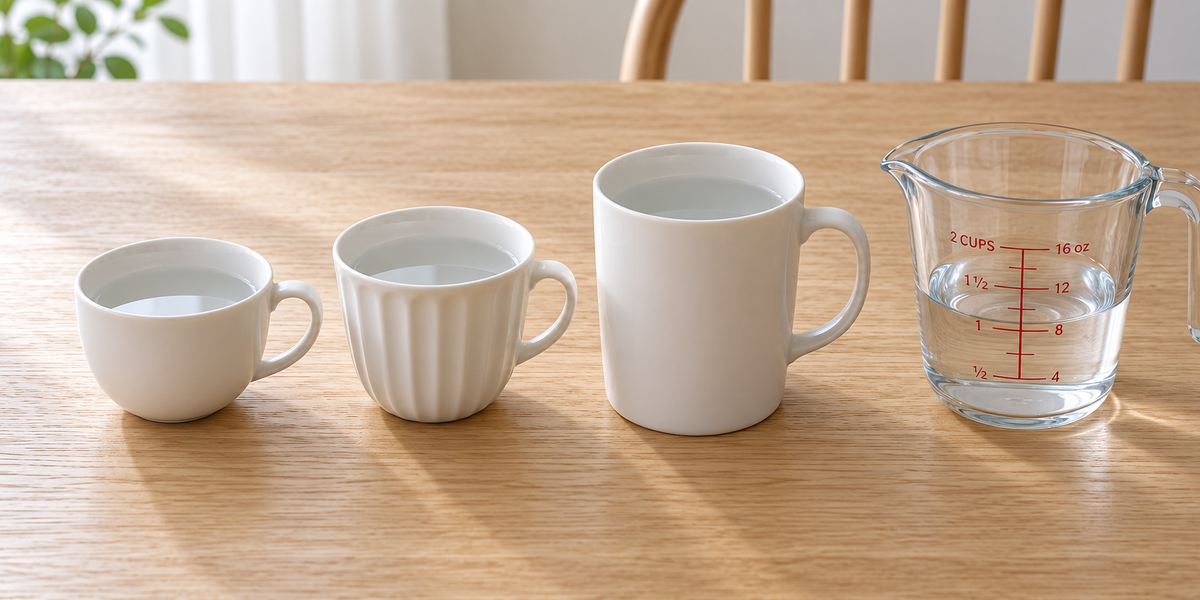
Pour one US measuring cup of water, right to the 8-ounce line, into an ordinary kitchen mug. You'll still have room at the top. That leftover space is the whole story behind breakfast cup vs mug size: recipes count in cups, drinkware is labeled in ounces or milliliters, and the two systems were never designed to agree. The name on the listing adds a third layer, because a traditional "breakfast cup" and a 20 oz "breakfast mug" are barely the same object.
We pack, pour, and answer questions about these vessels at our store every day, and sizing comes up more often than color or handle shape ever does. The question usually sounds like this: will it hold one full morning pour, or will I be up three times before the toast is done? We keep an 8-oz measuring cup beside our sample shelf for exactly this demonstration, because it settles the argument faster than any spec sheet. Below are the real numbers, the three capacities we list, and the trade-offs most product pages leave out.
Breakfast cup vs mug size: the numbers at a glance
Most of the confusion disappears once the vessels sit side by side:
| Vessel | Typical capacity | In milliliters | Best suited to |
|---|---|---|---|
| Espresso cup | 2–3 oz | 60–90 ml | Straight shots |
| Teacup | 6–8 oz | 180–240 ml | Tea, short coffee |
| Traditional breakfast cup | ~10 imperial fl oz | ~284 ml | One full sit-down pour |
| Standard coffee mug | 8–12 oz | 240–355 ml | Drip coffee, everyday tea |
| Latte mug | 10–14 oz | 300–415 ml | Milk-forward drinks |
| Oversized "breakfast mug" | 16–20 oz | 475–590 ml | One-pour mornings |
Two takeaways. First, the traditional breakfast cup sits in the middle: bigger than a teacup, smaller than most desk mugs. Second, the modern "breakfast mug" at 16–20 oz is a different object wearing the same word. Our own range brackets the classic sizes, and every vessel in our unique coffee mugs collection lists its exact capacity, so let the milliliter figure drive the decision rather than the name.
Why a measuring cup and a drinking cup never agree
Three numbers cause nearly all of it:
- A US measuring cup is 8 fluid ounces, about 237 ml. Nutrition labels round that to 240 ml per "cup," which is why packaged drink mixes and actual mugs never quite line up.
- The imperial system poured a bigger cup. A UK half-pint, the classic breakfast cup volume, runs about 284 ml — noticeably more than the American 8-oz measure.
- Listings round, and rounding drifts. A mug labeled "12 oz / 350 ml" is doing you a small favor: 12 fluid ounces is closer to 355 ml. Fine for coffee; worth knowing if you're matching a recipe.
The practical consequence: a 12-oz mug holds nearly one and a half measuring cups. In our experience, this is the top reason a mug feels smaller or larger than a buyer expected. A "two cups of water" brewing ratio poured into a "two-cup" mug will test the brim every single time.
How big is a traditional breakfast cup, really?
The breakfast cup is a British table convention: half an imperial pint, roughly 284 ml or 10 imperial fluid ounces. It was sized for a proper sit-down morning, one pour that could carry the whole meal, unlike the teacup beside it, which typically runs 6–8 ounces and leans on the pot for refills.
The name tells you the intent. The milliliter figure tells you the truth.
Modern marketing has blurred the term. Some brands now attach "breakfast mug" to 16–20 oz vessels that hold far more than the historical cup ever did. Neither approach is wrong, but the label alone tells you little. Under 300 ml on a listing, expect teacup-plus proportions; over 475 ml, expect something closer to a bowl with a handle, and ask whether that fits your hand, your cabinet shelf, and the strip of table beside your plate.
Brim fill vs your actual pour: what the capacity number means
Here's a detail almost no listing spells out: quoted capacity means filled to the brim or just beneath it, and nobody drinks that way. A comfortable fill lands around 80–90% of capacity, leaving a finger's width of headroom so milk, a stirrer, or one trip across a tiled kitchen doesn't end in a spill.
Applied to the three sizes we list, the real-world pours look like this:
- 170 ml cup — a comfortable 135–150 ml pour. Tea-with-milk territory.
- 200 ml cup — roughly 160–180 ml. A generous teacup serving with room for a splash of milk.
- 350 ml mug — around 280–315 ml. A full standard coffee pour, once, headroom included.
One more physical reality worth planning around: smaller volumes cool faster. A 170 ml pour reaches sip temperature well before a 350 ml one. Fast drinkers won't notice. Slow breakfast readers will.
170 ml, 200 ml, or 350 ml: which capacity fits your breakfast table?
We sell all three, and they solve different mornings:
- Retro coffee and tea cup (170 ml) — about 5.7 oz, teacup proportions. Built for pot-and-refill drinkers: pour short, stay hot, top up often. The smaller footprint earns its keep on a table already crowded with a juice glass and a plate. It is not the vessel for a one-pour latte, or for anyone who nurses the same coffee for an hour.
- Pleated coffee and tea cup (200 ml) — about 6.8 oz, a step up into generous-teacup ground. A good middle ground when two people share one pot and neither wants to be first up for a refill. We sized it against a standard mug in detail in our Pleated tea cup vs coffee mug size comparison.
- Landscape Tall coffee and tea mug (350 ml) — roughly 11.8 oz, squarely standard-mug territory. The one-pour option: a full drip coffee, or a home latte with milk, done in a single fill. The trade-offs are a taller profile that claims vertical space next to your plate and a clearance question under brewers, which we cover below.
If the naming itself is what's tripping you up, we break down breakfast cup vs coffee cup vs mug capacity in a separate guide.
Which breakfast drink belongs in which vessel?
Match the drink to the milliliters and sizing stops being a guess:
- Espresso — 2–3 oz in a dedicated demitasse. Our smallest listed cup runs larger, so treat it as a long-black vessel rather than a shot glass.
- Cappuccino — the classic 5–6 oz pour lands almost exactly in the Retro's 170 ml range.
- Flat white — 6–8 oz; the Pleated's 200 ml covers it with a little room to spare.
- Latte — 10–14 oz; the Landscape Tall's 350 ml sits mid-window.
- Drip or filter coffee — 8–12 oz standard. The Tall handles a full pour once; the smaller cups mean carafe trips, which some drinkers genuinely prefer.
- Tea — a 170–200 ml cup paired with a pot is the traditional rhythm: brew once, refresh as you sit.
No size is universally correct. A bigger vessel means coffee that lingers and cools through a slow breakfast; a smaller one means hotter refills and more standing up. Decide which interruption bothers you less.
Five checks before checkout: clearance, care, and what's in the box
These are the checks we walk customers through at our store, because they decide satisfaction more than color does:
- Brewer clearance. Single-serve machines and espresso makers have tight spout heights. Before buying any tall mug, ours included, measure from drip tray to spout and compare it with the listed mug height.
- Care instructions. Dishwasher and microwave behavior depends on material and finish, so read the care line on the exact listing instead of assuming either way from photos.
- Handle room. Larger hands need knuckle clearance. Check the listed dimensions, not just the pictures.
- What actually ships. Traditional breakfast cups were part of a saucer pairing. If a saucer matters to your table, confirm what's included on the current listing rather than assuming.
- Shelf fit. Tall mugs and overhead cabinet shelves don't always cooperate. If you store mugs upright under a shelf, measure that gap too.
For the fuller framework, our everyday mug rotation purchase checklist covers rotation, gifting, and desk duty in the same spirit.
Frequently asked questions
How many ounces is a breakfast cup?
The traditional British breakfast cup holds about 10 imperial fluid ounces, roughly 284 ml, or half an imperial pint. That's larger than a teacup and a touch under many 12-oz mugs. Products marketed today as "breakfast mugs" often run far larger, from 16 to 20 oz, so trust the listed milliliters over the name.
Is mug capacity measured to the brim?
Usually, yes. The quoted capacity means filled to the brim or just under. Your comfortable pour is closer to 80–90% of that figure, because you need headroom for milk and for carrying. A 350 ml mug realistically holds about 280–315 ml per fill.
Breakfast cup vs mug size: which is better for morning coffee?
Neither wins on its own; refill style decides it. If you pour once and sit down, a 10–12 oz mug like our 350 ml Landscape Tall fits the job. If you drink short coffees or tea from a pot and like hot top-ups, 170–200 ml cups keep the rhythm. Match the vessel to how you actually drink, not to the label.
Will a 12 oz mug fit under a coffee maker?
It depends on the machine's spout clearance, and single-serve brewers are the usual pinch point, since many offer only a few inches between drip tray and spout. Measure that gap and compare it with the mug's listed height before ordering. When in doubt, brew into a smaller vessel or a carafe and pour over.
What's the difference between a breakfast cup and a teacup?
Volume and intent. A teacup typically holds 6–8 ounces and leans on a pot for refills; the breakfast cup, at roughly 284 ml, was designed to carry a full morning pour on its own. If getting up to refill annoys you, that ~100 ml difference is the entire argument.
Ready to pick? Decide your refill style first, pot-topper or one-pour, then let capacity rather than the name make the call. Every vessel in our unique coffee mugs collection lists its exact milliliter capacity, so you can compare at a glance and order the size your breakfast table actually needs.
Read more

Unique Art Coffee Mugs Gift: 7 Things to Compare Before Checkout
How to judge a unique art coffee mugs gift the way a retailer does: compare decoration methods, verify a food-safe glaze, match capacity to the recipient's brewing habit, and sort out care, lead ti...
Read more
Ceramic Eggnog Mugs: What Buyers Should Compare Before Ordering
Eggnog pours smaller than coffee, so capacity, silhouette, and glaze condition matter more than shoppers expect. We compare 170, 200, and 270 ml ceramic cups and list the five checks to run before ...
Read more
Leave a comment
This site is protected by hCaptcha and the hCaptcha Privacy Policy and Terms of Service apply.