

Breakfast Cup vs Coffee Cup vs Mug: Pick the Right Capacity
Reading time: about 9 minutes
A cup can look compact in a product photo and still fight for space once a breakfast plate, toast, cutlery, and a phone land on the table. The practical breakfast cup vs coffee cup vs mug decision starts with listed capacity and the space around the handle, not the label alone. In our experience helping customers compare drinkware, the wrong purchase is usually a perfectly attractive vessel that needs one refill too many, leaves half the drink cooling, or cannot clear the cupboard shelf.
What do breakfast cup, coffee cup, and mug mean in practice?
These names are tableware conventions, not fixed international size classes. A breakfast cup commonly describes a roomier morning cup and may be associated with a saucer in coordinated tableware. A coffee cup generally suggests a smaller service cup, but it is not automatically an espresso cup. A mug usually signals informal, handled, saucer-less drinkware, often with more capacity.
The boundaries overlap by maker and region. A wide breakfast cup can hold as much as a taller mug, while two vessels with similar capacities can feel very different beside a plate. Breakfast cup size is not universal, and the coffee cup vs mug difference is better understood through capacity, shape, and service style than through a hard cutoff.
If a saucer matters to you, confirm it in the current product listing rather than relying on the word breakfast. This article compares the drinking vessels only; do not assume a saucer, spoon, food, or drink is included.
Breakfast cup vs coffee cup vs mug: capacity, footprint, or refills?
At a working breakfast table, five variables are more useful than the category name:
- Listed capacity: The stated millilitres provide the clearest starting point for comparing how much each vessel is designed to hold.
- Comfortable fill: A practical pour normally sits below the rim. The exact amount of headroom depends on the shape, so listed capacity should not be treated as an everyday fill line.
- Footprint: Include the base, the widest part of the body, the handle, and any separate saucer you plan to use.
- Refill rhythm: A smaller cup suits someone happy to top up. A larger mug suits someone who wants to sit down once.
- Vertical clearance: Height matters under cupboard shelves, inside a microwave if reheating is permitted, and beneath a dishwasher rack if machine washing is allowed.
The verified capacities in our current comparison are 170 ml, 200 ml, and 350 ml. They create three noticeably different routines without pretending that one of them is the universal breakfast-cup standard.
| Listed option | Capacity | Likely use pattern | Main trade-off |
|---|---|---|---|
| Retro Coffee Tea Cup | 170 ml | Short coffee or modest tea with easy refill access | Smallest listed capacity; not ideal for a long one-pour drink |
| Pleated Coffee Tea Cup | 200 ml | Middle-ground serving beside a regular breakfast plate | Only 30 ml above the Retro, so it is still cup-sized rather than mug-sized |
| Landscape Tall Coffee Tea Mug | 350 ml | Longer drink with fewer trips back to the kettle or brewer | Tall storage profile and more liquid that may remain after breakfast |
In this three-product comparison, 170 ml and 200 ml support cup-like serving habits, while 350 ml supports mug-like behavior. Those are relative descriptions, not universal tableware definitions.
How different do 170 ml, 200 ml, and 350 ml feel in use?
The move from 170 ml to 200 ml adds 30 ml. That is a fine adjustment rather than a complete change in drinking routine. The move from 200 ml to 350 ml adds 150 ml, while 350 ml provides 180 ml more than 170 ml. That larger jump is much more likely to change how often you refill and how long the drink sits.
Think about what goes into the cup after brewing. A short black coffee may look lost in a 350 ml mug, while a 170 ml cup can become cramped once you add a generous amount of milk. Ice also occupies working capacity, so an iced morning drink generally needs more room than the liquid volume alone suggests. Always check the current material and care guidance before exposing a vessel to major temperature changes.
We do not have comparative heat-loss testing for these three listings, so we will not claim that one keeps a drink hot for a set period. Material, wall thickness, starting temperature, room conditions, and drinking pace all affect the result. The dependable buying logic is behavioral: a smaller serving is usually finished sooner, while a larger serving reduces refills but may sit longer.
Will it fit beside a plate, under a shelf, and on a desk?
Capacity does not reveal exact footprint. We do not have verified diameter figures in this comparison, so we will not pretend that the 170 ml option automatically has the narrowest body or handle span. A broad low cup can occupy more tabletop width than a taller vessel with greater capacity.
Use your current favorite cup as a measuring reference. Record the base diameter, the widest part of the body, the full width including the handle, and the overall height. If you use a saucer, its diameter becomes the real footprint. If a dimension you need is not shown on a product page, do not estimate it from a styled photograph alone.
The Landscape Tall option deserves an extra vertical check. Measure the opening below a wall cabinet, the usable microwave height if its care instructions permit reheating, and the space beneath the dishwasher rack if machine washing is approved. Allow room to tilt the mug when lifting it out; a vessel can fit upright yet still strike the shelf above during removal.
On an office desk or crowded breakfast table, handle swing can matter more than a 30 ml capacity difference. Set out your normal plate and place your existing cup on the side you actually use. Rotate the handle toward your hand and check for contact with the plate, keyboard, mouse, jam jar, or another place setting.
What should you check during unboxing, washing, and storage?
For your own order or a gift unboxing, inspect the high-contact areas before the first drink. Our team recommends the same practical sequence for most rigid drinkware:
- Check the rim, handle joints, and base: Look in good light for chips, cracks, or shipping damage. Do not use a damaged vessel; contact the store first.
- Read the current care instructions: Do not assume every cup or mug is microwave-safe or dishwasher-safe based only on its appearance.
- Leave dishwasher clearance: If machine washing is allowed, keep the rim and handle from knocking adjacent dishes and confirm that a tall mug clears the rack and spray arm.
- Avoid abrupt temperature changes: Unless the manufacturer specifically permits it, do not move a chilled vessel directly to boiling liquid.
- Stack only stable shapes: Do not force non-nesting cups together or wedge a handle beneath a low shelf.
These are preventive category checks, not claims that the linked products are prone to failure. We call out the rim and handle attachment because they receive frequent contact at the sink, in storage, and during daily use. Material and wall thickness can also affect weight, lip feel, and thermal behavior, but product-specific facts should come from the current listing rather than assumption.
Which CoffeifyMug option matches your morning routine?
Start with the situation, then match the capacity and accept its limitation. That produces a more reliable choice than selecting the largest or most decorative option first.
- Your usual drink is short, and the kettle or brewer is nearby: Consider the Retro Coffee Tea Cup. Its listed 170 ml capacity is the lowest of the three, which suits deliberate smaller servings and planned refills. It is not a good fit for someone who wants a large milk-forward or ice-heavy drink in one pour.
- You want more room than 170 ml without moving to a large mug: The Pleated Coffee Tea Cup is listed at 200 ml. It works as the middle option when 170 ml feels slightly limited but 350 ml would be excessive. It is still only 30 ml above the Retro, so refill-averse shoppers may find it too small.
- You carry one larger drink to the table or desk: The Landscape Tall Coffee Tea Mug has a listed 350 ml capacity. It fits the shopper who values fewer refills and has checked vertical clearance. It is not the right choice for a short espresso-style drink, a low cupboard shelf, or someone who regularly leaves the last part of a large drink unfinished.
If none of those capacities suits your routine, browse our unique coffee mugs collection and compare capacity before color or pattern. For a gift, do not assume the biggest mug is the most generous choice. Measuring the recipient's current favorite cup—or at least asking whether they prefer refills—usually produces a better match.
Run this one-minute breakfast-table test before buying
You can settle most of the comparison with objects already in your kitchen:
- Set out the plate, cutlery, phone, and other items that normally share your breakfast space.
- Use room-temperature water and a measuring jug to view 170 ml, 200 ml, and 350 ml one at a time. Transfer each amount into your current cup if it can be done without overfilling.
- Decide whether your normal drink is closer to the smaller amount, the middle amount, or the larger one after adding milk or ice.
- Measure your available shelf height and the full handle clearance beside the plate.
- Choose the smallest capacity that satisfies your normal refill preference without creating a storage problem.
If 170 ml and 200 ml both work, choose between them by serving preference and style. If only 350 ml satisfies your one-pour routine, accept that the benefit comes with a taller storage profile and a greater chance of an unfinished last portion.
Frequently asked questions
What is the difference between a breakfast cup and a mug?
A breakfast cup commonly refers to a roomier cup intended for morning service and may be associated with a saucer. A mug is generally informal, handled, and used without a saucer. Because capacities overlap, check the listed millilitres and dimensions rather than choosing by the name alone.
Is a coffee cup the same as an espresso cup?
No. Coffee cup is a broader tableware term, while an espresso cup is intended for a much shorter serving. A 170 ml coffee cup can already provide substantially more room than many espresso preparations require.
What cup size works best on a small breakfast table?
Start by considering 170 ml or 200 ml, but confirm the actual body and handle measurements because lower capacity does not guarantee a smaller footprint. Choose 350 ml only if fewer refills matter more than vertical clearance. Include any saucer in your tabletop measurement.
In a breakfast cup vs coffee cup vs mug comparison, which should I buy if I hate refilling?
The 350 ml Landscape Tall mug is the strongest match among these three listed capacities because it holds 150 ml more than the 200 ml option. Check cupboard, microwave, and dishwasher clearance before choosing it, and confirm the relevant care permissions. If you drink slowly or make short coffee, a smaller cup with one fresh refill may still suit you better.
Should I choose 170 ml, 200 ml, or 350 ml for daily use?
Choose 170 ml for modest servings and planned refills, 200 ml for a small step up, or 350 ml for a longer one-pour drink. Measure your current favorite vessel and compare how much you actually drink at breakfast. Then open the closest product above or use the unique coffee mugs collection to continue your shortlist by capacity and fit.
More from our blog
Read more
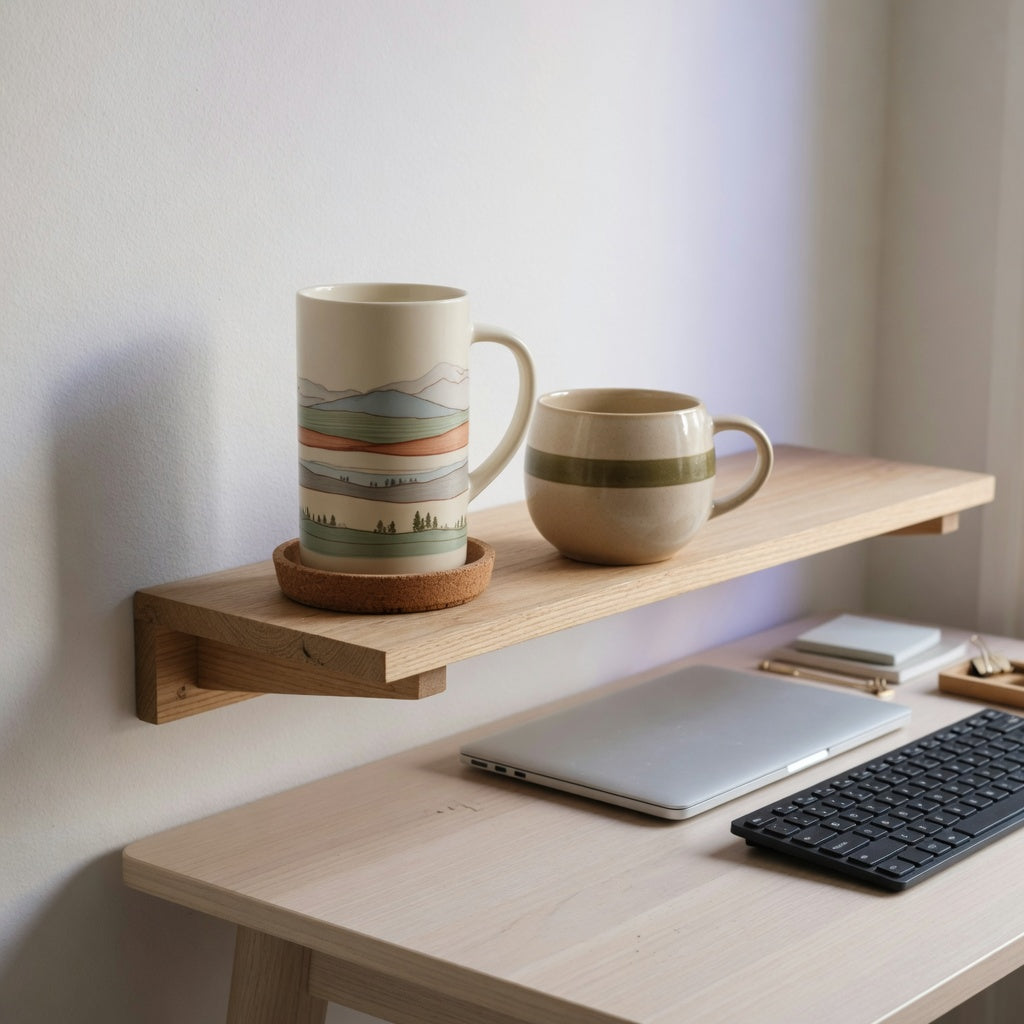
Tall Ceramic Mug Desk Shelf: 6 Fit Checks Before Buying
Measure usable shelf height, foot-ring support, handle sweep, and removal space before buying. Our desk-focused comparison covers heat protection, care labels, tall-versus-round trade-offs, and cas...
Read more
Small Ceramic Cup Guest Shelf: Compare Size, Care, and Fit
Compare the measurements and handling details that decide if a ceramic cup works on a narrow guest shelf. We cover short-cup versus tall-mug fit, rim and base checks, textured-glaze cleanup, food-u...
Read more
Leave a comment
This site is protected by hCaptcha and the hCaptcha Privacy Policy and Terms of Service apply.